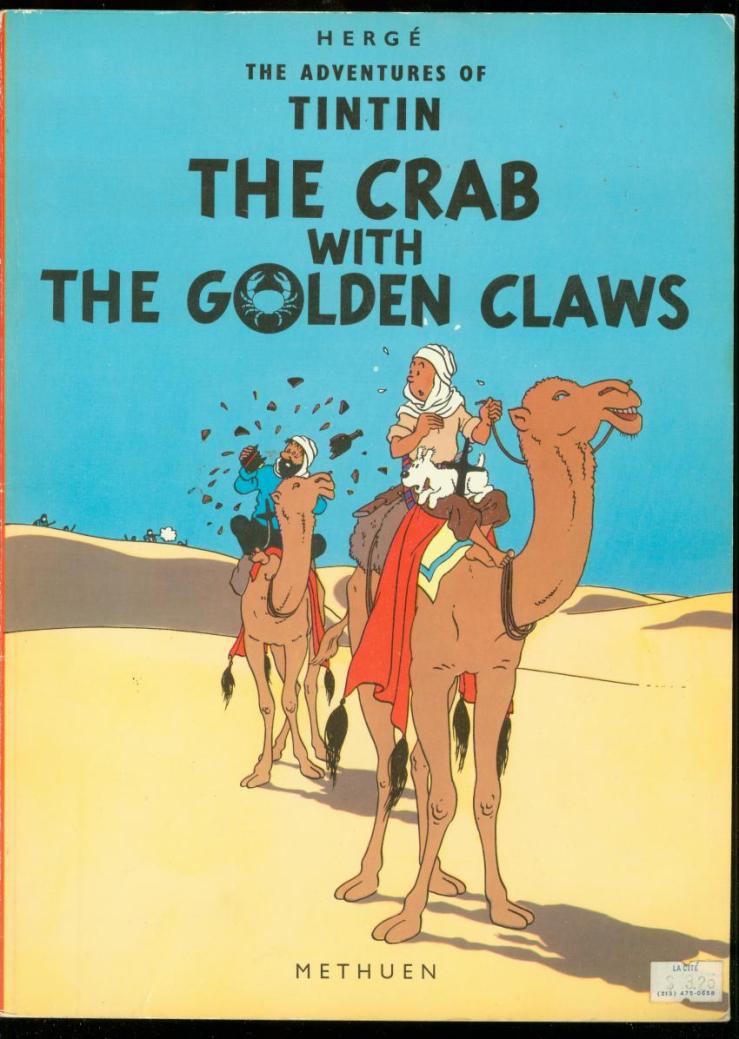
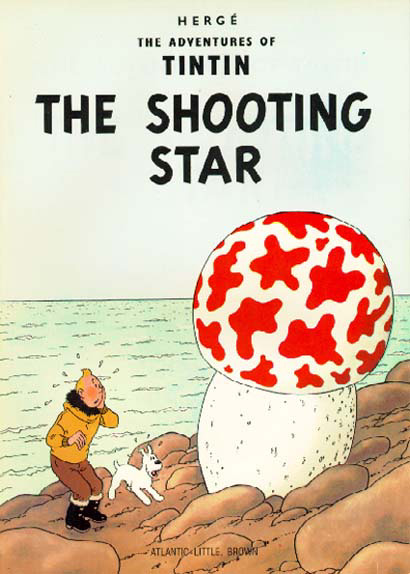
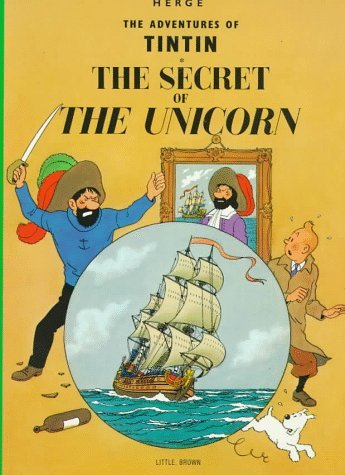
 I’ve long been interested in Hergé’s Belgian comic series Tintin, which chronicles the adventures of Tintin, boy reporter, and his faithful dog Snowy. When a batch of hardback three-in-one editions showed up at my favorite used book store I picked up Vol. 3, which collects The Crab with the Golden Claws, The Shooting Star, and The Secret of the Unicorn. I read The Crab with the Golden Claws in one pleasant sitting that night and finished the other two adventures in similar fashion. Then I went back to the bookshop and picked up the other four three-in-one editions they had in stock.
It’s hard to divide the tales, which are all fun adventures in the high style of boy-adventuring, but I think Crab was my favorite of the three. It involves a drug smuggling ring and a trip to the Sahara desert. It also introduces Captain Haddock, an alcoholic lummox who tips into a verbose stream of insults whenever he’s in a rage (he merely stutters when in his cups). Haddock is Tintin’s unlikely (but totally likely) sidekick in the other tales in the volume, and he shows up in the other books I bought as well. The Shooting Star is a bit more sporadic in its plot–it begins with the end of the world (by asteroid!) and when that doesn’t pan out, moves into an ocean race to recover a meteorite. Unicorn also boasts a nautical theme; Tintin finds part of a treasure map in a model ship and fights against antique-collecting brothers to recover the booty (Keno Bros. beware). These adventure stories share more in common with Indiana Jones and Edgar Rice Burroughs than Marvel or DC comics; there’s a prevalent sense of danger, fun, and mystery that underscores the series.
 Hergé’s clean, efficient style evokes beautiful and strange worlds. His economy of storytelling is simply brilliant; he knows how to connote his characters’ movements–including some sweaty action sequences–and he also knows how to move the plot forward without resorting to talking heads (although you will find the occasional expository-friendly radio broadcast pop up in a Tintin comic). It’s when Hergé drops a luscious market scene or a crowded basement-dungeon larded with antiquities that the art in Tintin shines. Hergé’s great talent is to evoke a startling sense of place for each setting in his comics, a fully-realized set that creates a sort of visual (and emotional) baseline for the reader. This allows for the cleaner, crisper panels to relay action without clutter. Hergé’s knack for storytelling cannot be underestimated either. He blends high adventure with slapstick and verbal comedy, much of it courtesy Tintin’s foils: the Thompsons, bungling detectives, precisely, who provide Tintin with many of his cases; Haddock; and Snowy, of course.
 If you know a bit about Hergé’s Tintin series, you may know that its depiction of non-white and non-European characters has come under attack in recent years; Tintin in the Congo has been singled out in particular. I haven’t read Congo, but Crab’s representation of Arabs (and Asians) is riddled with all kinds of wrong–at least when viewed from a PC postmodern post-colonialist post-whatever perspective. Hergé’s comics reveal at times a particularly suspect Western European ideology, one that privileges white male authority in the form of white male adventure. We can see the same colonialism and Orientalism at work decades later in the Indiana Jones movies (particularly Temple of Doom). This comparison is not meant to indict Indy (or Spielberg, rather) or excuse Tintin (and Hergé); instead, I’m merely pointing out that adventure tales that feature white heroes exploring–and dominating–the Other are hardly new; nor have they disappeared. The big mistake would be not to read Hergé’s work for fear of tripping over politically-correct mores. Banning a book is never a smart practice.
Far better is Charles Burns’s recent Tintin revisionism in X’ed Out: he moves his inverted hero Nitnit to a bizarro world version of the Saharan market, a place teeming with strangeness that is also largely indebted to William Burroughs’s Interzone. The inversion reverses Tintin’s a priori white male domination into an equally fantastic (but far more horrific) vision of confrontation with radical Otherness. Shit gets weird (as alien encounters should). Nitnit is not in control, not the master of this domain, which is plainly not his. Burns’s Tintin revision saliently calls attention to the ways that the best in art might be transformed and reinterpreted. It points toward the subconscious inheritance intrinsic to art.
But back to the book I am ostensibly reviewing. The Adventures of Tintin, Vol 3 seems to me as good a place as any to start with Tintin, and those interested should dig in. These three-in-one editions are smaller than the traditional oversized format, but you can compensate by holding the book closer to your face (ah, intimacy). Lovely stuff.

 Biblioklept