I don’t know the meaning of life. I don’t know why we are here. I think life is full of anxieties and fears and tears. It has a lot of grief in it, and it can be very grim. And I do not want to be the one who tries to tell somebody else what life is all about. To me it’s a complete mystery.”
All citations are from Charles M. Schulz: Conversations, which I now want to read.
I teach a night class on Wednesdays, and although I enjoy it, I also teach morning sections on Wednesdays, so I’m exhausted when I get home over twelve hours later that night. Anyway, I was thrilled to find a nice little packet from Shocken/Pantheon when I came home last Wednesday—a memoir, a graphic novel, and a book that blends and comments on both.
Meir Shalev’s My Russian Grandmother and Her American Vacuum Cleaner is new in translation from Schocken. Their description—
From the author of the acclaimed novel A Pigeon and a Boy comes a charming tale of family ties, over-the-top housekeeping, and the sport of storytelling in Nahalal, the village of Meir Shalev’s birth. Here we meet Shalev’s amazing Grandma Tonia, who arrived in Palestine by boat from Russia in 1923 and lived in a constant state of battle with what she viewed as the family’s biggest enemy in their new land: dirt.
Grandma Tonia was never seen without a cleaning rag over her shoulder. She received visitors outdoors. She allowed only the most privileged guests to enter her spotless house. Hilarious and touching, Grandma Tonia and her regulations come richly to life in a narrative that circles around the arrival into the family’s dusty agricultural midst of the big, shiny American sweeper sent as a gift by Great-uncle Yeshayahu (he who had shockingly emigrated to the sinful capitalist heaven of Los Angeles!). America, to little Meir and to his forebears, was a land of hedonism and enchanting progress; of tempting luxuries, dangerous music, and degenerate gum-chewing; and of women with painted fingernails. The sweeper, a stealth weapon from Grandpa Aharon’s American brother meant to beguile the hardworking socialist household with a bit of American ease, was symbolic of the conflicts and visions of the family in every respect.
The fate of Tonia’s “svieeperrr”—hidden away for decades in a spotless closed-off bathroom after its initial use—is a family mystery that Shalev determines to solve. The result, in this cheerful translation by Evan Fallenberg, is pure delight, as Shalev brings to life the obsessive but loving Tonia, the pioneers who gave his childhood its spirit of wonder, and the grit and humor of people building ever-new lives.
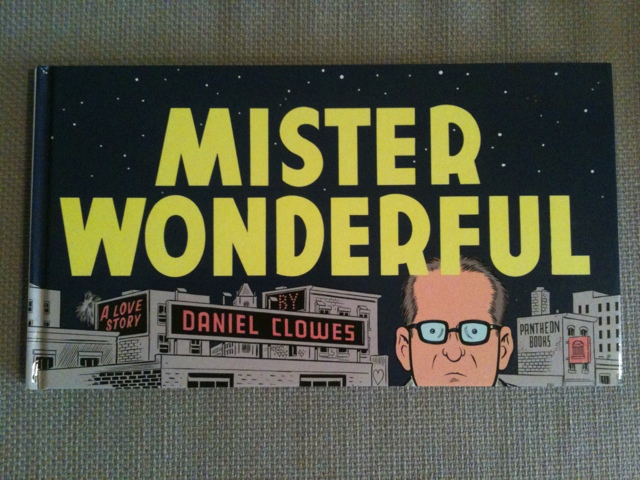
I read Daniel Clowes’s Mister Wonderful that Wednesday night. It was a treat—a wonderful balance of sweetness and acidity. I’m sometimes frightened by how closely I identify with Clowes’s protagonists. Full review next week.
I can’t believe that Art Spiegelman’s MetaMaus hasn’t been remarked upon more—perhaps folks are still digesting it, like me, I guess. I consumed the first 50 pages immediately after finishing Mr. Wonderful, staying up way too late (all of this, accompanied by some mediocre red zin led to a mini-hangover and a generally poor performance teaching classes the next morn). Anyway, MetaMaus is far more engaging than any description of it might suggest. It combines Spiegelman’s cartoons with interviews and other media to detail the process behind creating the original Maus books (or, book singular I suppose is more appropriate). Fascinating stuff, covering memory and art and representation and mice &c. I’ll probably review it in bits and pieces—it seems like too much to process. It also comes with a DVD which I haven’t taken the time to look at yet—-
Attack the Block is a strange, charming little film that imagines what would happen if aliens attacked a council estate in inner-city London on Guy Fawkes Night. (In Americanese, a council estate is a project, an urban ghetto marked by violent crime, disenfranchisement, and low opportunity). The teenage heroes of Attack the Block are slang- (and sword and bat) wielding youths right on the precipitous edge of adulthood; Attack the Block narrativizes the strange intersection of children’s games with the kind of real-world concrete violence that entails lifelong consequence. Moses, the gang’s perceptive and courageous leader, already has one foot strongly planted in the adult criminal world. The alien invasion—an attack on the block, which is to say the entire known world for these kids—affords Moses a real chance to rise to the talent—and violence—writhing inertly within him.
We first meet Moses and his gang of charming ruffians in the middle of a mugging. They rob poor Sam, a female nurse whom they don’t recognize as actually living in the same building as them, but a meteor crashes into a nearby car, interrupting the robbery. A bizarre ape-featured creatures erupts from the explosion; Sam takes the opportunity to run away and Moses and his gang follow the alien. In a tense scene that establishes Moses’ badassery (and thoughtless recklessness), they kill the thing. After scaring a few of the estate girls, Moses takes the creature’s corpse to the “weed room,” the most secure spot on the block. The weed room is owned and operated by Hi-Hatz, a ruthless drug dealer/would-be rap artist who is equal parts menacing and comical (Nick Frost plays his front room dealer). However, the alien corpse only serves to attract much larger, gorilla-sized aliens who, um, attack the block in manic droves. The kids’ response: go grab their store of weapons (bats, novelty swords, fireworks, and chains), jump on their bikes, and set out to kill the suckers. In the process, they’re reunited with their victim Sam, a conflict that underlines the core message of the movie, which concerns understanding our neighbors (so that we can, like, kill outside invading forces). The film is in a sense about the misplaced “othering” that functions in ideology, an “othering” that prescribes social and economic roles and prevents empathy or progress.
Attack the Block, a British production, was directed and written by Joe Cornish, whose sense of exactly what the film should be doing is muddy to say the least. Tonally, Attack the Block is all over the place: it’s not sure if it wants to be a hard-edged horror film, a “kids-take-the-night” adventure film with ironic edges and a fun-loving spirit, or a study in contemporary British views on race and class with preachy undertones. Is the movie ultimately dark or sweet, message-driven or an exposition of economic disenfranchisement and nihilism? It’s never quite clear. This messiness is awfully charming though, just like the creature effects which are, uh, very BBC. Attack the Block is at its best when it smashes its ironic self-awareness of the hoary tropes its trotting out (from War of the Worlds to The Goonies) up against an earnest, heart-felt spirit, a spirit that perfectly matches the enthusiasm of a bunch of repressed and forgotten young males actually getting to go prove themselves by doing awesome shit. Cornish’s best scenes restage the classical conventions of British romantic adventures, right down to a new-fashioned joust scene that’s both rousing and comical.
American viewers may feel we hold a monopoly on films about youth in the projects trying to survive (a survival which Attack the Block obviously literalizes through the magnifying lens of a sci-fi horror invasion); this sense of cultural entitlement can lead to strange moments of cross-cultural cognitive dissonance that won’t be unfamiliar to anyone who’s felt the minor alterity of watching a British synthesis of Hollywood tropes (Guy Ritchie’s films come immediately to mind). There’s also the issue of dialogue and slang; perhaps Cornish used LPs from Dizzee Rascal and The Streets to flesh out his lexicon (or maybe Cornish is just that “down,” but one senses affectation either way)—in any case, I was never quite sure if a British audience would find the youths’ speech legitimate, but I did very much enjoy it. It only compounded my sense that Attack the Block is sort of like a crueler E.T. scripted by Russell Hoban. There’s a lovely streak of Riddley Walker in Attack the Block.
Attack the Block, despite—or perhaps because of its flaws—is a charming, spirited film with a strong protagonist in Moses. It’s one of the few films I’ve seen that actually gains something (some ineffable quality I don’t know how to name) in trying to appeal to fans of different genres and backgrounds, and if it made me cringe at times with its clumsy tonal shifts, it also thrilled and moved me in turn. Recommended.

 Lots of great quotes from Charles M. Schulz on religion (and more) via Biblioklept reader JESCIE. Sample—




 Biblioklept