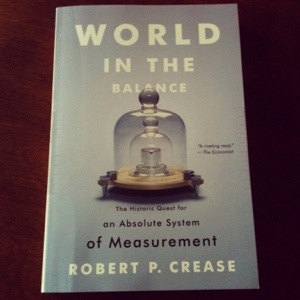
Robert P. Crease’s World in the Balance is now out in trade paperback. I wasn’t sure how interesting a book about the history of measurement could be, but when I flicked it open randomly to a chapter about Marcel Duchamp I found myself intrigued.
‘The non-scientific mind has the most ridiculous ideas of the precision of laboratory work, and would be much surprised to learn that . . . the bulk of it does not exceed the precision of an upholsterer who comes to measure a window for a pair of curtains.” So wrote the American philosopher and scientist Charles S. Peirce (1839-1914).
Peirce may have been giving the general public more credit than he intended; most people don’t think much about the precision of scientific measurements, let alone question where the standards of measurement have come from in the past or where they are headed today. These topics are addressed by Robert P. Crease’s educational and often entertaining book, “World in the Balance.” While some readers might be put off by the episodic and occasionally repetitive structure of the book—belying its origin as the author’s columns for Physics World—those who are not will be amply rewarded with a sweeping survey of the history of measurement and the search for universal and absolute standards, from ancient China up to practically yesterday.
In this passage from Thomas Bernhard’s Correction we can see the strange, bleak, black humor that characterizes the novel:
It’s a folk art of sorts, I said to Hoeller, always longing to kill oneself but being kept by one’s watchful intelligence from killing oneself, so that the condition is stabilized in the form of lifelong controlled suffering, it’s an art possessed only by this people and those belonging to it. We’re a nation of suicides, I said, but only a small percentage actually kill themselves, even though ours is the highest percentage of suicides in the world, even though we in this country hold the world’s record for suicide, I said. What mainly goes on in this country and among these people is thinking about suicide, everywhere, in the big cities, in the towns, in the country, a basic trait of this country’s population is the constant thought of suicide, they might be said to take pleasure in thinking constantly, steadily, without allowing anything to distract them, about how to do away with themselves at any time. It is their way of keeping their balance, I said, to think constantly about killing themselves without actually killing themselves. But of course the rest of the world doesn’t understand, and so whatever they think about us and regardless of what they say about us and of how they always and invariably treat us, every single one of us, they are all wrong. It’s a simple fact, I said, that our country is misunderstood, no matter how well intentioned the rest of the world may appear, what it sees when it looks at Austria and its people is total madness as a stable state of mind, a constant.
Sealand was founded as a sovereign Principality in 1967 in international waters, six miles off the eastern shores of Britain. The history of Sealand is a story of a struggle for liberty. Sealand was founded on the principle that any group of people dissatisfied with the oppressive laws and restrictions of existing nation states may declare independence in any place not claimed to be under the jurisdiction of another sovereign entity. The location chosen was Roughs Tower, an island fortress created in World War II by Britain and subsequently abandoned to the jurisdiction of the High Seas.
The independence of Sealand was upheld in a 1968 British court decision where the judge held that Roughs Tower stood in international waters and did not fall under the legal jurisdiction of the United Kingdom. This gave birth to Sealand’s national motto of E Mare Libertas, or “From the Sea, Freedom”.
The official language of Sealand is English and the Sealand Dollar has a fixed exchange rate of one U.S. dollar. Passports and stamps have been in circulation since 1969 and the latter decade of the 20th century saw an impressive expansion in its activity both socially and industrially as it began to develop a growing economic base which underscored its long-standing membership of the international community of States.




 Biblioklept