“I want it of the true death-temper” (Moby-Dick)

“Look ye, blacksmith, these are the gathered nail-stubbs of the steel shoes of racing horses.”

“Horse-shoe stubbs, sir? Why, Captain Ahab, thou hast here, then, the best and stubbornest stuff we blacksmiths ever work.”

“I know it, old man; these stubbs will weld together like glue from the melted bones of murderers. Quick! forge me the harpoon. And forge me first, twelve rods for its shank; then wind, and twist, and hammer these twelve together like the yarns and strands of a tow-line. Quick! I’ll blow the fire.”

When at last the twelve rods were made, Ahab tried them, one by one, by spiralling them, with his own hand, round a long, heavy iron bolt. “A flaw!” rejecting the last one. “Work that over again, Perth.”

This done, Perth was about to begin welding the twelve into one, when Ahab stayed his hand, and said he would weld his own iron. As, then, with regular, gasping hems, he hammered on the anvil, Perth passing to him the glowing rods, one after the other, and the hard pressed forge shooting up its intense straight flame, the Parsee passed silently, and bowing over his head towards the fire, seemed invoking some curse or some blessing on the toil. But, as Ahab looked up, he slid aside.

“What’s that bunch of lucifers dodging about there for?” muttered Stubb, looking on from the forecastle. “That Parsee smells fire like a fusee; and smells of it himself, like a hot musket’s powder-pan.”

At last the shank, in one complete rod, received its final heat; and as Perth, to temper it, plunged it all hissing into the cask of water near by, the scalding steam shot up into Ahab’s bent face.

“Would’st thou brand me, Perth?” wincing for a moment with the pain; “have I been but forging my own branding-iron, then?”

“Pray God, not that; yet I fear something, Captain Ahab. Is not this harpoon for the White Whale?”

“For the white fiend! But now for the barbs; thou must make them thyself, man. Here are my razors—the best of steel; here, and make the barbs sharp as the needle-sleet of the Icy Sea.”

For a moment, the old blacksmith eyed the razors as though he would fain not use them.

“Take them, man, I have no need for them; for I now neither shave, sup, nor pray till—but here—to work!”

Fashioned at last into an arrowy shape, and welded by Perth to the shank, the steel soon pointed the end of the iron; and as the blacksmith was about giving the barbs their final heat, prior to tempering them, he cried to Ahab to place the water-cask near.

“No, no—no water for that; I want it of the true death-temper. Ahoy, there! Tashtego, Queequeg, Daggoo! What say ye, pagans! Will ye give me as much blood as will cover this barb?” holding it high up. A cluster of dark nods replied, Yes. Three punctures were made in the heathen flesh, and the White Whale’s barbs were then tempered.

“Ego non baptizo te in nomine patris, sed in nomine diaboli!” deliriously howled Ahab, as the malignant iron scorchingly devoured the baptismal blood.

Now, mustering the spare poles from below, and selecting one of hickory, with the bark still investing it, Ahab fitted the end to the socket of the iron. A coil of new tow-line was then unwound, and some fathoms of it taken to the windlass, and stretched to a great tension. Pressing his foot upon it, till the rope hummed like a harp-string, then eagerly bending over it, and seeing no strandings, Ahab exclaimed, “Good! and now for the seizings.”

At one extremity the rope was unstranded, and the separate spread yarns were all braided and woven round the socket of the harpoon; the pole was then driven hard up into the socket; from the lower end the rope was traced half-way along the pole’s length, and firmly secured so, with intertwistings of twine. This done, pole, iron, and rope—like the Three Fates—remained inseparable, and Ahab moodily stalked away with the weapon; the sound of his ivory leg, and the sound of the hickory pole, both hollowly ringing along every plank. But ere he entered his cabin, light, unnatural, half-bantering, yet most piteous sound was heard. Oh, Pip! thy wretched laugh, thy idle but unresting eye; all thy strange mummeries not unmeaningly blended with the black tragedy of the melancholy ship, and mocked it!

From “The Forge,” Chapter 113 of Melville’s Moby-Dick.
 

Watch The Little Island, Richard Williams’s Animated Treatise on Truth, Beauty, and Good

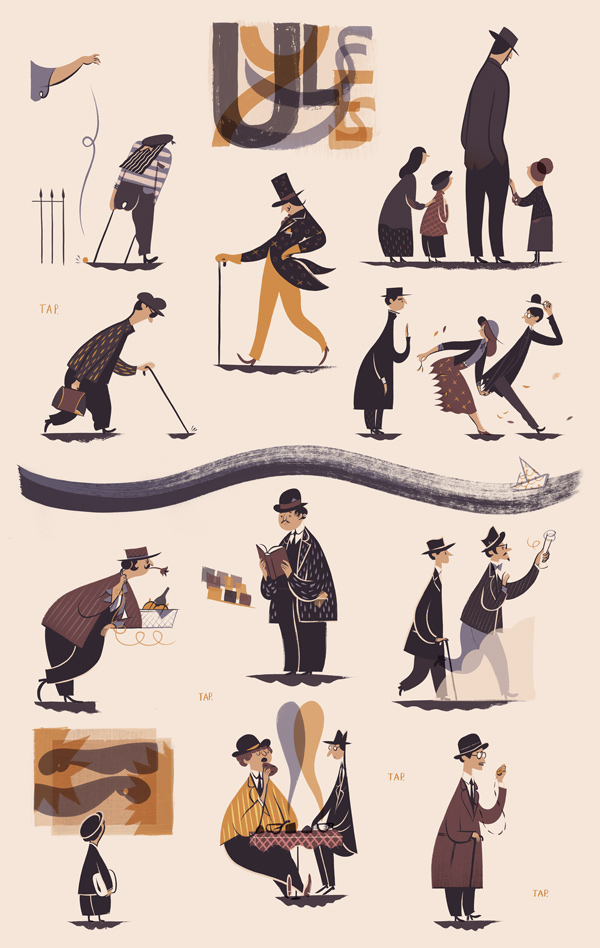
Ulysses — Roman Muradov

ulysses

(Roman Muradov’s wonderful illustration to the Wandering Rocks episode of Joyce’s Ulysses; lots more great stuff at Roman’s site and blog).

“Flaubert me no Flauberts, Bovary me no Bovarys” — Thomas Wolfe Writes to F. Scott Fitzgerald

Dear Scott:

I don’t know where you are living and I’ll be damned if I’ll believe anyone lives in a place called “The Garden of Allah,” which was what the address on your envelope said. I am sending this on to the old address we both know so well.

The unexpected loquaciousness of your letter struck me all of a heap. I was surprised to hear from you but I don’t know that I can truthfully say I was delighted. Your bouquet arrived smelling sweetly of roses but cunningly concealing several large-sized brick-bats. Not that I resented them. My resenter got pretty tough years ago; like everybody else I have at times been accused of “resenting criti[ci]sm” and although I have never been one of those boys who break out in a hearty and delighted laugh when someone tells them everything they write is lousy and agree enthusiastically, I think I have taken as many plain and fancy varieties as any American citizen of my age now living. I have not always smiled and murmured pleasantly “How true,” but I have listened to it all, tried to profit from it where and when I could and perhaps been helped by it a little. Certainly I don’t think I have been pig-headed about it. I have not been arrogantly contemptuous of it either, because one of my besetting sins, whether you know it or not, is a lack of confidence in what I do.

So I’m not sore at you or sore about anything you said in your letter. And if there is any truth in what you say— any truth for me—you can depend upon it I shall probably get it out. It just seems to me that there is not much in what you say. You speak of your “case” against me, and frankly I don’t believe you have much case. You say you write these things because you admire me so much and because you think my talent unmatchable in this or any other country and because you are ever my friend. Well Scott I should not only be proud and happy to think that all these things are true but my respect and admiration for your own talent and intelligence are such that I should try earnestly to live up to them and to deserve them and to pay the most serious and respectful attention to anything you say about my work.

I have tried to do so. I have read your letter several times and I’ve got to admit it doesn’t seem to mean much. I don’t know what you are driving at or understand what you expect or hope me to do about it. Now this may be pig-headed but it isn’t sore. I may be wrong but all I can get out of it is that you think I’d be a good writer if I were an altogether different writer from the writer that I am.

This may be true but I don’t see what I’m going to do about it. And I don’t think you can show me and I don’t see what Flaubert and Zola have to do with it, or what I have to do with them. I wonder if you really think they have anything to do with it, or if this is just something you heard in college or read in a book somewhere. This either—or kind of criticism seems to me to be so meaningless. It looks so knowing and imposing but there is nothing in it. Why does it follow that if a man writes a book that is not like Madame Bovary it is inevitably like Zola. I may be dumb but I can’t see this. You say that Madame Bovary becomes eternal while Zola already rocks with age. Well this may be true—but if it is true isn’t it true because Madame Bovary may be a great book and those that Zola wrote may not be great ones? Wouldn’t it also be true to say that Don Quixote or Pickwick or Tristram Shandy “become eternal” while already Mr. Galsworthy “rocks with age.” I think it is true to say this and it doesn’t leave much of your argument, does it? For your argument is based simply upon one way, upon one method instead of another. And have you ever noticed how often it turns out that what a man is really doing is simply rationalizing his own way of doing something, the way he has to do it, the way given him by his talent and his nature, into the only inevitable and right way of doing everything—a sort of classic and eternal art form handed down by Apollo from Olympus without which and beyond which there is nothing. Now you have your way of doing something and I have mine, there are a lot of ways, but you are honestly mistaken in thinking that there is a “way.” I suppose I would agree with you in what you say about “the novel of selected incident” so far as it means anything. I say so far as it means anything because every novel, of course, is a novel of selected incident. There are no novels of unselected incident. You couldn’t write about the inside of a telephone booth without selecting. You could fill a novel of a thousand pages with a description of a single room and yet your incidents would be selected. And I have mentioned Don Quixote and Pickwick and The Brothers Karamazov and Tristram Shandy to you in contrast to The Silver Spoon or The White Monkey as examples of books that have become “immortal” and that boil and pour. Just remember that although Madame Bovary in your opinion may be a great book, Tristram Shandy is indubitably a great book, and that it is great for quite different reasons. It is great because it boils and pours—for the unselected quality of its selection. You say that the great writer like Flaubert has consciously left out the stuff that Bill or Joe will come along presently and put in. Well, don’t forget, Scott, that a great writer is not only a leaver-outer but also a putter-inner, and that Shakespeare and Cervantes and Dostoevsky were great putter-inners—greater putter-inners, in fact, than taker-outers and will be remembered for what they put in—remembered, I venture to say, as long as Monsieur Flaubert will be remembered for what he left out.

As to the rest of it in your letter about cultivating an alter ego, becoming a more conscious artist, my pleasantness or grief, exuberance or cynicism, and how nothing stands out in relief because everything is keyed at the same emotional pitch—this stuff is worthy of the great minds that review books nowadays—the Fadimans and De Votos—but not of you. For you are an artist and the artist has the only true critical intelligence. You have had to work and sweat blood yourself and you know what it is like to try to write a living word or create a living thing. So don’t talk this foolish stuff to me about exuberance or being a conscious artist or not bringing things into emotional relief, or any of the rest of it. Let the Fadimans and De Votos do that kind of talking but not Scott Fitzgerald. You’ve got too much sense and you know too much. The little fellows who don’t know may picture a man as a great “exuberant” six-foot-six clodhopper straight out of nature who bites off half a plug of apple tobacco, tilts the corn liquor jug and lets half of it gurgle down his throat, wipes off his mouth with the back of one hairy paw, jumps three feet in the air and clacks his heels together four times before he hits the floor again and yells “Whoopee, boys I’m a rootin, tootin, shootin son of a gun from Buncombe County—out of my way now, here I come!”—and then wads up three-hundred thousand words or so, hurls it back at a blank page, puts covers on it and says “Here’s my book!” Now Scott, the boys who write book reviews in New York may think it’s done that way; but the man who wrote Tender Is the Night knows better. You know you never did it that way, you know I never did, you know) no one else who ever wrote a line worth reading ever did. So don’t give me any of your guff, young fellow. And don’t think I’m sore. But I get tired of guff—I’ll take it from a fool or from a book reviewer but I won’t take it from a friend who knows a lot better. I want to be a better artist. I want to be a more selective artist. I want to be a more restrained artist. I want to use such talent as I have, control such forces as I may own, direct such energy as I may use more cleanly, more surely and to better purpose. But Flaubert me no Flauberts, Bovary me no Bovarys. Zola me no Zolas. And exuberance me no exuberances. Leave this stuff for those who huckster in it and give me, I pray you, the benefits of your fine intelligence and your high creative faculties, all of which I so genuinely and profoundly admire. I am going into the woods for another two or three years. I am going to try to do the best, the most important piece of work I have ever done. I am going to have to do it alone. I am going to lose what little bit of reputation I may have gained, to have to hear and know and endure in silence again all of the doubt, the disparagement and ridicule, the post-mortems that they are so eager to read over you even before you are dead. I know what it means and so do you. We have both been through it before. We know it is the plain damn simple truth. Well, I’ve been through it once and I believe I can get through it again. I think I know a little more now than I did before, I certainly know what to expect and I’m going to try not to let it get me down. That is the reason why this time I shall look for intelligent understanding among some of my friends. I’m not ashamed to say that I shall need it. You say in your letter that you are ever my friend. I assure you that it is very good to hear this. Go for me with the gloves off if you think I need it. But don’t De Voto me. If you do I’ll call your bluff.

I’m down here for the summer living in a cabin in the country and I am enjoying it. Also I’m working. I don’t know how long you are going to be in Hollywood or whether you have a job out there but I hope I shall see you before long and that all is going well with you. I still think as I always thought that Tender Is the Night had in it the best work you have ever done. And I believe you will surpass it in the future. Anyway, I send you my best wishes as always for health and work and success. Let me hear from you sometime. The address is Oteen, North Carolina, just a few miles from Asheville, Ham Basso, as you know, is not far away at Pisgah Forest and he is coming over to see me soon and perhaps we shall make a trip together to see Sherwood Anderson. And now this is all for the present—unselective, you see, as usual. Good bye Scott and good luck.

Ever yours,
Tom Wolfe

(July 26, 1937; republished in New Directions’ edition of The Crack Up).

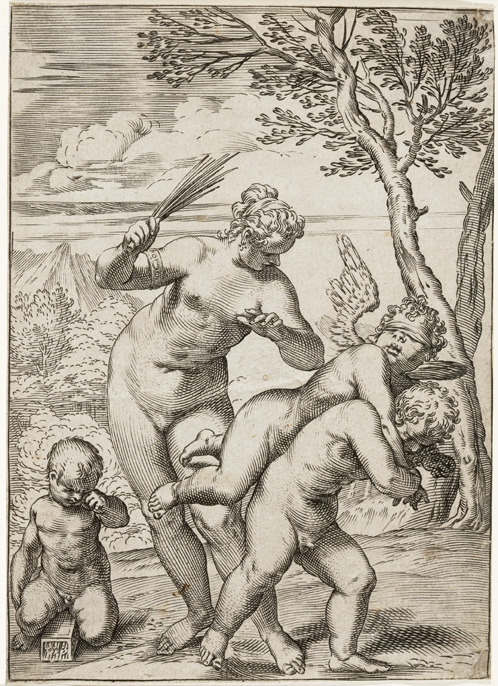
Venus Punishing Profane Love — Agostino Carracci

venus-punishing-profane-love-1595

“The Incredible and Sad Tale of Innocent Eréndira and Her Heartless Grandmother” — Gabriel García Márquez”

“The Incredible and Sad Tale of Innocent Eréndira and Her Heartless Grandmother” by Gabriel García Márquez

Erendira was bathing her grandmother when the wind of her misfortune began to blow. The enormous mansion of moon like concrete lost in the solitude of the desert trembled down to its foundations with the first attack. But Erendira and her grandmother were used to the risks of the wild nature there, and in the bathroom decorated with a series of peacocks and childish mosaics of Roman baths they scarcely paid any attention to the caliber of the wind.

The grandmother, naked and huge in the marble tub, looked like a handsome white whale. The granddaughter had just turned fourteen and was languid, soft-boned, and too meek for her age. With a parsimony that had something like sacred rigor about it, she was bathing her grandmother with water in which purifying herbs and aromatic leaves had been boiled, the latter clinging to the succulent back, the flowing metal-colored hair, and the powerful shoulders which were so mercilessly tattooed as to put sailors to shame.

“Last night I dreamt I was expecting a letter,” the grandmother said.

Erendira, who never spoke except when it was unavoidable, asked:

“What day was it in the dream?”

“Thursday.”

“Then it was a letter with bad news,” Erendira said, “but it will never arrive.”

When she had finished bathing her grandmother, she took her to her bedroom. The grandmother was so fat that she could only walk by leaning on her granddaughter’s shoulder or on a staff that looked like a bishop’s crosier, but even during her most difficult efforts the power of an antiquated grandeur was evident. In the bedroom, which had been furnished with an excessive and somewhat demented taste, like the whole house, Erendira needed two more hours to get her grandmother ready. She untangled her hair strand by strand, perfumed and combed it, put an equatorially flowered dress on her, put talcum powder on her face, bright red lipstick on her mouth, rouge on her cheeks, musk on her eyelids, and mother-of-pearl polish on her nails, and when she had her decked out like a larger than life-size doll, she led her to an artificial garden with suffocating flowers that were like the ones on the dress, seated her in a large chair that had the foundation and the pedigree of a throne, and left her listening to elusive records on a phonograph that had a speaker like a megaphone. Continue reading ““The Incredible and Sad Tale of Innocent Eréndira and Her Heartless Grandmother” — Gabriel García Márquez””

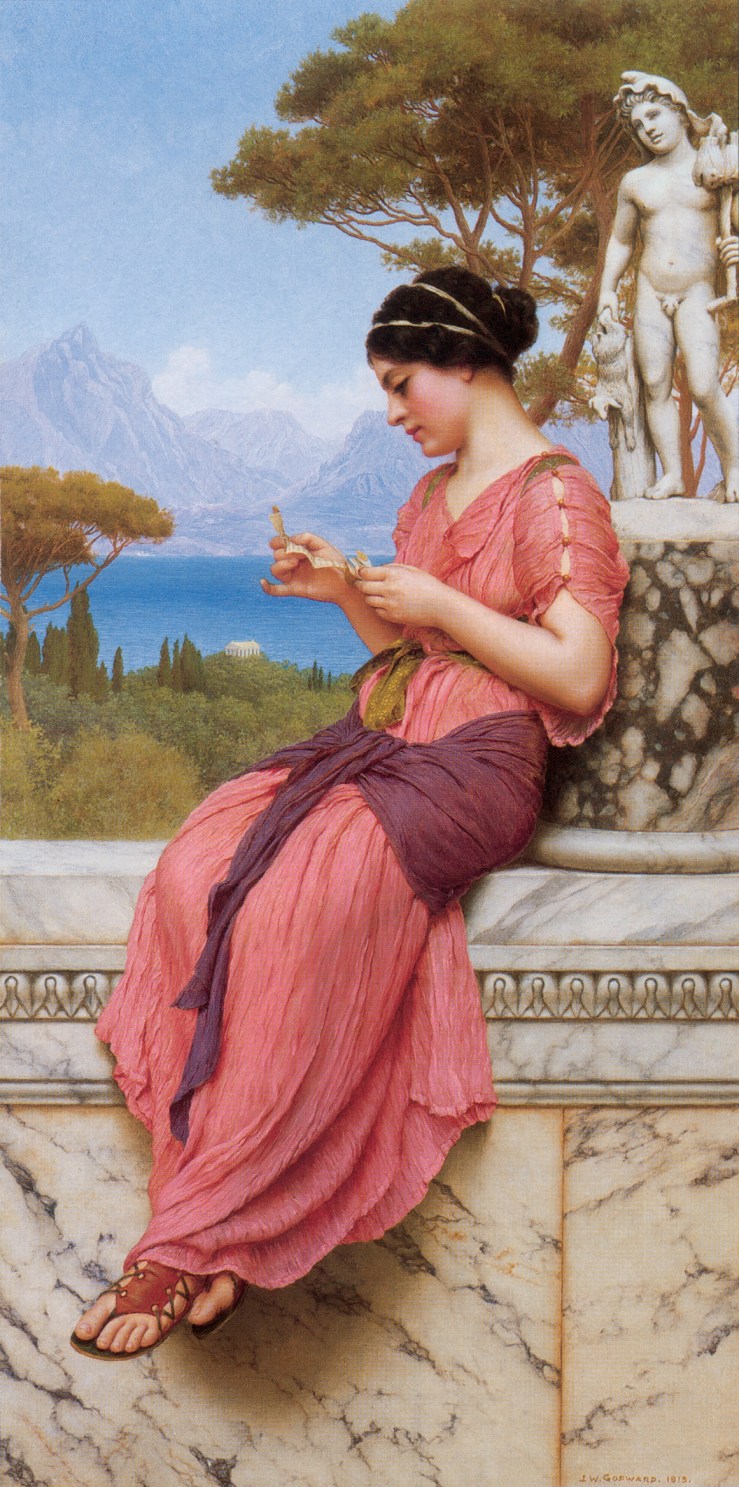
The Love Letter — John William Godward

the-love-letter-1913