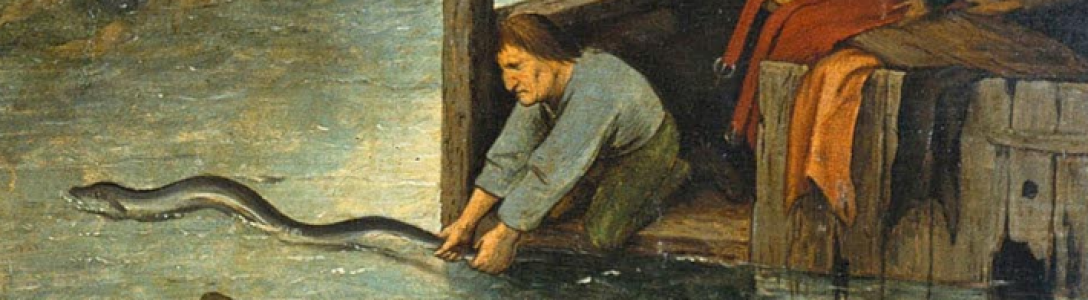
Trompe l’oeil with Studio Wall and Vanitas Still Life — Cornelis Norbertus Gysbrechts

“Lead us into temptation, and deliver us from no evil” (Thomas Bernhard)

“I used to take sleeping pills,” he said, “and slowly boosted the number of pills I took. In the end, they had absolutely no effect on me, and I could have gulped any number of them, and still not have got to sleep. I repeatedly took such high dosages, I should have died. But I only ever vomited them up. Then I would be unable for days to pursue the least thought, and it was precisely this inability to think that got me through long periods of complete horror … You have to be careful you don’t end up living for longer than your natural lifespan,” he said. “Life is a court case which you lose, whoever you are, and whatever you do. That was decided before any human being was even born. The first man fared no differently from us. Rebellion against this only leads to deeper despair,” he said. “And no more distraction. From the age of thirteen, no more distraction. After the first sexual experience, no distraction. Do you understand?” The only variety was thunderstorms, “and lightning the only poetry.” He said: “Seeing as you’re locked up, locked up in solitary confinement, you’re increasingly thrown back upon yourself.” The questions one asked oneself slowly became one’s death. “But you know, we’re all dead anyway from the outset.” There were simply “no more forms of assistance.” One lay on the floor of one’s cell, along with the shattered limbs of past millennia. “Deceits and subterfuges,” he said. Just as the handling of facts injected insignificance into the brain, whatever question one asked oneself. “Every question is a defeat.” Every question wrought devastation. Disinclination. With questions, the time passed, and the questions passed in time, “so meaningless that everything is just ruins … There, you see,” said the painter, “it’s quite black down there. Last night, I dreamed the workers climbed up the mountain, and flooded the village and the inn and everything. In their thousands and tens of thousands, they swarmed up here, and whatever didn’t belong to them, they trampled underfoot, or it was suffocated in their blackness. How calm it is now! Listen!” The butcher greeted us, and we greeted him back. The houses of Weng seemed jumbled together, as though crushed at the foot of the cliff. “Earlier,” said the painter, “I used to have no pity for human frailty. Any pain seemed to me unnatural! Suddenly I saw myself confronted with an abundance of frailty.” He said: “Will you be playing cards tonight? The knacker is a good cardplayer. The engineer as well. They’re all of them good cardplayers. I don’t know why I’ve always had such an aversion to cardplayers.” He muttered something about cretinism in the mountain valleys, in the high Alps. And then: “Our Father, who art in Hell, unhallowed be Thy name. No Kingdom come. Thy will not be done. On earth, as it is in Hell. Deny us this day our daily bread. And forgive us no trespasses. As we forgive none of those that trespass against us. Lead us into temptation, and deliver us from no evil. Amen. That one works just as well,” he said.

From Thomas Bernhard’s novel Frost.


Biblioklept’s Dictionary of Literary Terms

ALLEGORY

Didactic extended metaphor, best enjoyed amorally.

BIOGRAPHY

The sordid and lurid details of an author’s life; use as a critical rubric if the author’s work seems beyond comprehension.

CATACHRESIS

Mixed or imprecise metaphor. When an author stretches her words like taffy across the loom of meaning.

DEATH OF THE NOVEL

Declare the novel dead every few weeks. Resuscitate as necessary.

EPIC

Originally used to denote lengthy narrative works concerning serious subjects, this term may now be applied freely to modify failure, coffee, tacos, kittens, etc.

FANTASY

An inventive and imaginative style of fiction eschewed and denigrated by serious readers and writers.

GNOMIC POETRY

Poetry composed in the secret language of garden gnomes, inaudible to mortal ears.

HUBRIS

Defining common characteristic of all politicians.

IRONY

Dominant mode of much of 21st century communication (including, lamentably, this list).

JOYCEAN

Hyperbole used to describe lengthy works of contemporary authors. Use to disappoint potential readers.

KENNING

Circumlocution of meaning. E.g. “feed the eagle” for “kill,” “battle-sweat” for “blood,” “tube of garbage” for “internet.”

LEONINE VERSE

Poetry about lions.

MORAL

Each reader’s personal misunderstanding of the meaning of a work of literature.

NONFICTION

What your father reads.

OPEN LETTER

A solipsistic bid for attention delivered under the pretense of reaching out to another entity.

PASTORAL

Use to describe any work of literature set outside of a city.

QUATRAIN

A stanza

or poem

composed of

four lines.

RED HERRING

A false clue employed by an author to distract the reader. A novel where all points of evidence are red herrings (preferable) is a shaggy dog story.

STRUCTURALISM

Grab bag of theories you learned in college.

TRILOGY

Elevate any degraded work of pop culture by repeating it twice. Reboot as necessary.

UNRELIABLE NARRATOR

This narrator cannot be depended upon to pick you up from the airport, water your plants while you’re away, meet you on time for a beer or coffee, return small loans, etc.

VICTORIANISM

Indicative of literature of the prudish, uptight Victorian Era. Famous Victorian works include Venus in FursThe Pearl, and The Lustful Turk.

WITTGENSTEIN

Twentieth-century philosopher. Quote the first and last lines of his book Tractatus Logico-Philosophicus frequently (don’t worry about reading anything in between).

XENOPHOBIA

Fear of warrior princesses.

YELP

The pinnacle of contemporary criticism.

ZEUGMA

The list ended with zeugma and disappointment.

(Previous entries here and here).
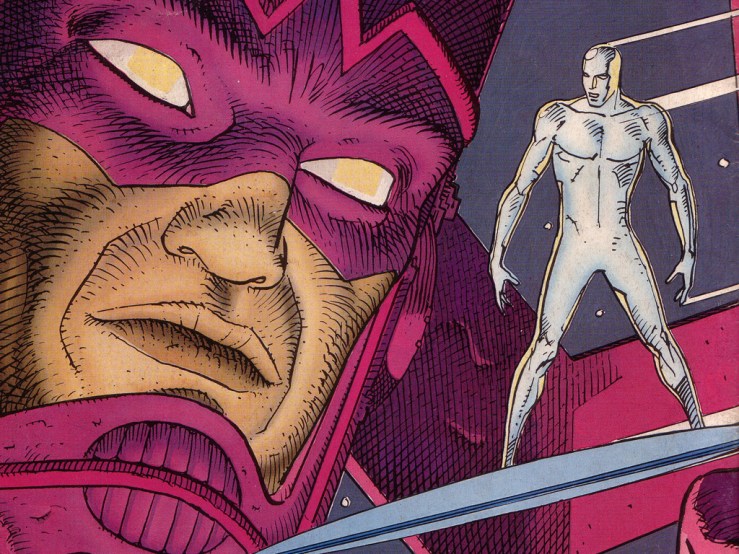
Silver Surfer and Galactus — Moebius

silver-surfer-and-galactus-by-moebius

Susan Sontag on W.G. Sebald

Susan Sontag on W.G. Sebald:

IS LITERARY GREATNESS still possible? Given the implacable devolution of literary ambition, and the concurrent ascendancy of the tepid, the glib, and the senselessly cruel as normative fictional subjects, what would a noble literary enterprise look like now? One of the few answers available to English-language readers is the work of W. G. Sebald.

Vertigo, the third of Sebald’s books to be translated into English, is how he began. It appeared in German in 1990, when its author was forty-six; three years later came The Emigrants; and two years after that, The Rings of Saturn. When The Emigrants appeared in English in 1996, the acclaim bordered on awe. Here was a masterly writer, mature, autumnal even, in his persona and themes, who had delivered a book as exotic as it was irrefutable. The language was a wonder—delicate, dense, steeped in thinghood; but there were ample precedents for that in English. What seemed foreign as well as most persuasive was the preternatural authority of Sebald’s voice: its gravity, its sinuosity, its precision, its freedom from all-undermining or undignified self-consciousness or irony.

In W. G. Sebald’s books, a narrator who, we are reminded oc­casionally, bears the name W. G. Sebald, travels about registering evidence of the mortality of nature, recoiling from the ravages of modernity, musing over the secrets of obscure lives. On some mission of investigation, triggered by a memory or news from a world irretriev­ably lost, he remembers, evokes, hallucinates, grieves.

Is the narrator Sebald? Or a fictional character to whom the author has lent his name, and selected elements of his biography? Born in 1944, in a village in Germany he calls “W.” in his books (and the dust jacket identifies for us as Wertach im Allgau), settled in England in his early twenties, and a career academic currently teaching modern German literature at the University of East Anglia, the author in­cludes a scattering of allusions to these bare facts and a few others, as well as, among other self-referring documents reproduced in his books, a grainy picture of himself posed in front of a massive Lebanese cedar in The Rings of Saturn and the photo on his new passport in Vertigo. Continue reading “Susan Sontag on W.G. Sebald”

Annunciation Triptych (Center Panel) — Rogier van der Weyden