The Mystic Wood — John William Waterhouse

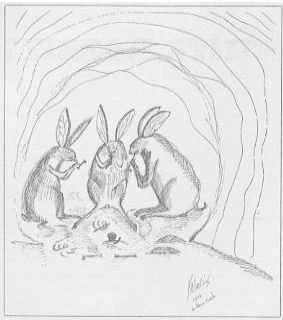
“White Rabbits” — Leonora Carrington

rabbit

“White Rabbits”

by Leonora Carrington

THE TIME has come that I must tell the events which began in 40 Pest St. The houses which were reddish-black looked as if they had survived mysteriously from the fire of London. The house in front of my window, covered with an occasional wisp of creeper, was as blank and empty looking as any plague-ridden residence subsequently licked by flames and saliv’d with smoke. This is not the way that I had imagined New York.

It was so hot that I got palpitations when I ventured out into the streets—so I sat and considered the house opposite and occasionally bathed my sweating face.

The light was never very strong in Pest Street. There was always a reminiscence of smoke which made visibility troubled and hazy—still it was possible to study the house opposite carefully, even precisely; besides my eyes have always been excellent.

I spent several days watching for some sort of movement opposite but there was none and I finally took to undressing quite freely before my open window and doing breathing exercises optimistically in the thick Pest Street air. This must have blackened my lungs as dark as the houses. One afternoon I washed my hair and sat out on the diminuitive stone crescent which served as a balcony to dry it. I hung my head between my knees ¡and watched a blue-bottle suck the dry corpse of a spider between my feet. I looked up through my lank hair and saw something black in the sky, ominously quiet for an airplane. Parting my hair I was in time to see a large raven alight on the balcony of the house opposite. It sat on the balustrade and seemed to peer into the empty window, then poked its head under its wing apparently searching for lice. A few minutes later I was not unduly surprised to see the double windows open and and admit a woman onto the balcony—she carried a large dish full of bones which she emptied onto the floor. With a short appreciative squawk, the raven hopped down and picked about amongst its unpleasant repast.

The woman, who had hemp-long black hair, wiped out the dish, using her hair for this purpose.

Then she looked straight at me and smiled in a friendly fashion. I smiled back and waved a towel. This seemed to encourage her for she tossed her head coquettishly and gave me a very elegant salute after the fashion of a queen.

“Do you happen to have any bad meat over there that you don’t need?” she called.

“Any what?” I called back, wondering if my ears had deceived me.

“Any stinking meat? Decomposed flesh … meat?”

“Not at the moment,” I replied, wondering if she was trying to be funny.

“Won’t you have any towards the end of the week? If so, I would be very grateful if you would bring it over.”

Then she stepped back into the empty window and disappeared. The raven flew away. Continue reading ““White Rabbits” — Leonora Carrington”

The ever-increasing deluge of bad and useless books (Schopenhauer)

Literary journals should be a dam against the unconscionable scribbling of the age, and the ever-increasing deluge of bad and useless books. Their judgments should be uncorrupted, just and rigorous; and every piece of bad work done by an incapable person; every device by which the empty head tries to come to the assistance of the empty purse, that is to say, about nine-tenths of all existing books, should be mercilessly scourged. Literary journals would then perform their duty, which is to keep down the craving for writing and put a check upon the deception of the public, instead of furthering these evils by a miserable toleration, which plays into the hands of author and publisher, and robs the reader of his time and his money.

If there were such a paper as I mean, every bad writer, every brainless compiler, every plagiarist from other’s books, every hollow and incapable place-hunter, every sham-philosopher, every vain and languishing poetaster, would shudder at the prospect of the pillory in which his bad work would inevitably have to stand soon after publication. This would paralyze his twitching fingers, to the true welfare of literature, in which what is bad is not only useless but positively pernicious. Now, most books are bad and ought to have remained unwritten. Consequently praise should be as rare as is now the case with blame, which is withheld under the influence of personal considerations, coupled with the maxim accedas socius, laudes lauderis ut absens.

It is quite wrong to try to introduce into literature the same toleration as must necessarily prevail in society towards those stupid, brainless people who everywhere swarm in it. In literature such people are impudent intruders; and to disparage the bad is here duty towards the good; for he who thinks nothing bad will think nothing good either. Politeness, which has its source in social relations, is in literature an alien, and often injurious, element; because it exacts that bad work shall be called good. In this way the very aim of science and art is directly frustrated.

The ideal journal could, to be sure, be written only by people who joined incorruptible honesty with rare knowledge and still rarer power of judgment; so that perhaps there could, at the very most, be one, and even hardly one, in the whole country; but there it would stand, like a just Aeropagus, every member of which would have to be elected by all the others. Under the system that prevails at present, literary journals are carried on by a clique, and secretly perhaps also by booksellers for the good of the trade; and they are often nothing but coalitions of bad heads to prevent the good ones succeeding. As Goethe once remarked to me, nowhere is there so much dishonesty as in literature.

From The Art of Literature by Arthur Schopenhauer.

Science Fiction — Klaus Winichner