Movies-Canton Island — Paul Sample

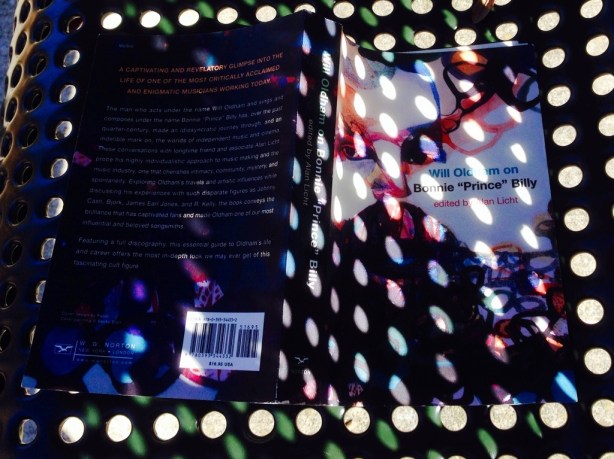
Will Oldham on Bonnie “Prince” Billy (Book Acquired 3.01.2014)

20140311-143148.jpg

Earlier this month, my good friend sent me Will Oldham on Bonnie “Prince” Billy, a book-length interview between Oldham and musician Alan Licht. In the book, Oldham parses his identity from Bonnie “Prince” Billy, the character he’s been performing (in different versions) for over a decade now. The book is fascinating stuff and strangely personal/weird for me—reading his oral history is bizarre, I guess, because I remember it all happening. Like, I remember buying the 7″s he talks about making; I remember puzzling over the early Palace LPs, trying to glean meaning from the covers, the personnel. Palace—Oldham—B”P”B—soundtracked so much of my high school and college days that I inevitably had a falling out with him/them/it—or maybe that’s not the right word…what is the term for the emotional intensity we feel toward certain albums, certain records imprinted in the back of our souls? (I used a line from “For the Mekons et al” for my Senior yearbook quote but the fucking yearbook staff fucked it up. But fuck a yearbook anyway). Ease Down the Road was the last Oldham record that I let get to me; intellectually, I realize that the stuff he did after is somehow superior—tighter, richer even—but it couldn’t sink in, I wouldn’t let it sink in, too many too-good memories already there, I don’t know. I saw him on the Superwolf tour; he deepthroated the mic during an R. Kelly cover, and after the show my wife remarked that he would never be welcome as a guest in our home. I thought that seemed harsh. I tried—years later, reading this book—to explain that it was just a character. No dice.

Thanks Nick.
The Banjo Lesson — Henry Ossawa Tanner

“Physiognomy of a Dog” — Ryan Chang

Frequent Biblioklept contributor Ryan Chang’s new short story, “Physiognomy of a Dog” (about shame and feces and etc.) is up now at Hypothetical. Here’s a taster:

It’s come to my attention that a rumor, of which I am the sole authority to its verity, has been pinging through the halls of our fine institution. He, the normal student, M—, enrolled in a program that would take at least one hundred years to complete—this being the exception, established by the Exceptional Student—supposedly reported to me that were it not for the existence of such an exception his “anxieties and pains” may have been relieved; the dream of graduation in just 99 years would not have evaporated. Red-rashed, he’d said, according to the halls, the normal student rushed a letter to the Advisory, only to be told to consult the framed statement on the wall that details the circumstances of this particular exception; he’d see it on his way to the Advisory, near the door to the infirmary, which often doubles as our morgue.—Before I continue, the Advisory, the governing body pro-tem, now entering its seventh century, having caught wind of this normal student’s experience, would have me preface this with the acknowledgment of said student’s discomforts, and their, let’s say, profound effects.

Read the rest of “Physiognomy of a Dog.”

“The brain may be regarded as a kind of parasite” (Schopenhauer)

The brain may be regarded as a kind of parasite of the organism, a pensioner, as it were, who dwells with the body: and leisure, that is, the time one has for the free enjoyment of one’s consciousness or individuality, is the fruit or produce of the rest of existence, which is in general only labor and effort. But what does most people’s leisure yield?—boredom and dullness; except, of course, when it is occupied with sensual pleasure or folly. How little such leisure is worth may be seen in the way in which it is spent: and, as Ariosto observes, how miserable are the idle hours of ignorant men!—ozio lungo d’uomini ignoranti. Ordinary people think merely how they shall spend their time; a man of any talent tries to use it. The reason why people of limited intellect are apt to be bored is that their intellect is absolutely nothing more than the means by which the motive power of the will is put into force: and whenever there is nothing particular to set the will in motion, it rests, and their intellect takes a holiday, because, equally with the will, it requires something external to bring it into play. The result is an awful stagnation of whatever power a man has—in a word, boredom. To counteract this miserable feeling, men run to trivialities which please for the moment they are taken up, hoping thus to engage the will in order to rouse it to action, and so set the intellect in motion; for it is the latter which has to give effect to these motives of the will. Compared with real and natural motives, these are but as paper money to coin; for their value is only arbitrary—card games and the like, which have been invented for this very purpose. And if there is nothing else to be done, a man will twirl his thumbs or beat the devil’s tattoo; or a cigar may be a welcome substitute for exercising his brains.

From The Wisdom of Life by Arthur Schopenhauer (translation by T. Bailey Saunders).

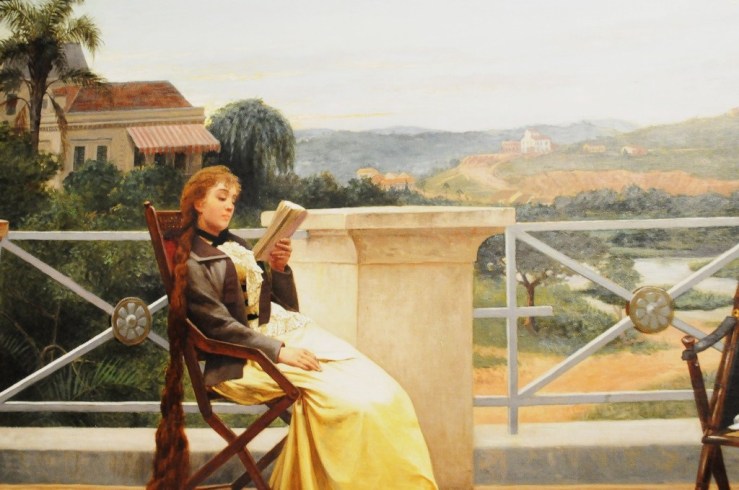
Reading — Jose Ferraz de Almeida Junior

almeida-jr-reader