Nausicaä of the Valley of the Wind — Hayao Miyazaki

nausicaa-valley-of-the-wind_2946621-e1374866693706

The public is a huge nothing (Kierkegaard)

In order for leveling really to occur, first it is necessary to bring a phantom into existence, a spirit of leveling, a huge abstraction, an all-embracing something that is nothing, an illusion–the phantom of the public. . . . The public is the real Leveling-Master, rather than the leveler itself, for leveling is done by something, and the public is a huge nothing.

The public is an idea, which would never have occurred to people in ancient times, for the people themselves en masse in corpora took steps in any active situation, and bore responsibility for each individual among them, and each individual had to personally, without fail, present himself and submit his decision immediately to approval or disapproval. When first a clever society makes concrete reality into nothing, then the Media creates that abstraction, “the public,” which is filled with unreal individuals, who are never united nor can they ever unite simultaneously in a single situation or organization, yet still stick together as a whole. The public is a body, more numerous than the people which compose it, but this body can never be shown, indeed it can never have only a single representation, because it is an abstraction. Yet this public becomes larger, the more the times become passionless and reflective and destroy concrete reality; this whole, the public, soon embraces everything. . . .

The public is not a people, it is not a generation, it is not a simultaneity, it is not a community, it is not a society, it is not an association, it is not those particular men over there, because all these exist because they are concrete and real; however, no single individual who belongs to the public has any real commitment; some times during the day he belongs to the public, namely, in those times in which he is nothing; in those times that he is a particular person, he does not belong to the public. Consisting of such individuals, who as individuals are nothing, the public becomes a huge something, a nothing, an abstract desert and emptiness, which is everything and nothing. . . .

The Media is an abstraction (because a newspaper is not concrete and only in an abstract sense can be considered an individual), which in association with the passionlessness and reflection of the times creates that abstract phantom, the public, which is the actual leveler. . . . More and more individuals will, because of their indolent bloodlessness, aspire to become nothing, in order to become the public, this abstract whole, which forms in this ridiculous manner: the public comes into existence because all its participants become third parties. This lazy mass, which understands nothing and does nothing, this public gallery seeks some distraction, and soon gives itself over to the idea that everything which someone does, or achieves, has been done to provide the public something to gossip about. . . . The public has a dog for its amusement. That dog is the Media. If there is someone better than the public, someone who distinguishes himself, the public sets the dog on him and all the amusement begins. This biting dog tears up his coat-tails, and takes all sort of vulgar liberties with his leg–until the public bores of it all and calls the dog off. That is how the public levels.

From Soren Kierkegaard’s essay “The Present Age.”

I read the passage first in Dwight Macdonald’s essay “Masscult and Midcult” — it’s the final section of Macdonald’s essay, followed simply by “This is the essence of what I have tried to say.” (The translation in Macdonald’s essay is a bit different than the one I’ve cited/linked to here, which is by Alexander Dru).

Sparta (Book Acquired, 5.19.2014)

20140528-143453-52493527.jpg

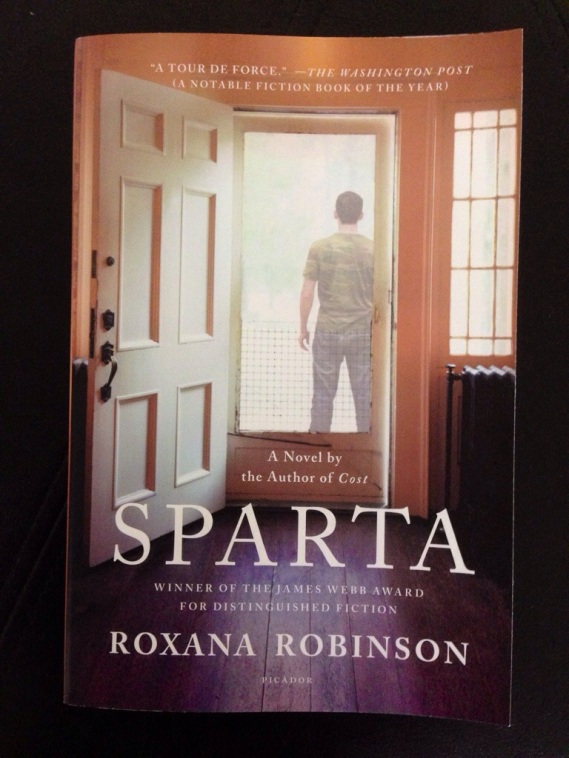
Roxana Robinson’s Sparta is new in trade paperback from Picador. Their blurb:

Conrad Farrell does not come from a military family, but as a classics major at Williams College, he has encountered the powerful appeal of the Marine Corps ethic: Semper Fidelis comes straight from Sparta, a society where every citizen doubled as a full-time soldier. When Conrad graduates, he joins the Marines to continue a long tradition of honor, courage, and commitment over the course of a four-year tour in Iraq. When we meet him, he has just come home to Katonah, New York. As Conrad attempts to find his footing in the civilian world, he learns how hard it is to return to the people and places he used to love. Gradually, he awakens to a growing rage and the realization that something has gone wrong.

Suspenseful, compassionate, and perceptive, Roxana Robinson’s Sparta “is a beautifully written novel that illuminates what happens when we’re estranged from the world as we know it” (Chicago Tribune).

Minerva and the Centaur — Sandro Botticelli

RIP Maya Angelou

600full-maya-angelou

RIP Maya Angelou, 1928-2014

In my time as a teacher, I’ve seen Maya Angelou’s stories and poems—and in particular her memoir I Know Why the Caged Bird Sings—command the attention of students who had previously complained that they hated reading. I’ve seen my classroom library looted of her works; I’ve seen tattered copies of her books passed from hand to hand; I’ve had students ask for More please, more of this, more like this. Angelou’s writing has served as a bridge to life-long reading habits for many young people, and I imagine it will into the future. RIP.

Breakfast was not suspected. No prophecy, no type of breakfast had been published. (De Quincey)

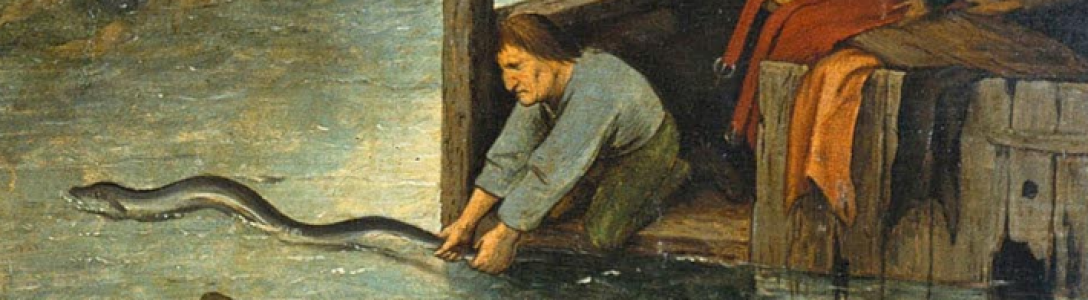
No such discovery as “breakfast” had then been made: breakfast was not invented for many centuries after that. We have always admired, and always shall admire, as the very best of all human stories, Charles Lamb’s account of the origin of roast pig in China. Ching Ping, it seems, had suffered his father’s house to be burned down; the outhouses were burned along with the house; and in one of these the pigs, by accident, were roasted to a turn. Memorable were the results for all future China and future civilization. Ping, who (like all China beside) had hitherto eaten his pig raw, now for the first time tasted it in a state of torrefaction. Of course he made his peace with his father by a part (tradition says a leg) of the new dish. The father was so astounded with the discovery, that he burned his house down once a year for the sake of coming at an annual banquet of roast pig. A curious prying sort of fellow, one Chang Pang, got to know of this. He also burned down a house with a pig in it, and had his eyes opened. The secret was ill kept—the discovery spread—many great conversions were made—houses were blazing in every part of the Celestial Empire. The insurance offices took the matter up. One Chong Pong, detected in the very act of shutting up a pig in his drawing-room, and then firing a train, was indicted on a charge of arson. The chief justice of Pekin, on that occasion, requested an officer of the court to hand him a piece of the roast pig, the corpus delicti, for pure curiosity led him to taste; but within two days after it was observed that his lordship’s town-house was burned down. In short, all China apostatized to the new faith; and it was not until some centuries had passed, that a great genius arose, who established the second era in the history of roast pig, by showing that it could be had without burning down a house.

No such genius had yet arisen in Rome. Breakfast was not suspected. No prophecy, no type of breakfast had been published. In fact, it took as much time and research to arrive at that great discovery as at the Copernican system. True it is, reader, that you have heard of such a word as jentaculum; and your dictionary translates that old heathen word by the Christian word breakfast. But dictionaries, one and all, are dull deceivers. Betweenjentaculum and breakfast the differences are as wide as between a horse-chestnut and chestnut horse; differences in the time when, in the place where, in the manner how, but preeminently in the thing which.

Galen is a good authority upon such a subject, since, if (like other pagans) he ate no breakfast himself, in some sense he may be called the cause of breakfast to other men, by treating of those things which could safely be taken upon an empty stomach. As to the time, he (like many other authors) says, [peri tritaen, ae (to makroteron) peri tetartaen,] about the third, or at farthest about the fourth hour: and so exact is he, that he assumes the day to lie exactly between six and six o’clock, and to be divided into thirteen equal portions. So the time will be a few minutes before nine, or a few minutes before ten, in the forenoon. That seems fair enough. But it is not time in respect to its location that we are so much concerned with, as time in respect to its duration. Now, heaps of authorities take it for granted, that you are not to sit down—you are to stand; and, as to the place, that any place will do—”any corner of the forum,” says Galen, “any corner that you fancy;” which is like referring a man for his salle à manger to Westminster Hall or Fleet Street. Augustus, in a letter still surviving, tells us that he jentabat, or took hisjentaculum in his carriage; now in a wheel carriage, (in essedo,) now in a litter or palanquin (in lecticâ.) This careless and disorderly way as to time and place, and other circumstances of haste, sufficiently indicate the quality of the meal you are to expect. Already you are “sagacious of your quarry from so far.” Not that we would presume, excellent reader, to liken you to Death, or to insinuate that you are “a grim feature.” But would it not make a saint “grim,” to hear of such preparations for the morning meal? And then to hear of such consummations as panis siccus, dry bread; or, (if the learned reader thinks it will taste better in Greek,) [Greek: artos xaeros!] And what may this word dry happen to mean? “Does it mean stale bread?” says Salmasius. “Shall we suppose,” says he, in querulous words, “molli et recenti opponi,” and from that antithesis conclude it to be, “durum et non recens coctum, eoque sicciorem?” Hard and stale, and for that reason the more arid! Not quite so bad as that, we hope. Or again—”siccum pro biscocto, ut hodie vocamus, sumemus?”[5] By hodie Salmasius means, amongst his countrymen of France, where biscoctus is verbatim reproduced in the word bis (twice) cuit, (baked;) whence our own biscuit. Biscuit might do very well, could we be sure that it was cabin biscuit: but Salmasius argues—that in this case he takes it to mean “buccellatum, qui est panis nauticus;” that is, the ship company’s biscuit, broken with a sledge-hammer. In Greek, for the benefit again of the learned reader, it is termed [Greek: dipuros], indicating that it has passed twice under the action of fire.
From Thomas de Quincey’s “Dinner, Real and Reputed.”

Something to Read — Vincent Giarrano

something