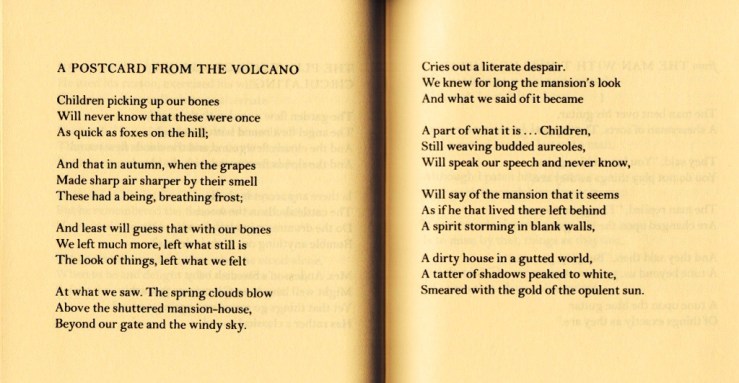
“A Postcard from the Volcano” — Wallace Stevens

20140801-165912-61152581.jpg

The difficulty of writing about sex (Doris Lessing’s The Golden Notebook)

Sex. The difficulty of writing about sex, for women, is that sex is best when not thought about, not analysed. Women deliberately choose not to think about technical sex. They get irritable when men talk technically, it’s out of self-preservation: they want to preserve the spontaneous emotion that is essential for their satisfaction.

Sex is essentially emotional for women. How many times has that been written? And yet there’s always a point even with the most perceptive and intelligent man, when a woman looks at him across a gulf: he hasn’t understood; she suddenly feels alone; hastens to forget the moment, because if she doesn’t she would have to think. Julia, myself and Bob sitting in her kitchen gossiping. Bob telling a story about the breakup of a marriage. He says: ‘The trouble was sex. Poor bastard, he’s got a prick the size of a needle.’ Julia: ‘I always thought she didn’t love him.’ Bob, thinking she hadn’t heard”
“heard: ‘No, it’s always worried him stiff, he’s just got a small one.’ Julia: ‘But she never did love him, anyone could see that just by looking at them together.’ Bob, a bit impatient now: ‘It’s not their fault, poor idiots, nature was against the whole thing from the start.’ Julia: ‘Of course it’s her fault. She should never have married him if she didn’t love him.’ Bob, irritated because of her stupidity, begins a long technical explanation, while she looks at me, sighs, smiles, and shrugs. A few minutes later, as he persists, she cuts him off short with a bad-tempered joke, won’t let him go on.

From Doris Lessing’s novel The Golden Notebook, which I was inspired to read after this essay by K. Thomas Khanh (aka @proustitute).

I started reading Lessing’s book after finishing Alasdair Gray’s novel Lanark. Gray’s novel was published in 1981 nineteen years after The Golden Notebook, but he was writing it for at least three decades before its publication, and the structural features of the two books are similar: both novels self-deconstruct, self-criticize, and rely on fragmentation and juxtaposition to evoke their themes. The themes are fairly different, I suppose, although not really. It’s all sex and death, yes?
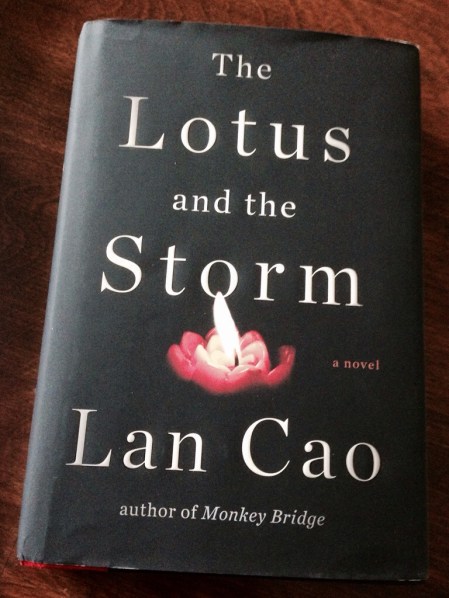
The Lotus and the Storm (Book Acquired, 07.25.2014)

20140728-123802-45482241.jpg

Lan Cao’s novel The Lotus and the Storm is out in hardback later this month. Here’s the Kirkus review:

Written with acute psychological insight and poetic flair, this deeply moving novel illuminates the ravages of war as experienced by a South Vietnamese family.

In a rewarding follow-up to her well-received debut, Monkey Bridge (1997), the author returns to the conflict that shaped her own destiny before she was airlifted from her native Saigon to live in Virginia. Here, she shows what happens to a family of four—a South Vietnamese airborne commander, his beautiful wife and their two young daughters—as the war challenges loyalties with betrayals. The story is narrated by two characters: Mai, the younger daughter, who recalls her girlhood as the war intensified from her current home in Virginia; and Minh, her father, who’s living with Mai and with his memories of what transpired in Vietnam 40 years earlier. “Saigon still wraps itself around me and squeezes me with sudden force,” he explains, though the traumatic effects on Mai prove stronger and even stranger. What’s plain from the setup, with its alternating voices, is that only half of this family will be telling the story, a story in which what happened to the other two proves crucial. The novel’s most complex figure is Quý, Mai’s mother and Minh’s wife, from whom the reader never hears but whose depth of character reveals itself through the perspectives of others. She made a sacrifice by marrying a man considered below her, and she continued to make sacrifices, some of which seemed like betrayals, to protect the lives of those she loved, including her Viet Cong brother as well as her husband. Mai can’t really comprehend through a child’s eyes what’s happening with her family and how threatened their future is, though she intuitively senses that something is wrong. Even Minh doesn’t realize until decades later what really happened, and the revelations will surprise the reader as well.

A novel that humanizes the war in a way that body counts and political analyses never will.

The Ecstatic Virgin Anna Katharina Emmerich — Gabriel von Max

Pain wears no mask (Oscar Wilde)

I now see that sorrow, being the supreme emotion of which man is capable, is at once the type and test of all great art. What the artist is always looking for is the mode of existence in which soul and body are one and indivisible: in which the outward is expressive of the inward: in which form reveals. Of such modes of existence there are not a few: youth and the arts preoccupied with youth may serve as a model for us at one moment: at another we may like to think that, in its subtlety and sensitiveness of impression, its suggestion of a spirit dwelling in external things and making its raiment of earth and air, of mist and city alike, and in its morbid sympathy of its moods, and tones, and colours, modern landscape art is realising for us pictorially what was realised in such plastic perfection by the Greeks. Music, in which all subject is absorbed in expression and cannot be separated from it, is a complex example, and a flower or a child a simple example, of what I mean; but sorrow is the ultimate type both in life and art.

Behind joy and laughter there may be a temperament, coarse, hard and callous. But behind sorrow there is always sorrow. Pain, unlike pleasure, wears no mask. Truth in art is not any correspondence between the essential idea and the accidental existence; it is not the resemblance of shape to shadow, or of the form mirrored in the crystal to the form itself; it is no echo coming from a hollow hill, any more than it is a silver well of water in the valley that shows the moon to the moon and Narcissus to Narcissus. Truth in art is the unity of a thing with itself: the outward rendered expressive of the inward: the soul made incarnate: the body instinct with spirit. For this reason there is no truth comparable to sorrow. There are times when sorrow seems to me to be the only truth. Other things may be illusions of the eye or the appetite, made to blind the one and cloy the other, but out of sorrow have the worlds been built, and at the birth of a child or a star there is pain.

More than this, there is about sorrow an intense, an extraordinary reality. I have said of myself that I was one who stood in symbolic relations to the art and culture of my age. There is not a single wretched man in this wretched place along with me who does not stand in symbolic relation to the very secret of life. For the secret of life is suffering. It is what is hidden behind everything. When we begin to live, what is sweet is so sweet to us, and what is bitter so bitter, that we inevitably direct all our desires towards pleasures, and seek not merely for a ‘month or twain to feed on honeycomb,’ but for all our years to taste no other food, ignorant all the while that we may really be starving the soul.

From Oscar Wilde’s essay De Profundis.

The Screen Porch — Fairfield Porter