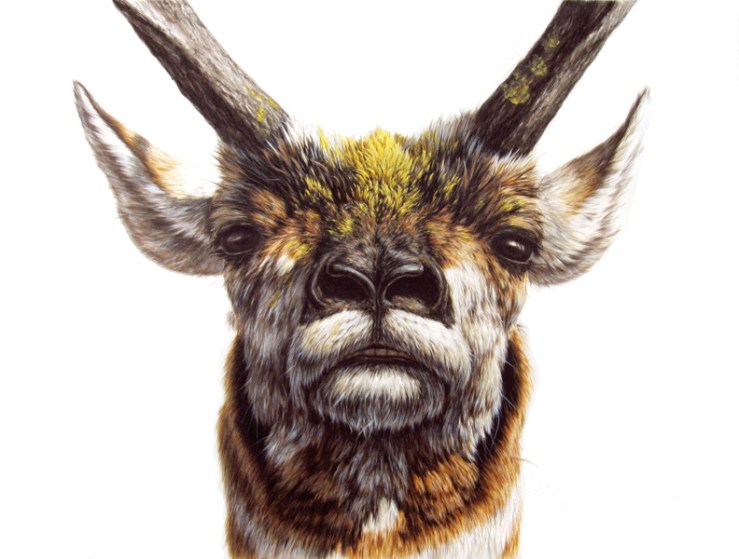
George Boorujy’s work is on exhibit in The Baker Museum in Naples, Florida, through the end of this week.

“Please,” the sailor said. “Go on now. You don’t want to stay here.” She looked in her purse, found a ten and a single, gave him the ten. “I’ll spend it on booze,” he said.
“Remember your friends,” said the arthritic, watching the ten.
“Bitch,” said the sailor. “Why didn’t you wait till he was gone?”
Oedipa watched him make adjustments so he’d fit easier against the mattress. That stuffed memory. Register A . . .
“Give me a cigarette, Ramírez,” the sailor said. “I know you got one.”
Would it be today? “Ramírez,” she cried. The arthritic looked around on his rusty neck. “He’s going to die,” she said.
“Who isn’t?” said Ramírez.
She remembered John Nefastis, talking about his Machine, and massive destructions of information. So when this mattress flared up around the sailor, in his Viking’s funeral: the stored, coded years of uselessness, early death, self-harrowing, the sure decay of hope, the set of all men who had slept on it, whatever their lives had been, would truly cease to be, forever, when the mattress burned. She stared at it in wonder. It was as if she had just discovered the irreversible process. It astonished her to think that so much could be lost, even the quantity of hallucination belonging just to the sailor that the world would bear no further trace of. She knew, because she had held him, that he suffered DT’s. Behind the initials was a metaphor, a delirium tremens, a trembling unfurrowing of the mind’s plowshare. The saint whose water can light lamps, the clairvoyant whose lapse in recall is the breath of God, the true paranoid for whom all is organized in spheres joyful or threatening about the central pulse of himself, the dreamer whose puns probe ancient fetid shafts and tunnels of truth all act in the same special relevance to the word, or whatever it is the word is there, buffering, to protect us from. The act of metaphor then was a thrust at truth and a lie, depending where you were: inside, safe, or outside, lost. Oedipa did not know where she was. Trembling, unfurrowed, she slipped sidewise, screeching back across grooves of years, to hear again the earnest, high voice of her second or third collegiate love Ray Glozing bitching among “uhs” and the syncopated tonguing of a cavity, about his freshman calculus; “dt,” God help this old tattooed man, meant also a time differential, a vanishingly small instant in which change had to be confronted at last for what it was, where it could no longer disguise itself as something innocuous like an average rate; where velocity dwelled in the projectile though the projectile be frozen in midflight, where death dwelled in the cell though the cell be looked in on at its most quick. She knew that the sailor had seen worlds no other man had seen if only because there was that high magic to low puns, because DT’s must give access to dt’s of spectra beyond the known sun, music made purely of Antarctic loneliness and fright. But nothing she knew of would preserve them, or him.
From Thomas Pynchon’s novel The Crying of Lot 49.
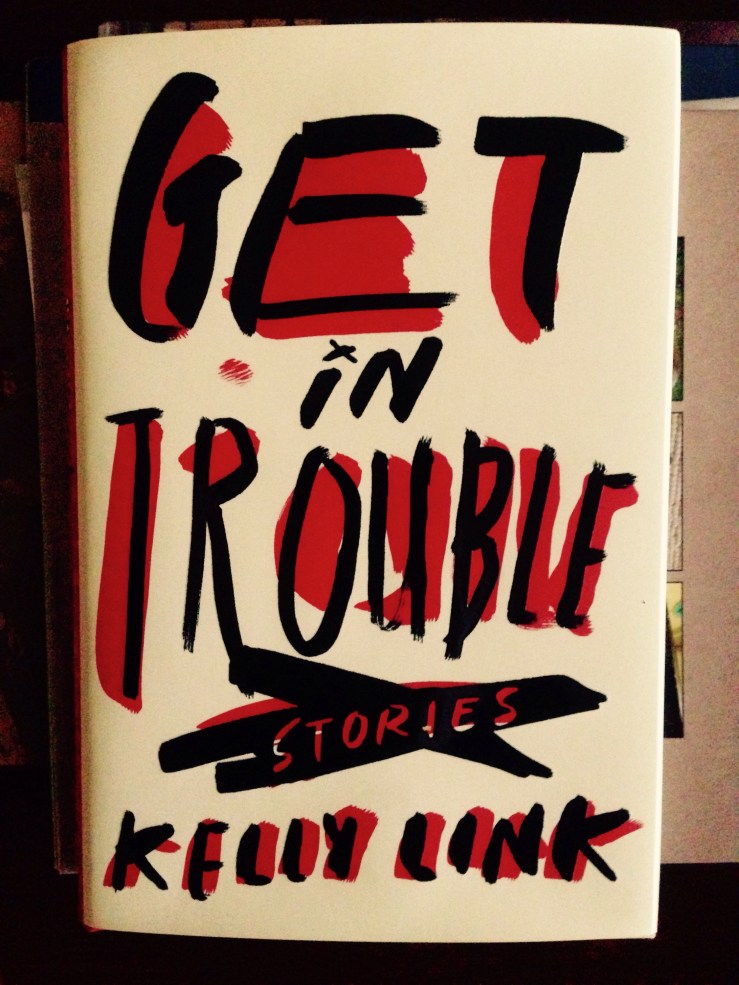
Kelly Link’s new collection Get In Trouble is forthcoming from Random House in hardback. Their blurb:
She has been hailed by Michael Chabon as “the most darkly playful voice in American fiction” and by Neil Gaiman as “a national treasure.” Now Kelly Link’s eagerly awaited new collection—her first for adult readers in a decade—proves indelibly that this bewitchingly original writer is among the finest we have.
Link has won an ardent following for her ability, with each new short story, to take readers deeply into an unforgettable, brilliantly constructed fictional universe. The nine exquisite examples in this collection show her in full command of her formidable powers. In “The Summer People,” a young girl in rural North Carolina serves as uneasy caretaker to the mysterious, never-quite-glimpsed visitors who inhabit the cottage behind her house. In “I Can See Right Through You,” a middle-aged movie star makes a disturbing trip to the Florida swamp where his former on- and off-screen love interest is shooting a ghost-hunting reality show. In “The New Boyfriend,” a suburban slumber party takes an unusual turn, and a teenage friendship is tested, when the spoiled birthday girl opens her big present: a life-size animated doll.
Hurricanes, astronauts, evil twins, bootleggers, Ouija boards, iguanas, The Wizard of Oz, superheroes, the Pyramids . . . These are just some of the talismans of an imagination as capacious and as full of wonder as that of any writer today. But as fantastical as these stories can be, they are always grounded by sly humor and an innate generosity of feeling for the frailty—and the hidden strengths—of human beings. In Get in Trouble, this one-of-a-kind talent expands the boundaries of what short fiction can do

 Biblioklept