Haunted City — Michael Sowa

Jeffrey Rotter’s The Only Words That Are Worth Remembering (Book acquired, 4.14.2015)

Jeffrey Rotter’s novel The Only Words That Are Worth Remembering  is new in hardback from Henry Holt. Their blurb:

A darkly comic, wildly original novel of a family in flight from the law, set in a near-future America — a Clockwork Orange with a Huck Finn heart.

In a not-so-distant future, astronomy has become a fairy tale, Copernicus is forgotten, and the Earth has resumed its lonely spot in the center of the universe. But when an ancient bunker containing a preserved space vehicle is discovered beneath the ruins of Cape Canaveral, it has the power to turn this retrograde world inside out.Enter the Van Zandt clan, whose run-ins with the law leave them with a no-win choice: test-pilot the rocket together as a family or be sent separately to prison for life. Their decision sets off an antic and heartbreaking search for human solace in a world bent on isolation, as the Van Zandts embark on an unforgettable road trip across the ass-end of an America only slightly more dissolute than our own. Uniquely tying an absurdist future to gut-bucket wit, The Only Words That Are Worth Remembering hauls our dark humanity into the light and shows us the precious places where it gleams.

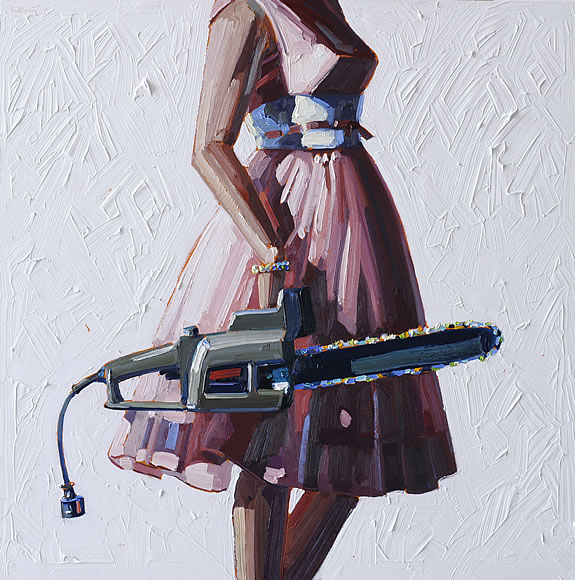
Short Leash — Kelly Reemsten

kelly-reemtsen-short-leash

“Gloria” — Bonnie ‘Prince’ Billy

Leonora Carrington in the LRB

 spaw01_3708_04

The Temptation of St. Antony, Leonora Carrington

Nice piece by Alice Sprawls on Leonora Carrington (whose work is now on display in the Tate) in The London Review of Books today. Excerpt:

Domesticity in Carrington’s paintings and stories is the scene of Ovidian and spiritual transformations; cooking was a sort of alchemy, like painting, and she began increasingly to use egg tempera – influenced by paintings she had seen in Siena but also by its almost culinary processes (separating the egg yolk, adding wine or vinegar then water and pigment). She refused to explain her personal symbolism, but called reading The White Goddess ‘the greatest revelation of my life’. The figure of the muse, Robert Graves’s ‘Mother of all Living, the ancient power of fright and lust’, became less burdensome as manifested in The Giantess (c.1950), whose colossal central figure towers over the scene like a Madonna della Misericordia. She cradles an egg; geese fly out from beneath her pallium; her golden hair is a field of wheat. Around her feet a hunt is taking place – Uccello’s Hunt in the Forest but with a sylph instead of a stag – while the sea behind is teeming with boats, whales, crabs and bizarre creatures like monsters on a medieval map.

From 1950 the paintings become even more fantastical. Many are dominated by bald, spectral white figures: the Sidhe of Irish legends her grandmother told her. In Darvault(1950), Carrington’s two sons by Weisz, Pablo and Gabriel, stand in a de Chirico-esque courtyard, pale and cloaked with small plants growing from their heads. Is Carrington the feline figure in the apron with the elaborate white headdress and whiskers? InDown Below Carrington had described the worldview of her madness – ‘the father was the planet Cosmos, represented by the planet Saturn: the son was the Sun and I the Moon, an essential element of the Trinity, with a microscopic knowledge of the earth’ – and in Mexico she incorporated more and more elements of myth and occultism into her works; not just the Catholicism and Celtic stories of her childhood but astrological and Egyptian imagery, cabbala, Tibetan Buddhism, tarot.
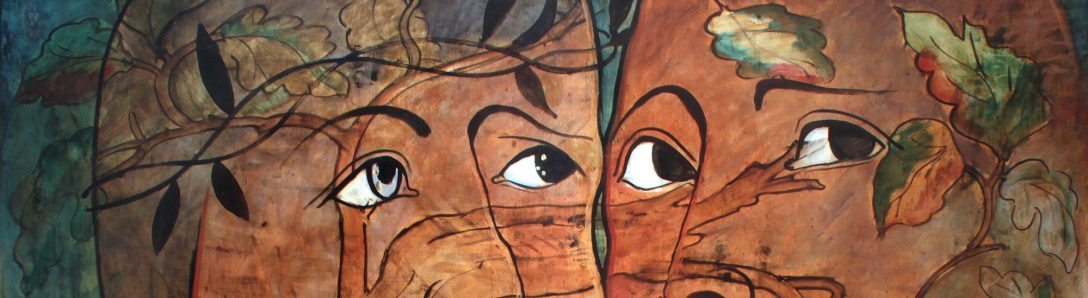
I write only for myself (Dostoevsky)

Every man has reminiscences which he would not tell to every one, but only to his friends. He has other matters in his mind which he would not reveal even to his friends, but only to himself, and that in secret. But there are other things which a man is afraid to tell even to himself, and every decent man has a number of such things stored away in his mind. The more decent he is, the greater the number of such things in his mind. Anyway, I have only lately determined to remember some of my early adventures. Till now I have always avoided them, even with a certain uneasiness. Now, when I am not only recalling them, but have actually decided to write an account of them, I want to try the experiment whether one can, even with oneself, be perfectly open and not take fright at the whole truth. I will observe, in parenthesis, that Heine says that a true autobiography is almost an impossibility, and that man is bound to lie about himself. He considers that Rousseau certainly told lies about himself in his confessions, and even intentionally lied, out of vanity. I am convinced that Heine is right; I quite understand how sometimes one may, out of sheer vanity, attribute regular crimes to oneself, and indeed I can very well conceive that kind of vanity. But Heine judged of people who made their confessions to the public. I write only for myself, and I wish to declare once and for all that if I write as though I were addressing readers, that is simply because it is easier for me to write in that form. It is a form, an empty form—I shall never have readers. I have made this plain already….

From Fyodor Dostoevsky’s novel Notes from Underground. English translation by Constance Garnett.