Obsession Falls (Book acquired, some time in August, 2015)

IMG_8164

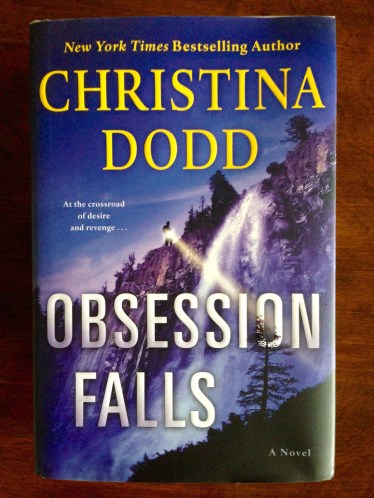
Christina Dodd’s novel Obsession Falls is new in hardback and ebook from Macmillan. Their blurb:

In Obsession Falls, New York Times bestselling author Christina Dodd returns to the town of Virtue Falls, Washington-an idyllic place on the surface, but one that holds close its secrets…

When Taylor Summers witnesses the death threat to a young boy, she does the only thing she can do-she sacrifices herself to distract the killers. Her reward is a life in ruins, on the run in the wilderness, barely surviving a bitter winter and the even more bitter knowledge she has lost everything: her career, her reputation, her identity. She finds refuge in Virtue Falls, and there comes face to face with the knowledge that, to live her life again, she must enlist the help of the man who does not trust her to defeat the man who would destroy her.

She’s being hunted, but it’s time to turn the tables….

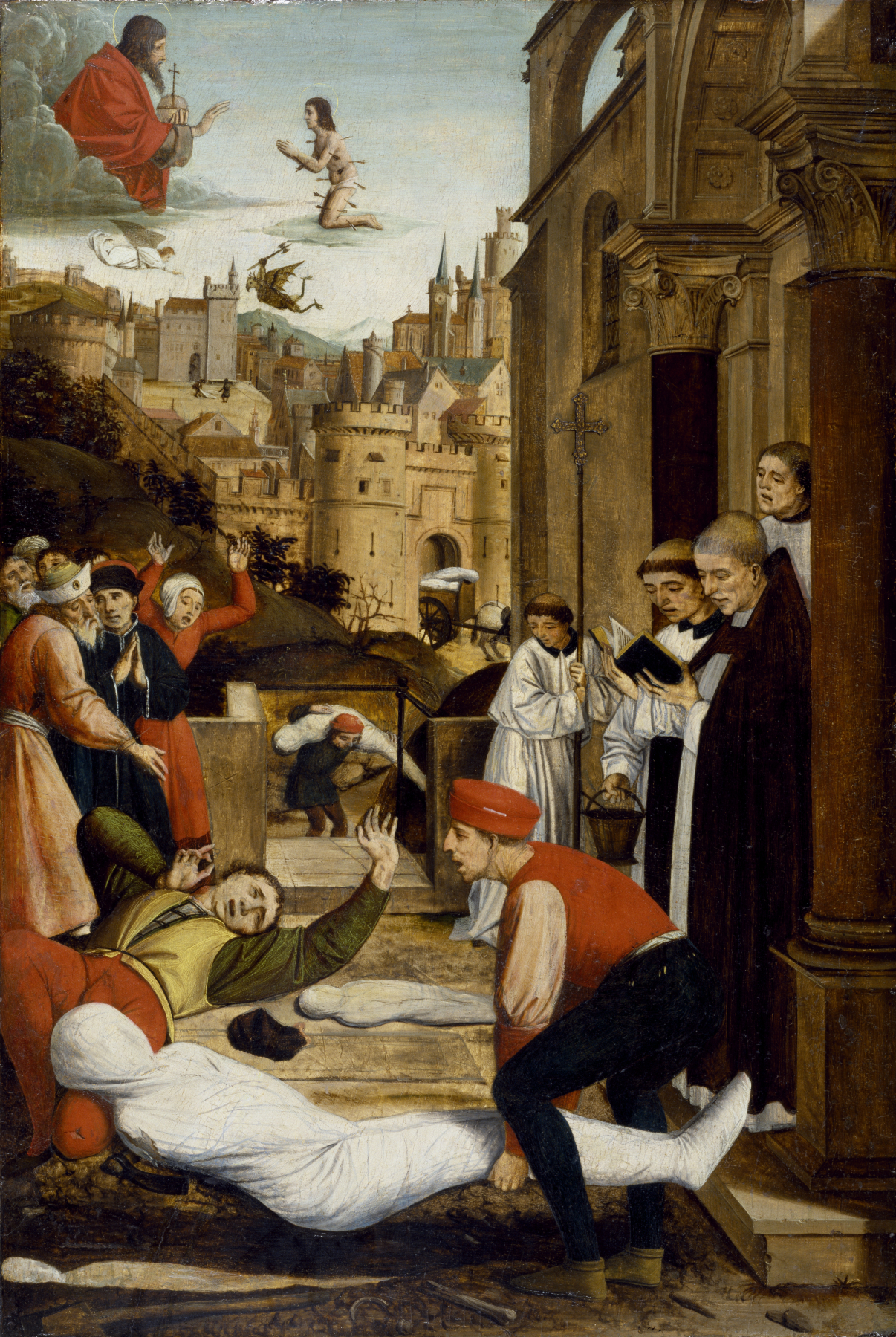
Saint Sebastian Interceding for the Plague Stricken — Josse Lieferinxe

“Wells” — Alice Meynell

“Wells”

by

Alice Meynell


The world at present is inclined to make sorry mysteries or unattractive secrets of the methods and supplies of the fresh and perennial means of life.  A very dull secret is made of water, for example, and the plumber sets his seal upon the floods whereby we live.  They are covered, they are carried, they are hushed, from the spring to the tap; and when their voices are released at last in the London scullery, why, it can hardly be said that the song is eloquent of the natural source of waters, whether earthly or heavenly.  There is not one of the circumstances of this capture of streams—the company, the water-rate, and the rest—that is not a sign of the ill-luck of modern devices in regard to style.  For style implies a candour and simplicity of means, an action, a gesture, as it were, in the doing of small things; it is the ignorance of secret ways; whereas the finish of modern life and its neatness seem to be secured by a system of little shufflings and surprises.

Dress, among other things, is furnished throughout with such fittings; they form its very construction.  Style does not exist in modern arrayings, for all their prettiness and precision, and for all the successes—which are not to be denied—of their outer part; the happy little swagger that simulates style is but another sign of its absence, being prepared by mere dodges and dexterities beneath, and the triumph and success of the present art of raiment—“fit” itself—is but the result of a masked and lurking labour and device.

The masters of fine manners, moreover, seem to be always aware of the beauty that comes of pausing slightly upon the smaller and slighter actions, such as meaner men are apt to hurry out of the way.  In a word, the workman, with his finish and accomplishment, is the dexterous provider of contemporary things; and the ready, well-appointed, and decorated life of all towns is now altogether in his hands; whereas the artist craftsman of other times made a manifestation of his means.  The first hides the streams, under stress and pressure, in paltry pipes which we all must make haste to call upon the earth to cover, and the second lifted up the arches of the aqueduct.

The search of easy ways to live is not always or everywhere the way to ugliness, but in some countries, at some dates, it is the sure way.  In all countries, and at all dates, extreme finish compassed by hidden means must needs, from the beginning, prepare the abolition of dignity.  This is easy to understand, but it is less easy to explain the ill-fortune that presses upon the expert workman, in search of easy ways to live, all the ill-favoured materials, makes them cheap for him, makes them serviceable and effectual, urges him to use them, seal them, and inter them, turning the trim and dull completeness out to the view of the daily world.  It is an added mischance.  Nor, on the other hand, is it easy to explain the beautiful good luck attending the simpler devices which are, after all, only less expert ways of labour.  In those happy conditions, neither from the material, suggesting to the workman, nor from the workman looking askance at his unhandsome material, comes a first proposal to pour in cement and make fast the underworld, out of sight.  But fate spares not that suggestion to the able and the unlucky at their task of making neat work of the means, the distribution, the traffick of life.

The springs, then, the profound wells, the streams, are of all the means of our lives those which we should wish to see open to the sun, with their waters on their progress and their way to us; but, no, they are lapped in lead.

King Pandion and his friends lie not under heavier seals.

Yet we have been delighted, elsewhere, by open floods.  The hiding-place that nature and the simpler crafts allot to the waters of wells are, at their deepest, in communication with the open sky.  No other mine is so visited; for the noonday sun himself is visible there; and it is fine to think of the waters of this planet, shallow and profound, all charged with shining suns, a multitude of waters multiplying suns, and carrying that remote fire, as it were, within their unalterable freshness.  Not a pool without this visitant, or without passages of stars.  As for the wells of the Equator, you may think of them in their last recesses as the daily bathing-places of light; a luminous fancy is able so to scatter fitful figures of the sun, and to plunge them in thousands within those deeps.

Round images lie in the dark waters, but in the bright waters the sun is shattered out of its circle, scattered into waves, broken across stones, and rippled over sand; and in the shallow rivers that fall through chestnut woods the image is mingled with the mobile figures of leaves.  To all these waters the agile air has perpetual access.  Not so can great towns be watered, it will be said with reason; and this is precisely the ill-luck of great towns.

Nevertheless, there are towns, not, in a sense, so great, that have the grace of visible wells; such as Venice, where every campo has its circle of carved stone, its clashing of dark copper on the pavement, its soft kiss of the copper vessel with the surface of the water below, and the cheerful work of the cable.

Or the Romans knew how to cause the parted floods to measure their plain with the strong, steady, and level flight of arches from the watersheds in the hills to the and city; and having the waters captive, they knew how to compel them to take part, by fountains, in this Roman triumph.  They had the wit to boast thus of their brilliant prisoner.

None more splendid came bound to Rome, or graced captivity with a more invincible liberty of the heart.  And the captivity and the leap of the heart of the waters have outlived their captors.  They have remained in Rome, and have remained alone.  Over them the victory was longer than empire, and their thousands of loud voices have never ceased to confess the conquest of the cold floods, separated long ago, drawn one by one, alive, to the head and front of the world.

Of such a transit is made no secret.  It was the most manifest fact of Rome.  You could not look to the city from the mountains or to the distance from the city without seeing the approach of those perpetual waters—waters bound upon daily tasks and minute services.  This, then, was the style of a master, who does not lapse from “incidental greatness,” has no mean precision, out of sight, to prepare the finish of his phrases, and does not think the means and the approaches are to be plotted and concealed.  Without anxiety, without haste, and without misgiving are all great things to be done, and neither interruption in the doing nor ruin after they are done finds anything in them to betray.  There was never any disgrace of means, and when the world sees the work broken through there is no disgrace of discovery.  The labour of Michelangelo’s chisel, little more than begun, a Roman structure long exposed in disarray—upon these the light of day looks full, and the Roman and the Florentine have their unrefuted praise.

Les Petites Faunesses — Eugène Grasset

Pat me on the head, I did manage to get through one novel that long in the past decade, David Markson remarked of Infinite Jest

Seriously—to paraphrase Ezra Pound, there’s no record of a critic ever saying anything significant about a writer who came later than he did. You grow up getting interested in books, and the writers of your own generation or the generation or two before your own are the ones you pay most attention to. But listen, I’m scarcely as bad as some of the people I know. But good lord, some of the people I went to college or even graduate school with pretty much quit about nine days after they got their diplomas. And haven’t read a poet since Auden, or a novelist since Hemingway. There was one fat novel I did read. In 1996, in fact. I remember the date because my novel Reader’s Block had also just been published: Infinite Jest. Before I’d heard of David Foster Wallace, way back in 1990, he’d written a very perceptive long essay on Wittgenstein’s Mistress for a periodical. Even though I was never able to solve the structure of his novel, to understand why it ended where it did, I admired the hell out of it. Eight or nine years ago even, I wasn’t reading with the equipment I possessed when I was younger. But pat me on the head, I did manage to get through one novel that long in the past decade.

David Markson, interviewed by Joey Rubin in 2005. Rubin’s interview was first published in Bookslut, and is reprinted in the inaugural issue of The Scofield with a new introduction.


Profile and Flowers — Odilon Redon

Read “Arrangement in Black and White,” a short story by Dorothy Parker

“Arrangement in Black and White”

by Dorothy Parker


The woman with the pink velvet poppies twined round the assisted gold of her hair traversed the crowded room at an interesting gait combining a skip with a sidle, and clutched the lean arm of her host.

“”Now I got you!” she said. “Now you can’t get away!”

“Why, hello,” said her host. “Well. How are you?”

“Oh, I’m finely,” she said. “Just simply finely. Listen. I want you to do me the most terrible favor. Will you? Will you please? Pretty please?”

“What is it?” said her host.

“Listen,” she said. “I want to meet Walter Williams. Honestly, I’m just simply crazy about that man. Oh, when he sings! When he sings those spirituals! Well, I said to Burton, ‘It’s a good thing for you Walter Williams is colored,’ I said, ‘or you’d have lots of reason to be jealous.’ I’d really love to meet him. I’d like to tell him I’ve heard him sing. Will you be an angel and introduce me to him?”

“Why, certainly,” said her host. “I thought you’d met him. The party’s for him. Where is he, anyway?”

“He’s over there by the bookcase,” she said. “Let’s wait till those people get through talking to him. Well, I think you’re simply marvelous, giving this perfectly marvelous party for him, and having him meet all these white people, and all. Isn’t he terribly grateful?”

“I hope not,” said her host. Continue reading “Read “Arrangement in Black and White,” a short story by Dorothy Parker”

Hypnose — Sascha Schneider

tumblr_mhemm5Mnye1ryb81eo1_1280

The Richest Man in the World — Siegfried Zademack

14

David Foster Wallace’s blurbs as “a parallel history to the aesthetic agendas he set down elsewhere”

There’s been a bit of DFW overload in the wake of that movie, which has made me wary (and weary) of so many of the “thought pieces” out there. But I really dug Lucas Thompson’s essay “David Foster Wallace and ‘Blurbspeak'” in the L.A. Review of BooksFrom the article:

….I think there are three key reasons why it’s worth paying attention to these blurbs. For one thing, they work as an oblique record of Wallace’s evolving views on what literature is really for, comprising a parallel history to the aesthetic agendas he set down elsewhere. Read carefully, his blurbs reveal intriguing overlaps with these broader agendas, as well as gesturing to the particular qualities he valued in fiction. They also indicate an engagement with a surprising and often counterintuitive range of texts, hinting at Wallace’s broad intellectual interests. And finally, the blurbs themselves are in most cases finely crafted, elegant sentences, which may even represent one of the final frontiers of Wallace’s published — though uncollected — work. Although much of Wallace’s previously uncollected essays, teaching documents, and other work have been published in recent years, the twenty-odd blurbs he composed across his career have, in my opinion, been unfairly neglected. The following survey makes a case for giving these blurbs a closer look.

Edward St. Aubyn’s A Clue to the Exit (Book acquired, 8.17.2015)

IMG_8166

Edward St. Aubyn’s 2000 novel A Clue to the Exit is getting a U.S. paperback release from Picador. Their blurb—

Charlie Fairburn, successful screenwriter, ex-husband, and absent father, has been given six months to live. He resolves to stake half his fortune on a couple of turns of the roulette wheel and, to his agent’s disgust, to write a novel-about death. In the casino he meets his muse. Charlie grows as addicted to writing fiction as she is to gambling.

His novel is set on a train and involves a group of characters (familiar to readers of St. Aubyn’s earlier work) who are locked in a debate about the nature of consciousness. As this train gets stuck at Didcot, and Charlie gets more passionately entangled with the dangerous Angelique, A Clue to the Exitcomes to its startling climax. Exquisitely crafted, witty, and thoughtful, Edward St. Aubyn’s dazzling novel probes the very heart of being.

Kachina — Georgia O’Keeffe

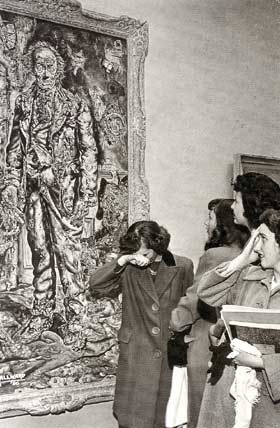
Viewers repulsed by Ivan Albright’s The Picture of Dorian Gray

tumblr_n0ia2iZNpl1skjxjao1_400

“Aunt Helen” — T.S. Eliot

Screenshot 2015-08-18 at 5.14.24 PM

The Traveler — Camilo Mori

camilomori.jpg

Issue 1.1 of The Scofield catches up to David Markson

If someone is merely ahead of his time, it will catch up to him one day.

From Culture and Value by Ludwig Wittgenstein. Translation by Peter Winch.

David Markson was ahead of his time.

I don’t know if David Markson read Ludwig Wittgenstein’s Culture and Value but it seems unlikely incredible improbable impossible unreasonable that he didn’t.

I don’t know what the “merely” means in that quote above—it seems pejorative, perhaps, no?

Wittgenstein’s original German being Wer seiner Zeit voraus ist, den holt sie einmal ein. 

Was David Markson “merely” ahead of his time?

And what would that mean?

Issue 1.1 of a new literary magazine, The Scofield, is available as a free pdf.

For our inaugural issue, we have chosen David Markson and Solitude. We chose David Markson, I must confess, because I have long been obsessed with his work, especially the late novels. Five years ago, just after his death, when his personal library was sold off at the Strand Bookstore, I collected hundreds of his books, posting scans of the pages with marginalia on my tumblr blog Reading Markson Reading.

From editor Tyler Malone’s introduction to the volume.

There are poems and essays and riffs and stories and art and comics and marginalia and older public domainish things in The Scofield 1.1.

And a cocktail recipe.

There are interviews: With Markson, with Ann Beattie, with Steven Moore, with others.

There are bits and pieces you might’ve read before,

There are tendencies towards imitating Markson’s style too, which I’ve lapsed into here my own goddamn self.

Evan Lavender-Smith doesn’t imitate Markson in the quartet of stories he contributes, including this one:

Screenshot 2015-08-18 at 1.36.56 PM

But still: Was David Markson “merely” ahead of his time?

By which ahead I mean the last four (anti-)novels, the so-called Notecard Quartet.

I’m reminded of some lines from Evan Lavender-Smith’s Marksonesque novel From Old Notebooks.

I count David Markson’s literary-anecdote books among the few things I want to read over and over again, yet I have no idea whether they are actually any good. They’re like porn for English majors.

No idea whether they are actually any good.

In his essay contribution to The Scofield, Matt Bucher writes:

I think this is partly what makes the Quartet novels so easily digestible: the names change in every paragraph, but the context stays the same.

So easily digestible. There’s a sustenance there, yes. But also a kind of rhetorical infection.

I think they, the quartet, The Notecard Quartet, those (anti-)novels, are actually very very good.

You can read the beginning of the last one, The Last Novel in The Scofield.

You can also read the opening of Wittgenstein’s Mistress in The Scofield.

Capture

Wittgenstein’s Markson.

Merely ahead of his time, as in, like, not transcendent of his time?

I have not read all of The Scofield 1.1 yet (it is very long, as these things go, despite an easy digestibility), but it makes a very nice catching up to David Markson, a recognition/performance of his impact and influence on writers and readers of this time, which was his to be caught up into.

I squander untold effort making an arrangement of my thoughts that may have no value whatever.

From Culture and Value by Ludwig Wittgenstein. Translation by Peter Winch.

and

W o r t e   s i n d   T a t e n.

Illustration for Sendai Airport Mural — Katsuhiro Otomo

img_51604_11

And the finished mural:


img_7578

About; see more pics of the finished mural here and here.