
On 1 Oct. 2018 on this foolish blog I foolishly wrote about my foolish “good intent to blog about something—books, film, art—every day or nearly every day.” I added, ” I’m not sure how it will go,” although I was a little bit sure about how it would go, which was, not great. Like, I knew that I would stumble in writing every day this month, which I have. October has snuck up (or sneaked up) on me like a thief or a serpent or a hobbit or a pick-your-simile—I even somehow missed taking my kid to her dentist appointment yesterday, and will almost surely get a bill from them over that. October sneaked/snuck up on me, and here we are 16 of 31 days in, and I have only managed 10 of these posts (including this one), which is like, 10 of 16, or 62.5%. (10/16 is also today’s date though, so like, uh, so like nothing).
Anyway.
I have been reading, and the initial blog I wrote about even included some specific goals, along with this picture, which semi-summarized those goals:

From bottom to top—
I did, as I promised I would, return (and not steal) the Ravel book, Irony and Sound, which was frankly over my head.
I have not returned to Hoffman’s Poe book, but I haven’t shelved it.
I’ve been reading the Gordon Lish interviews. Like, the book is good—it’s sort of almost like a book of Lish stories. I blogged about it a bit even.
I’ve absolutely loved reading William Gaddis’s third novel Carpenter’s Gothic. It’s turned out to be a perfect Halloween novel, too. I’ll finish the last of its seven chapters tonight—I would’ve finished last night, but I got sidetracked by some lines that reminded me of Leslie Fiedler’s 1960 analysis of American literature, Love and Death in the American Novel. Gaddis’s book in many ways performs a similar analysis to Fiedler’s—they both trace the weight of American guilt. As if anticipating Gaddis’s postmodern postGothic Gothic novel, Fiedler writes, a quarter century before Carpenter’s Gothic’s publication,
…in the United States, certain special guilts awaited projection in the gothic form. A dream of innocence had sent Europeans across the ocean to build a new society immune to the compounded evil of the past from which no one else in Europe could ever feel himself free. But the slaughter of the Indians, who would not yield their lands to the carriers of utopia, and the abominations of the slave trade, in which the black man, rum, and money were inextricably entwined in a knot of guilt, provided new evidence that evil did not remain with the world that had been left behind—but stayed alive in the human heart, which had come the long way to America only to confront the horrifying image of itself.
(I have stalled out on writing a stupid “Blog about” blog post these past few days because I have been cobbling together notes on something about Fiedler and Gaddis. But, like, really—I need to finish Gaddis’s book first).
No dent in the Pirandello.
I’ll return to David Bunch’s Moderan after finishing Carpenter’s Gothic. Bunch’s work is, so far, a perfectly-pitched pitch black satire of toxic (like nuclearly-toxic) masculinity. Horror-as-comedy, weird and undelightful.
I finished George Eliot’s Silas Marner pretty quickly in October, and enjoyed it. I’m glad I read Middlemarch first though. What Eliot next, reader?
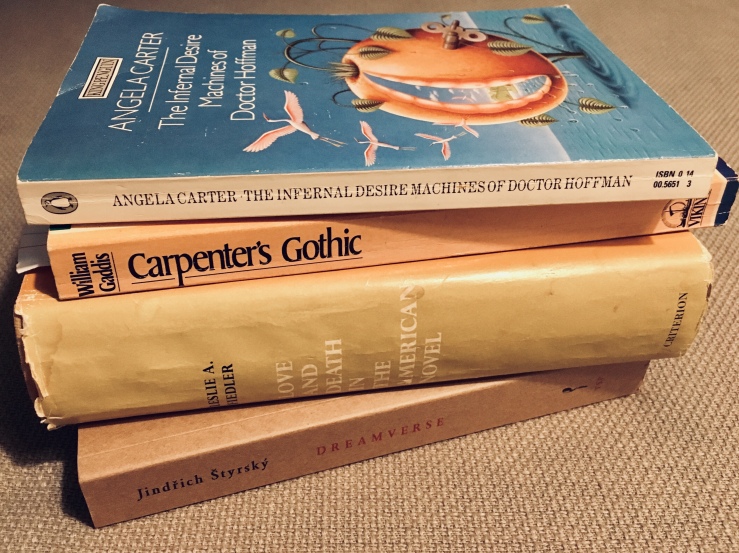
So—what next? The picture at the top is the stack I’ve been stacking and unstacking and restacking. Gaddis and Fiedler feel like the thing I really want to write about—gender roles, Gothic promises, domesticity vs. adventure, the house vs. the frontier, the collapse of self into fragments of language, etc. I’m also loving Dreamverse, a collection of poems, art, and prose by Jindřich Štyrský’ that Twisted Spoon Press has put together. Its insides look like this, at least in one place—

I think the next novel I will read will be Angela Carter’s The Infernal Machines of Doctor Hoffman.


 Biblioklept