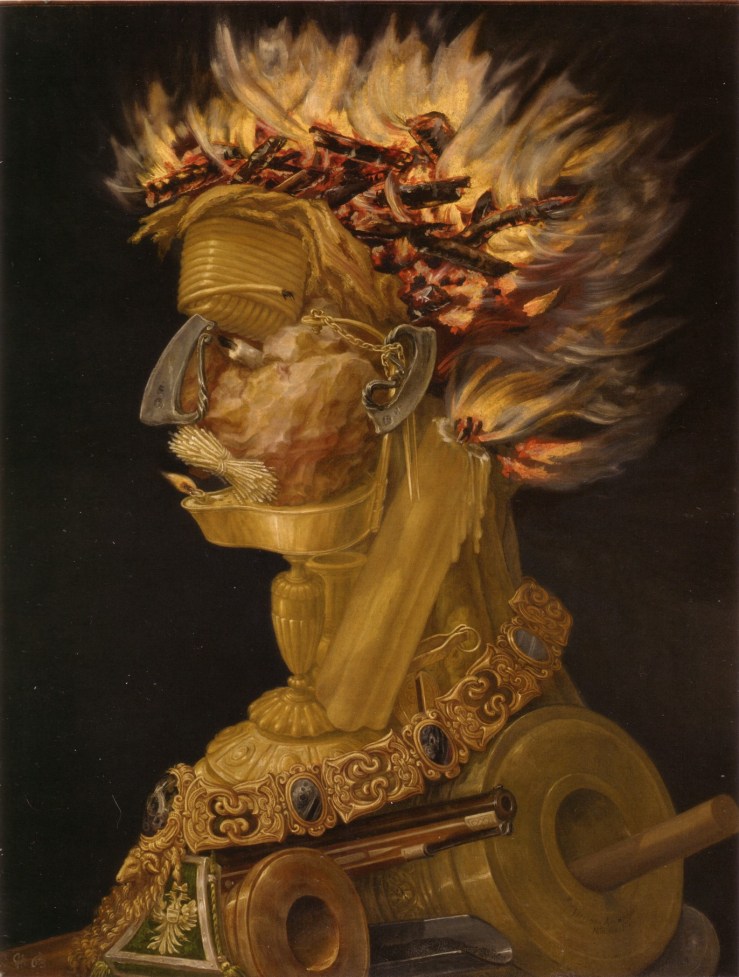
The Fire — Giuseppe Arcimboldo

“All News Is Fake” — Marshall McCluhan

“In the Dry” — Breece D’J Pancake

Read Breece D’J Pancake’s short story “In the Dry.” Excerpt —

He sees the bridge coming, sees the hurt in it, and says aloud his name, says, “Ottie.” It is what he has been called, and he says again, “Ottie.” Passing the abutment, he glances up, and in the side mirror sees his face, battered, dirty; hears Bus’s voice from a far-off time, I’m going to show you something. He breathes long and tired, seems to puff out the years since Bus’s Chevy slammed that bridge, rolled, and Ottie crawled out. But somebody told it that way—he only recalls the hard heat of asphalt where he lay down. And sometimes, Ottie knows. Now and again, his nerves bang one another until he sees a fist, a fist gripping and twisting at once; then hot water runs down the back of his throat, he heaves. After comes the long wait—not a day or night, but both folding on each other until it is all just a time, a wait. Then there is no more memory, only years on the hustle with a semi truck—years roaring with pistons, rattling with roads, waiting to sift out one day. For one day, he comes back.

This hill-country valley is not his place: it belongs to Sheila, to her parents, to her Cousin Buster. Ottie first came from outside the valley, from the welfare house at Pruntytown; and the Gerlocks raised him here a foster child, sent him out when the money-crop of welfare was spent. He sees their droughty valley, cannot understand—the hills to either side can call down rain. Jolting along the pike, he looks at withered fields, corn tassling out at three feet, the high places worse with yellowish leaves. August seems early for the hills to rust with dying trees, early for embankments to show patches of pale clay between milkweed and thistle. All is ripe for fire.

Hyperion: The James Purdy Issue

The new issue of Hyperion is devoted to the somewhat-neglected American writer James Purdy, author of Malcolm. You can read Purdy’s short story “Color of Darkness” here. Excerpt—

Sometimes he thought about his wife, but a thing had begun of late, usually after the boy went to bed, a thing which should have been terrifying but which was not: he could not remember now what she had looked like. The specific thing he could not remember was the color of her eyes. It was one of the most obsessive things in his thought. It was also a thing he could not quite speak of with anybody. There were people in the town who would have remembered, of course, what color her eyes were, but gradually he began to forget the general structure of her face also. All he seemed to remember was her voice, her warm hearty comforting voice.

Read “Deniers,” a New Sam Lipsyte Story

The New Yorker has published “Deniers,” a new story by Biblioklept fave Sam Lipsyte. Excerpt—

“Trauma this, atrocity that, people ought to keep their traps shut,” Mandy’s father said. American traps tended to hang open. Pure crap poured out. What he and the others had gone through shouldn’t have a name, he told her friend Tovah, all those years later in the nursing home. People gave names to things so they could tell stories about them, goddam fairy tales about children who got out alive.

Mandy’s father, Jacob, had never said anything like this to Mandy, not in any of his tongues. He’d said other things, or nothing at all. He had worked for thirty-nine years as a printer in Manhattan. The founders of the company had invented the Yellow Pages.

“Think about that,” he’d often said.

Mandy did think about it, the thick directory that used to boost her up on her stool at the kitchen counter.

She’d spent her childhood mornings at that counter, culling raisins from her cereal, surveying the remains of her father’s dawn meal, his toast crusts, the sugared dregs in his coffee mug. Sometimes she’d wondered if he would come home from work that day, but it was a game, because he always came home. He’d eat his dinner and take to his reclining—or, really, collapsing—chair, listen to his belly gurgle, read popular histories of the American West. Maybe he’d watch a rerun of “Hogan’s Heroes,” the only show he could abide.

His gastric arias mostly stood in for conversation, but some evenings he managed a few words, such as the night he spotted Mandy’s library book on the credenza. This teen novel told the story of a suburban boy who befriends an elderly neighbor, a wanted Nazi. Mandy watched her father study the book from across the room. The way he handled it made her think he was scornful of its binding or paper stock, but then he read the dust flap, shuddered. He whispered in his original language, the one he rarely used, so glottal, abyssal.

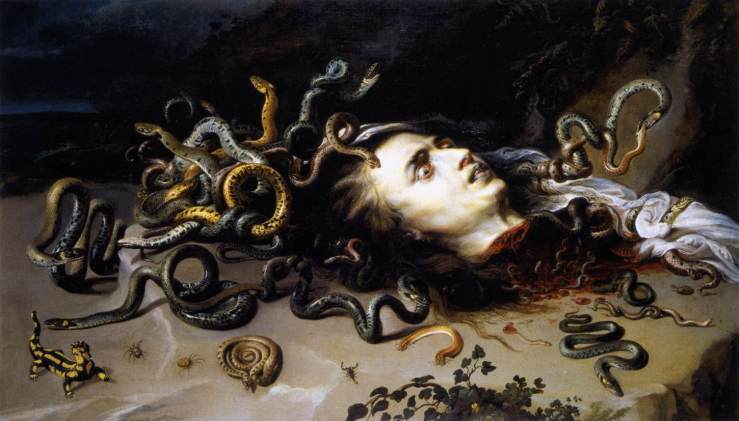
Head of Medusa — Peter Paul Rubens

“The Point of RoboCop, of Course, It Is a Christ Story” — Paul Verhoeven’s Cyborg Messiah

Vodpod videos no longer available.

Director Paul Verhoeven explains why his film RoboCop is a Christ allegory, and suggests what the American Jesus might be like—

 The point of RoboCop, of course, it is a Christ story.  It is about a guy who gets crucified in the first 50 minutes, and then is resurrected in the next 50 minutes, and then is like the supercop of the world, but is also a Jesus figure as he walks over water at the end.  Walking over water was in the steel factory in Pittsburgh, and there was water there, and I put something just underneath the water so he could walk over the water and say that wonderful line, “I am not arresting you anymore.” Meaning, I’m going to shoot you.  And that is of course the American Jesus.

Werner Herzog on NPR’s Fresh Air

Werner Herzog on NPR’s Fresh Air with Terry Gross. Herzog discusses his new documentary The Cave of Forgotten Dreams. (Thanks to Bblklpt reader Josh for forwarding us the link).

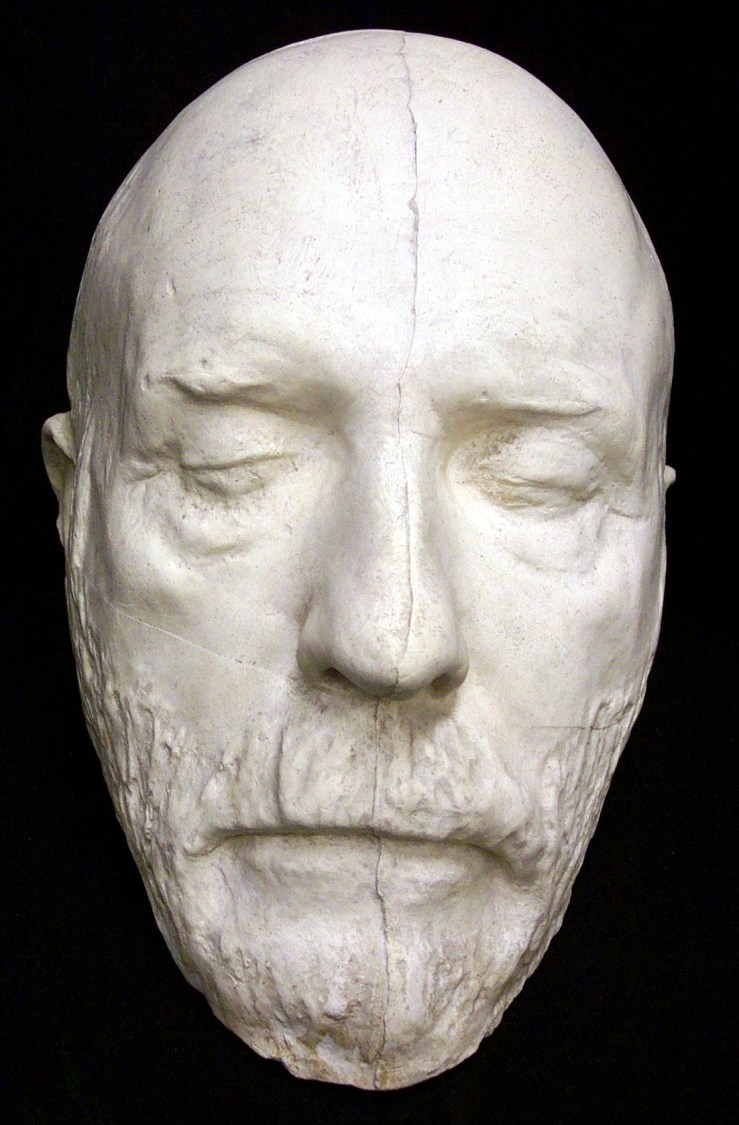
Robert E. Lee’s Death Mask

“I Don’t Approve of Religion” — Ayn Rand Defends Her Atheism

The Fountainhead in Five Seconds

In Brief: Novels from Siri Hustvedt, Katherine Shonk, and Benjamin Black

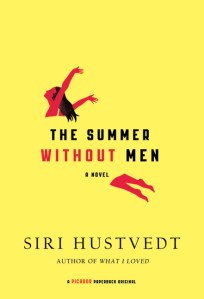
The narrator of Siri Hustvedt’s new novel The Summer Without Men is Mia Fredrickson, a sharp but wounded poet whose husband decides to put their marriage on “pause” after thirty years so he can shtup his younger assistant. Diagnosed with Brief Psychotic Disorder (“which means that you’re genuinely crazy but not for long”), Mia finds herself confined to a psychiatric hospital. The summer after her stay, she leaves Brooklyn for the “backwater town on what used to be the prairie in Minnesota” where she grew up, where she can be closer to her mom, who lives in an assisted living facility. Mia’s plan is to fill the summer with rest and poems—and ultimately restore her sanity. She spends time with her mother and her friends, becomes involved in the lives of a neighbor with two young children, and teaches a poetry workshop for pre-adolescent girls. Here, she encounters the “Gang of Four,” mean girls who spend their summer tormenting an alienated Chicago transplant with whom Mia strongly identifies. Composed in tight vivid prose, The Summer Without Men is energetic, and handles its subjects with depth and wit, painting its characters and their complex emotions in the kind of detail that rings true to life. 
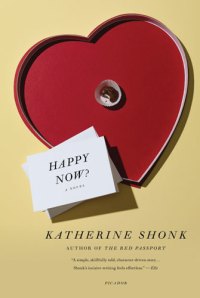
Katherine Shonk’s début novel Happy Now? also features a heroine dealing with the psychic shock caused by the end of her marriage. Claire Kessler’s husband Jay commits suicide on Valentine’s Day, leaving a book-length suicide note on the coffee table that Claire cannot bring herself to read. Claire moves in with her sister, who emotionally abandons her husband during the process. Her parents try to help too, but her overprotective father ends up trailing her every move and smothering her. Claire’s adventures in psychoanalysis become a tragicomic journey, but one handled with compassion. Shonk has an ear for dialog and the good sense not to clutter her novel with too many plots or characters.
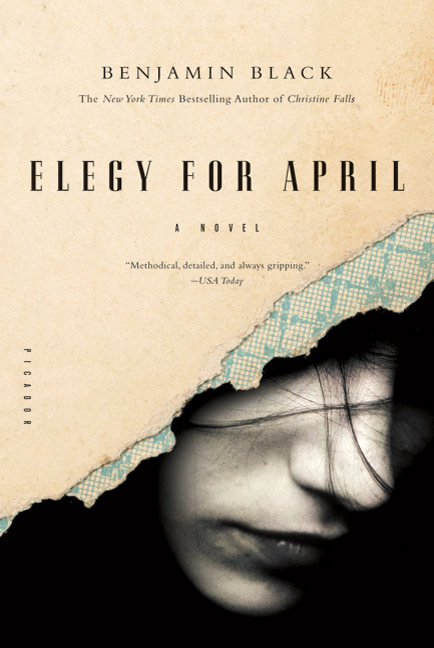
Elegy for April is the fourth novel of John Banville’s detective noir series under the pseudonym Benjamin Black. April Latimer is a doctor in conservative 1950s Dublin, whose unconventional behavior scandalizes what is essentially a big small town (her prominent Catholic family isn’t too keen that she’s dating a Nigerian man). When April disappears, her friend Phoebe Griffin enlists the help of her (sort-of) recovering alcoholic father, the brilliant pathologist Garret Quirke. Quirke’s investigation—also Phoebe’s investigation, of course—plumbs into the conservative mores of a secretive upper echelon of families, revealing hidden truths that are at times painful. Bleak, dark, and often morally ambivalent, Black’s book is best suited for those who don’t mind their mysteries delivered with ambiguity and loose ends.

The Summer Without Men, Happy Now?, and Elegy for April are all new in trade paperback this month from Picador.

“Writing Is Like a Struggle to Get Back to a Kind of Belated, Quite Impure Virginity” — Harold Brodkey on Writing

Harold Brodkey at the The Paris Review

Often writing is like a struggle to get back to a kind of belated, quite impure virginity where the issues are not entirely those of corruption and despair. Everything you know about language, writing, talking, holding an audience, everything you have theorized about what was wrong about the work of the generation before you and is wrong in your contemporaries’ work emerges in the performance stress of writing a final draft or the master draft in one sitting.

“I Found His Name Carved into the Wooden Desk Where I Sat” — Harold Brodkey on Tennessee Williams

Harold Brodkey talks Tennessee Williams—and other St. Louis writers—in his interview with The Paris Review

INTERVIEWER

You grew up in St. Louis, which has a reputation for spawning writers—Eliot, Inge, Williams, Burroughs . . .

BRODKEY

People in St. Louis talked, oddly enough, like simpler Eliots, inhibited William Burroughses, and shy Tennessee Williamses. Williams and I had the same high school English teacher.

INTERVIEWER

Did she say Williams was a pretty good student?

BRODKEY

She said he was a horrible person. I found his name carved into the wooden desk where I sat. Tennessee Williams was the obverse of Eliot, and at the same time was like him. When I was at Harvard I’d get drunk and I’d recite Eliot and I’d sound like a character in Williams. I don’t think I honestly ever saw a Williams play, or reacted to one as a member of the audience because I identify so with the background out of which the work comes. All of the writers from St. Louis have a vaguely similar dependence on metaphor . . . Burroughs, Fred Seidel . . .

I do think, seriously but without much study, that the influence of Eliot, and the influence of Eliot’s becoming famous, did affect people like Williams and William Inge. I knew Inge in New York at the Actors’ Studio. Tennessee Williams and I used to swim at the West Side Y together but we never spoke to each other.

INTERVIEWER

Did you ever clap as he walked by, cheer for him?

BRODKEY

No. At bottom there’s a dishonesty in artists.

David Milch and Michael Mann Discuss Their New HBO Show Luck

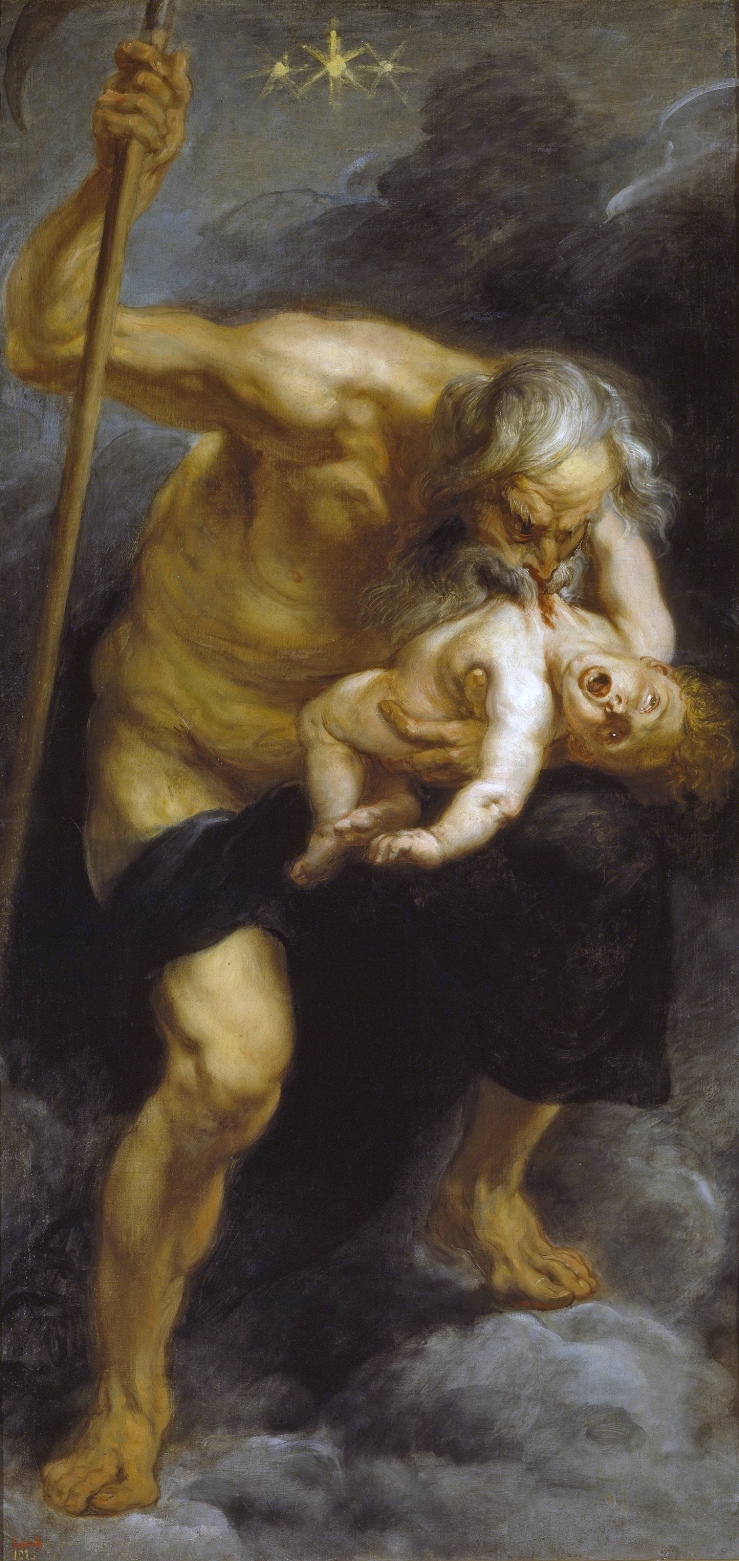
Saturn Devouring His Son — Peter Paul Rubens

Six (More) Stoner Novels (And a Bonus Short Story)

One year ago, to celebrate 4/20, Sam Munson at the Daily Beast wrote an article praising “The Best Stoner Novels.” Not a bad list—Wonder Boys, sure, Invisible Man, a bit of a stretch, The Savage Detectives, a very big stretch, but sure, why not. Anyway, six more stoner novels (not that we advocate the smoking of the weed)—

Junkie, William Burroughs

Burroughs’s (surprisingly lucid) early novel Junkie may take its name from heroin, but it’s full of weed smoking. Lesson: weed smoking leads to heroin. And the inevitable search for yage.

Inherent Vice, Thomas Pynchon

Doc Sportello, the wonky PI at the off-center of Pynchon’s California noir, is always in the process of lighting another joint, if not burning his fingers on the edges of a roach. A fuzzy mystery with smoky corners.

Infinite Jest, David Foster Wallace

Hal Incandenza, protagonist of Wallace’s opus, spends much of his time hiding in the tunnels of Enfield Tennis Academy, feeding his bizarre marijuana addiction, which is, in many ways, more of an addiction to a secret ritual than to a substance. Hal’s hardly the only character in IJ who likes his Mary Jane; there’s a difficult section near the novel’s beginning that features a minor character preparing to go on a major weed binge. His pre-smoking anxiety works as a challenge to any reader seeking to enter the world of Infinite Jest.

The Lord of the Rings, J.R.R. Tolkien

I’m pretty sure “pipe-weed” isn’t tobacco.

Chronic City, Jonathan Lethem

I kind of hated Chronic City, a novel where characters seem to light up joints on every other page. It seems to have been written in an ambling, rambling fog, absent of any sense of immediacy, urgency, or, uh, plot. Bloodless stuff, but, again, very smoky.

Stoner, John Williams

Okay. Stoner has nothing to do with marijuana. But, hey, it’s called Stoner, right?

Bonus short story: Raymond Carver’s “Cathedral”

Carver’s classic story features a myopic narrator who comes up against his own shortcomings when he meets an old friend of his wife, a blind man who ironically sees deeper than he does. After drinking too much booze, they spark up, share a doob, and take in a documentary about European cathedrals. Great stuff.