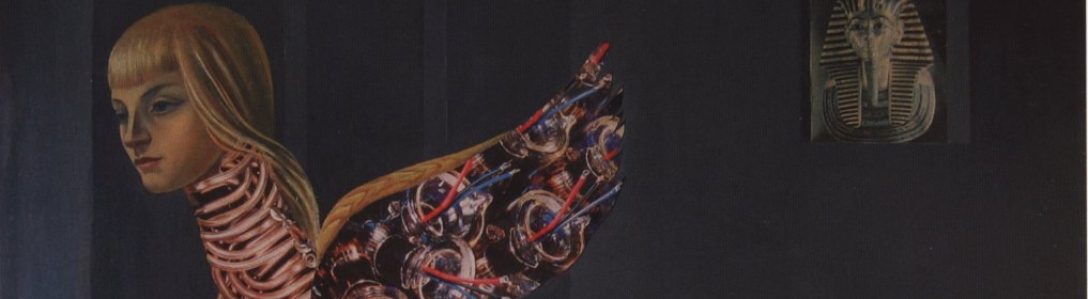
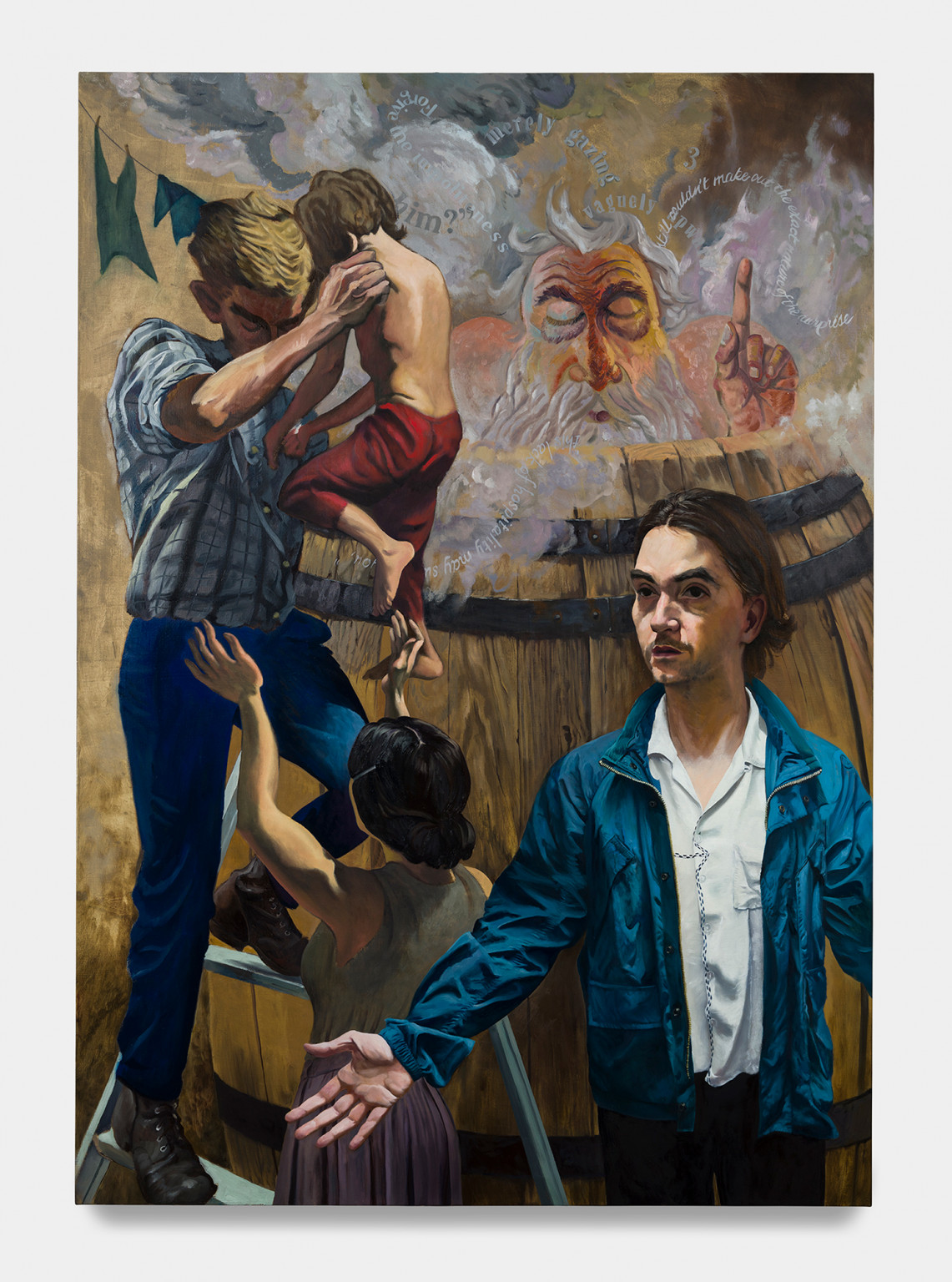
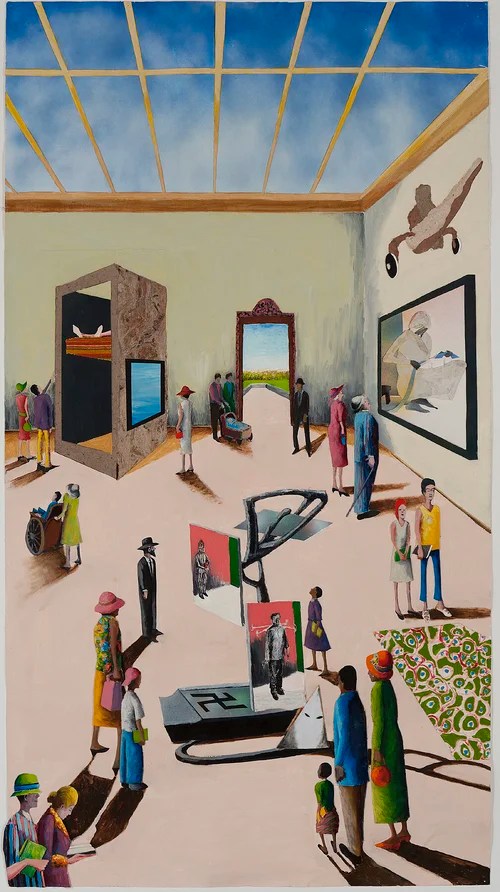
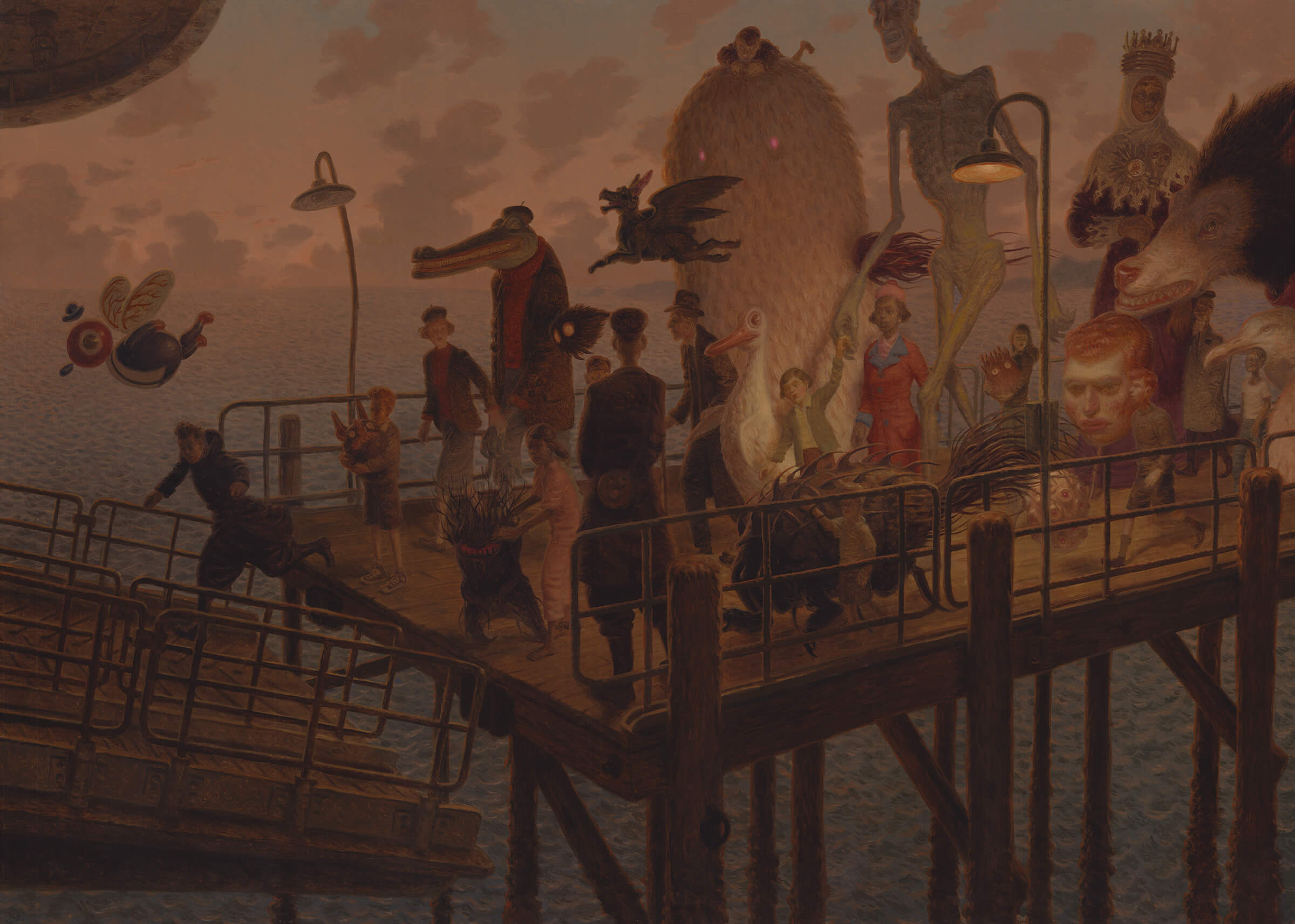
Vessels — Josh Dorman

Vessels, 2021 by Josh Dorman (b. 1966)

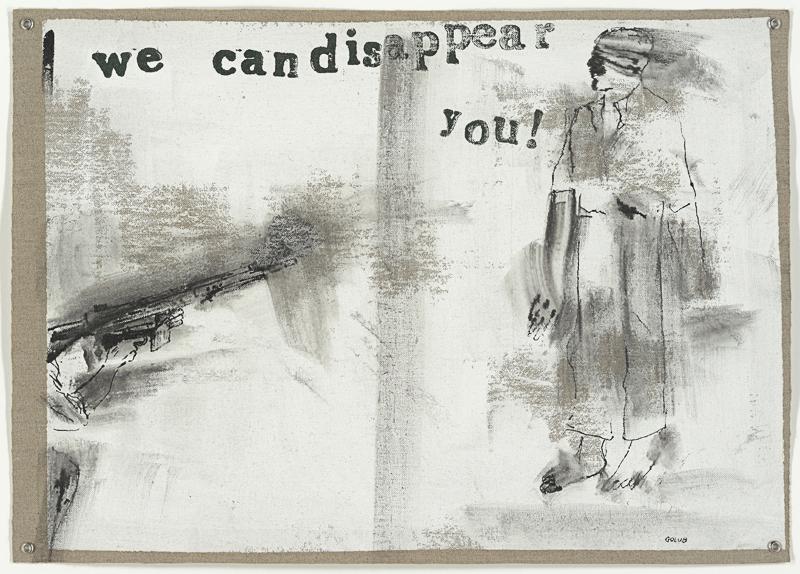
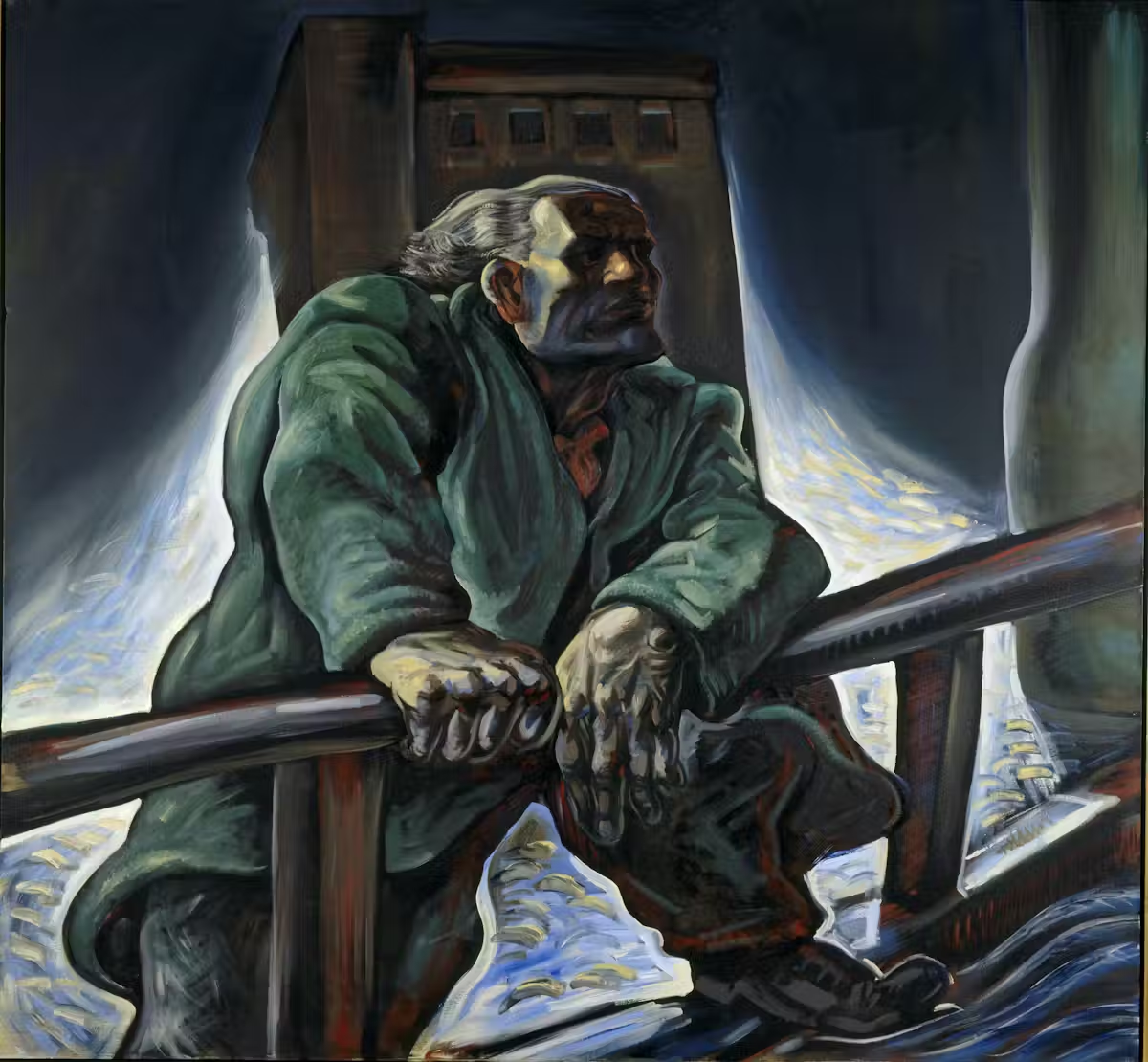
Skull of an Ancestor — Gely Korzhev

Skull of an Ancestor, 1991 by Gely Korzhev (1925-2012)

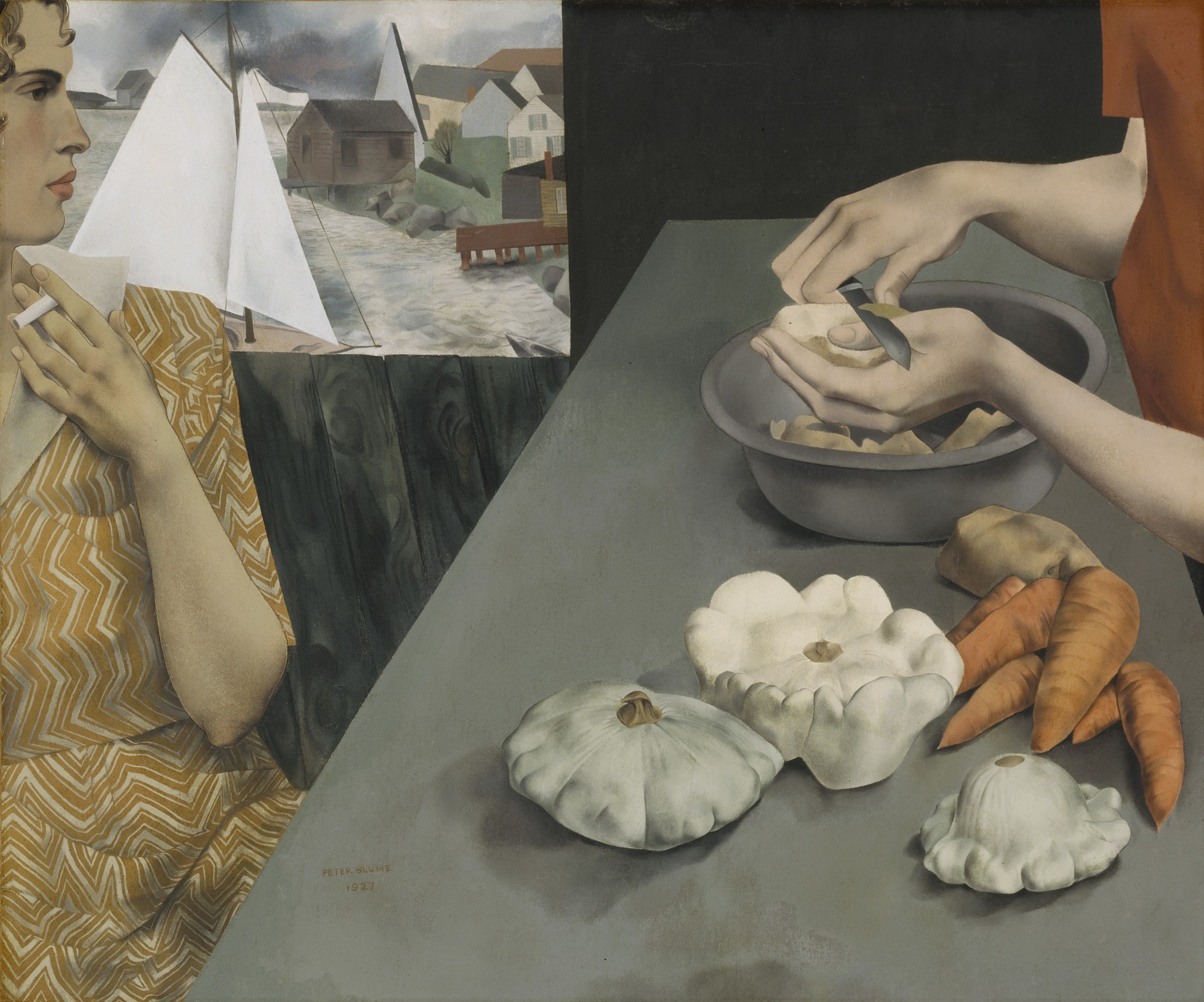
Man Reading a Newspaper — Roland Jarvis

Man Reading a Newspaper, c. 1957 by Roland Jarvis (1926-2016)

Sunday Comix

From “The Creature in the Tunnels” by Rory Hayes. Published in Bogeyman Comics #1, 1969, Twelve A.M. Publications.

Self-Portrait — Flannery O’Connor

Self-Portrait, 1952 by Flannery O’Connor (1925-1964)

The Villages — Barnaby Whitfield

The Villages, 2023 by Barnaby Whitfield (b. 1970)

Easy to hang puppets

An aphorism from Stanislaw J. Lec’s Unkempt Thoughts with an illustration by Barbara Carr. Translation by Jacek Galazka.

Paul Kirchner’s metaphysical trip continues in The Bus 3

Paul Kirchner’s surreal comic strip The Bus is a looping, deadpan fugue of modern alienation and mechanical ritual, where a lone Commuter drifts through absurd, Escher-like permutations of transit life.

The Commuter’s foil and ferry is the titular bus (which Kirchner himself described as “demonic” in a 2015 essay in The Boston Globe); his Charon (and, really, partner) is the bus’s Driver. Each Bus strip is a double-decker one-pager rendered in precise black ink; most strips are wordless and consist of six or eight panels. Kirchner uses these constraints to conjure metaphysical gags that upend the banality of everyday existence. The previous two sentences that attempt to describe Kirchner’s formal techniques are a poor substitute for an example — so here is an example:

The strip above is the first entry in Kirchner’s new collection, The Bus 3. This strip neatly ushers us into The Bus’s charms. Old partners Commuter and Driver reunite; the bus subtly transforms into a theater; the Commuter turns to witness the loop start anew. Is there an exit? And would the Commuter want to escape the loop?

The second strip reaffirms Kirchner’s commitment to the Commuter’s eternal return. Our hapless hero is a kind of chthonic demigod, simultaneously plastic and immutable, wholly absurd:

The Bus’s first route was between 1978 and 1985 in the pages of Heavy Metal magazine. French publisher Tanibis Editions republished this original run in 2012. In 2015, they published The Bus 2, a sequel of new material. In my review, I wrote that “The Bus 2, like its predecessor, is a remarkably and perhaps unexpectedly human strip.” The same is true for The Bus 3. Kirchner’s strips demonstrate that the absurdity of the modern condition, for all its dulling machinations, reaffirms humanity and the imaginative, artistic vision as a site of surreal resistance.

I kept The Bus 3 out on my coffee table the entire summer. I tried not to gobble up all the strips right away, but rather to read one or two a day, each page a small treat against the absurdity of the day. As I reached the end of the volume a week ago, I found myself strangely moved by the last three strips. Kirchner’s Möbius strips always send the Commuter back to his starting position. These last three pull the same move, but with a difference. In the first of the final three, the Commuter dies (waiting on the Driver, natch) and his spirit ascends. In eight speechless panels, Kirchner retells Kafka’s parable “Before the Law.”

The penultimate strip, a gag on Macy’s Thanksgiving Day Parade balloons literally deflates the bus. The crowd has left, but the Commuter remains, stoic, waiting. And the last proper strip shows a techno-utopian future with a splendid flying bus — but our Commuter refuses to board. His neck stooped, he wanders to the outskirts of town to find the apocalyptic wreckage of his beloved broken down bus. It’s a lovely moment.

Has Kirchner retired his Commuter? Perhaps. The last page of the book shows our hero somehow looking bemused in a folding lawn chair, a cold one in his hand. He sits in front of the bus, now converted to an immobile home, scene of domestic bliss, maybe, everything tranquil and normal (just ignore the fish).

Is it really the end of service? If so, The Bus 3 offers a sweet send off for its hero. But I’ll hold out hope for one more ride. Great stuff.

Surrealist Occupational Index

Published in Arsenal: Surrealist Subversion, No. 2, Summer 1973.

Burning Land — Christopher Croft

Burning Land, 1973 by Christopher Croft (b. 1947)

Sunday Comix

From “They Crawl by Night” by Daniel Keyes and Basil Wolverton, Journey Into Unknown Worlds #15, February 1953, Atlas Comics. Reprinted in Basil Wolverton’s Gateway to Horror #1, June 1988, Dark Horse Comics.

The object of art is to make the reader or viewer or listener aware of what he knows but doesn’t know that he knows | William S. Burroughs on photography

The object of art is to make the reader or viewer or listener aware of what he knows but doesn’t know that he knows … And this is doubly true of photography, because the photographer is making the viewer aware of what he is actually seeing and yet at the same time not seeing. So many people in urban environments are walking around without seeing what is in front of them, let alone what is at the margin of vision, because what they see seems to have no meaningful relationship to them as observers. It is the art of the photographer to wrest back meaning for the observer from the input of impressions. Cut, shuffle, pick a card, any card… what do we see as we walk the streets of a city? A jumble of fragments. Now, these fragments are meaningful to you because they are what you have chosen to see.

I used to have an exercise that I suggested to my students at New York City College. Walk around the block and try to keep your eyes open for a change. Now sit down and write what you have just seen with particular attention to what you were thinking when someone walked by, when you saw a certain billboard, when a car passed… and so forth.

It soon becomes apparent that these fragments are not meaningless, that they mean something very definite to you, spelling out messages, cryptic messages … Some students think they are going insane. “Everything is talking to me.” Of course it is … it always was… You are just starting to listen and see a little. (One student became convinced that I was the Anti-Christ and that voices were telling him to kill me. At this point I edged into the kitchen and sought the proximity of a potato masher.)

Another exercise I called “color walks.” Walk down a New York street and pick out all the reds-focusing on the red. Now shift to the blues, the yellows, the whites… Blue again and I know the car coming up behind me will be blue… and it is. Or you’re running out of yellow… a yellow cab comes right on cue. Just start looking and you will see. Example-I am thinking about New Mexico. Round a corner and there is a New Mexico license plate. “New Mexico, Land of Enchantment.”

Click, click, click. Catch these intersection points between your inner reality and what you are seeing, between the inner reality and the outer reality. They have a particular relevance to the observer and, if the observer is also a photographer, the intersection points give the photographs their special style. Now take a stack of photographs. We are looking for the point where inner reality and outer reality intersect.

From William S. Burroughs’s introduction to Robert Walker’s New York Inside Out, a 1984 collection of street photography. The introduction was published, along with several of Walker’s photographs, in the August 1984 issue of Popular Photography.

Plumber’s Shop Studio, Essendon — Charles Bush

Plumber’s Shop Studio, Essendon, 1938 by Charles Bush (1919-1989)

Illustration for Lilus Kikus — Leonora Carrington

Illustration for Elena Poniatowska’s children’s novel, Lilus Kikus, c. 1954 by Leonora Carrington (1917 – 2011)

Girl Seated on the Ground beside a Tall Table — Charles Blackman

Girl Seated on the Ground beside a Tall Table, c. 1955 by Charles Blackman (1928-2018)

Reading — Ishikawa Toraji

Reading, 1934 by Ishikawa Toraji (1875-1964)

Museum — Edith Rimmington

Museum, 1951 by Edith Rimmington (1902-1986)