Horn! — Kevin Thomas’s Collected Reviews (Book Acquired, 6.14.2014)

20140618-113731-41851102.jpg

Kevin Thomas has been doing illustrated reviews of contemporary books for The Rumpus for a few years now. Now, the good people of OR Books have published the reviews in one volume—HORN! The Collected Reviews.

I’d read a few of Thomas’s reviews in the past and always been a bit jealous at his control of his medium—of his ability to go past or through or beyond the language under discussion to provoke with a sequence of images. Reviews is maybe not the right term—commentaries seems more fitting. Take his review of George Saunders’s Tenth of December for example, which manages to condense an overview of the collection’s themes along with a viewpoint on those themes into nine small panels. (I needed over 2000 words for my own review of the Saunders book).

Thomas’s technique works especially well with novels that are very difficult to write about/after, like one of my favorite recent titles, Jason Schwartz’s John the Posthumous. I stammered and hiccuped through my essay; Thomas explicates, illustrates, and piques reader interest—again, in just nine panels.

20140618-113733-41853283.jpg

I’ve been trying to limit myself to just a few strips a day from the collection, but more often than not I’ve failed, curious to see Thomas’s takes on Levin’s The Instructions (a novel I couldn’t finish), Peter Hook’s memoir, Renata Adler’s Speedboat (yes!) and more. Great stuff.

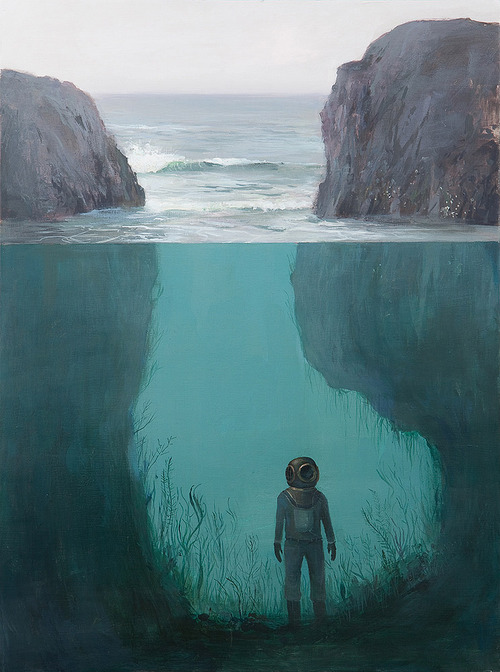
Sacred Trees (Under Water) — JoAnn Verburg

Fray Jerónimo Pérez — Francisco de Zurbarán

Don Quixote (Illustration) — Edward Hopper

hopper quixote

Royal Goldfish — Rokni Haerizadeh

Lowercase Components — Tauba Auerbach

LowercaseComponents

Dictionary — Liu Dan

A Woman in Netherlandish Dress Seen from Behind — Albrecht Dürer

Coffee — Mernet Larsen

coffee Mernet-Larsen_4

Young Woman Dreaming of The Ise Stories — Hosoda Eishi

Portrait of the Artist’s Father

Duchamp
Cezanne
Dali
Durer
Picasso

My Father — Carlos Botelho

Before the Parachute Opens — Tullio Crali

More colour is wanted (Oscar Wilde)

You have too many white walls.  More colour is wanted.  You should have such men as Whistler among you to teach you the beauty and joy of colour.  Take Mr. Whistler’s ‘Symphony in White,’ which you no doubt have imagined to be something quite bizarre.  It is nothing of the sort.  Think of a cool grey sky flecked here and there with white clouds, a grey ocean and three wonderfully beautiful figures robed in white, leaning over the water and dropping white flowers from their fingers.  Here is no extensive intellectual scheme to trouble you, and no metaphysics of which we have had quite enough in art.  But if the simple and unaided colour strike the right key-note, the whole conception is made clear.  I regard Mr. Whistler’s famous Peacock Room as the finest thing in colour and art decoration which the world has known since Correggio painted that wonderful room in Italy where the little children are dancing on the walls.  Mr. Whistler finished another room just before I came away—a breakfast room in blue and yellow.  The ceiling was a light blue, the cabinet-work and the furniture were of a yellow wood, the curtains at the windows were white and worked in yellow, and when the table was set for breakfast with dainty blue china nothing can be conceived at once so simple and so joyous.

The fault which I have observed in most of your rooms is that there is apparent no definite scheme of colour.  Everything is not attuned to a key-note as it should be.  The apartments are crowded with pretty things which have no relation to one another.  Again, your artists must decorate what is more simply useful.  In your art schools I found no attempt to decorate such things as the vessels for water.  I know of nothing uglier than the ordinary jug or pitcher.  A museum could be filled with the different kinds of water vessels which are used in hot countries.  Yet we continue to submit to the depressing jug with the handle all on one side.  I do not see the wisdom of decorating dinner-plates with sunsets and soup-plates with moonlight scenes.  I do not think it adds anything to the pleasure of the canvas-back duck to take it out of such glories.  Besides, we do not want a soup-plate whose bottom seems to vanish in the distance.  One feels neither safe nor comfortable under such conditions.  In fact, I did not find in the art schools of the country that the difference was explained between decorative and imaginative art.

From “House Decoration,” a lecture delivered by Oscar Wilde on his 1882 American tour.

Book with Wavy Pages — Abelardo Morell