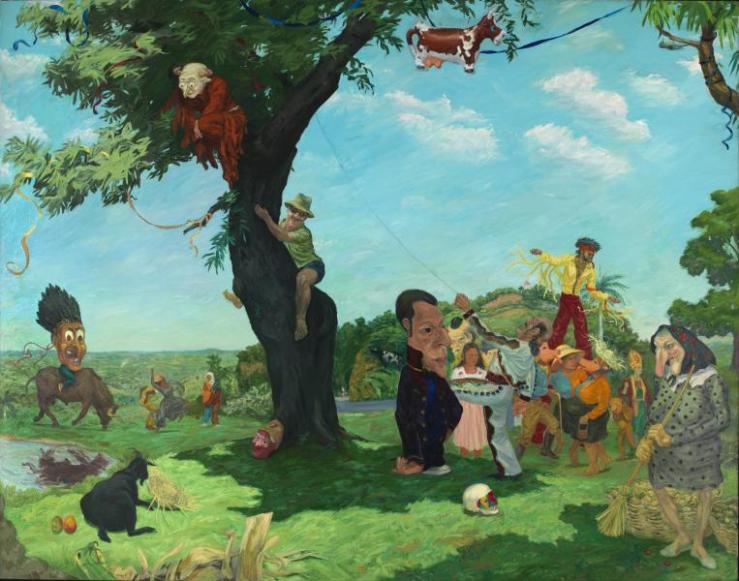
The Carnival of St. Cerro — Manuel Macarrulla

saam-2016.62_1

The Carnival of St. Cerro, 1981 by Manuel Macarrulla (b. 1952)

Mother and Son — Ambrose McEvoy

Mother and Son c.1910 by Ambrose McEvoy 1878-1927

Mother and Son c.1910 by Ambrose McEvoy (1877–1927)

“A Mother” — James Joyce

“A Mother”

by

James Joyce


Mr Holohan, assistant secretary of the Eire Abu Society, had been walking up and down Dublin for nearly a month, with his hands and pockets full of dirty pieces of paper, arranging about the series of concerts. He had a game leg and for this his friends called him Hoppy Holohan. He walked up and down constantly, stood by the hour at street corners arguing the point and made notes; but in the end it was Mrs Kearney who arranged everything.

Miss Devlin had become Mrs Kearney out of spite. She had been educated in a high-class convent, where she had learned French and music. As she was naturally pale and unbending in manner she made few friends at school. When she came to the age of marriage she was sent out to many houses where her playing and ivory manners were much admired. She sat amid the chilly circle of her accomplishments, waiting for some suitor to brave it and offer her a brilliant life. But the young men whom she met were ordinary and she gave them no encouragement, trying to console her romantic desires by eating a great deal of Turkish Delight in secret. However, when she drew near the limit and her friends began to loosen their tongues about her, she silenced them by marrying Mr Kearney, who was a bootmaker on Ormond Quay.

He was much older than she. His conversation, which was serious, took place at intervals in his great brown beard. After the first year of married life, Mrs Kearney perceived that such a man would wear better than a romantic person, but she never put her own romantic ideas away. He was sober, thrifty and pious; he went to the altar every first Friday, sometimes with her, oftener by himself. But she never weakened in her religion and was a good wife to him. At some party in a strange house when she lifted her eyebrow ever so slightly he stood up to take his leave and, when his cough troubled him, she put the eider-down quilt over his feet and made a strong rum punch. For his part, he was a model father. By paying a small sum every week into a society, he ensured for both his daughters a dowry of one hundred pounds each when they came to the age of twenty-four. He sent the elder daughter, Kathleen, to a good convent, where she learned French and music, and afterward paid her fees at the Academy. Every year in the month of July Mrs Kearney found occasion to say to some friend:

“My good man is packing us off to Skerries for a few weeks.”

If it was not Skerries it was Howth or Greystones.

When the Irish Revival began to be appreciable Mrs Kearney determined to take advantage of her daughter’s name and brought an Irish teacher to the house. Kathleen and her sister sent Irish picture postcards to their friends and these friends sent back other Irish picture postcards. On special Sundays, when Mr Kearney went with his family to the pro-cathedral, a little crowd of people would assemble after mass at the corner of Cathedral Street. They were all friends of the Kearneys—musical friends or Nationalist friends; and, when they had played every little counter of gossip, they shook hands with one another all together, laughing at the crossing of so many hands, and said good-bye to one another in Irish. Soon the name of Miss Kathleen Kearney began to be heard often on people’s lips. People said that she was very clever at music and a very nice girl and, moreover, that she was a believer in the language movement. Mrs Kearney was well content at this. Therefore she was not surprised when one day Mr Holohan came to her and proposed that her daughter should be the accompanist at a series of four grand concerts which his Society was going to give in the Antient Concert Rooms. She brought him into the drawing-room, made him sit down and brought out the decanter and the silver biscuit-barrel. She entered heart and soul into the details of the enterprise, advised and dissuaded; and finally a contract was drawn up by which Kathleen was to receive eight guineas for her services as accompanist at the four grand concerts. Continue reading ““A Mother” — James Joyce”

Figure in a Room I — Jack Smith

Figure in a Room I 1959 by Jack Smith 1928-2011

Figure in a Room I, 1959 by Jack Smith 1928–2011

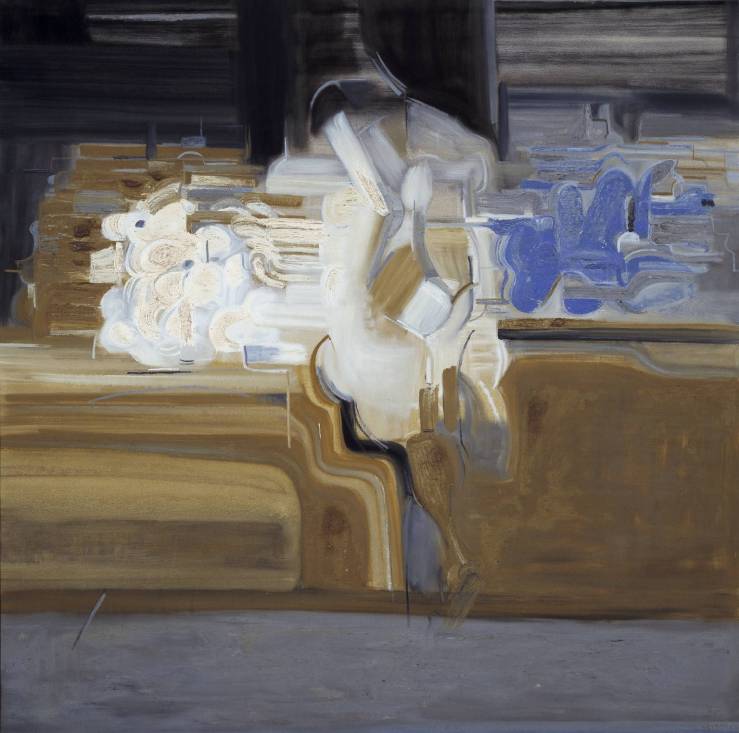
In the Rocks — Christian Brandl

brandl-in-den-felsen2c-20162c-135x160cm2c-occ88l-auf-leinwand

In the Rocks, 2016 by Christian Brandl (b. 1970)

Some Roses and Their Phantoms — Dorothea Tanning

Some Roses and Their Phantoms 1952 by Dorothea Tanning born 1910

Some Roses and Their Phantoms, 1952 by Dorothea Tanning (1910-2012)

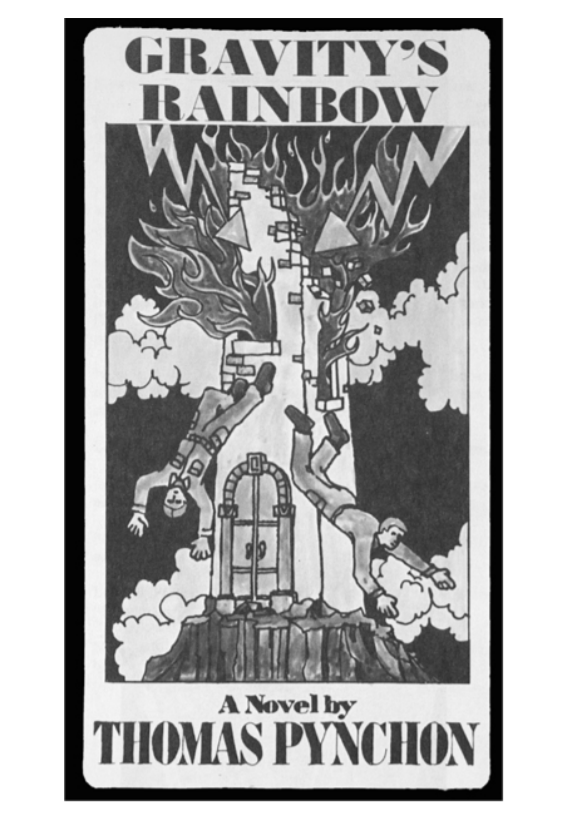
Trial cover art for Gravity’s Rainbow

trial art for gr

This trial cover for Thomas Pynchon’s novel Gravity’s Rainbow is included in Luc Herman and Steven Weisenburger’s book Gravity’s Rainbow, Domination, and Freedom (University of Georgia Press, 2013).

Herman and Weisenburger note the existence of an even earlier version with Pynchon’s working title Mindless Pleasures. I found it quickly at Pynchon Wiki, which notes:

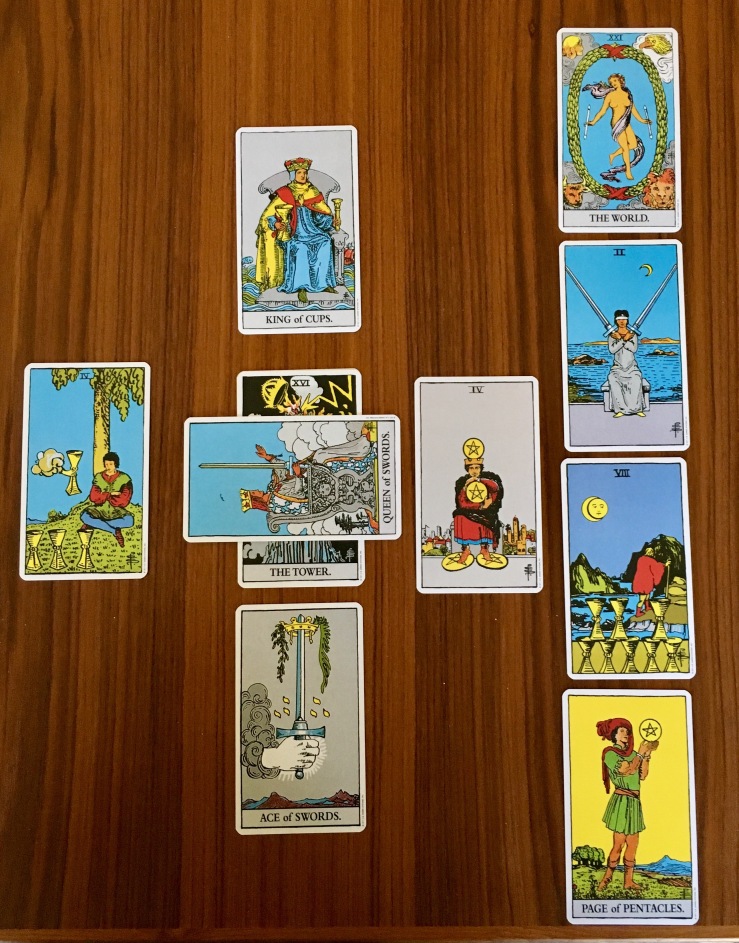
how the image is based on the Tarot card The Tower, which – as we learn in Weissmann’s Tarot (p. 746-47) – represents “any System which cannot tolerate heresy: a system which, by its nature, must sooner or later fall. We know by now that it is also the Rocket.”

mindless-pleasures

Here are Herman and Weisenburger on that first title, Mindless Pleasures:

…Pynchon’s, or perhaps the Viking editors’, extraction of that phrase [“mindless pleasures”] for the book title, although scotched, surely indexed some shared sense of thematic relevance. An early trial cover put the title “Mindless Pleasures” over a cleverly stylized version of the Tower, a key card in Weissmann/Blicero’s tarot reading. A second trial cover, also scotched, put “Gravity’s Rainbow” over the same image. The Tower gathers several interpretations, most notably (says our narrator) that of “a Gnostic or Cathar symbol for the Church of Rome, and this is generalized to mean any system which cannot tolerate heresy: a system which, by its nature, must sooner or later fall. We know by now that it is also the Rocket.” The notion of tolerance and intolerance is catchy and may also link to Marcuse on repression…. One reading of this cover would be that mindless pleasures bring down the system, are anathema to it. The common gloss of “mindless” is that it refers to the contrary of normativity, or not a mentality conditioned or “defined within rigid societal parameters”…. This contrariness presumes a hierarchy, an established order elevated above a variety of upstart alternatives, many of them popular, carnivalesque, of the body. And the arts are among them…

Weissmann’s tarot:

img_4289-1

Herman and Weisenburger cite Clifford Mead’s Thomas Pynchon: A Bibliography of Primary and Secondary Materials (Dalkey, 1989) as their source for the trial cover.

As far as I can find, no cover designer is credited.

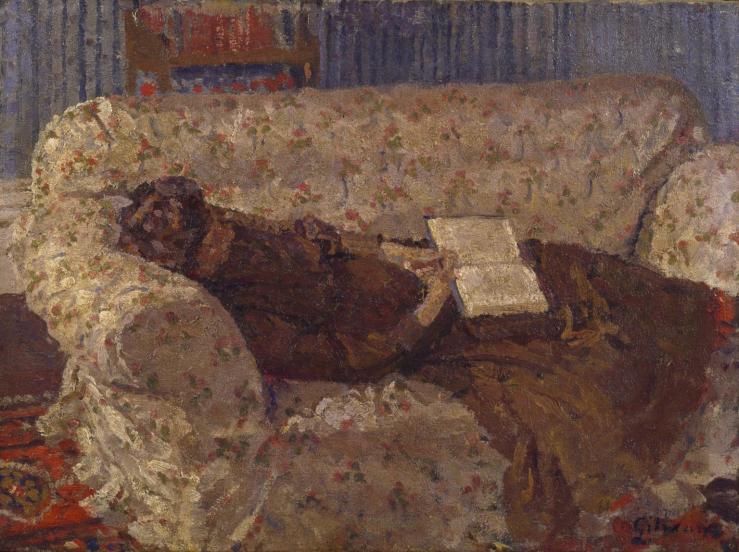
Lady on a Sofa — Harold Gilman

Lady on a Sofa c.1910 by Harold Gilman 1876-1919

Lady on a Sofa, c.1910 by Harold Gilman (1876–1919)

Casement to Infinity — Leon Underwood

Casement to Infinity 1930 by Leon Underwood 1890-1975

Casement to Infinity, 1930 by Leon Underwood 1890–1975

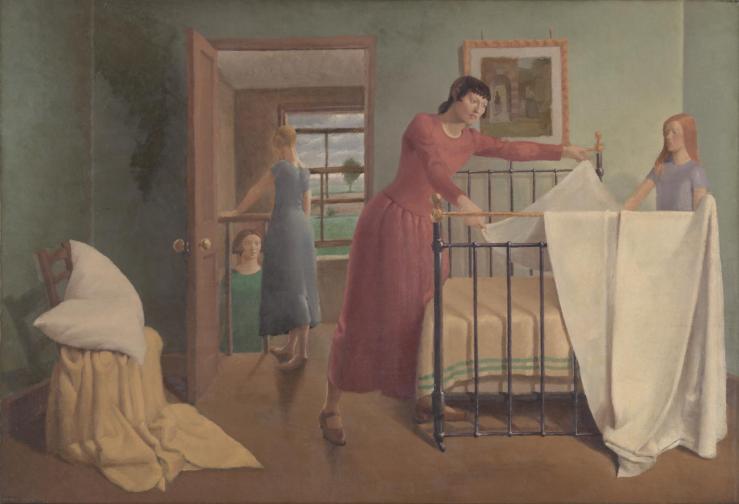
Any Morning — Margaret Barker

Any Morning exhibited 1929 by Margaret Barker 1907-2003

Any Morning, 1929 by Margaret Barker (1907–2003)

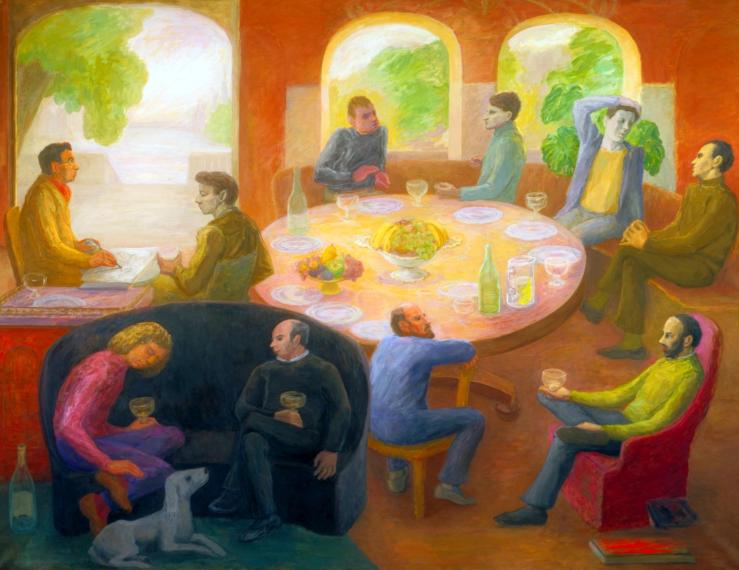
Symposium I — Helen Lessore

Symposium I 1974-77 by Helen Lessore 1907-1994

Symposium I, 1977 by Helen Lessore (1907–1994)

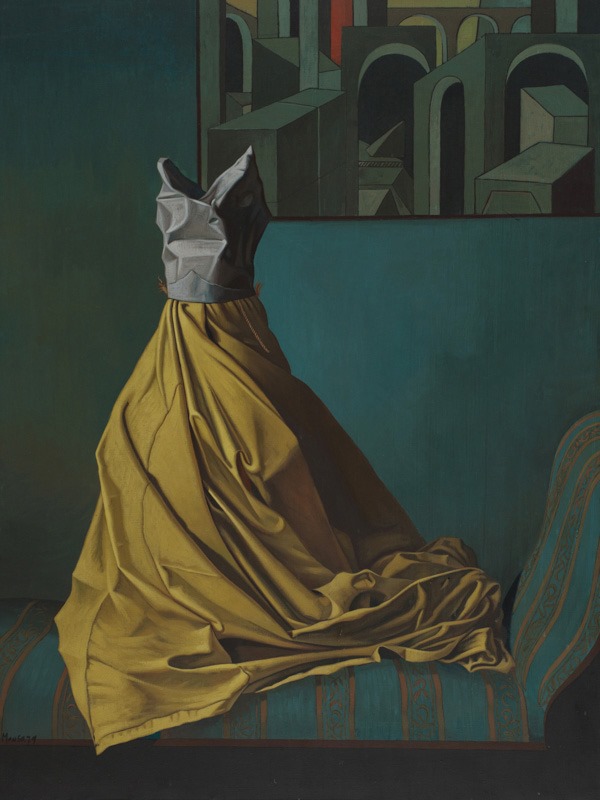
Tribute to De Chirico — Carlos Mensa

carlos mensa tribute

Tribute to De Chirico, 1974 by Carlos Mensa (1936-1982)

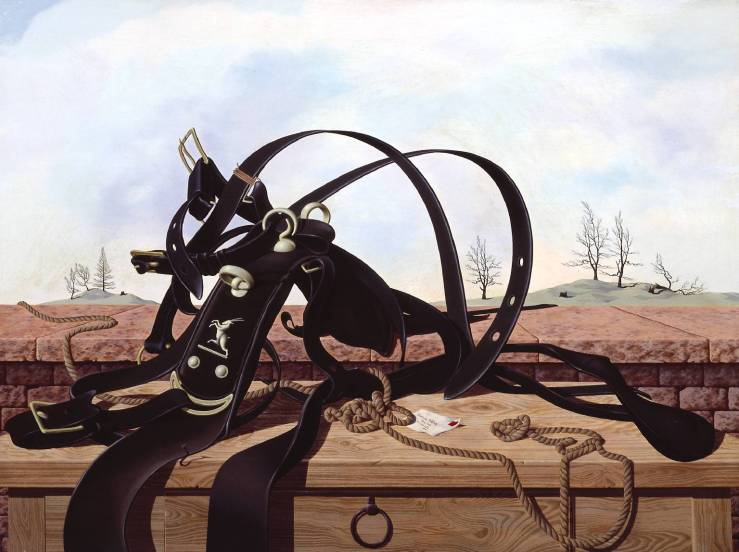
Harness — Tristram Hillier

Harness 1944 by Tristram Hillier 1905-1983

Harness, 1944 by Tristram Hillier (1905–1983)

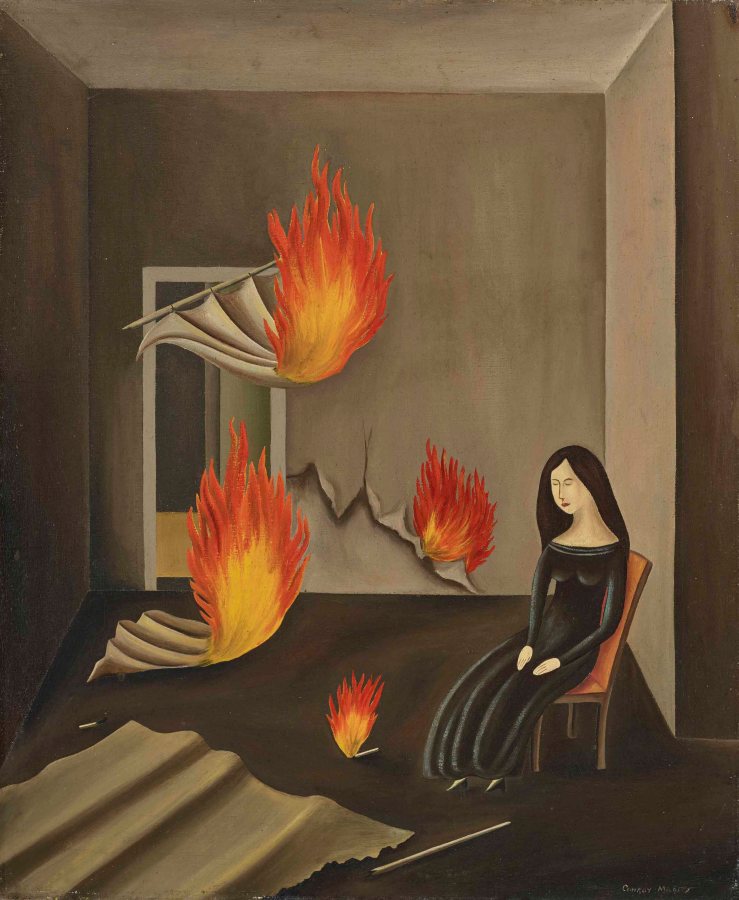
Poltergeist — Conroy Maddox

2018_par_16169_0103_000conroy_maddox_poltergeist

Poltergeist, 1940s by Conroy Maddox (1912-2005)

A kind of boot camp for military time travelers | Thomas Pynchon

The colonel’s face fills the screen, broken up sporadically, smeared, pixelated, blown through by winds of noise and forgetfulness, failing links, lost servers. Its voice was synthesized several generations back and never updated, lip movements don’t match the words, if they ever did. What it has to say is this.

“There is a terrible prison, most informants believe it’s located here in the U.S., though we also have Russian input comparing it unfavorably to the worst parts of the gulag. With classic Russian reluctance they will not name it. Wherever it is, brutal is too kind a description. They kill you but keep you alive. Mercy is unknown.

“It’s supposed to be a kind of boot camp for military time travelers. Time travel, as it turns out, is not for civilian tourists, you don’t just climb into a machine, you have to do it from inside out, with your mind and body, and navigating Time is an unforgiving discipline. It requires years of pain, hard labor, and loss, and there is no redemption—of, or from, anything.

“Given the lengthy schooling, the program prefers to recruit children by kidnapping them. Boys, typically. They are taken without consent and systematically rewired. Assigned to secret cadres to be sent on government missions back and forth in Time, under orders to create alternative histories which will benefit the higher levels of command who have sent them out.

“They need to be prepared for the extreme rigors of the job. They are starved, beaten, sodomized, operated on without anesthetic. They will never see their families or friends again. If by accident this should ever happen, during an assignment or simply as a contingency of the day, their standing orders are immediately to kill anyone who recognizes them.

“Standard strategies for deflecting public attention are considered to be in effect. Rapture by UFOs, disappearance into the correctional system, MKUltra-type programs have all proven useful as diversionary narratives.”

From Thomas Pynchon’s novel Bleeding Edge.

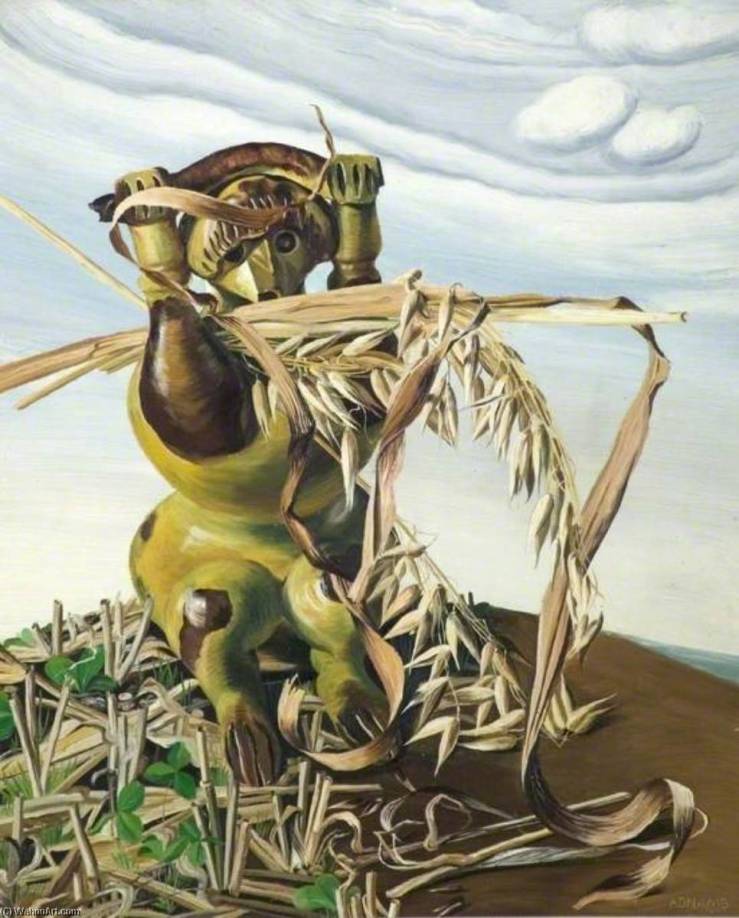
Monkey Harvest — Marion Adnams

marion-elizabeth-adnams-monkey-harvest

Monkey Harvest, 1945 by Marion Adnams (1898-1995)

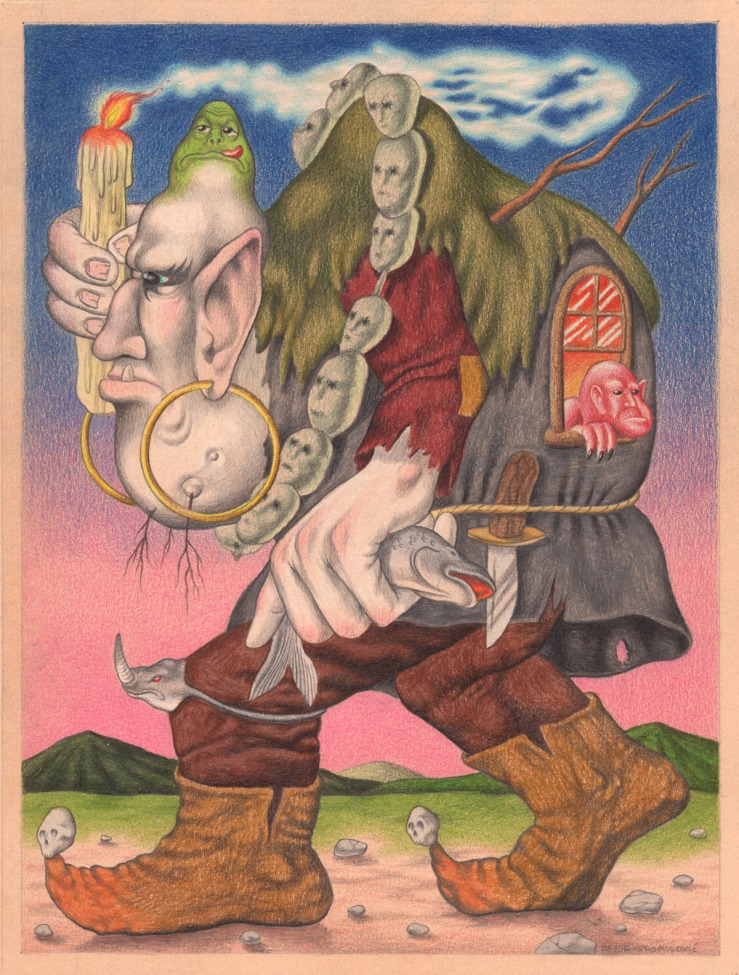
Fisher the Giant — Davor Gromilovic

5

Fisher the Giant, 2019 by Davor Gromilovic (b. 1985)