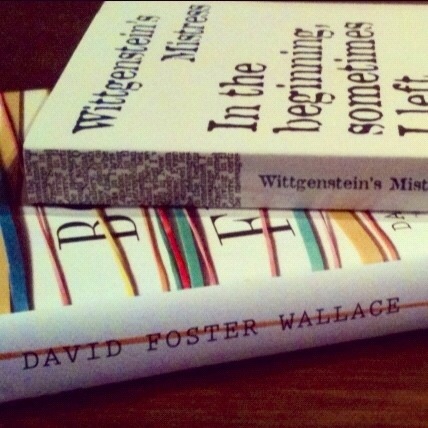
1. Like many David Foster Wallace fans, I’d already read many of the essays collected in the posthumous Both Flesh and Not. I hadn’t read “The Empty Plenum: David Markson’s Wittgenstein’s Mistress” though, originally published in a 1990 issue of The Review of Contemporary Fiction.
I suspect that the Markson essay hasn’t been collected up until now because it is so focused on Wittgenstein’s Mistress—this in contrast to, say “How Tracy Austin Broke My Heart” (Consider the Lobster) which is nominally about Austin’s autobiography but really about much bigger frying fish, like fan-idol relationships and ghostwriting and genre, or “Greatly Exaggerated,” which, again is nominally a review of Dix’s Morte d’Author: An Autopsy but is really more about postmodernism in general. I can’t recall exactly—maybe in his Charlie Rose interview—but Wallace said that he wanted the pieces in his books to be about more than just the ephemeral surface-level topic at hand; like most writers, he was contending for posterity. Wallace’s Markson essay is about Wittgenstein’s philosophy and the state of postmodern or experimental writing in the late 1980s and certain feminist analytic approaches to literature—but mostly it’s a detailed review of Markson’s novel—and it’s not trying to be anything more—which is actually really nice.
2. I read Wittgenstein’s Mistress on David Foster Wallace’s recommendation (I could add the modifier “like many David Foster Wallace fans” here again, I suspect). (That recommendation– “Five direly underappreciated U.S. novels >1960”—is also reprinted in Flesh (perhaps superfluously)). (While I’m getting all parenthetical: I read all five books Wallace recommended and all were excellent).
Here’s Wallace’s recommendation:
“W’s M” is a dramatic rendering of what it would be like to live in the sort of universe described by logical atomism. A monologue, formally very odd, mostly one-sentence 6s. Tied with “Omensetter’s Luck” for the all-time best U.S. book about human loneliness. These wouldnt constitute ringing endorsements if they didnt happen all to be simultaneously true — i.e., that a novel this abstract and erudite and avant-garde that could also be so moving makes “Wittgenstein’s Mistress” pretty much the high point of experimental fiction in this country.
—This is in some ways a condensation of his essay “The Empty Plenum,” where he writes:
Markson’s is not a pop book, and it’s not decocted philosophy or a docudrama-of-the-week. Rather, for me, the novel does artistic & emotional justice to the politico-ethical implications of Ludwig Wittgenstein’s abstract mathematical metaphysics , makes what is designed to be a mechanism pulse, breathe, suffer, live, etc. In so doing, it pays emotional tribute to a philosopher who by all evidence lived in a personal spiritual torment over the questions too many of his academic followers have made into elaborate empty exercises.
3. After Wittgenstein’s Mistress, Markson wrote four more novels, or anti-novels, if you like, sometimes called the note-card novels, novels “of intellectual reference and allusion, so to speak minus much of the novel,” as Novelist puts it in The Last Novel. I read these novels after WM: better-if-not-as-precise (in its metaphoricity) verb: I devoured them. Refinement isn’t exactly the right word, but Markson’s last four novels distill the elliptical and monotone style that he began in WM into a kind of word collage, a frieze of loops, motifs, ideas that the reader has the privilege/burden to construct meaning from. At the beginning of his essay on WM, Wallace posits that the novel is an “INTERPRET-ME” novel; the four novels after WM go beyond INTERPRET-ME—they ask the reader to construct-me, build-me, make-me. These late novels cast away the onus of a narrator; they jettison the already-jettisoned figure of Kate, narrator of Wittgenstein’s Mistress, the last person on earth. And perhaps because of all this, I’ve come to think that they are in many ways superior to WM (or at least showcase a clear evolution in Markson’s style)—that they more purely enact the canon-making, curatorial process that I take to be the core of Markson’s last five books.
4. Here’s Wallace on Markson’s curatorial curve:
The curator’s job—to recall, choose, arrange: to impose order & so communicate meaning—is marvelously synechdochic of the life of the solipsist, of the survival strategies apposite one’s existence as monad in a world of diffracted fact.
Except a big question is: whence facts, if the world is “empty”?
And then Wallace goes about answering this question w/r/t (am I borrowing too many Wallacian shortcuts here?) Wittgenstein’s philosophy. (And this I will not attempt to summarize here).
5. But I will quote Wallace again:
[Wittgenstein] never actually wrote anything about the exquisite tensions between atomism & attendant solipsism on the one hand & distinctively human values & qualities on the other. But, see, this is exactly what Mr. Markson does in WM; and in this way Markson’s novel succeeds in speaking where Wittgenstein is mute, weaving Kate’s obsession with responsibility (for the world’s emptiness) gorgeously into the character’s mandala of cerebral conundrum & spiritual poverty.
6. The greatest weaknesses of Wallace’s essay:
a). He doesn’t do a great job of explicating specifically how Wittgensteinian philosophy—or even themes—are alluded to by Markson in WM. (Or maybe I’m just a weak reader).
b). He gets bogged down in a long discussion of WM as a male-authored text featuring a female narrator w/r/t passivity vs. agency and object vs. subject and Helen vs. Eve (etc.) that I think is ultimately the kind of business far better sorted out in the novel itself.
7. The greatest strength of Wallace’s essay:
He made me want to reread Wittgenstein’s Mistress.








 Biblioklept