“The Star” — H.G. Wells

The Graphic 25/12/1897, Christmas Issue p.18
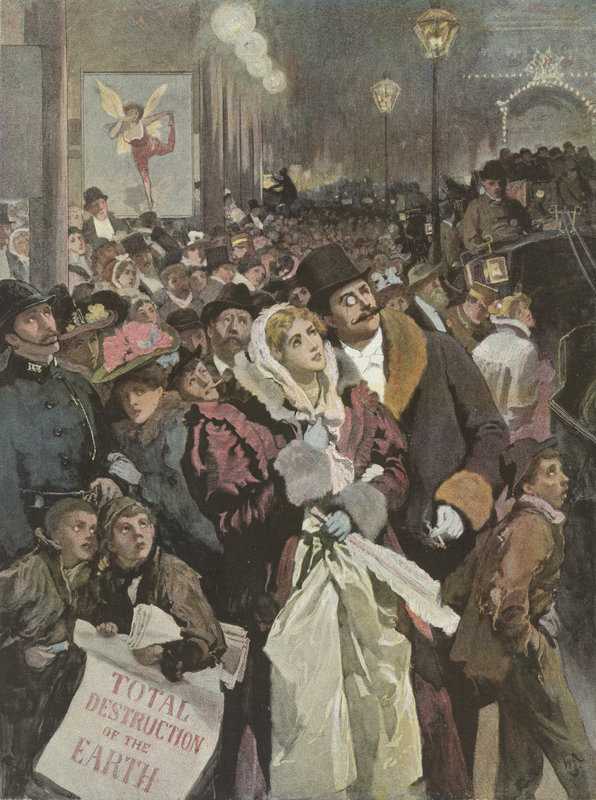
Illustration to Wells’s “The Star” by Ludek Marold

“The Star”

by

H.G. Wells


It was on the first day of the New Year that the announcement was made, almost simultaneously from three observatories, that the motion of the planet Neptune, the outermost of all the planets that wheel about the sun, had become very erratic. Ogilvy had already called attention to a suspected retardation in its velocity in December. Such a piece of news was scarcely calculated to interest a world the greater portion of whose inhabitants were unaware of the existence of the planet Neptune, nor outside the astronomical profession did the subsequent discovery of a faint remote speck of light in the region of the perturbed planet cause any very great excitement. Scientific people, however, found the intelligence remarkable enough, even before it became known that the new body was rapidly growing larger and brighter, that its motion was quite different from the orderly progress of the planets, and that the deflection of Neptune and its satellite was becoming now of an unprecedented kind.

Few people without a training in science can realise the huge isolation of the solar system. The sun with its specks of planets, its dust of planetoids, and its impalpable comets, swims in a vacant immensity that almost defeats the imagination. Beyond the orbit of Neptune there is space, vacant so far as human observation has penetrated, without warmth or light or sound, blank emptiness, for twenty million times a million miles. That is the smallest estimate of the distance to be traversed before the very nearest of the stars is attained. And, saving a few comets more unsubstantial than the thinnest flame, no matter had ever to human knowledge crossed this gulf of space, until early in the twentieth century this strange wanderer appeared. A vast mass of matter it was, bulky, heavy, rushing without warning out of the black mystery of the sky into the radiance of the sun. By the second day it was clearly visible to any decent instrument, as a speck with a barely sensible diameter, in the constellation Leo near Regulus. In a little while an opera glass could attain it.

On the third day of the new year the newspaper readers of two hemispheres were made aware for the first time of the real importance of this unusual apparition in the heavens. “A Planetary Collision,” one London paper headed the news, and proclaimed Duchaine’s opinion that this strange new planet would probably collide with Neptune. The leader writers enlarged upon the topic; so that in most of the capitals of the world, on January 3rd, there was an expectation, however vague of some imminent phenomenon in the sky; and as the night followed the sunset round the globe, thousands of men turned their eyes skyward to see–the old familiar stars just as they had always been. Continue reading ““The Star” — H.G. Wells”

“Staley Fleming’s Hallucination,” a very short story by Ambrose Bierce

“Staley Fleming’s Hallucination”

by

Ambrose Bierce


Of two men who were talking one was a physician.

“I sent for you, Doctor,” said the other, “but I don’t think you can do me any good.  May be you can recommend a specialist in psychopathy.  I fancy I’m a bit loony.”

“You look all right,” the physician said.

“You shall judge – I have hallucinations.  I wake every night and see in my room, intently watching me, a big black Newfoundland dog with a white forefoot.”

“You say you wake; are you sure about that?  ‘Hallucinations’ are sometimes only dreams.”

“Oh, I wake, all right.  Sometimes I lie still a long time, looking at the dog as earnestly as the dog looks at me – I always leave the light going.  When I can’t endure it any longer I sit up in bed – and nothing is there!”

“‘M, ‘m – what is the beast’s expression?”

“It seems to me sinister.  Of course I know that, except in art, an animal’s face in repose has always the same expression.  But this is not a real animal.  Newfoundland dogs are pretty mild looking, you know; what’s the matter with this one?”

“Really, my diagnosis would have no value: I am not going to treat the dog.”

The physician laughed at his own pleasantry, but narrowly watched his patient from the corner of his eye.  Presently he said: “Fleming, your description of the beast fits the dog of the late Atwell Barton.”

Fleming half-rose from his chair, sat again and made a visible attempt at indifference.  “I remember Barton,” he said; “I believe he was – it was reported that – wasn’t there something suspicious in his death?”

Looking squarely now into the eyes of his patient, the physician said: “Three years ago the body of your old enemy, Atwell Barton, was found in the woods near his house and yours.  He had been stabbed to death.  There have been no arrests; there was no clew.  Some of us had ‘theories.’  I had one.  Have you?”

“I?  Why, bless your soul, what could I know about it?  You remember that I left for Europe almost immediately afterward – a considerable time afterward.  In the few weeks since my return you could not expect me to construct a ‘theory.’  In fact, I have not given the matter a thought.  What about his dog?”

“It was first to find the body.  It died of starvation on his grave.”

We do not know the inexorable law underlying coincidences.  Staley Fleming did not, or he would perhaps not have sprung to his feet as the night wind brought in through the open window the long wailing howl of a distant dog.  He strode several times across the room in the steadfast gaze of the physician; then, abruptly confronting him, almost shouted: “What has all this to do with my trouble, Dr. Halderman?  You forget why you were sent for.”

Rising, the physician laid his hand upon his patient’s arm and said, gently: “Pardon me.  I cannot diagnose your disorder off-hand – to-morrow, perhaps.  Please go to bed, leaving your door unlocked; I will pass the night here with your books.  Can you call me without rising?”

“Yes, there is an electric bell.”

“Good.  If anything disturbs you push the button without sitting up.  Good night.”

Comfortably installed in an armchair the man of medicine stared into the glowing coals and thought deeply and long, but apparently to little purpose, for he frequently rose and opening a door leading to the staircase, listened intently; then resumed his seat.  Presently, however, he fell asleep, and when he woke it was past midnight.  He stirred the failing fire, lifted a book from the table at his side and looked at the title.  It was Denneker’s “Meditations.”  He opened it at random and began to read:

“Forasmuch as it is ordained of God that all flesh hath spirit and thereby taketh on spiritual powers, so, also, the spirit hath powers of the flesh, even when it is gone out of the flesh and liveth as a thing apart, as many a violence performed by wraith and lemure sheweth.  And there be who say that man is not single in this, but the beasts have the like evil inducement, and – ”

The reading was interrupted by a shaking of the house, as by the fall of a heavy object.  The reader flung down the book, rushed from the room and mounted the stairs to Fleming’s bed-chamber.  He tried the door, but contrary to his instructions it was locked.  He set his shoulder against it with such force that it gave way.  On the floor near the disordered bed, in his night clothes, lay Fleming gasping away his life.

The physician raised the dying man’s head from the floor and observed a wound in the throat.  “I should have thought of this,” he said, believing it suicide.

When the man was dead an examination disclosed the unmistakable marks of an animal’s fangs deeply sunken into the jugular vein.

But there was no animal.

“The Cone” — H.G. Wells

Plaza Italia (Great Game), Giorgio de Chirico

“The Cone”

by

H.G. Wells


The night was hot and overcast, the sky red, rimmed with the lingering sunset of mid-summer. They sat at the open window, trying to fancy the air was fresher there. The trees and shrubs of the garden stood stiff and dark; beyond in the roadway a gas-lamp burnt, bright orange against the hazy blue of the evening. Farther were the three lights of the railway signal against the lowering sky. The man and woman spoke to one another in low tones.

“He does not suspect?” said the man, a little nervously.

“Not he,” she said peevishly, as though that too irritated her. “He thinks of nothing but the works and the prices of fuel. He has no imagination, no poetry.”

“None of these men of iron have,” he said sententiously.
“They have no hearts.”

He has not,” she said. She turned her discontented face towards the window. The distant sound of a roaring and rushing drew nearer and grew in volume; the house quivered; one heard the metallic rattle of the tender. As the train passed, there was a glare of light above the cutting and a driving tumult of smoke; one, two, three, four, five, six, seven, eight black oblongs—eight trucks—passed across the dim grey of the embankment, and were suddenly extinguished one by one in the throat of the tunnel, which, with the last, seemed to swallow down train, smoke, and sound in one abrupt gulp. Continue reading ““The Cone” — H.G. Wells”

“The Sphinx” — Edgar Allan Poe

Capture
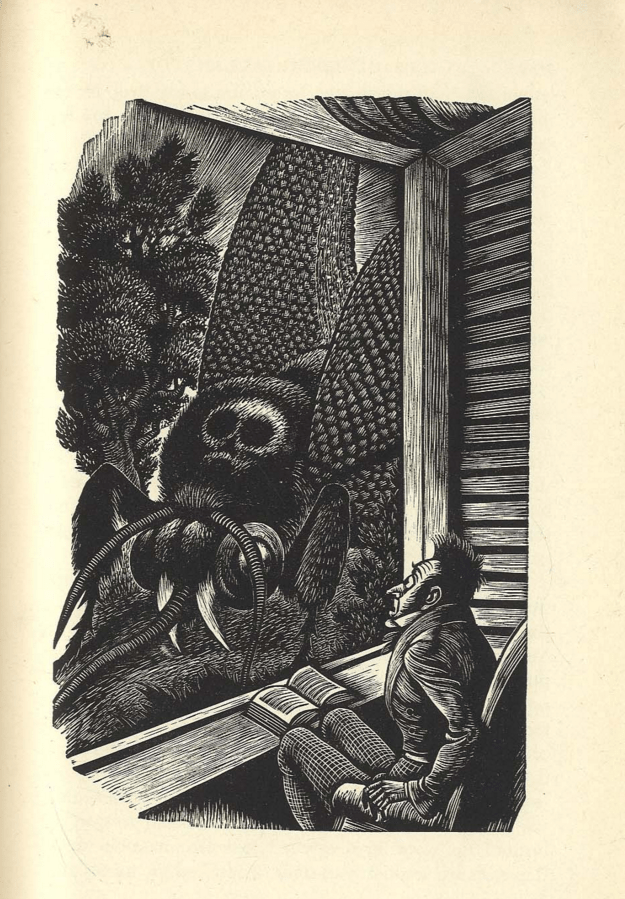
Illustration for Poe’s “The Sphinx,” Fritz Eichenberg

“The Sphinx”

by

Edgar Allan Poe


DURING the dread reign of the Cholera in New York, I had accepted the invitation of a relative to spend a fortnight with him in the retirement of his cottage ornee on the banks of the Hudson. We had here around us all the ordinary means of summer amusement; and what with rambling in the woods, sketching, boating, fishing, bathing, music, and books, we should have passed the time pleasantly enough, but for the fearful intelligence which reached us every morning from the populous city. Not a day elapsed which did not bring us news of the decease of some acquaintance. Then as the fatality increased, we learned to expect daily the loss of some friend. At length we trembled at the approach of every messenger. The very air from the South seemed to us redolent with death. That palsying thought, indeed, took entire possession of my soul. I could neither speak, think, nor dream of any thing else. My host was of a less excitable temperament, and, although greatly depressed in spirits, exerted himself to sustain my own. His richly philosophical intellect was not at any time affected by unrealities. To the substances of terror he was sufficiently alive, but of its shadows he had no apprehension.

His endeavors to arouse me from the condition of abnormal gloom into which I had fallen, were frustrated, in great measure, by certain volumes which I had found in his library. These were of a character to force into germination whatever seeds of hereditary superstition lay latent in my bosom. I had been reading these books without his knowledge, and thus he was often at a loss to account for the forcible impressions which had been made upon my fancy.

A favorite topic with me was the popular belief in omens—a belief which, at this one epoch of my life, I was almost seriously disposed to defend. On this subject we had long and animated discussions—he maintaining the utter groundlessness of faith in such matters,—I contending that a popular sentiment arising with absolute spontaneity- that is to say, without apparent traces of suggestion—had in itself the unmistakable elements of truth, and was entitled to as much respect as that intuition which is the idiosyncrasy of the individual man of genius.

The fact is, that soon after my arrival at the cottage there had occurred to myself an incident so entirely inexplicable, and which had in it so much of the portentous character, that I might well have been excused for regarding it as an omen. It appalled, and at the same time so confounded and bewildered me, that many days elapsed before I could make up my mind to communicate the circumstances to my friend. Continue reading ““The Sphinx” — Edgar Allan Poe”

“The Flowering of the Strange Orchid” — H.G. Wells

t_morino_monster_10
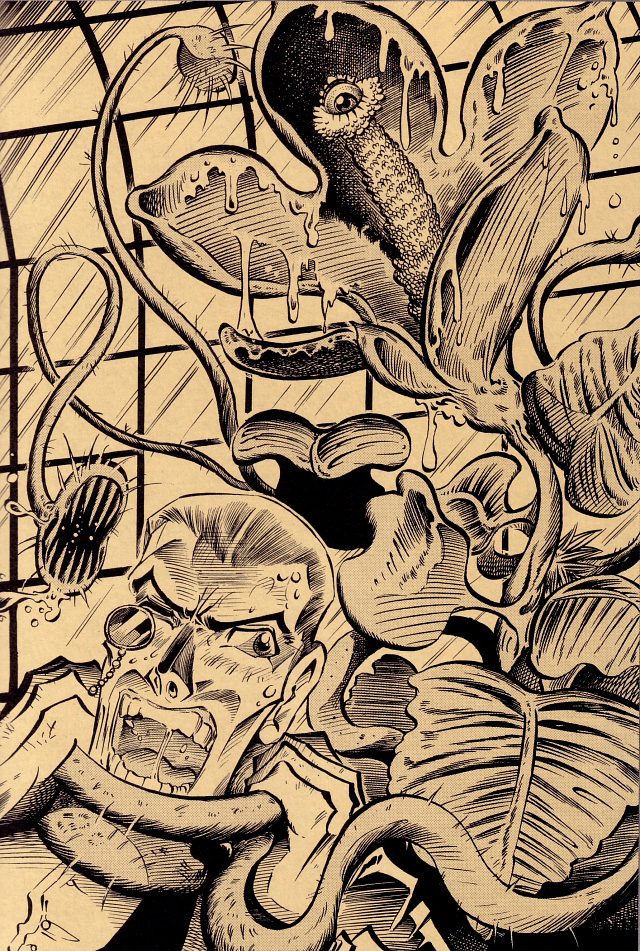
Illustration for “The Flowering of the Strange Orchid,” Tatsuya Morino

“The Flowering of the Strange Orchid”

by

H.G. Wells

The buying of orchids always has in it a certain speculative flavour. You have before you the brown shrivelled lump of tissue, and for the rest you must trust your judgment, or the auctioneer, or your good-luck, as your taste may incline. The plant may be moribund or dead, or it may be just a respectable purchase, fair value for your money, or perhaps – for the thing has happened again and again – there slowly unfolds before the delighted eyes of the happy purchaser, day after day, some new variety, some novel richness, a strange twist of the labellum, or some subtler coloration or unexpected mimicry.

Pride, beauty, and profit blossom together on one delicate green spike, and it may be, even immortality. For the new miracle of Nature may stand in need of a new specific name, and what so convenient as that of its discoverer? “Johnsmithia!” There have been worse names.

It was perhaps the hope of some such happy discovery that made Winter-Wedderburn such a frequent attendant at these sales – that hope, and also, maybe, the fact that he had nothing else of the slightest interest to do in the world. He was a shy, lonely, rather ineffectual man, provided with just enough income to keep off the spur of necessity, and not enough nervous energy to make him seek any exacting employments. He might have collected stamps or coins, or translated Horace, or bound books, or invented new species of diatoms. But, as it happened, he grew orchids, and had one ambitious little hothouse. Continue reading ““The Flowering of the Strange Orchid” — H.G. Wells”

“The House of the Sphinx” — Lord Dunsany

Sidney_Sime-The_House_of_the_Sphinx-sm
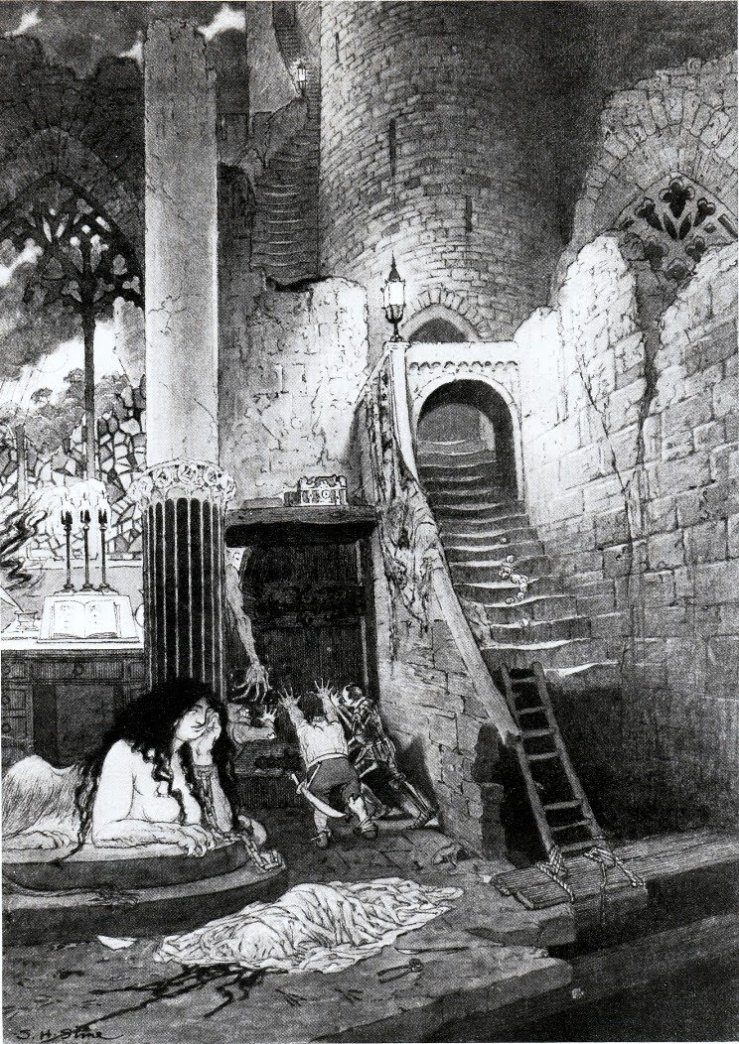
“The House of the Sphinx” illustration by Sidney Sime

“The House of the Sphinx”

by

Lord Dunsany


When I came to the House of the Sphinx it was already dark. They made me eagerly welcome. And I, in spite of the deed, was glad of any shelter from that ominous wood. I saw at once that there had been a deed, although a cloak did all that a cloak may do to conceal it. The mere uneasiness of the welcome made me suspect that cloak.

The Sphinx was moody and silent. I had not come to pry into the secrets of Eternity nor to investigate the Sphinx’s private life, and so had little to say and few questions to ask; but to whatever I did say she remained morosely indifferent. It was clear that either she suspected me of being in search of the secrets of one of her gods, or of being boldly inquisitive about her traffic with Time, or else she was darkly absorbed with brooding upon the deed.

I saw soon enough that there was another than me to welcome; I saw it from the hurried way that they glanced from the door to the deed and back to the door again. And it was clear that the welcome was to be a bolted door. But such bolts, and such a door! Rust and decay and fungus had been there far too long, and it was not a barrier any longer that would keep out even a determined wolf. And it seemed to be something worse than a wolf that they feared.

A little later on I gathered from what they said that some imperious and ghastly thing was looking for the Sphinx, and that something that had happened had made its arrival certain. It appeared that they had slapped the Sphinx to vex her out of her apathy in order that she should pray to one of her gods, whom she had littered in the house of Time; but her moody silence was invincible, and her apathy Oriental, ever since the deed had happened. And when they found that they could not make her pray, there was nothing for them to do but to pay little useless attentions to the rusty lock of the door, and to look at the deed and wonder, and even pretend to hope, and to say that after all it might not bring that destined thing from the forest, which no one named.

It may be said I had chosen a gruesome house, but not if I had described the forest from which I came, and I was in need of any spot wherein I could rest my mind from the thought of it.

I wondered very much what thing would come from the forest on account of the deed; and having seen that forest—as you, gentle reader, have not—I had the advantage of knowing that anything might come. It was useless to ask the Sphinx—she seldom reveals things, like her paramour Time (the gods take after her), and while this mood was on her, rebuff was certain. So I quietly began to oil the lock of the door. And as soon as they saw this simple act I won their confidence. It was not that my work was of any use—it should have been done long before; but they saw that my interest was given for the moment to the thing that they thought vital. They clustered round me then. They asked me what I thought of the door, and whether I had seen better, and whether I had seen worse; and I told them about all the doors I knew, and said that the doors of the baptistry in Florence were better doors, and the doors made by a certain firm of builders in London were worse. And then I asked them what it was that was coming after the Sphinx because of the deed. And at first they would not say, and I stopped oiling the door; and then they said that it was the arch-inquisitor of the forest, who is investigator and avenger of all silverstrian things; and from all that they said about him it seemed to me that this person was quite white, and was a kind of madness that would settle down quite blankly upon a place, a kind of mist in which reason could not live; and it was the fear of this that made them fumble nervously at the lock of that rotten door; but with the Sphinx it was not so much fear as sheer prophecy.

The hope that they tried to hope was well enough in its way, but I did not share it; it was clear that the thing that they feared was the corollary of the deed—one saw that more by the resignation upon the face of the Sphinx than by their sorry anxiety for the door.

The wind soughed, and the great tapers flared, and their obvious fear and the silence of the Sphinx grew more than ever a part of the atmosphere, and bats went restlessly through the gloom of the wind that beat the tapers low.

Then a few things screamed far off, then a little nearer, and something was coming towards us, laughing hideously. I hastily gave a prod to the door that they guarded; my finger sank right into the mouldering wood—there was not a chance of holding it. I had not leisure to observe their fright; I thought of the back-door, for the forest was better than this; only the Sphinx was absolutely calm, her prophecy was made and she seemed to have seen her doom, so that no new thing could perturb her.

But by mouldering rungs of ladders as old as Man, by slippery edges of the dreaded abyss, with an ominous dizziness about my heart and a feeling of horror in the soles of my feet, I clambered from tower to tower till I found the door that I sought; and it opened on to one of the upper branches of a huge and sombre pine, down which I climbed on to the floor of the forest. And I was glad to be back again in the forest from which I had fled.

And the Sphinx in her menaced house—I know not how she fared—whether she gazes for ever, disconsolate, at the deed, remembering only in her smitten mind, at which the little boys now leer, that she once knew well those things at which man stands aghast; or whether in the end she crept away, and clambering horribly from abyss to abyss, came at last to higher things, and is wise and eternal still. For who knows of madness whether it is divine or whether it be of the pit?

“Berenice” — Edgar Allan Poe

berenice
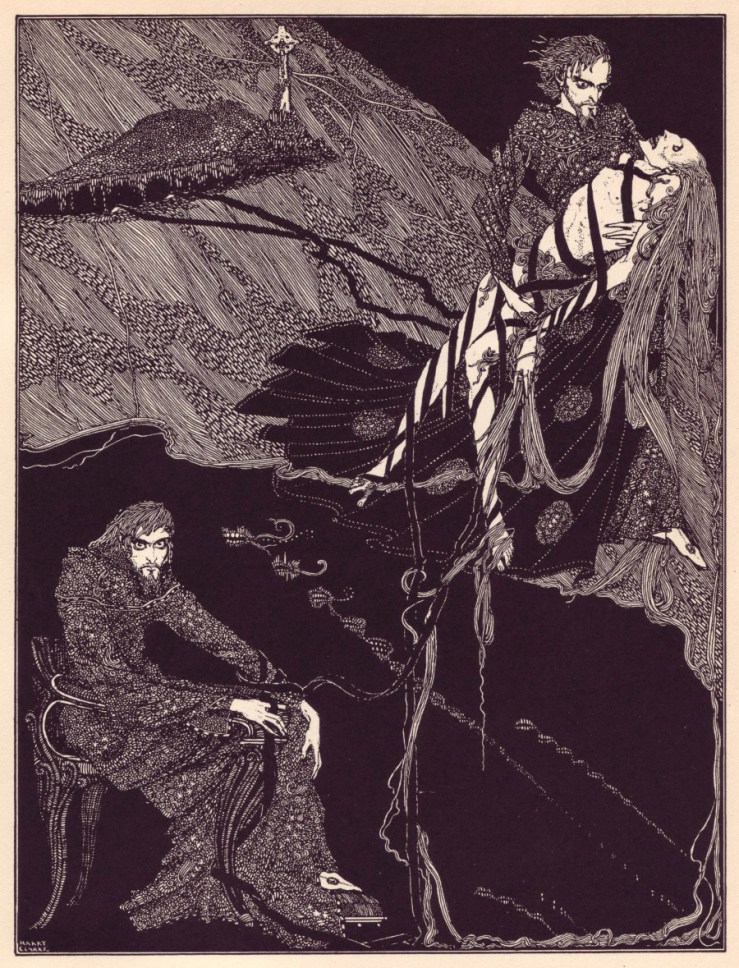
“It was a fearful page in the record of my existence” –Harry Clarke’s illustration for Edgar Allan Poe’s “Berenice”

“Berenice”

by

Edgar Allan Poe


Dicebant mihi sodales, si sepulchrum amicae visitarem, curas meas aliquantulum forelevatas. —Ebn Zaiat.

MISERY is manifold. The wretchedness of earth is multiform. Overreaching the wide horizon as the rainbow, its hues are as various as the hues of that arch—as distinct too, yet as intimately blended. Overreaching the wide horizon as the rainbow! How is it that from beauty I have derived a type of unloveliness?—from the covenant of peace, a simile of sorrow? But as, in ethics, evil is a consequence of good, so, in fact, out of joy is sorrow born. Either the memory of past bliss is the anguish of to-day, or the agonies whichare, have their origin in the ecstasies which might have been.

My baptismal name is Egaeus; that of my family I will not mention. Yet there are no towers in the land more time-honored than my gloomy, gray, hereditary halls. Our line has been called a race of visionaries; and in many striking particulars—in the character of the family mansion—in the frescos of the chief saloon—in the tapestries of the dormitories—in the chiselling of some buttresses in the armory—but more especially in the gallery of antique paintings—in the fashion of the library chamber—and, lastly, in the very peculiar nature of the library’s contents—there is more than sufficient evidence to warrant the belief.

The recollections of my earliest years are connected with that chamber, and with its volumes—of which latter I will say no more. Here died my mother. Herein was I born. But it is mere idleness to say that I had not lived before—that the soul has no previous existence. You deny it?—let us not argue the matter. Convinced myself, I seek not to convince. There is, however, a remembrance of aerial forms—of spiritual and meaning eyes—of sounds, musical yet sad—a remembrance which will not be excluded; a memory like a shadow—vague, variable, indefinite, unsteady; and like a shadow, too, in the impossibility of my getting rid of it while the sunlight of my reason shall exist.

In that chamber was I born. Thus awaking from the long night of what seemed, but was not, nonentity, at once into the very regions of fairy land—into a palace of imagination—into the wild dominions of monastic thought and erudition—it is not singular that I gazed around me with a startled and ardent eye—that I loitered away my boyhood in books, and dissipated my youth in reverie; but it is singular that as years rolled away, and the noon of manhood found me still in the mansion of my fathers—it is wonderful what stagnation there fell upon the springs of my life—wonderful how total an inversion took place in the character of my commonest thought. The realities of the world affected me as visions, and as visions only, while the wild ideas of the land of dreams became, in turn, not the material of my every-day existence, but in very deed that existence utterly and solely in itself.


Berenice and I were cousins, and we grew up together in my paternal halls. Yet differently we grew—I, ill of health, and buried in gloom—she, agile, graceful, and overflowing with energy; hers, the ramble on the hill-side—mine the studies of the cloister; I, living within my own heart, and addicted, body and soul, to the most intense and painful meditation—she, roaming carelessly through life, with no thought of the shadows in her path, or the silent flight of the raven-winged hours. Berenice!—I call upon her name—Berenice!—and from the gray ruins of memory a thousand tumultuous recollections are startled at the sound! Ah, vividly is her image before me now, as in the early days of her light-heartedness and joy! Oh, gorgeous yet fantastic beauty! Oh, sylph amid the shrubberies of Arnheim! Oh, Naiad among its fountains! And then—then all is mystery and terror, and a tale which should not be told. Disease—a fatal disease, fell like the simoon upon her frame; and, even while I gazed upon her, the spirit of change swept over her, pervading her mind, her habits, and her character, and, in a manner the most subtle and terrible, disturbing even the identity of her person! Alas! the destroyer came and went!—and the victim—where is she? I knew her not—or knew her no longer as Berenice. Continue reading ““Berenice” — Edgar Allan Poe”

“The Adventure of the Three Robbers” by Apuleius

“The Adventure of the Three Robbers” by Apuleius

An episode from The Golden Ass, reproduced here from The Lock and Key Library’s Classic Detective and Mystery Stories of All Nations series, edited by Julian Hawthorne. The translator is likely Frederick Taber Cooper.


As Telephron reached the point of his story, his fellow revelers, befuddled with their wine, renewed the boisterous uproar. And while the old topers were clamoring for the customary libation to laughter, Byrrhæna explained to me that the morrow was a day religiously observed by her city from its cradle up; a day on which they alone among mortals propitiated that most sacred god, Laughter, with hilarious and joyful rites. “The fact that you are here,” she added, “will make it all the merrier. And I do wish that you would contribute something amusing out of your own cleverness, in honor of the god, to help us duly worship such an important divinity.”

“Surely,” said I, “what you ask shall be done. And, by Jove! I hope I shall hit upon something good enough to make this mighty god of yours reveal his presence.”

Hereupon, my slave reminding me what hour of night it was, I speedily got upon my feet, although none too steadily after my potations, and, having duly taken leave of Byrrhæna, guided my zigzag steps upon the homeward way. But at the very first corner we turned, a sudden gust of wind blew out the solitary torch on which we depended, and left us, plunged in the unforeseen blackness of night, to stumble wearily and painfully to our abode, bruising our feet on every stone in the road. Continue reading ““The Adventure of the Three Robbers” by Apuleius”

“A Telephone Call” — Dorothy Parker

“A Telephone Call”

by

Dorothy Parker


Please, God, let him telephone me now. Dear God, let him call me now. I won’t ask anything else of You, truly I won’t. It isn’t very much to ask. It would be so little to You, God, such a little, little thing. Only let him telephone now. Please, God. Please, please, please.

If I didn’t think about it, maybe the telephone might ring. Sometimes it does that. If I could think of something else. If I could think of something else. Knobby if I counted five hundred by fives, it might ring by that time. I’ll count slowly. I won’t cheat. And if it rings when I get to three hundred, I won’t stop; I won’t answer it until I get to five hundred. Five, ten, fifteen, twenty, twenty-five, thirty, thirty-five, forty, forty-five, fifty…. Oh, please ring. Please.

This is the last time I’ll look at the clock. I will not look at it again. It’s ten minutes past seven. He said he would telephone at five o’clock. “I’ll call you at five, darling.” I think that’s where he said “darling.” I’m almost sure he said it there. I know he called me “darling” twice, and the other time was when he said good-by. “Good-by, darling.” He was busy, and he can’t say much in the office, but he called me “darling” twice. He couldn’t have minded my calling him up. I know you shouldn’t keep telephoning them–I know they don’t like that. When you do that they know you are thinking about them and wanting them, and that makes them hate you. But I hadn’t talked to him in three days-not in three days. And all I did was ask him how he was; it was just the way anybody might have called him up. He couldn’t have minded that. He couldn’t have thought I was bothering him. “No, of course you’re not,” he said. And he said he’d telephone me. He didn’t have to say that. I didn’t ask him to, truly I didn’t. I’m sure I didn’t. I don’t think he would say he’d telephone me, and then just never do it. Please don’t let him do that, God. Please don’t.
Continue reading ““A Telephone Call” — Dorothy Parker”

Read Herman Melville’s story “The Fiddler”

“The Fiddler”

by

Herman Melville


So my poem is damned, and immortal fame is not for me! I am nobody forever and ever. Intolerable fate!

Snatching my hat, I dashed down the criticism, and rushed out into Broadway, where enthusiastic throngs were crowding to a circus in a side-street near by, very recently started, and famous for a capital clown.

Presently my old friend Standard rather boisterously accosted me.

“Well met, Helmstone, my boy! Ah! what’s the matter? Haven’t been committing murder? Ain’t flying justice? You look wild!”

“You have seen it then?” said I, of course referring to the criticism.

“Oh yes; I was there at the morning performance. Great clown, I assure you. But here comes Hautboy. Hautboy—Helmstone.”

Without having time or inclination to resent so mortifying a mistake, I was instantly soothed as I gazed on the face of the new acquaintance so unceremoniously introduced. His person was short and full, with a juvenile, animated cast to it. His complexion rurally ruddy; his eye sincere, cheery, and gray. His hair alone betrayed that he was not an overgrown boy. From his hair I set him down as forty or more.

“Come, Standard,” he gleefully cried to my friend, “are you not going to the circus? The clown is inimitable, they say. Come; Mr. Helmstone, too—come both; and circus over, we’ll take a nice stew and punch at Taylor’s.”

The sterling content, good humor, and extraordinary ruddy, sincere expression of this most singular new acquaintance acted upon me like magic. It seemed mere loyalty to human nature to accept an invitation from so unmistakably kind and honest a heart.

During the circus performance I kept my eye more on Hautboy than on the celebrated clown. Hautboy was the sight for me. Such genuine enjoyment as his struck me to the soul with a sense of the reality of the thing called happiness. The jokes of the clown he seemed to roll under his tongue as ripe magnum bonums. Now the foot, now the hand, was employed to attest his grateful applause. At any hit more than ordinary, he turned upon Standard and me to see if his rare pleasure was shared. In a man of forty I saw a boy of twelve; and this too without the slightest abatement of my respect. Because all was so honest and natural, every expression and attitude so graceful with genuine good-nature, that the marvelous juvenility of Hautboy assumed a sort of divine and immortal air, like that of some forever youthful god of Greece. Continue reading “Read Herman Melville’s story “The Fiddler””

“The Egg,” a short story by Sherwood Anderson

“The Egg”

by

Sherwood Anderson


My father was, I am sure, intended by nature to be a cheerful, kindly man. Until he was thirty-four years old he worked as a farmhand for a man named Thomas Butterworth whose place lay near the town of Bidwell, Ohio. He had then a horse of his own and on Saturday evenings drove into town to spend a few hours in social intercourse with other farmhands. In town he drank several glasses of beer and stood about in Ben Head’s saloon–crowded on Saturday evenings with visiting farmhands. Songs were sung and glasses thumped on the bar. At ten o’clock father drove home along a lonely country road, made his horse comfortable for the night and himself went to bed, quite happy in his position in life. He had at that time no notion of trying to rise in the world.

It was in the spring of his thirty-fifth year that father married my mother, then a country schoolteacher, and in the following spring I came wriggling and crying into the world. Something happened to the two people. They became ambitious. The American passion for getting up in the world took possession of them.

It may have been that mother was responsible. Being a schoolteacher she had no doubt read books and magazines. She had, I presume, read of how Garfield, Lincoln, and other Americans rose from poverty to fame and greatness and as I lay beside her–in the days of her lying-in–she may have dreamed that I would someday rule men and cities. At any rate she induced father to give up his place as a farmhand, sell his horse and embark on an independent enterprise of his own. She was a tall silent woman with a long nose and troubled grey eyes. For herself she wanted nothing. For father and myself she was incurably ambitious.

The first venture into which the two people went turned out badly. They rented ten acres of poor stony land on Griggs’s Road, eight miles from Bidwell, and launched into chicken raising. I grew into boyhood on the place and got my first impressions of life there. From the beginning they were impressions of disaster and if, in my turn, I am a gloomy man inclined to see the darker side of life, I attribute it to the fact that what should have been for me the happy joyous days of childhood were spent on a chicken farm. Continue reading ““The Egg,” a short story by Sherwood Anderson”

Watch a 1977 PBS adaptation of Flannery O’Connor’s story “The Displaced Person” (featuring a young Samuel L. Jackson)

https://www.youtube.com/watch?v=e3I9o6OwDNI