The Minotaur — Remedios Varo

Look at Borges (Pynchon’s Gravity’s Rainbow)

In the days of the gauchos, my country was a blank piece of paper. The pampas stretched as far as men could imagine, inexhaustible, fenceless. Wherever the gaucho could ride, that place belonged to him. But Buenos Aires sought hegemony over the provinces. All the neuroses about property gathered strength, and began to infect the countryside. Fences went up, and the gaucho became less free. It is our national tragedy. We are obsessed with building labyrinths, where before there was open plain and sky. To draw ever more complex patterns on the blank sheet. We cannot abide that openness: it is terror to us. Look at Borges. Look at the suburbs of Buenos Aires. The tyrant Rosas has been dead a century, but his cult flourishes. Beneath the city streets, the warrens of rooms and corridors, the fences and the networks of steel track, the Argentine heart, in its perversity and guilt, longs for a return to that first unscribbled serenity… that anarchic oneness of pampas and sky…

From Thomas Pynchon’s novel Gravity’s Rainbow.

Osprey — John James Audubon

Katkelma — Helene Schjerfbeck

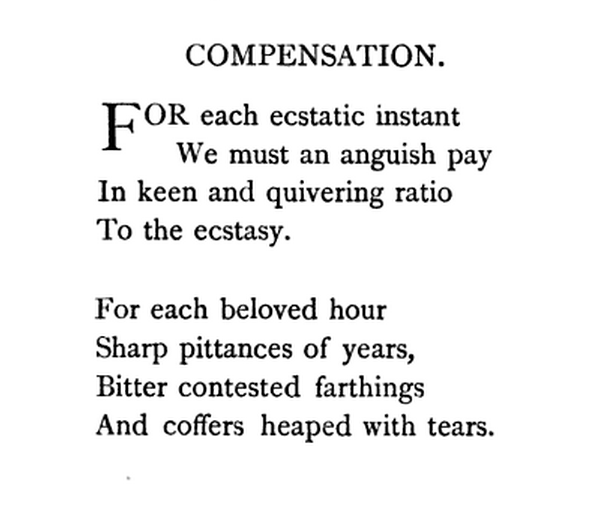
“For each ecstatic instant” — Emily Dickinson

anguish

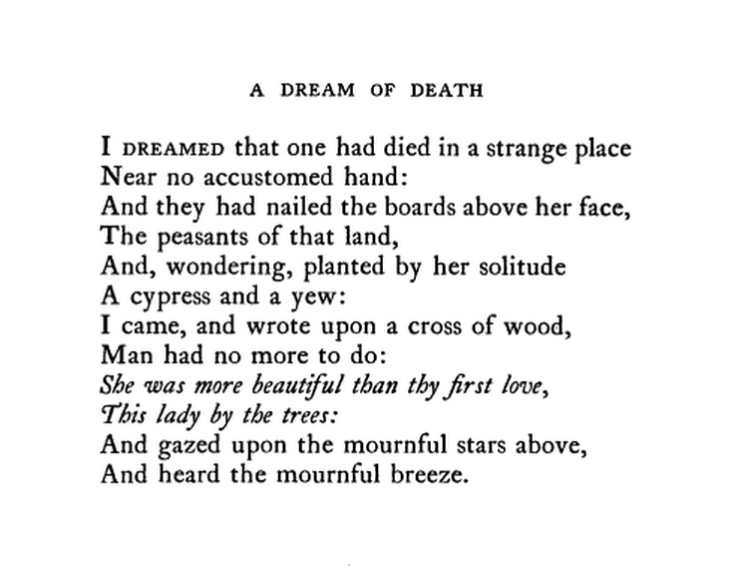
“A Dream of Death” — W.B. Yeats

Capture

Green Bathtub — Elmer Bischoff

Mirror Scene, Blood of a Poet (Jean Cocteau)

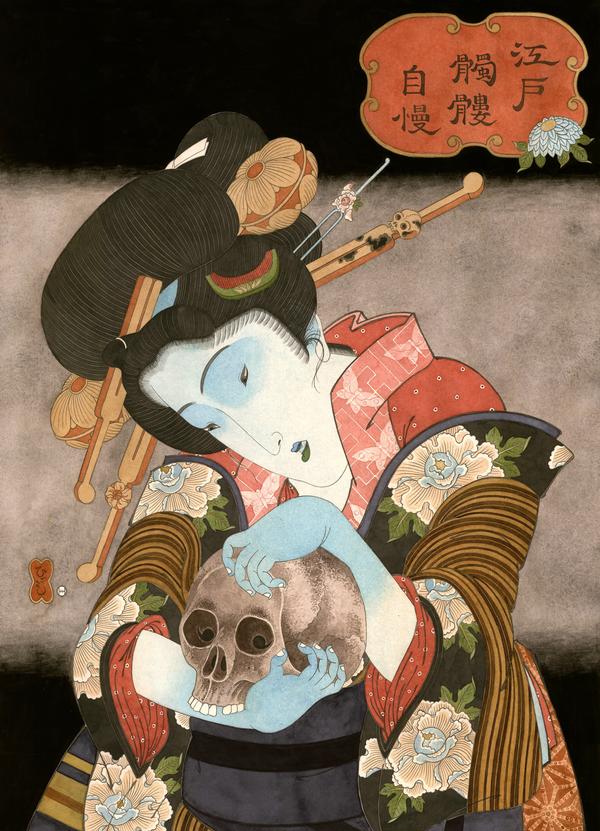
Woman with Skull — Hiroshi Hirakawa

tumblr_lski17J1Wh1qbcporo1_1280

A List of Irish Heroes from James Joyce’s Ulysses

One of my favorite passages in Ulysses (it’s from the “Cyclops” chapter, episode 12)—

He wore a long unsleeved garment of recently flayed oxhide reaching to the knees in a loose kilt and this was bound about his middle by a girdle of plaited straw and rushes. Beneath this he wore trews of deerskin, roughly stitched with gut. His nether extremities were encased in high Balbriggan buskins dyed in lichen purple, the feet being shod with brogues of salted cowhide laced with the windpipe of the same beast. From his girdle hung a row of seastones which dangled at every movement of his portentous frame and on these were graven with rude yet striking art the tribal images of many Irish heroes and heroines of antiquity, Cuchulin, Conn of hundred battles, Niall of nine hostages, Brian of Kincora, the Ardri Malachi, Art MacMurragh, Shane O’Neill, Father John Murphy, Owen Roe, Patrick Sarsfield, Red Hugh O’Donnell, Red Jim MacDermott, Soggarth Eoghan O’Growney, Michael Dwyer, Francy Higgins, Henry Joy M’Cracken, Goliath, Horace Wheatley, Thomas Conneff, Peg Woffington, the Village Blacksmith, Captain Moonlight, Captain Boycott, Dante Alighieri, Christopher Columbus, S. Fursa, S. Brendan, Marshal Mac-Mahon, Charlemagne, Theobald Wolfe Tone, the Mother of the Maccabees, the Last of the Mohicans, the Rose of Castille, the Man for Galway, The Man that Broke the Bank at Monte Carlo, The Man in the Gap, The Woman Who Didn’t, Benjamin Franklin, Napoleon Bonaparte, John L. Sullivan, Cleopatra, Savourneen Deelish, Julius Caesar, Paracelsus, sir Thomas Lipton, William Tell, Michelangelo, Hayes, Muhammad, the Bride of Lammermoor, Peter the Hermit, Peter the Packer, Dark Rosaleen, Patrick W. Shakespeare, Brian Confucius, Murtagh Gutenberg, Patricio Velasquez, Captain Nemo, Tristan and Isolde, the first Prince of Wales, Thomas Cook and Son, the Bold Soldier Boy, Arrah na Pogue, Dick Turpin, Ludwig Beethoven, the Colleen Bawn, Waddler Healy, Angus the Culdee, Dolly Mount, Sidney Parade, Ben Howth, Valentine Greatrakes, Adam and Eve, Arthur Wellesley, Boss Croker, Herodotus, Jack the Giantkiller, Gautama Buddha, Lady Godiva, The Lily of Killarney, Balor of the Evil Eye, the Queen of Sheba, Acky Nagle, Joe Nagle, Alessandro Volta, Jeremiah O’Donovan Rossa, Don Philip O’Sullivan Beare. A couched spear of acuminated granite rested by him while at his feet reposed a savage animal of the canine tribe whose stertorous gasps announced that he was sunk in uneasy slumber, a supposition confirmed by hoarse growls and spasmodic movements which his master repressed from time to time by tranquillising blows of a mighty cudgel rudely fashioned out of paleolithic stone.


Weaver — Vincent van Gogh

Speaking of dancers (Kafka)

The necessity of speaking of dancers with exclamation marks. Because in that way one imitates their motion, because one remains in the rhythm and the thought does not then interfere with the enjoyment, because then the action always comes at the end of the sentence and prolongs its effect better.

From Franz Kafka’s diary entry, 16 March 1912.

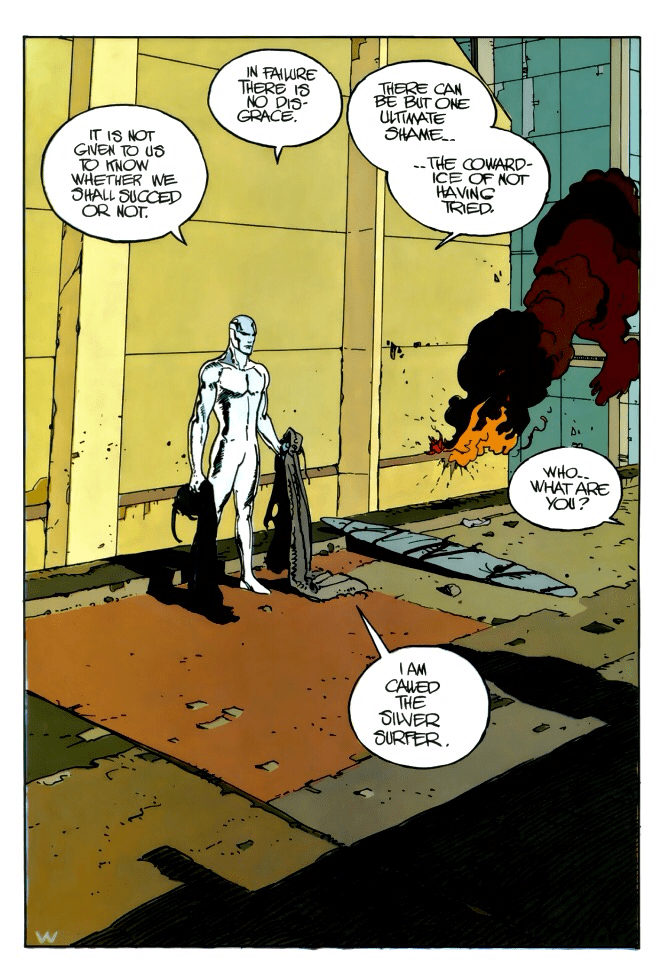
Silver Surfer — Moebius 


“Marriage à la Mode” — Katherine Mansfield

“Marriage à la Mode”

by

Katherine Mansfield

On his way to the station William remembered with a fresh pang of disappointment that he was taking nothing down to the kiddies. Poor little chaps! It was hard lines on them. Their first words always were as they ran to greet him, “What have you got for me, daddy?” and he had nothing. He would have to buy them some sweets at the station. But that was what he had done for the past four Saturdays; their faces had fallen last time when they saw the same old boxes produced again.

And Paddy had said, “I had red ribbing on mine bee-fore!”

And Johnny had said, “It’s always pink on mine. I hate pink.”

But what was William to do? The affair wasn’t so easily settled. In the old days, of course, he would have taken a taxi off to a decent toyshop and chosen them something in five minutes. But nowadays they had Russian toys, French toys, Serbian toys—toys from God knows where. It was over a year since Isabel had scrapped the old donkeys and engines and so on because they were so “dreadfully sentimental” and “so appallingly bad for the babies’ sense of form.”

“It’s so important,” the new Isabel had explained, “that they should like the right things from the very beginning. It saves so much time later on. Really, if the poor pets have to spend their infant years staring at these horrors, one can imagine them growing up and asking to be taken to the Royal Academy.” Continue reading ““Marriage à la Mode” — Katherine Mansfield”

Robert Seydel’s ‘Songs of S.’

Siglio_Maybe-S_Seydel-8

S., locked in a room, is singing. He is surrounded by dust and books about the South Pole, animals, “Paleolithic Masters,” and poetry. He lives around the corner from Emily Dickinson, another shut-in, who visits S. “in form of a bee.” And he sings and sings; in fact, he writes, “songs / dominating / everything / now –,” ending the line with hisfamous neighbor’s signature dash.

I was lucky enough to study with Robert Seydel at Hampshire College from 2008 – 2011, when he died suddenly of a heart attack. ‘Songs of S.’ is a book of Robert’s poetry and drawings that was recently published by Siglio Press and Ugly Duckling Presse. You can read the rest of my brief review over at The Improbable.

Beware

beware