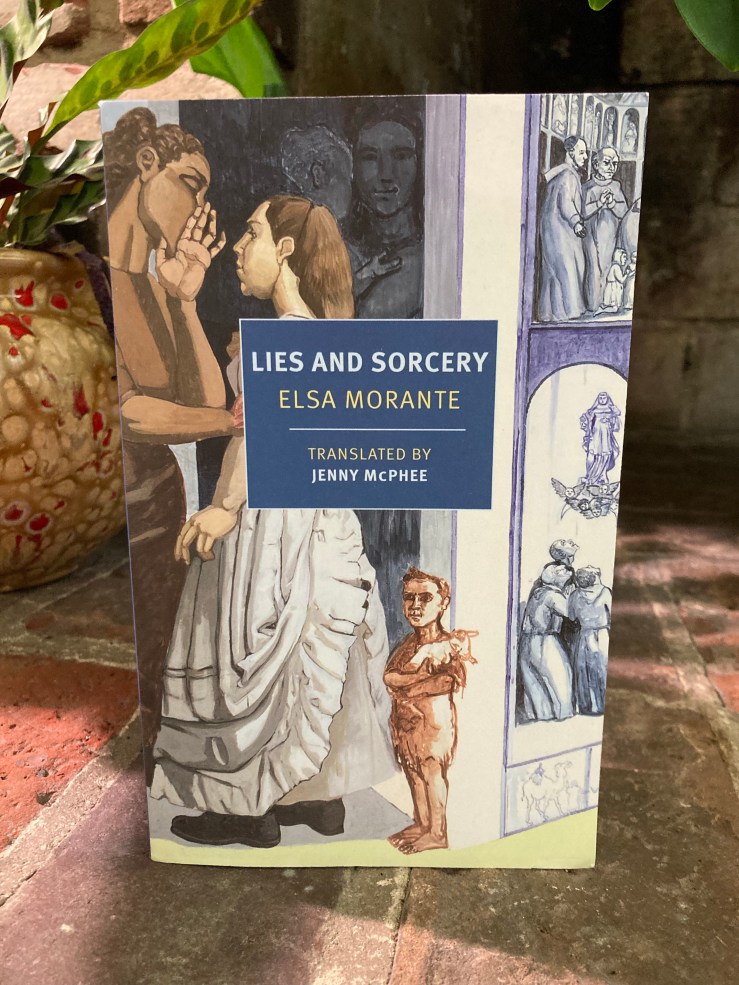

NYRB is publishing a new translation of Elsa Morante’s Lies and Sorcery by Jenny McPhee.
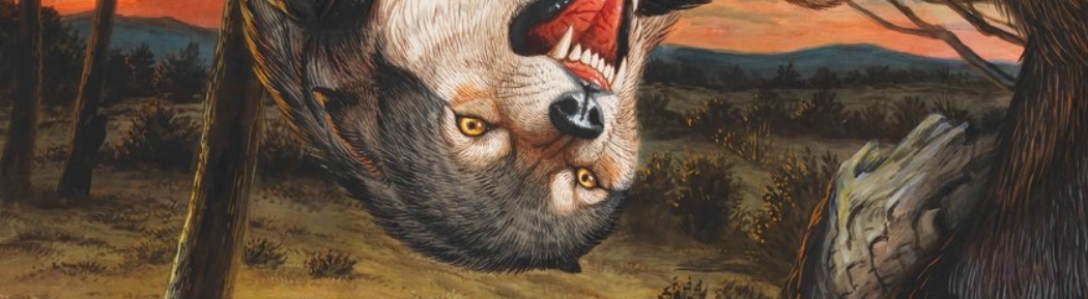
“From Below, as a Neighbor”
by
Lydia Davis
If I were not me and overheard me from below, as a neighbor, talking to him, I would say to myself how glad I was not to be her, not to be sounding the way she is sounding, with a voice like her voice and an opinion like her opinion. But I cannot hear myself from below, as a neighbor, I cannot hear how I ought not to sound, I cannot be glad I am not her, as I would be if I could hear her. Then again, since I am her, I am not sorry to be here, up above, where I cannot hear her as a neighbor, where I cannot say to myself, as I would have to from below, how glad I am not to be her.
Imagine a brilliant police detective summarizing his investigations for the husband of the victim, the widower. Thanks to his subtle deductions he has been able to “reconstruct” how the murder was committed; he does not know the identity of the murderer, but he has managed to work out everything else with an almost magical precision, as if he had seen it happen. And his interlocutor, the widower, who is, in fact, the murderer, has to admit that the detective is a genius, because it really did happen exactly as he says; yet at the same time, although of course he actually saw it happen and is the only living eyewitness as well as the culprit, he cannot match what happened with what the policeman is telling him, not because there are errors, large or small, in the account, or details out of place, but because the match is inconceivable, there is such an abyss between one story and the other, or between a story and the lack of a story, between the lived experience and the reconstruction (even when the reconstruction has been executed to perfection) that widower simply cannot see a relation between them; which leads him to conclude that he is innocent, that he did not kill his wife.
From César Aira’s short novel An Episode in the Life of a Landscape Painter; translation by Chris Andrews.
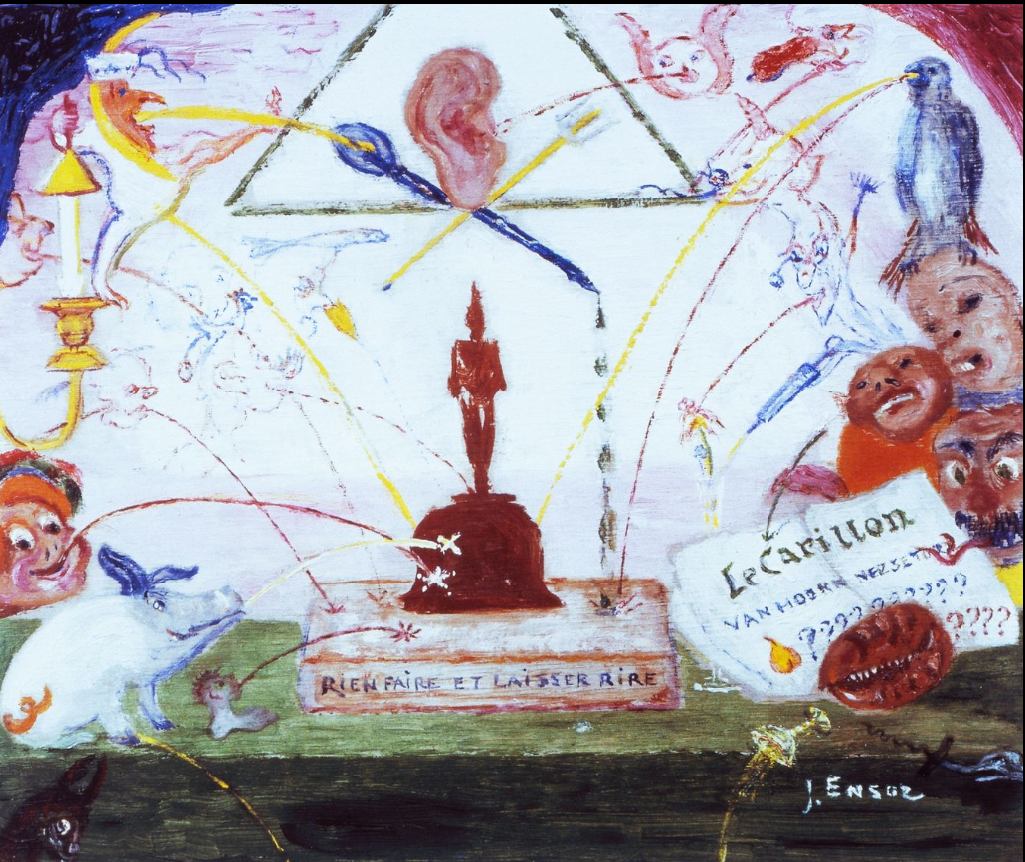
Do Nothing and Let Them Laugh, 1939 by James Ensor (1860-1949)

Correspondence, 2021 by Erik Thor Sandberg (b. 1975)
At Socrates on the Beach, there’s a nice long essay by critic Steven Moore that traces the occult influence of Charles Fort on Thomas Pynchon and William Gaddis.
From “Wild Talents: Pynchon, Gaddis, and Charles Fort“:
Pynchon and Gaddis are “wild talents” not in Fort’s original sense, but in their daring willingness to incorporate such exotic material into their novels, which previously had been confined to science fiction, fantasy, and occult novels. At any rate, it is an extraordinary coincidence that two of the greatest American novels of the 20th century evoke Charles Fort, of all people, despite what he thought of coincidences.
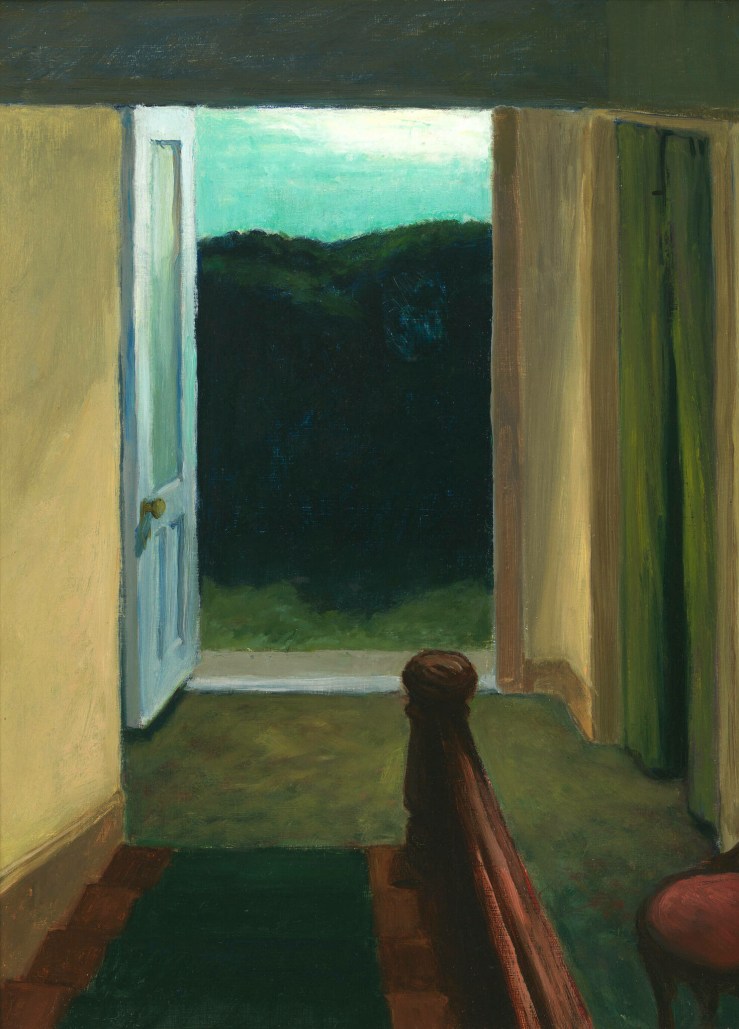
Stairway, 1949 by Edward Hopper (1882-1967)
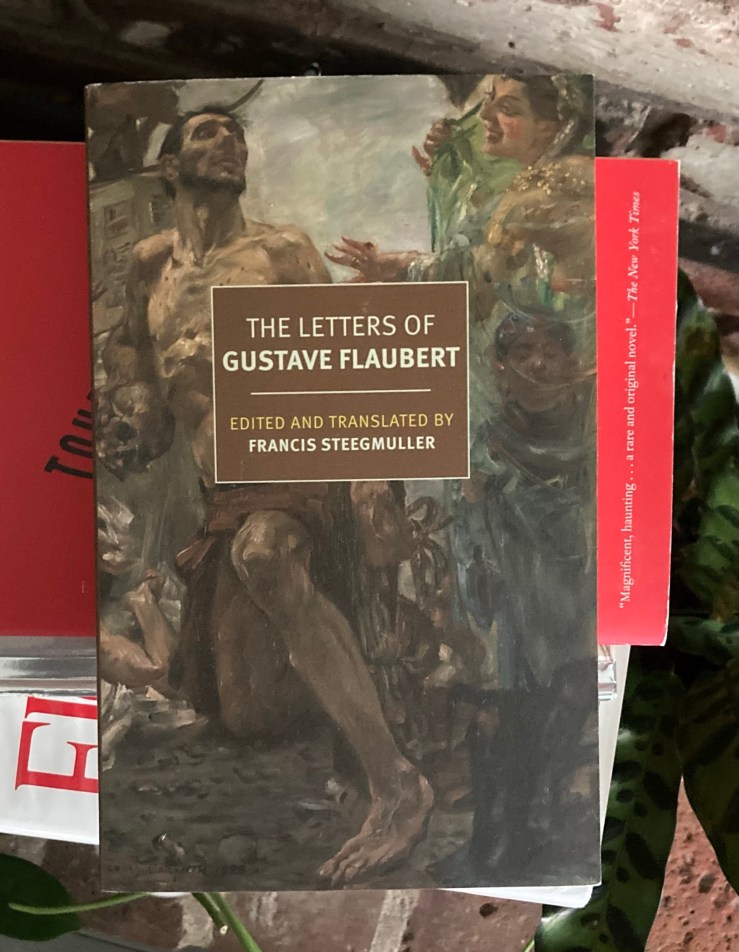
NYRB has a new one-volume edition of Francis Steegmuller’s translation of Flaubert’s letters. Their blurb:
Here we have Flaubert’s youthful, sensual outpourings to his mistress, the poet Louise Colet, and, as he advances, still unknown, into his thirties, the wrestle to write Madame Bovary. We hear, too, of his life-changing trip to Egypt, as described to family and friends, and then there are lively exchanges with Baudelaire, with the influential critic Sainte-Beuve, and with Guy de Maupassant, his young protégé. Flaubert’s letters to George Sand reveal her as the great confidante of his later years.
Steegmuller’s book, a classic in its own right, is both a splendid life of Flaubert in his own words and the ars poetica of the master who laid the foundations for modern writers from James Joyce to Lydia Davis. Originally issued in two volumes, the book appears here for the first time under a single cover.
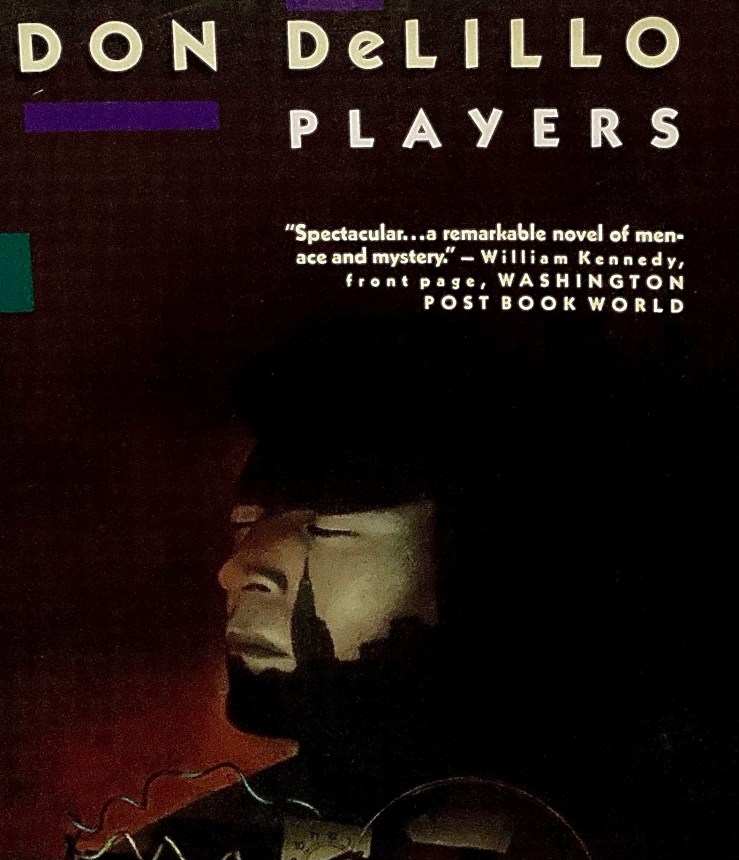
The day after that he experienced what at first he thought might be some variation of déjà vu. He’d finished lunch and stood at the door of a corner restaurant, able to see, at a severe angle, the lean elderly man who frequently appeared outside Federal Hall holding a hand-lettered political placard over his head for the benefit of those gathered on the steps. He, Lyle, was cleaning his fingernails, surreptitiously, using a toothpick he’d taken from a bowl near the cash register inside the restaurant. The paradox of material flowing backward toward itself. In this case there was no illusion involved. He had stood on this spot, not long ago, at this hour of the day, doing precisely what he was doing now, his eyes on the old man, whose body was aligned identically with the edge of a shadow on the façade of the building he faced, his sign held at the same angle, it seemed, the event converted into a dead replica by means of structural impregnation, the mineral replacement of earlier matter. Lyle decided to scatter the ingredients by heading directly toward the man instead of back to the Exchange, as he was certain he’d done the previous time. First he read the back of the sign, the part facing the street, recalling the general tenor. Then he sat on the steps, with roughly a dozen other people, and reached for his cigarettes. Burks was across the street, near the entrance to the Morgan Bank. People were drifting back to work. Lyle smoked a moment, then got up and approached the sign-holder. The strips of wood that steadied the edges of the sign extended six inches below it, giving the man a natural grip. Burks looked unhappy, arms folded across his chest.
“How long have you been doing this?” Lyle said. “Holding this sign?”The man turned to see who was addressing him.
“Eighteen years.”
Sweat ran down his temples, trailing pale outlines on his flushed skin. He wore a suit but no tie. The life inside his eyes had dissolved. He’d made his own space, a world where people were carvings on rock. His right hand jerked briefly. He needed a haircut.
“Where, right here?”
“I moved to here.”
“Where were you before?”
“The White House.”
“You were in Washington.”
“They moved me out of there.”
“Who moved you out?”
“Haldeman and Ehrlichman.”
“They wouldn’t let you stand outside the gate.”
“The banks sent word.”
Lyle wasn’t sure why he’d paused here, talking to this man. Dimly he perceived a strategy. Perhaps he wanted to annoy Burks, who obviously was waiting to talk to him. Putting Burks off to converse with a theoretical enemy of the state pleased him. Another man moved into his line of sight, middle-aged and heavy, a drooping suit, incongruous pair of glasses—modish and overdesigned. Lyle turned, noting Burks had disappeared.
“Why do you hold the sign over your head?”
“People today.”
“They want to be dazzled.”
“There you are.”
Lyle wasn’t sure what to do next. Best wait for one of the others to move first. He took a step back in order to study the front of the man’s sign, which he’d never actually read until now.
RECENT HISTORY
OF THE WORKERS OF THE WORLD
CIRCA 1850–1920 Workers hands cut off on Congo rubber plantations, not meeting work quotas. Photos in vault Bank of England. Rise of capitalism.
THE INDUSTRIAL AGE Child labor, accidents, death. Cruelty = profits. Workers slums Glasgow, New York, London. Poverty, disease, separation of family. Strikes, boycotts, etc. = troops, police, injunctions. Bitter harvest of Ind. Revolution.
MAY 1886 Haymarket Riot, Chicago, protest police killings of workers, 10 dead, 50 injured, bomb blast, firing into crowd.
SEPT 1920 Wall St. blast, person or persons unknown, 40 dead, 300 injured, marks remain on wall of J. P. Morgan Bldg. Grim reminder.
FEB 1934 Artillery fire, Vienna, shelling of workers homes, 1,000 dead inc. 9 Socialist leaders by hanging/strangulation. Rise of Nazis. Eve of World War, etc.
There was more in smaller print fitted onto the bottom of the sign. The overweight man, wilted, handkerchief in hand, was standing five feet away. Lyle, stepping off the sidewalk, touched the old man, the sign-holder, as he walked behind him, putting a hand on the worn cloth that covered his shoulder, briefly, a gesture he didn’t understand. Then he accompanied the other man down to Bowling Green, where they sat on a bench near a woman feeding pigeons.
From Don DeLillo’s novel Players.

Labor, 1935 by Will Barnet (1911-2012)
“Marabou”
by
Joy Williams
The funeral of Anne’s son, Harry, had not gone smoothly. Other burials were taking place at the same hour, including that of a popular singer several hundred yards away whose mourner fans carried on loudly under a lurid striped tent. Still more fans pressed against the cemetery’s wrought-iron gates, screaming and eating potato chips. Anne had been distracted. She gazed at the other service in disbelief, thinking of the singer’s songs that she had heard now and then on the radio.
Her own group, Harry’s friends, was subdued. They were pale, young, and all wore sunglasses. Most of them were classmates from the prep school he had graduated from two years before, and all were addicts, or former addicts of some sort. Anne couldn’t tell the difference between those who were recovering and those who were still hard at it. She was sure there was a difference, of course, and it only appeared there wasn’t. They all had a manner. There were about twenty of them, boys and girls, strikingly alike in black. Later she took them all out to a restaurant. “Death … by none art thou understood,” one boy kept saying. “Henry Vaughan.”
They were all bright enough, Anne supposed. After a while he stopped saying it. They had calamari, duck, champagne, everything. They were on the second floor of the restaurant and had the place to themselves. They stayed for hours. By the time they left, one girl was saying earnestly, “You know a word I like is interplanetary.” Continue reading ““Marabou” — Joy Williams”

Milking Practice with Artificial Udders, 1940 by Evelyn Dunbar (1906-1960)
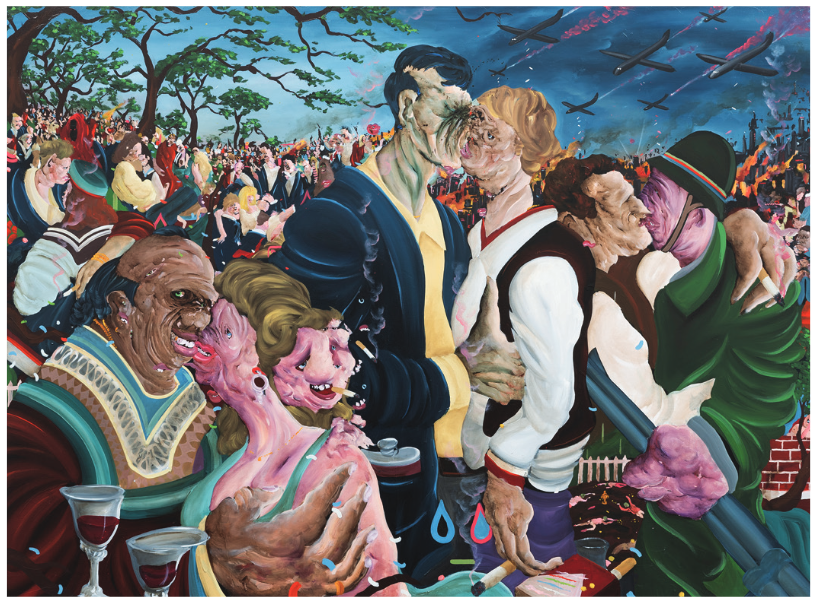
While the World Is Burning, 2022 by Willehad Eilers (b. 1981)
“Fridge”
by
Stuart Dybek
At midnight the expedition of the bride and groom arrives at the Fridge and pauses to get its bearings from the pale, arctic twenty-watt sun before proceeding across a border there is no need to map.
Before them lies the taiga where the wolf vowel of wind penetrates the heart with the aim of a winter draft through an uncaulked bedroom window—a draft that feels its way down corridors of sleep, its Freon breath scented with the rotten moss of unmade salads and wilted scallions.
And beyond the taiga, a tundra stretches that, from its smell, must be the snow-blinding white of sour milk.
There’s a sadness locked away here that emerges slowly like the freezer-burned flavors from some glacial past molded into cubes of ice. There’s a cheese never meant to be blue. There are undesired dreams and memories preserved in an isolation in which dream and memory have become indistinguishable from one another, both smoldering like ghosts of cold around a temperature dial forced beyond its lowest subtraction.
Here are the silent regions of rock-hard meat frozen into obscene postures like the dead around Stalingrad, regions where body heat has vanished beneath a crust of frost, where breath hangs although the breathers are long gone; dangerous regions where, even after the plug has been pulled, love can still be smothered as if it were a child playing hide-and-seek in a junked appliance.
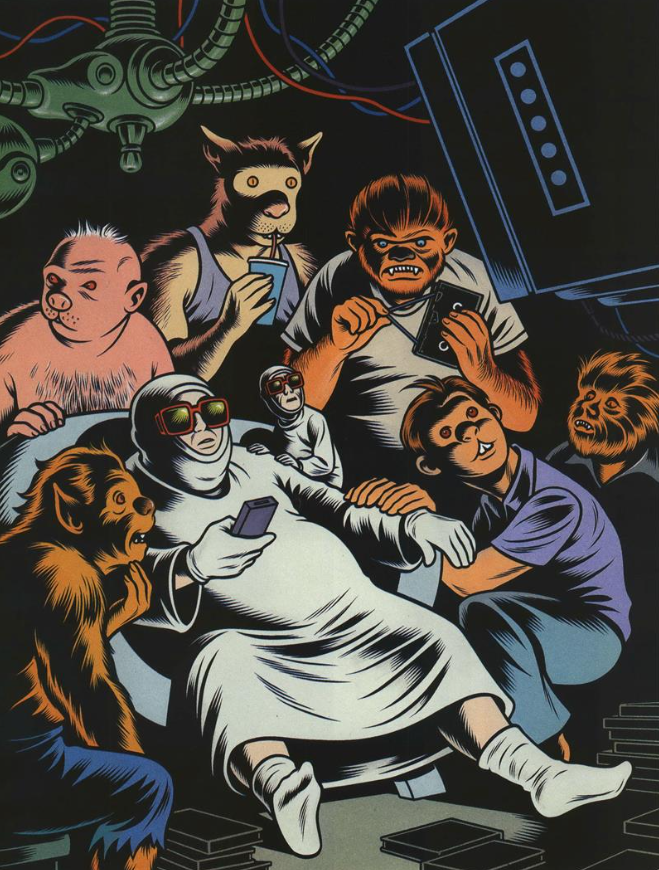
Charles Burns’ illustration for a Jan. 2000 Esquire article by Jeff Gordinier titled “The Best Movies You’ve Never Seen.”

Hurricane by Alphonse Legros (1837-1911)
Yeah . . . stubbing out another cigarette, in a voice like warm asphalt — this was an arrangement I had in hard times. I had root canal work to be done, and this man, who was an endodontologist, which is a root canal man, was writing pieces for dental journals. But he was not awfully good with the language, so we made an agreement, a barter arrangement, of one paper, one root. So I’d come in with one tooth with two bad roots and he would do them and then I’d rewrite, really write, because these were very, and there was a battle in the endodontological world about whether debridement was desirable or even possible. Debridement is when they try to remove any source of infection so that when they do pack the root, it won’t come to life. And his side was debridement was possible and necessary and can be done. So that’s the side I was supporting.
— Nice word, isn’t it.
— Oh yeah. Debridement is one of the great words . . . says novelist William Gaddis, one of the great survivors.
 Biblioklept