
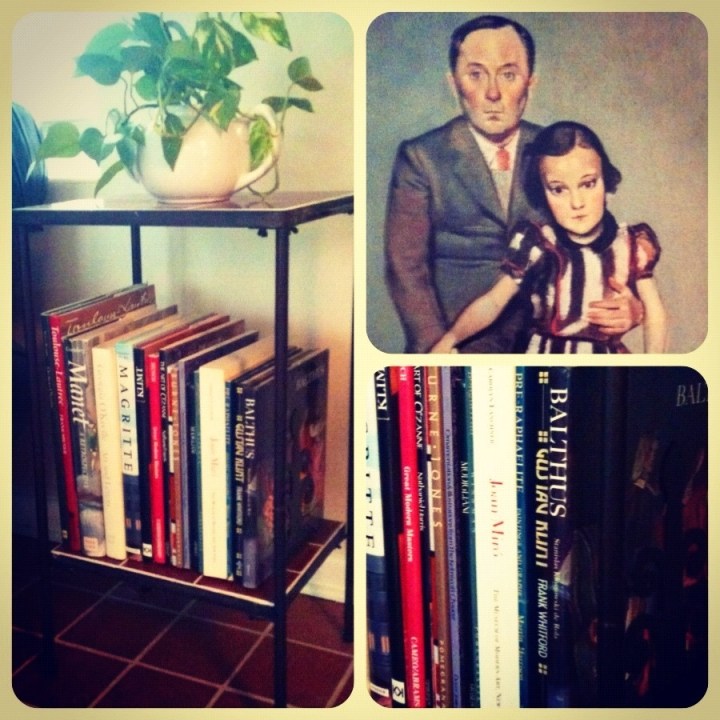
Book Shelves #26, 6.24.2012

20120624-143352.jpg

Book shelves series #26, twenty-sixth Sunday of 2012: Some old art books.

This little shelf sits next to a solitary couch in a den/fireplace room that abuts the eat-in kitchen. The shelf is mostly to hold the occasional drink if feet are propped on the coffee table. There are old art books in here, dating back to high school and college, when my wife and I (separately, of course, in those days) still bought lots and lots of art books, before the internet made accessibility to images so ubiquitous. As such, the shelf holds books that reflected our tastes of fifteen, sixteen, seventeen years ago: Lots of Pre-Raphaelite and Romantic stuff (hers) and lots of surrealist/modernist/cubist stuff (mine). Anyway. These rarely get dug out these days. If I want to check out Burne-Jones I usually visit an online gallery.

The portrait of Joan Miro and his daughter in the upper right corner is by the painter who called himself Balthus. I love the painting. It’s deeply creepy but also tender.

The Evil Thief — Albrecht Dürer

Flower Shell — Max Ernst

Woman Reading (1960) — Pablo Picasso

Boy Cutting Grass with a Sickle — Vincent van Gogh

St. Jerome Reading — Giovanni Bellini

Shark Fishing — Winslow Homer

Tom McCarthy on William Burroughs’s Verbal Remix Software

A passage from Tom McCarthy’s essay “Transmission and the Individual Remix:”

It might be inferred, from what I’ve said, that any old remix will do. Not so: there are good and bad ones. Tristan Tzara cutting Shakespeare sonnets up and pulling their words from hats is an exercise in randomizing. William Burroughs and Brion Gysin mixing poems in with sliced-up pages of The New York Times is quite another matter: it is assiduous composition—composition understood in all its secondary nature: as reading, tracing, reconfiguring. Using the same technique, Gysin comes up with a few clumsy permutations along the lines of “Rub the Word Right Out . . . Word Right Rub the Out” and so on—whereas Burroughs generates such gorgeous sequences as:

Visit of memories. Only your dance and your voice house. On the suburban air improbable desertions . . . all harmonic pine for strife.

or

The great skies are open. Supreme bugle burning flesh children to mist.

Why does Burroughs conjure so much more richness from the same source material? Because (unlike the painter Gysin, whose skill lies primarily in the domain of images), he has uploaded the right verbal remix software. He has read and memorized his Dante, his Shakespeare, his Eliot—to such an extent that his activity as a composer consists of giving himself over to their cadences and echoes, their pulses, codas, loops, the better that these may work their way, through him, The New York Times and any other body thrown into the mix, into an audibility that, booming and echoing in the here-and-now, transforms all the mix’s elements, and time itself.

This is what all good writers are doing, and always have been.

St. Jerome Reading — Rembrandt

Heads of Torture Victims (Study for The Raft of the Medusa) — Theodore Gericault

The Magdelene Reading — Rogier van der Weyden

Summer Interior — Edward Hopper

List of Fictional Suicides (From David Markson’s Reader’s Block)

Emma Bovary.

Anna Karenina.

Othello.

Jocasta.

Brunnhilde.

Hedda Gabler.

Romeo and Juliet.

Werther.

Dido.

Cio-Cio-San.

Antigone and Haemon.

Miss Julie.

Axel Heyst.

Quentin Compson.

Aida.

Inspector Javert.

Mynheer Peeperkorn. Leo Naphta.

Smerdyakov.

Rudolf Virag.

Edna Pontellier.

Hero.

Manrico’s Leonora.

Cheri.

Goneril.

Richard Cory.

McWatt.

Tosca.

Stravrogin. Kirillov.

Martin Eden.

Hurstwood.

Pyramus and Thisbe.

Roithamer.

Pierre Glendinning.

Winnie Verloc.

George Wilson.

Hedvig Ekdal.

Christine Mannon. Orin Mannon.

Willy Loman.

Senta.

Maggie Johnson.

Peter Grimes.

Bess, the landlord’s black-eyed daughter.

Svidrigailov.

James O. Incandenza.

Konstantin Treplev.

Bartleby.

Septimus Smith.

Deirdre.

Seymour Glass.

Ophelia.

Samson.

Eustacia Vye.

Phaedra.

Alcetis.

Launcelot.

From David Markson’s Reader’s Block.  By my count, Markson references throughout the book 149 suicides (or near-suicides, or presumed suicides) of real, actual persons (i.e., not including the list above). This count does not include Markson’s reference to “Nine hundred and sixty Jews” who “committed suicide at Masada, in 73 A.D., rather than surrender to the Roman legions that had lately sacked Jersusalem.” It’s entirely possible I miscounted.

Geisha Reading — Katsushika Hokusai

Woman Reading (1953) — Pablo Picasso

“They Passed in Review” (Mark Twain Illustration)

Image by Daniel Carter Beard for Twain’s 1897 volume Following the Equator.

Philosopher Reading — Rembrandt