The Forever Watch (Book acquired some time in February, 2015)

IMG_5281Can’t seem to keep up with the review copies lately.

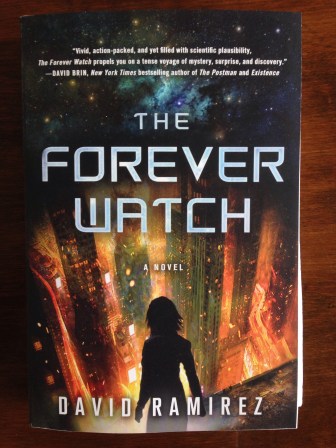
David Ramirez’s The Forever Watch is new from St. Martin’s Griffin imprint. Their blurb:

An exciting new novel from a bold up-and-coming sci fi talent, The Forever Watchis so full of twists and surprises it’s impossible to put down.
All that is left of humanity is on a thousand-year journey to a new planet aboard one ship, The Noah, which is also carrying a dangerous serial killer…
As a City Planner on the Noah, Hana Dempsey is a gifted psychic, economist, hacker and bureaucrat and is considered “mission critical.” She is non-replaceable, important, essential, but after serving her mandatory Breeding Duty, the impregnation and birthing that all women are obligated to undergo, her life loses purpose as she privately mourns the child she will never be permitted to know.
When Policeman Leonard Barrens enlists her and her hacking skills in the unofficial investigation of his mentor’s violent death, Dempsey finds herself increasingly captivated by both the case and Barrens himself. According to Information Security, the missing man has simply “Retired,” nothing unusual. Together they follow the trail left by the mutilated remains. Their investigation takes them through lost dataspaces and deep into the uninhabited regions of the ship, where they discover that the answer may not be as simple as a serial killer after all.

What they do with that answer will determine the fate of all humanity in David Ramirez’s thrilling page turner.

Jonathan Littell’s Syrian Notebooks (Book acquired, 3.23.2015)

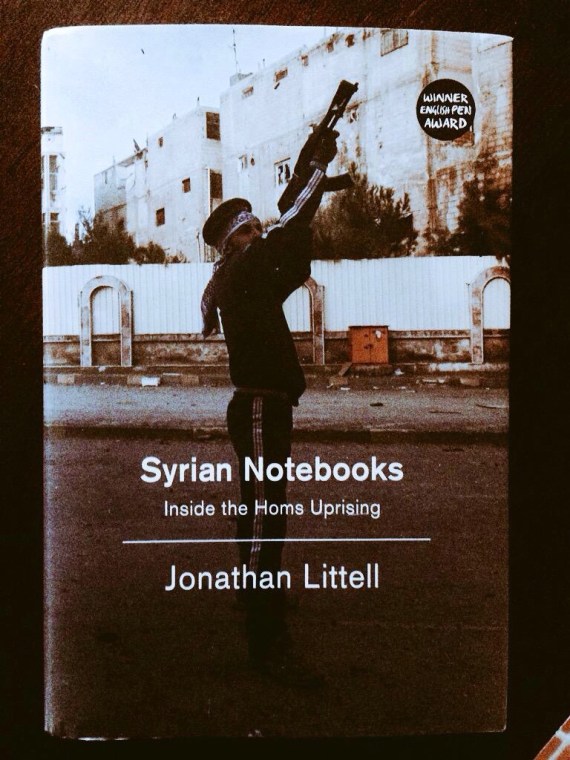
Jonathan Littell’s Syrian Notebooks is new in English translation (by Charlotte Mandell) from indie Verso. This one seems like a big departure from The Kindly Ones (which, uh, it should be), which I loved hating that I loved. Verso’s blurb:

A blistering firsthand account of the conflict in Homs by the internationally acclaimed author of The Kindly Ones
“We fight for our religion, for our women, for our land, and lastly to save our skin. As for them, they’re only fighting to save their skin.”

In 2012, Jonathan Littell traveled to the heart of the Syrian uprising, smuggled in by the Free Syrian Army to the historic city of Homs. For three weeks, he watched as neighborhoods were bombed and innocent civilians murdered. His notes on what he saw on the ground speak directly of horrors that continue today in the ongoing civil war.

Amid the chaos, Littell bears witness to the lives and the hopes of freedom fighters, of families caught within the conflict, as well as of the doctors who attempt to save both innocents and combatants who come under fire. As government forces encircle the city, Littell charts the first stirrings of the fundamentalist movement that would soon hijack the revolution.

Littell’s notebooks were originally the raw material for the articles he wrote upon his return for the French daily Le Monde. Published nearly immediately afterward in France, Syrian Notebooks has come to form an incomparable close-up account of a war that still grips the Middle East—a classic of war reportage.


Midnight in Europe (Book acquired, some time in February 2015)

IMG_5139

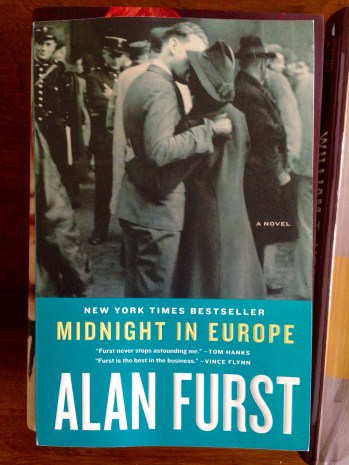
Alan Furst’s Midnight in Europe is out next week in paperback from Random House. Their blurb:

Paris, 1938. As the shadow of war darkens Europe, democratic forces on the Continent struggle against fascism and communism, while in Spain the war has already begun. Alan Furst, whom Vince Flynn has called “the most talented espionage novelist of our generation,” now gives us a taut, suspenseful, romantic, and richly rendered novel of spies and secret operatives in Paris and New York, in Warsaw and Odessa, on the eve of World War II.

Cristián Ferrar, a brilliant and handsome Spanish émigré, is a lawyer in the Paris office of a prestigious international law firm. Ferrar is approached by the embassy of the Spanish Republic and asked to help a clandestine agency trying desperately to supply weapons to the Republic’s beleaguered army—an effort that puts his life at risk in the battle against fascism.

Joining Ferrar in this mission is a group of unlikely men and women: idealists and gangsters, arms traders and aristocrats and spies. From shady Paris nightclubs to white-shoe New York law firms, from brothels in Istanbul to the dockyards of Poland, Ferrar and his allies battle the secret agents of Hitler and Franco. And what allies they are: there’s Max de Lyon, a former arms merchant now hunted by the Gestapo; the Marquesa Maria Cristina, a beautiful aristocrat with a taste for danger; and the Macedonian Stavros, who grew up “fighting Bulgarian bandits. After that, being a gangster was easy.” Then there is Eileen Moore, the American woman Ferrar could never forget.

In Midnight in Europe, Alan Furst paints a spellbinding portrait of a continent marching into a nightmare—and the heroes and heroines who fought back against the darkness.

Paris Red (Book acquired some time in February, 2015)

IMG_5138

Maureen Gibbon’s novel Paris Red is forthcoming (April 2015) in hardback from W.W. Norton. Their blurb:

For readers of Girl with a Pearl Earring, a luminous and evocative novel of Édouard Manet’s muse.

Paris, 1862. A young girl in a threadbare dress and green boots, hungry for experience, meets the mysterious and wealthy artist Édouard Manet. The encounter will change her—and the art world—forever.

At seventeen, Victorine Meurent abandons her old life to become immersed in the Parisian society of dance halls and cafés, meeting writers and artists like Baudelaire and Alfred Stevens. As Manet’s model, Victorine explores a world of new possibilities and stirs the artist to push the boundaries of painting in his infamous portrait Olympia, which scandalizes even the most cosmopolitan city.

Manet becomes himself because of Victorine. But who does she become, that figure on the divan?

Intense, erotic, and beautifully wrought, Paris Red evokes the unconventional love story of a painter and his muse that changed the history of art.

What the Fly Saw (Book acquired, some time in February 2015)

IMG_5098

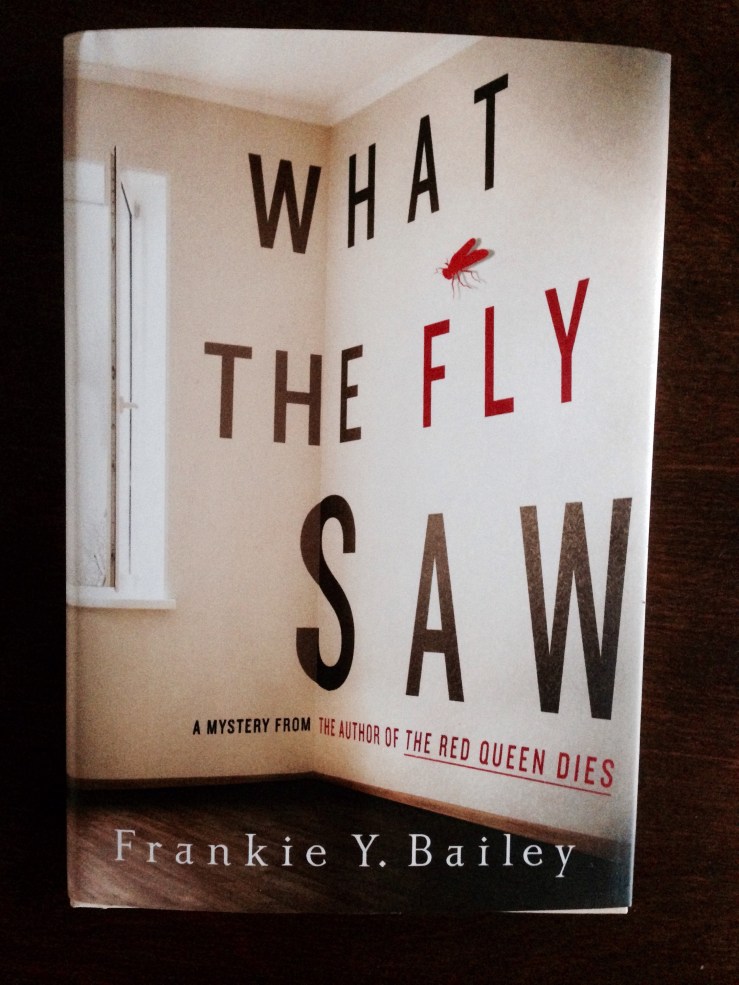
Frankie Y. Bailey’s What the Fly Saw. Blurb from the author’s site:

The morning after a blizzard that shut down the city, funeral director Kevin Novak is found dead in the basement of his funeral home. The arrow sticking out of his chest came from his own hunting bow. A loving husband and father and an active member of a local megachurch, Novak had no known enemies. His family and friends say he had been depressed because his best friend died suddenly of a heart attack and Novak blamed himself. But what does his guilt have to do with his death? Maybe nothing, maybe a lot. The minister of the megachurch, the psychiatrist who provides counseling to church members, or the folksy Southern medium who irritates both men – one of these people may know why Novak was murdered. Detective Hannah McCabe and her partner, Mike Baxter, sort through lies and evasions to find the person who killed their “Cock Robin,” But McCabe is distracted by a political controversy involving her family, unanswered questions from another high-profile case, and her own guilt when a young woman dies after McCabe fails to act.


Infinite Fictions (Book acquired 2.10.2015)

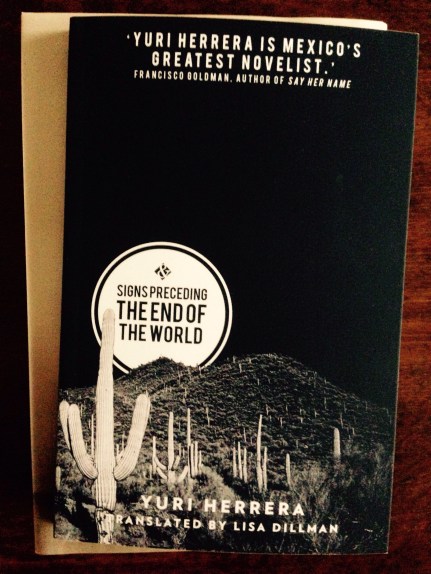
Signs Preceding the End of the World (Book acquired, 2.13.2015)

IMG_5097

Yuri Herrera’s novel Signs Preceding the End of the World is forthcoming from And Other Stories. It looks pretty good. Their blurb:

Signs Preceding the End of the World is one of the most arresting novels to be published in Spanish in the last ten years. Yuri Herrera does not simply write about the border between Mexico and the United States and those who cross it. He explores the crossings and translations people make in their minds and language as they move from one country to another, especially when there’s no going back.

Traversing this lonely territory is Makina, a young woman who knows only too well how to survive in a violent, macho world.  Leaving behind her life in Mexico to search for her brother, she is smuggled into the USA carrying a pair of secret messages – one from her mother and one from the Mexican underworld.

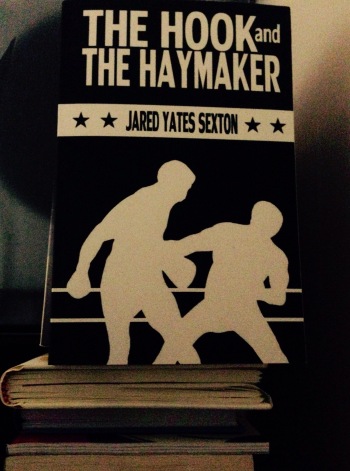
The Hook and the Haymaker (Book acquired, 2.12.2015)

IMG_5102

Jared Yates Sexton’s The Hook and the Haymaker is new from Split Lip Press. Dug his last joint, An End to All Things and looking forward to getting into this one. Blurb from his site:

In 2012 Atticus Books released An End To All Things, Jared Yates Sexton’s acclaimed debut collection of stories. Called “invigorating” and “shades of Barry Hannah, Raymond Carver, and Breece D’J Pancake,” it was lauded byThe Portland Book Review as “the beginning of a long literary career.” Here, his next installment of stories, The Hook and The Haymaker, twenty-three award-winning pieces that have appeared in The Southern Humanities Review, Night Train, Verdad, PANK, Midwestern Gothic, among other prominent magazines and publications from around the country.

This book picks up right where Sexton’s debut left off with hard-hitting, gritty glimpses into an America that too-often goes unseen. Set in sweat-saturated sparring rings, the backrooms of gas station speakeasies, and the kitchens of the houses down the street, witness here the untold tales of the losers and the should’ve-beens, the dreamers and the hustlers, all of them just spoiling for their turn at glory or the inevitable one-two punch that puts them down for good.

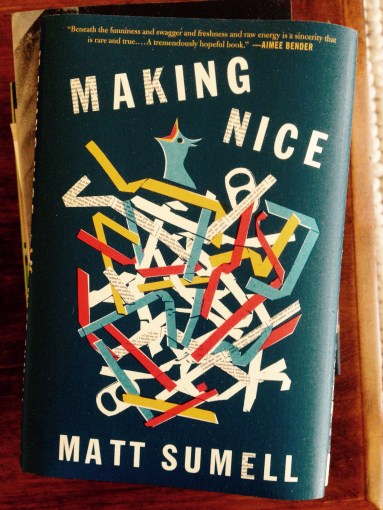
Matt Sumell’s Making Nice (Book acquired some time in January)

IMG_4953

I was hoping to save up a little energy to write a bit about the stories I’ve read in Matt Sumell’s debut collection Making Nice…but I don’t seem to have it. There’s a macho swagger here that will repel a lot of folks but hell I’m a barbarian and I dig what he’s doing, even if it’s been done by a few (many) other folks before (there’s that Carver/Johnson/Lipsyte axis, yes)—it’s funny and savage stuff. Continue reading “Matt Sumell’s Making Nice (Book acquired some time in January)”

A Spool of Blue Thread (Book acquired some time in January, 2015)

IMG_4954Anne Tyler’s novel A Spool of Blue Thread is new in hardback from publisher Random House. Their blurb:

“It was a beautiful, breezy, yellow-and-green afternoon. . .” This is how Abby Whitshank always begins the story of how she fell in love with Red that day in July 1959. The Whitshanks are one of those families that radiate togetherness: an indefinable, enviable kind of specialness. But they are also like all families, in that the stories they tell themselves reveal only part of the picture. Abby and Red and their four grown children have accumulated not only tender moments, laughter, and celebrations, but also jealousies, disappointments, and carefully guarded secrets. From Red’s father and mother, newly arrived in Baltimore in the 1920s, to Abby and Red’s grandchildren carrying the family legacy boisterously into the twenty-first century, here are four generations of Whitshanks, their lives unfolding in and around the sprawling, lovingly worn Baltimore house that has always been their anchor.

Brimming with all the insight, humor, and generosity of spirit that are the hallmarks of Anne Tyler’s work, A Spool of Blue Thread tells a poignant yet unsentimental story in praise of family in all its emotional complexity. It is a novel to cherish.

Evan Dara (Books acquired 1.28/29/2015)

IMG_4990

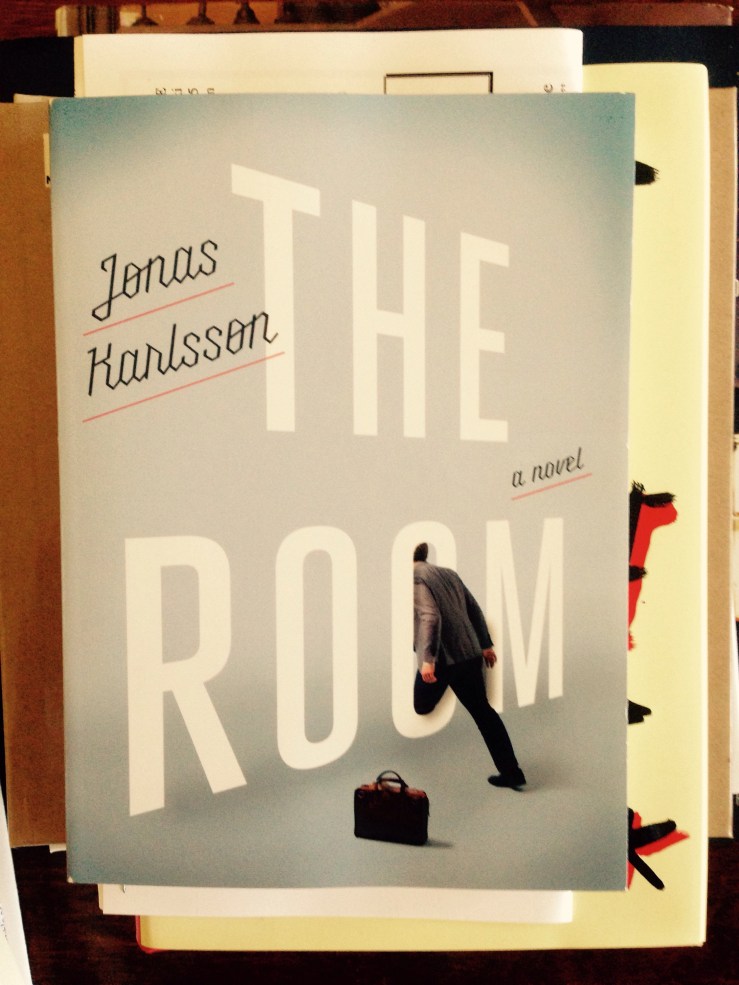
Jonas Karlsson’s The Room (Book acquired some time last week)

IMG_4955

Jonas Karlsson’s novel The Room comes out later this month from Random House. Their blurb:

Funny, clever, surreal, and thought-provoking, this Kafkaesque masterpiece introduces the unforgettable Bjorn, an exceptionally meticulous office worker striving to live life on his own terms.
 
Bjorn is a compulsive, meticulous bureaucrat who discovers a secret room at the government office where he works–a secret room that no one else in his office will acknowledge. When Bjorn is in his room, what his co-workers see is him standing by the wall and staring off into space looking dazed, relaxed, and decidedly creepy. Bjorn’s bizarre behavior eventually leads his co-workers to try and have him fired, but Bjorn will turn the tables on them with help from his secret room.
Debut author Jonas Karlsson doesn’t leave a word out of place in this brilliant, bizarre, delightful take on how far we will go–in a world ruled by conformity–to live an individual and examined life.

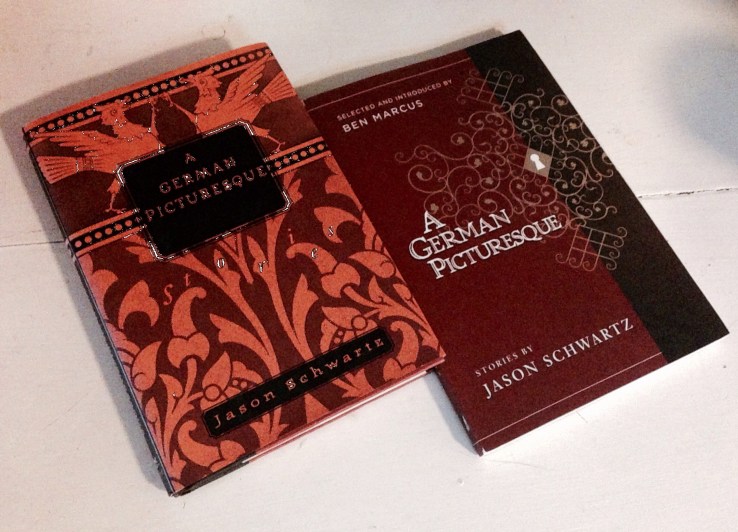
A German Picturesque (Book acquired, 1.23.2014)

2015/01/img_4947.jpg

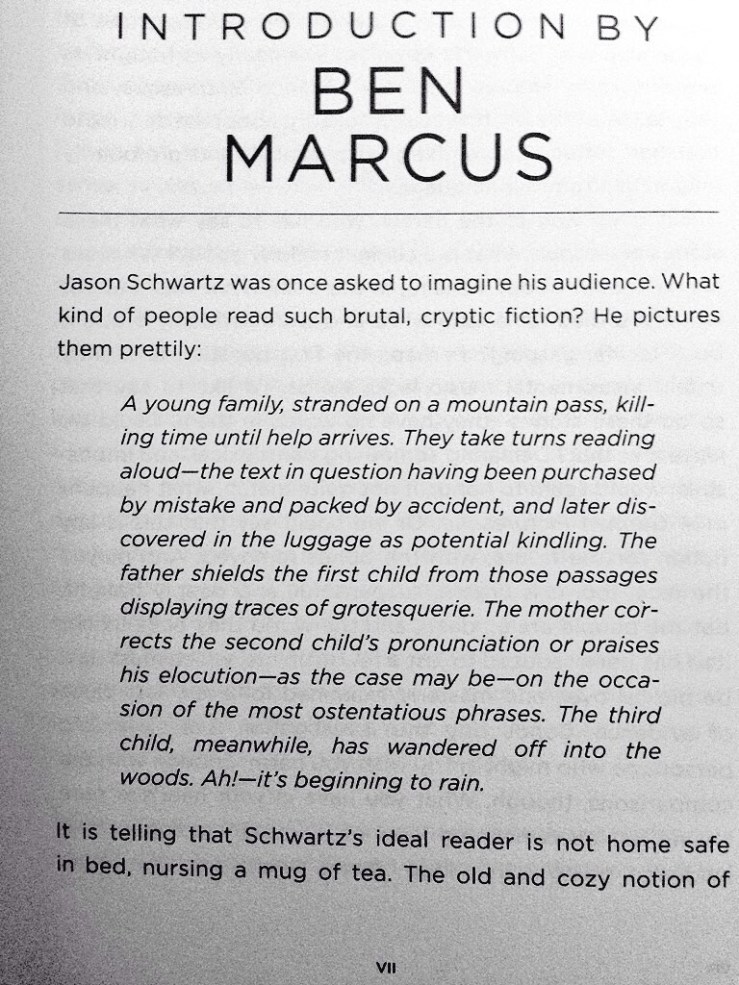
Pharos is reissuing Jason Schwartz’s debut collection A German Picturesque, pictured on the right, above, by the original. The title was selected and introduced by Ben Marcus, who quotes from the interview Schwartz granted me last year—

2015/01/img_4923.jpg

I actually think that it was this review which led to Ben Marcus consenting to talk with me over the phone for an hour in December. I’ve been typing that interview very slowly and swear it’s on the horizon. Painful dreadful anxious work. Interview with Marcus to come. Review of Schwartz to come.

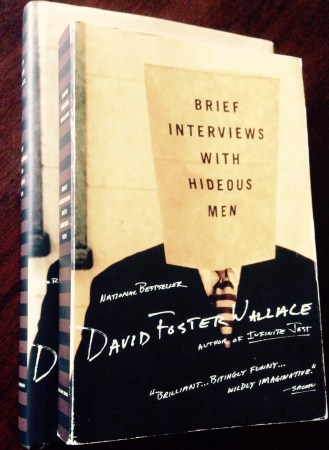
DFW’s Brief Interviews with Hideous Men, books as memory objects, etc.

2015/01/img_4925.jpg

On our short walk home from her school yesterday, my darling daughter inquires if we can go to the bookstore. She needs some new Junie B. Jones, she reports. I assent.

This particular bookstore is about a mile away, a big labyrinth of shelves and stacks and strange little closets crammed with books. The owner once kindly estimated to me that the place houses somewhere between one million and two million books, but probably not more than three million books. The place is a hive, or better yet a brain. An archive.

On this warmish January afternoon, a coverless paperback wedged and warped keeps the front door propped open. My daughter doesn’t dally, fetching up a bevy of Ms. Jones’ adventures (and the third volume of Ivy + Bean to boot: “It’s Ivy “plus” Bean, not Ivy “and” Bean, her graceful correction).

We have a few minutes before we need to pick up my son, so I do a fairly regular patrol about the premises, looking for a copy of Jane Bowles’s Two Serious Ladies for a colleague. No dice. And, out of weird old habits, go past the last shelf, where Vollmann’s underattended tomes rest near David Foster Wallace novels, always depleted. I like to look at the new covers, I guess.

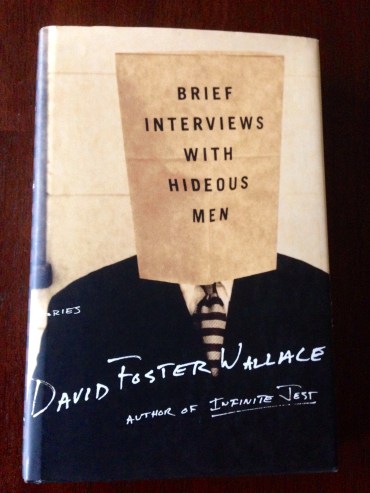
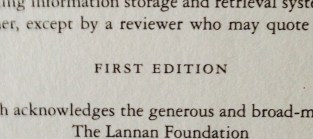
Well so and anyway, I spied a pristine hardcover copy of Brief Interviews with Hideous Men, clearly never read, and thought, Oh hey, this must be a first edition. Which it was and Oh hey you don’t need this book.
2015/01/img_4926.jpg

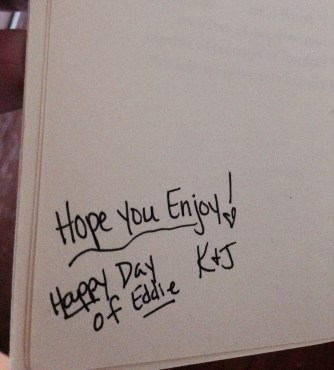
There is nothing rare or especially valuable about a first hardback U.S. edition of Hideous Men. The store is selling it for half of the publisher’s recommended price, but I have more than enough credit (thanks unsolicited review copies!) to pick it up. Which I do. Despite of course already owning it in the far more flexible trade paperback edition (first edition!) inscribed by some of the dearest damn friends who gave it to me for a birthday, an edition I reread memorably over a few weeks in Italy, an edition warped by strange moistures (I’d love to pretend the warping arose from the salty splash of the ancient Mediterranean but my own body sweat is a far more likely culprit).
2015/01/img_4927.jpg

Brief Interviews is my favorite collection of David Foster Wallace stories. The stories here are much better than those in his first collection, Girl with Curious Hair (which, the first DFW I read, has a special place in my gizzards), and though there’s nothing here that can touch the best moments of Oblivion (“The Suffering Channel” and “Good Old Neon”), the collection is cohesive, propulsive, engaging, its longer pieces punctuated by blips and vignettes. Here is the first selection, “A Radically Condensed History of Postindustrial Life”:

When they were introduced, he made a witticism, hoping to be liked. She laughed very hard, hoping to be liked. Then each drove home alone, staring straight ahead, with the very same twist to their faces.

The man who’d introduced them didn’t much like either of them, though he acted as if he did, anxious as he was to preserve good relations at all times. One never knew, after all, now did one now did one now did one.

So I picked up the hardback first edition, realizing that what I really wanted (in addition to this edition that I didn’t and don’t really need) was the copy that I read in college, the copy I borrowed from UF’s Library West (I’ll pay you $10,000 if you can think of a better library name, which you can’t), a flat brown squashed brick—-I must’ve been one of the first to read it, this was in ’99 or early ’00—I checked it out three times and then I had to return it. I ripped off “Adult World (I)” and “Adult World (II)” (these are actually the same story, but…) for a project in some bullshit class I was taking at the time, some class called Post-Historical Visual Culture or some other such nonsense—I didn’t rip off the plot, but the structure, the whole narrative/outline thing that Wallace did there. (My story was about a geneticist trying to clone a son or maybe someone to love, I can’t recall, shudder to recall…And why was I turning in a story and not an essay?!).

Why do I want the very edition that I first read, Dewey’s decimals imprinted on its drab jacketless spine? Why do I want an object that proclaims first, first, first, even though I don’t need it—why the compulsion? And then the sentimental compulsion to keep a less sturdy paperback version just because my name is incribed in itjust because I recall so vividly shaving my beard in Minori in Amalfi after reading “Tri-Stan: I Sold Sissee Nar to Ecko” and realizing that Oh my god this story is fucking terrible, DFW, I get what you’re doing, but my god. 

A book is a memory object, a placeholder, a bookmark for the memory of the reading experience, because we don’t remember what we read, not really. I have a few novels committed to memory (more or less) through yearly rereading, through teaching, but on the whole the details fade, the misremembering opens to misreading. My dream is to disband all of my books, march them out into the world, my memory secure, transcendent, stable, eternal, etc.—the objects gone, their dusty physicality imprinted in some psychic library of the soul. But I don’t believe in my dream, and even though I dig e-books, they don’t shock my memory in the same way that old pressed leaves do. So I live with these guys, nestled together unnecessarily, necessarily so.
2015/01/img_4928.jpg

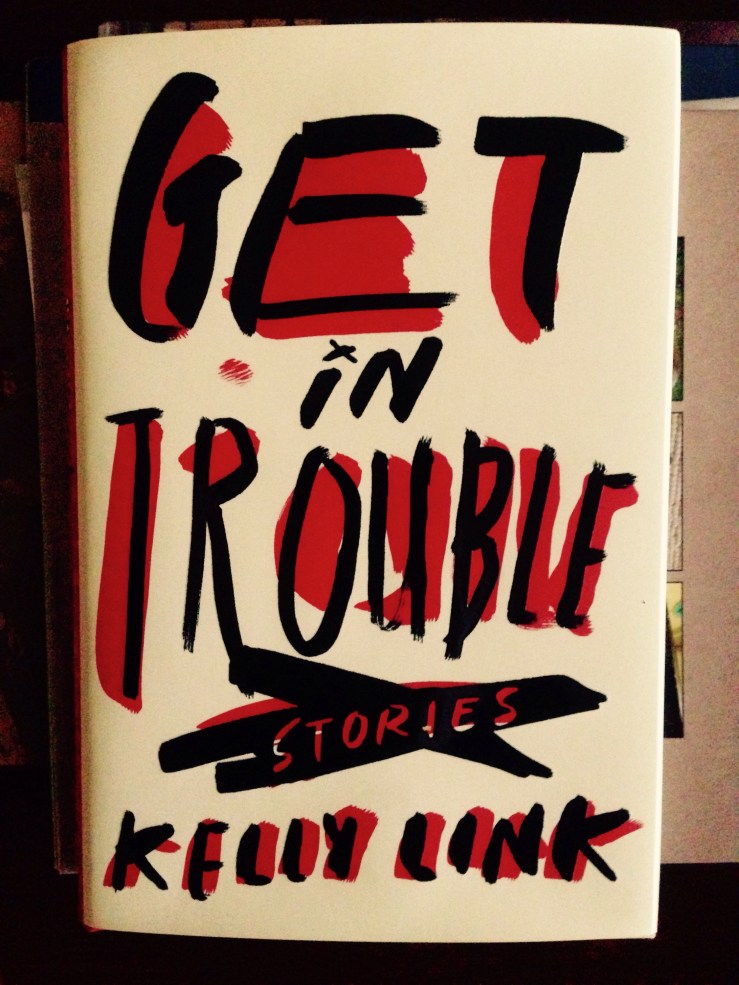
Kelly Link’s Get In Trouble (Book acquired, 1.14.2015)

IMG_4853

Kelly Link’s new collection Get In Trouble is forthcoming from Random House in hardback. Their blurb:

She has been hailed by Michael Chabon as “the most darkly playful voice in American fiction” and by Neil Gaiman as “a national treasure.” Now Kelly Link’s eagerly awaited new collection—her first for adult readers in a decade—proves indelibly that this bewitchingly original writer is among the finest we have.

Link has won an ardent following for her ability, with each new short story, to take readers deeply into an unforgettable, brilliantly constructed fictional universe. The nine exquisite examples in this collection show her in full command of her formidable powers. In “The Summer People,” a young girl in rural North Carolina serves as uneasy caretaker to the mysterious, never-quite-glimpsed visitors who inhabit the cottage behind her house. In “I Can See Right Through You,” a middle-aged movie star makes a disturbing trip to the Florida swamp where his former on- and off-screen love interest is shooting a ghost-hunting reality show. In “The New Boyfriend,” a suburban slumber party takes an unusual turn, and a teenage friendship is tested, when the spoiled birthday girl opens her big present: a life-size animated doll.

Hurricanes, astronauts, evil twins, bootleggers, Ouija boards, iguanas, The Wizard of Oz, superheroes, the Pyramids . . . These are just some of the talismans of an imagination as capacious and as full of wonder as that of any writer today. But as fantastical as these stories can be, they are always grounded by sly humor and an innate generosity of feeling for the frailty—and the hidden strengths—of human beings. In Get in Trouble, this one-of-a-kind talent expands the boundaries of what short fiction can do

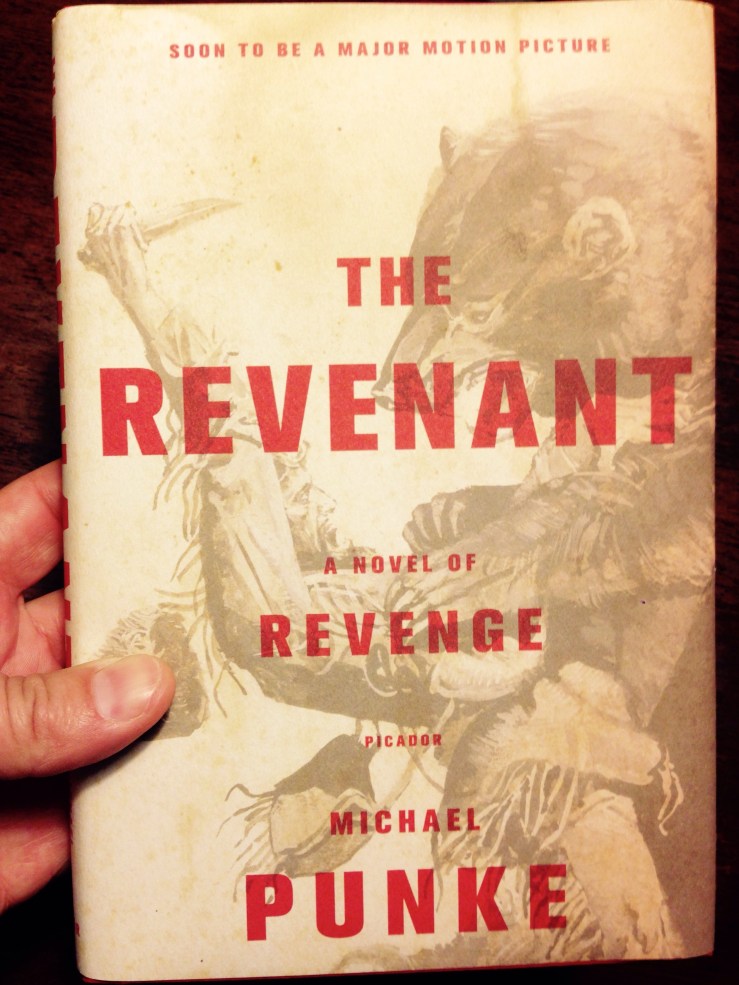
The Revenant (Book acquired some time in December, 2014)

2015/01/img_4851.jpg

Michael Punke’s novel (of revenge!) The Revenant is being adapted into an upcoming Iñárritu film, and consequently getting the hardback reissue treatment. The Wikipedia entry:

The Revenant is an upcoming American westernthriller film produced and directed by Alejandro González Iñárritu. The screenplay, adapted from Michael Punke’s 2003 novel of the same name, was written by González Iñárritu and Mark L. Smith and is partially based in the life of frontiersman Hugh Glass. The film is set to star Leonardo DiCaprio, Tom Hardy, Will Poulter, and Domhnall Gleeson.

Development of the film began in August 2001 when Akiva Goldsman purchased Punke’s manuscript with the intent of producing the film. The film was originally set to be directed by Park Chan-wook with Samuel L. Jackson in mind to star, and later by John Hillcoat with Christian Bale in negotiations to star. Both directors left the project, and González Iñárritu signed on to direct in August 2011. In April 2014, after several delays in production due to other projects, González Iñárritu confirmed that he was beginning work on The Revenantand that DiCaprio would play the lead role. Principal photography began in October 2014, and is scheduled to last 80 days.

I still haven’t seen Birdman.

Introduction to English Rhetoric (Book acquired, 12.25.2014)

IMG_4803

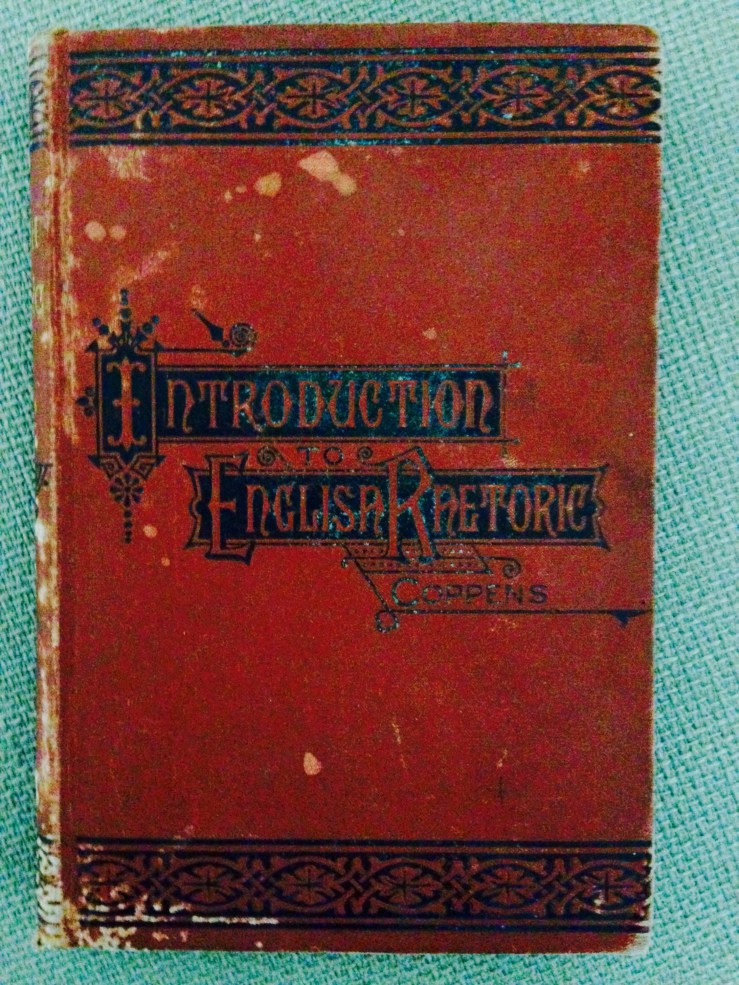
For Christmas, my mother-in-law gave me Introduction to English Rhetoric (1886) by the Rev. Charles Coppens, SJ. You can read the book here.