Blossom (Detail) — Rustam Qbic

qbic-2

Stephen Collins’s Allegorical Fable The Gigantic Beard That Was Evil Reviewed

IMG_3543

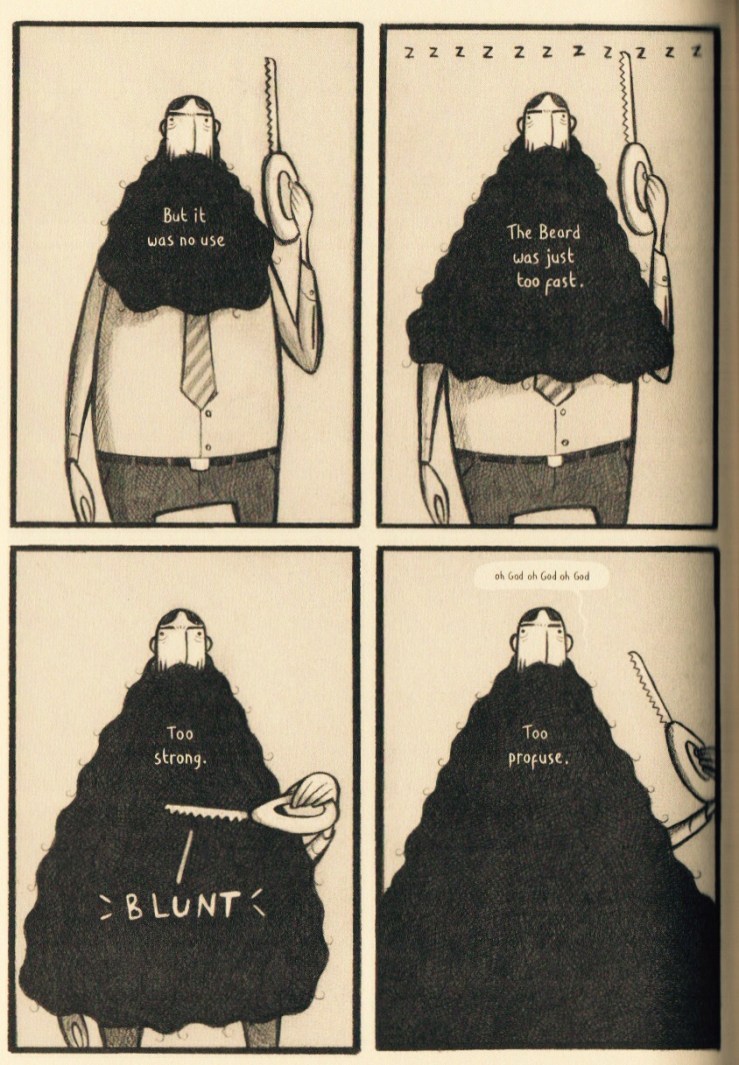
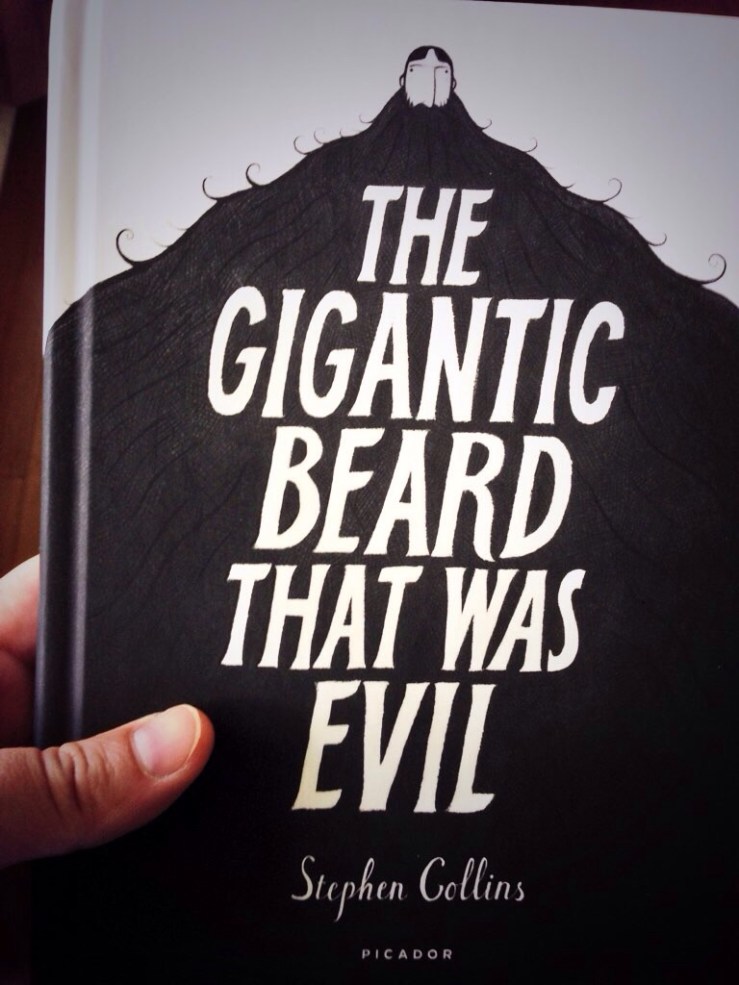
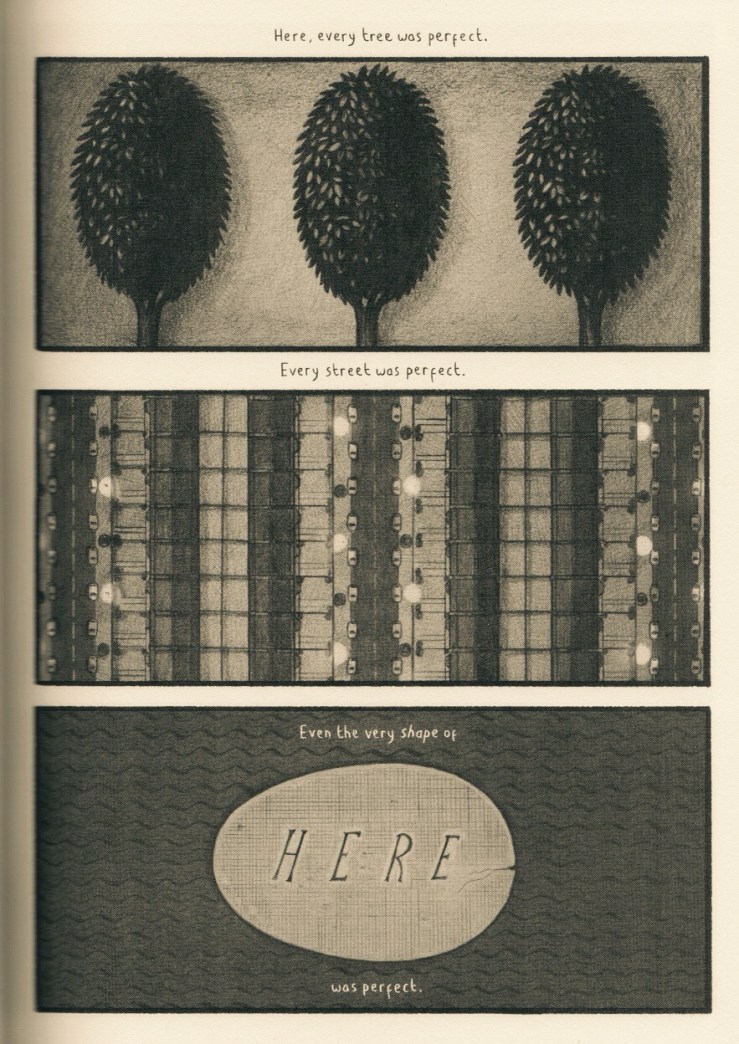
Stephen Collins’s début graphic novel The Gigantic Beard That Was Evil tells the story of Dave, an especially average (forgive the oxymoron) guy in the neat-and-tidy island of Here, a place where conformity rules and difference is unthinkable. Dave fits like a cog into his tidy world until a beard erupts from his face, severing him from society.
IMG_3865.JPG

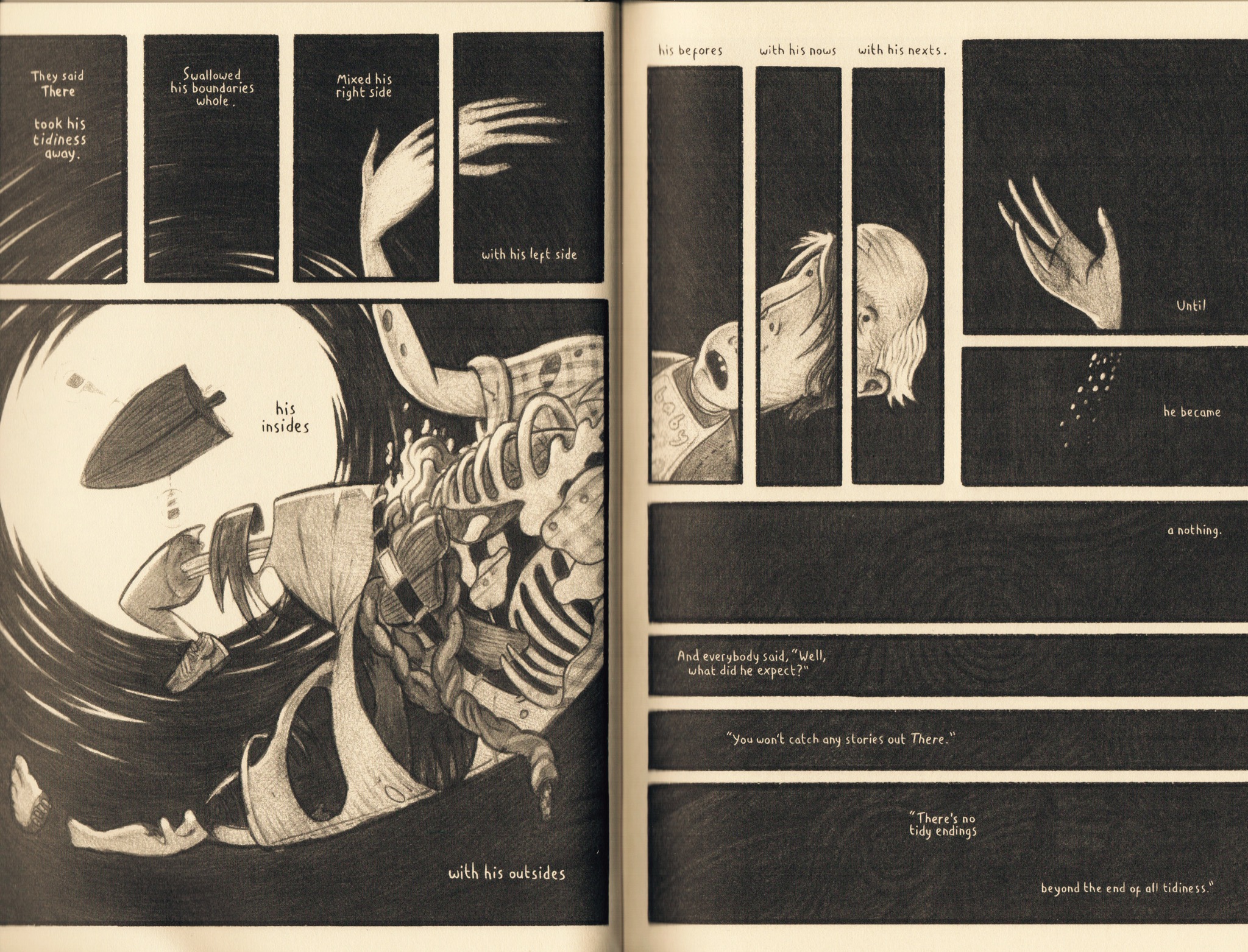
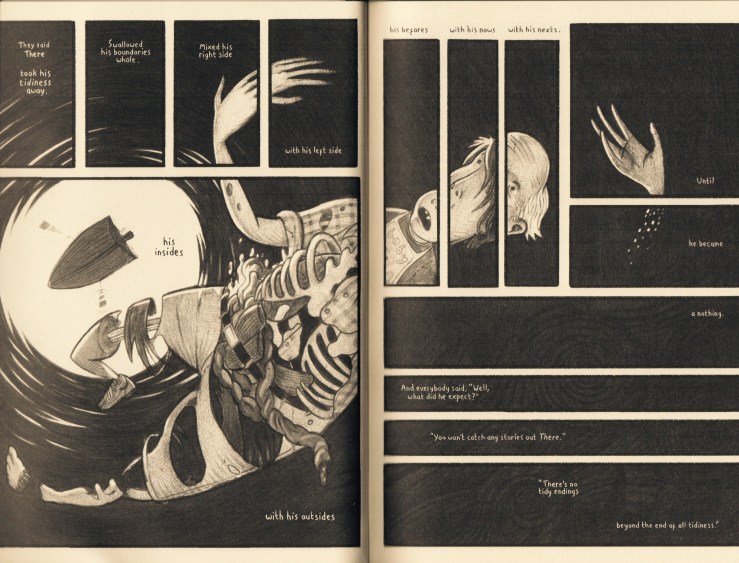
Despite its neat and tidy contours, an omnipresent dread of otherness gestates in the egg-shaped isle of Here. That dread manifests in the fabled land of There. Dave’s psyche is haunted by There; its very existence threatens both body and mind. Collins renders this anxiety in a remarkable series of panels that concretize Dave’s nightmare of otherness:
IMG_3873

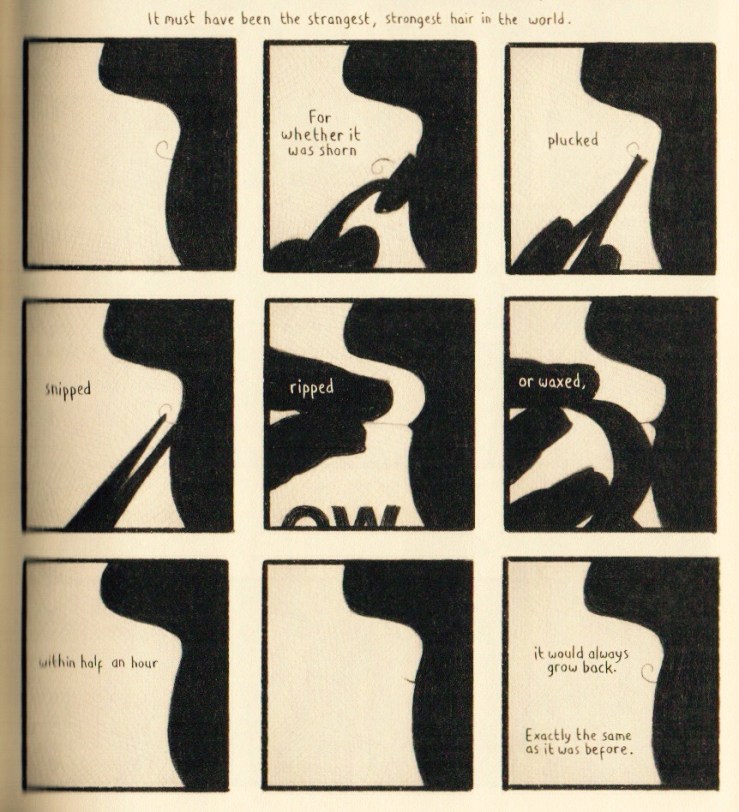
Dave’s nightmare highlights his subconscious realization that there cannot be a Here without a There. The realization leaves him abject, torn, and destabilized, even before his beard appears. When the first hairs do arrive, Dave’s interior existential crisis spills outward, his messy difference oozing out to disrupt and upset the tidy normalcy of Here.
IMG_3867.JPG

Poor Dave.

IMG_3871.JPG

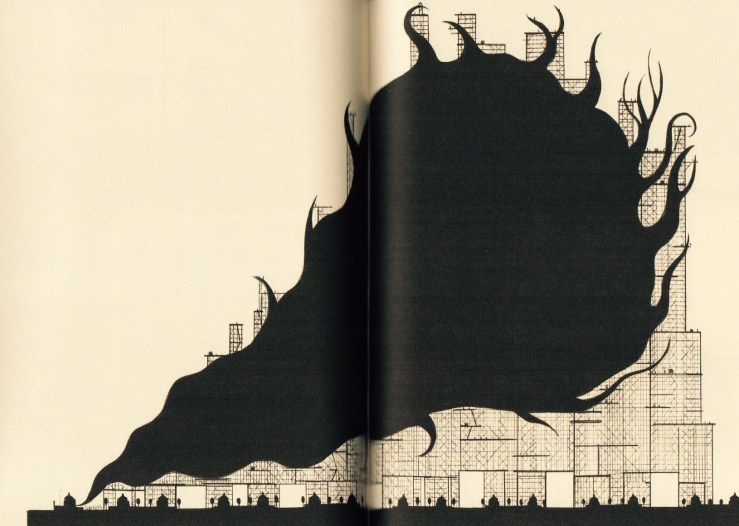
The beard quickly becomes a national emergency requiring enormous resources. Police, military, the media, and eventually the entire society become entangled in the crisis. United against a common foe, the citizens of Here are nevertheless distracted, letting their grooming habits slip. Things become less tidy. In their battle against the beard, they overlook the greater war on weird.
IMG_3868.JPG

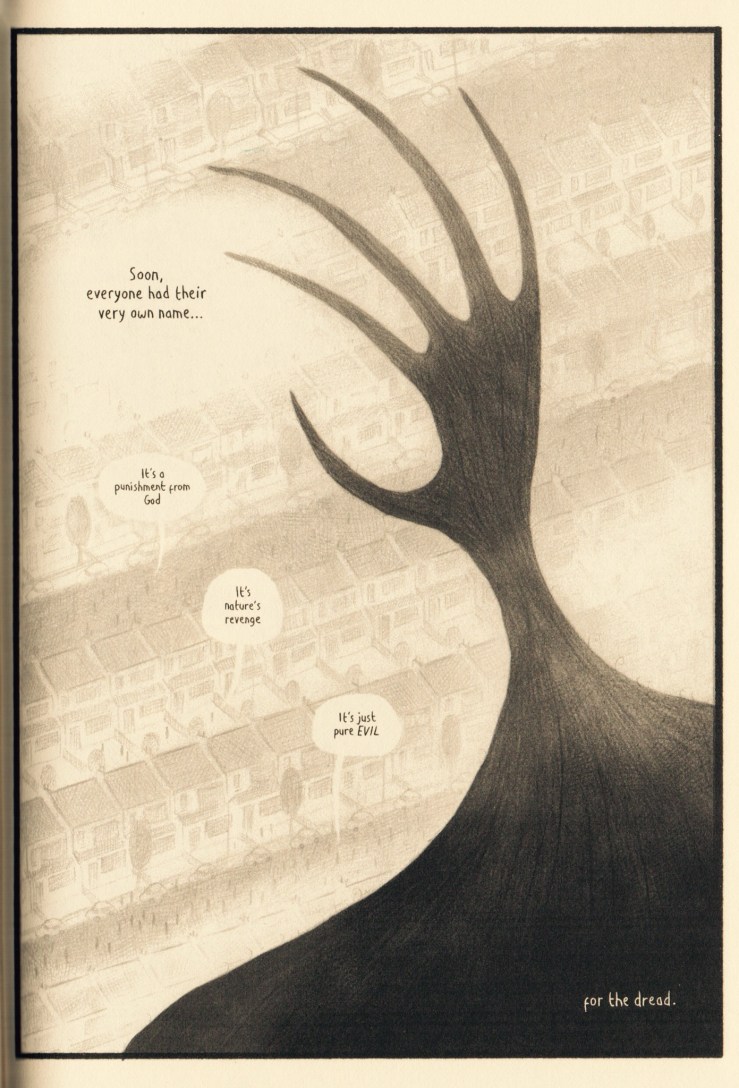
The Gigantic Beard That Was Evil is an allegorical fable. Collins attacks conformity and fear of otherness, but also depicts just how complex and horrifying otherness can be. While the island of Here is clearly a stand-in for England, Collins’s satire of xenophobia and the dangers of groupthink will resonate pretty much everywhere. All kinds of 21st-century anxieties writhe under the text: fear of immigration, the collapse of cultural homogeneity, ecological devastation—the end of a particular way of life. The angry mob castigating poor Dave call him a terrorist, but they are the authors of their own terror.
IMG_3874

In an unexpected and rewarding fourth act, Collins examines the aftermath of what comes to be known as “The Beard Event.” The Untidiness that happened while the citizens of Here were distracted dealing with Dave becomes the new normal. Fits of nonconformity inevitably become trends, then commodities.
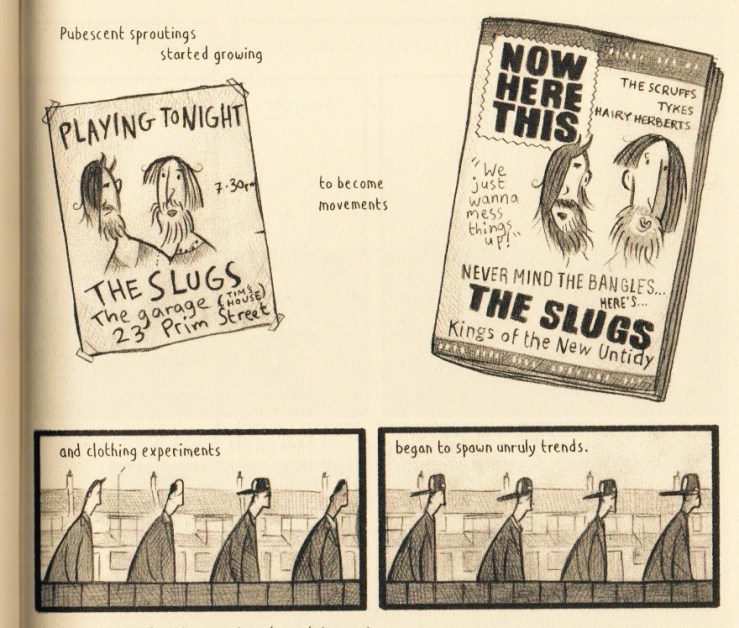
IMG_3869.JPG

The Beard Event eventually becomes “A story many times retold and resold,” complete with its own museum (enter through the gift shop). Collins offers a clear depiction of difference—how it’s first feared, then resisted and attacked, and eventually absorbed and recycled.

I’ve tried to offer enough of Collin’s words and art to convey a sense of his simple but refined style. His lines are often gentle and always precise, his subtle shading all the color this tale needs. The Gigantic Beard That Was Evil succeeds visually on the strength of Collins’s pacing and panel design. Collins seamlessly integrates his prose into the panels, moving the story along in a lilt of rhymes and non-rhymes evocative of Edward Gorey or Roald Dahl. Collins nimbly avoids the potential pitfalls of preachiness or meaningless absurdity here, leading to a confident and convincing début. I look forward to more. Great stuff.

The Gigantic Beard That Was Evil is now available in the United States in hardback and ebook from Picador.

Portrait of Zacharie Astruc — Edouard Manet

Cynthia — William Strang

Witches Ready to Fly — Francisco Goya

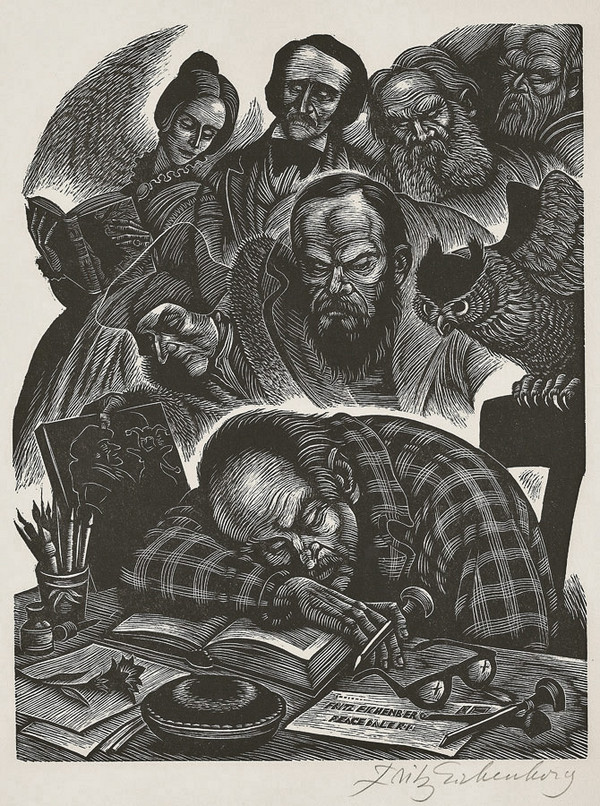
Dream of Reason — Fritz Eichenberg

dream of reason

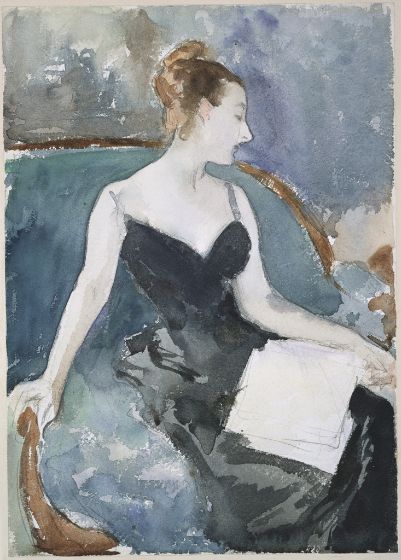
Madame Gautreau (Study) — John Singer Sargent

43183414

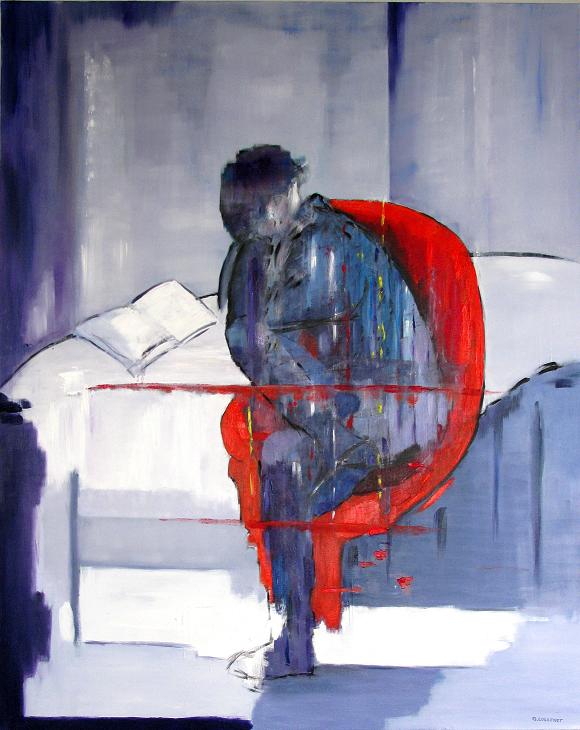
Character Reading — Benoit Colsenet

Personnage-lisant-2

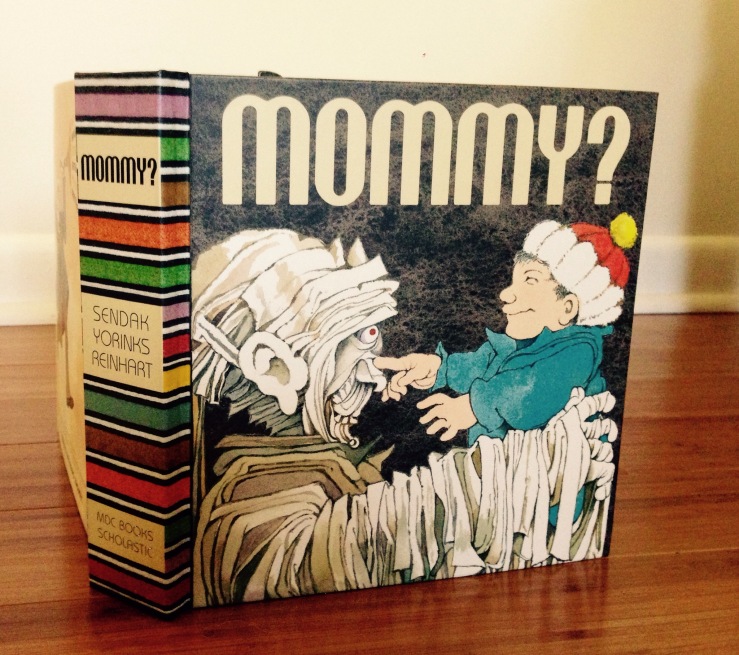
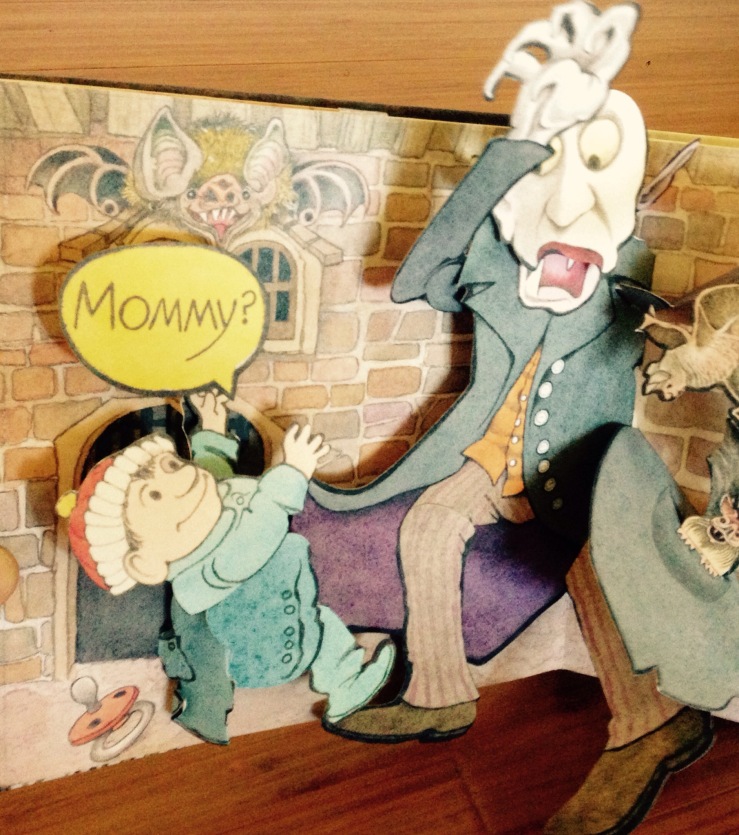
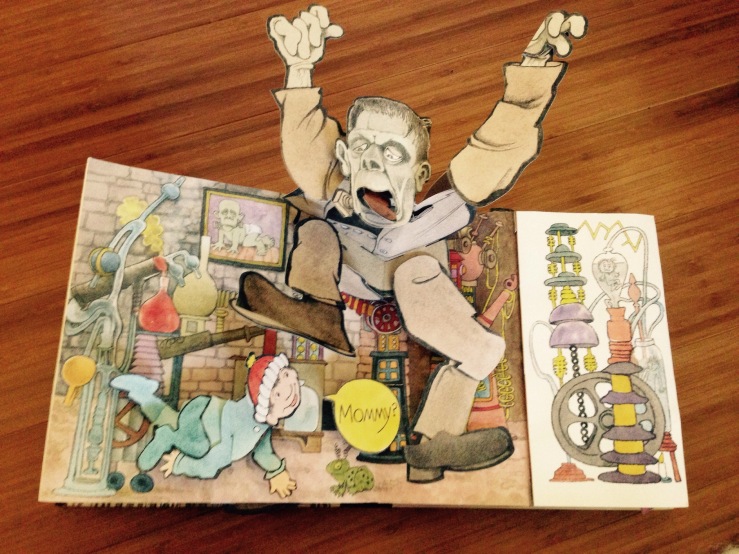
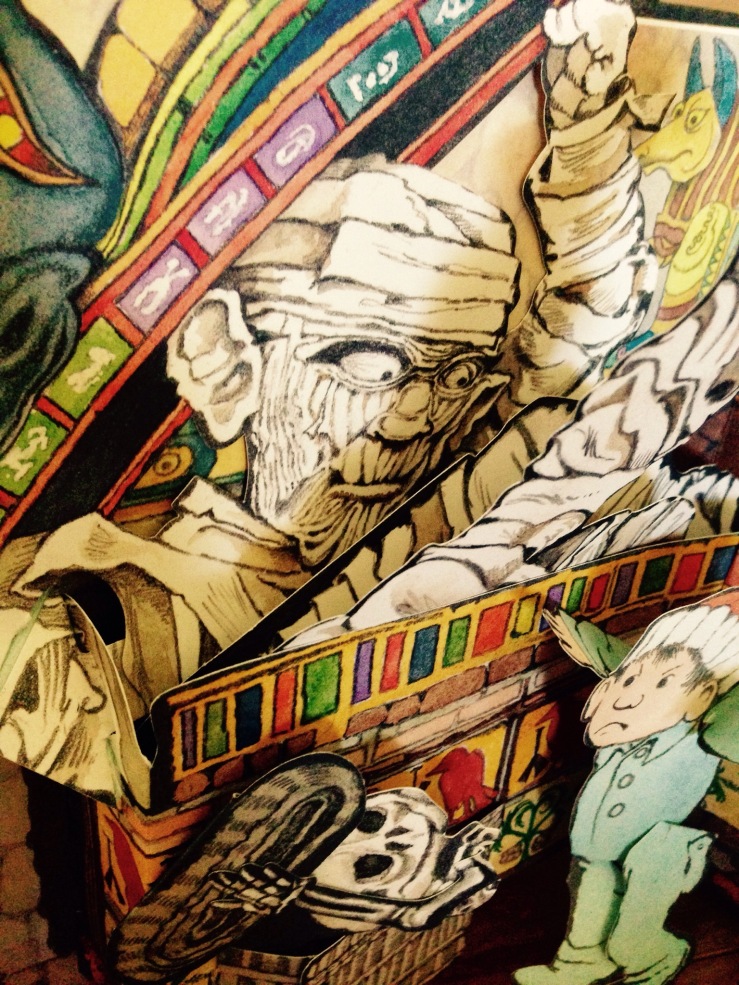
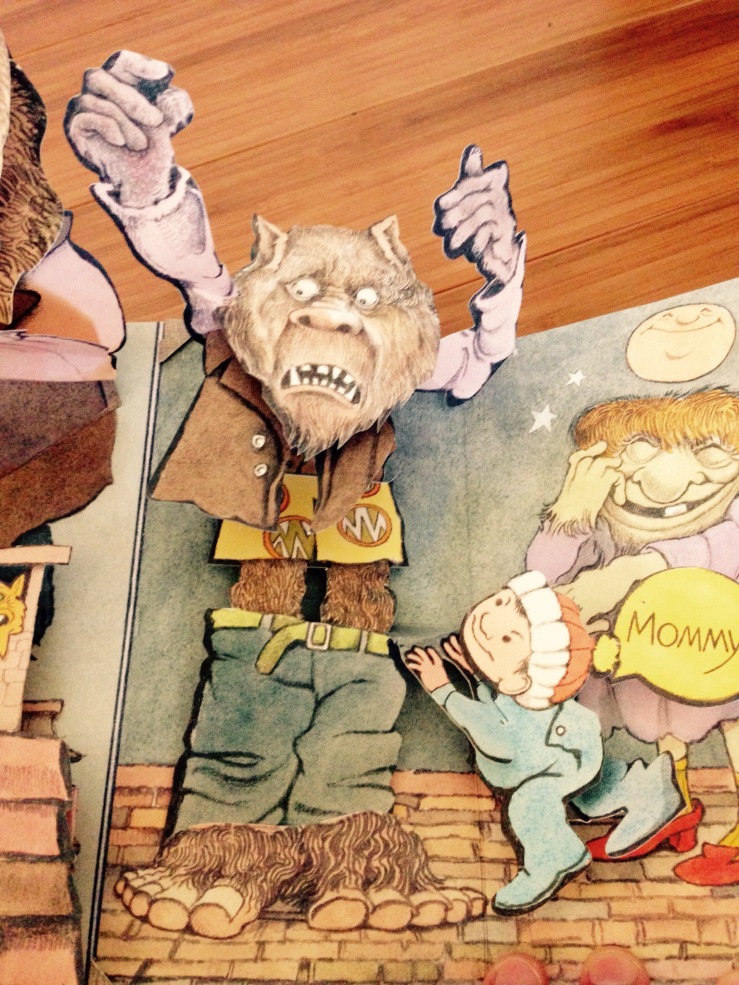
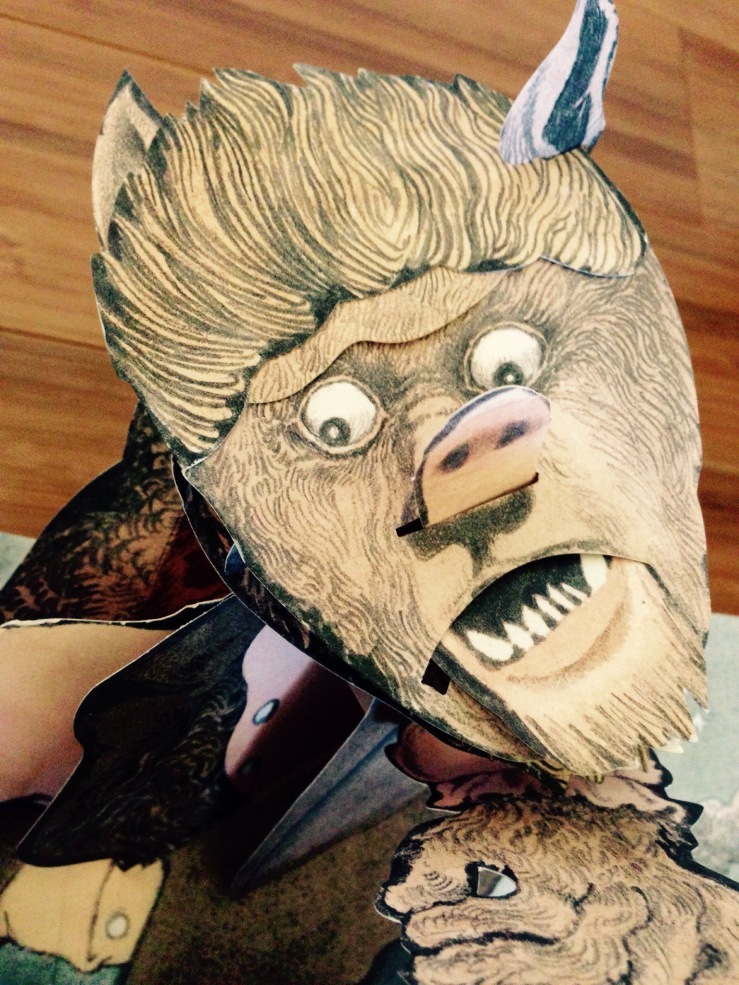
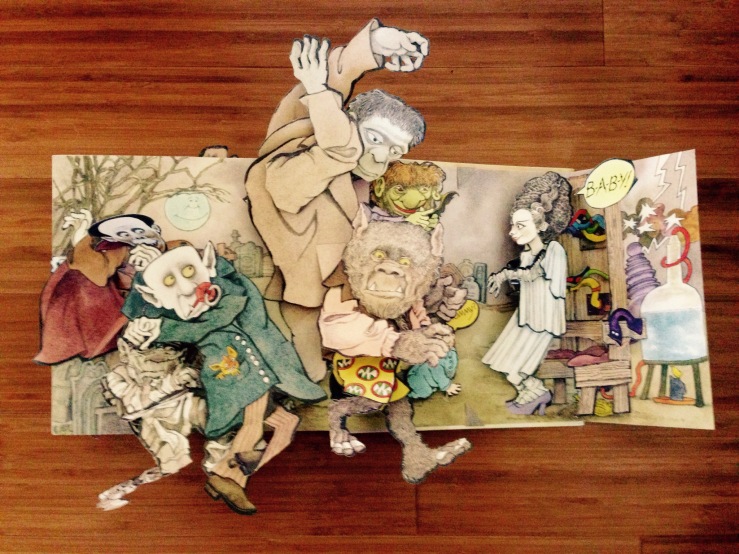
Maurice Sendak’s Pop-Up Book of Monsters (Book Acquired, 10.24.2014)

IMG_3785 IMG_3789 IMG_3791 IMG_3795 IMG_3798 IMG_3797 IMG_3799

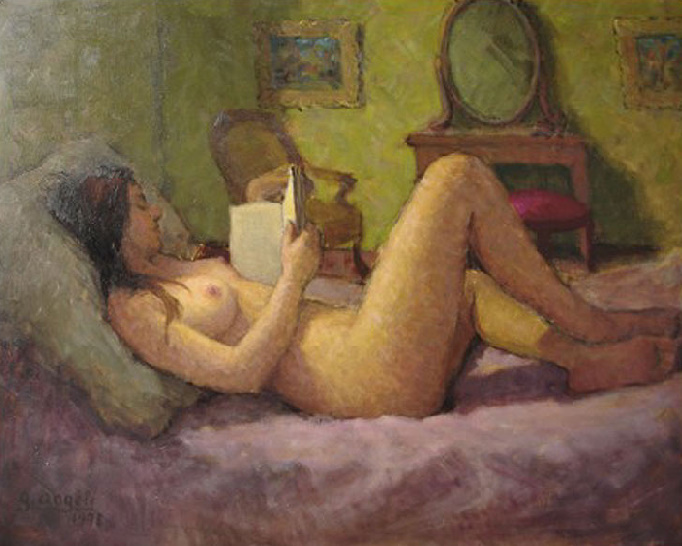
Nude Reading — Guérino Angèli

Angeli, Guerino - nu lisant

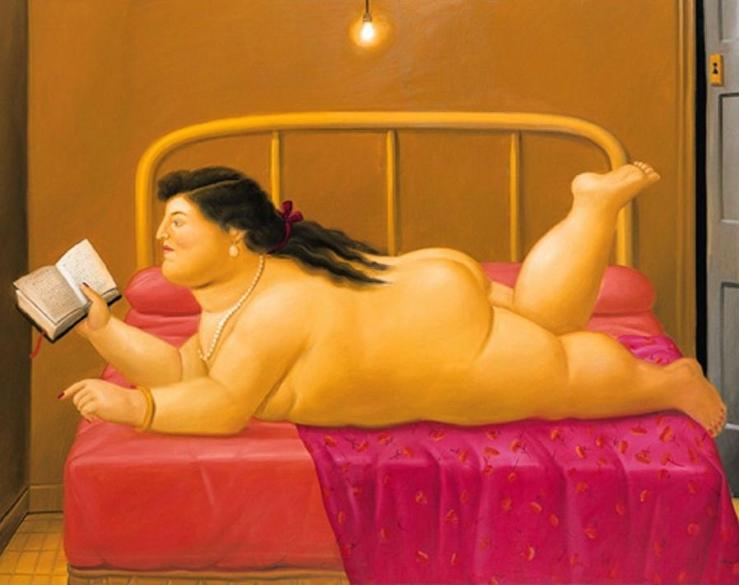
Woman Reading — Fernando Botero

538

The Person’s Guide to Ritual and Invasive Mind Control

mindcontrolwww-scarfolk-blogspot-com

“Sun Worship. The Sources of Hallowe’en”

“Sun Worship. The Sources of Hallowe’en” is the first chapter of Ruth Edna Kelley’s The Book of Hallowe’en (1919)

If we could ask one of the old-world pagans whom he revered as his greatest gods, he would be sure to name among them the sun-god; calling him Apollo if he were a Greek; if an Egyptian, Horus or Osiris; if of Norway, Sol; if of Peru, Bochica. As the sun is the center of the physical universe, so all primitive peoples made it the hub about which their religion revolved, nearly always believing it a living person to whom they could say prayers and offer sacrifices, who directed their lives and destinies, and could even snatch men from earthly existence to dwell for a time with him, as it draws the water from lakes and seas.

In believing this they followed an instinct of all early peoples, a desire to make persons of the great powers of nature, such as the world of growing things, mountains and water, the sun, moon, and stars; and a wish for these gods they had made to take an interest in and be part of their daily life. The next step was making stories about them to account for what was seen; so arose myths and legends.

The sun has always marked out work-time and rest, divided the year into winter idleness, seed-time, growth, and harvest; it has always been responsible for all the beauty and goodness of the earth; it is itself splendid to look upon. It goes away and stays longer and longer, leaving the land in cold and gloom; it returns bringing the long fair days and resurrection of spring. A Japanese legend tells how the hidden sun was lured out by an image made of a copper plate with saplings radiating from it like sunbeams, and a fire kindled, dancing, and prayers; and round the earth in North America the Cherokees believed they brought the sun back upon its northward path by the same means of rousing its curiosity, so that it would come out to see its counterpart and find out what was going on.

All the more important church festivals are survivals of old rites to the sun. “How many times the Church has decanted the new wine of Christianity into the old bottles of heathendom.” Yule-tide, the pagan Christmas, celebrated the sun’s turning north, and the old midsummer holiday is still kept in Ireland and on the Continent as St. John’s Day by the lighting of bonfires and a dance about them from east to west as the sun appears to move. The pagan Hallowe’en at the end of summer was a time of grief for the decline of the sun’s glory, as well as a harvest festival of thanksgiving to him for having ripened the grain and fruit, as we formerly had husking-bees when the ears had been garnered, and now keep our own Thanksgiving by eating of our winter store in praise of God who gives us our increase.

Pomona, the Roman goddess of fruit, lends us the harvest element of Hallowe’en; the Celtic day of “summer’s end” was a time when spirits, mostly evil, were abroad; the gods whom Christ dethroned joined the ill-omened throng; the Church festivals of All Saints’ and All Souls’ coming at the same time of year—the first of November—contributed the idea of the return of the dead; and the Teutonic May Eve assemblage of witches brought its hags and their attendant beasts to help celebrate the night of October 31st.

Colombine — Francine van Hove

escrever - escritor, livro

The Magdalen Reading — Ambrosius Benson

“A very fanciful person, when dead, to have his burial in a cloud” (And other ideas from Nathaniel Hawthorne’s Note-Books)

  1. When scattered clouds are resting on the bosoms of hills, it seems as if one might climb into the heavenly region, earth being so intermixed with sky, and gradually transformed into it.
  2. A stranger, dying, is buried; and after many years two strangers come in search of his grave, and open it.
  3. The strange sensation of a person who feels himself an object of deep interest, and close observation, and various construction of all his actions, by another person.
  4. Letters in the shape of figures of men, etc. At a distance, the words composed by the letters are alone distinguishable. Close at hand, the figures alone are seen, and not distinguished as letters. Thus things may have a positive, a relative, and a composite meaning, according to the point of view.
  5. “Passing along the street, all muddy with puddles, and suddenly seeing the sky reflected in these puddles in such a way as quite to conceal the foulness of the street.”
  6. A young man in search of happiness,–to be personified by a figure whom he expects to meet in a crowd, and is to be recognized by certain signs. All these signs are given by a figure in various garbs and actions, but he does not recognize that this is the sought-for person till too late.
  7. If cities were built by the sound of music, then some edifices would appear to be constructed by grave, solemn tones,–others to have danced forth to light, fantastic airs.
  8. Familiar spirits, according to Lilly, used to be worn in rings, watches, sword-hilts. Thumb-rings were set with jewels of extraordinary size.
  9. A very fanciful person, when dead, to have his burial in a cloud.


From Nathaniel Hawthorne’s American Note-Books.

Young Woman Reading — Karl Müller

tumblr_n9wk6pWXoL1soqrhbo1_1280