Under the Volcano and elsewhere (Books acquired, week of 10 March 2023)

My family and I had a wonderful time vacationing in Mexico City last week. We rented an apartment in Condesa, a friendly, walkable neighborhood marked by shade trees, lush gardens, and robust parks. And dogs. Lots of lovely dogs. Over eight days, we took in as much of the city as we could (as well as some excellent day trips to Grutas Tolantongo in Hidalgo and Teotihuacán in Edomex). The city is huge, with more than 150 museums, and the food is excellent. While the four members of our family share common interests (including a love of art), making sightseeing somewhat streamlined, I left Mexico City feeling like I had barely scratched the surface. It reminded me in disparate ways of New York City, Bangkok, and New Orleans. Like those cities, there’s not a single aspect that intrigues me, but rather a vibe. But this is not a travel blog, it is a book blog, so:

The first thing I noticed is that the selection of titles in the several bookstores I visited (a few just very briefly) was generally excellent. Shops tended to feature big-ell Literature titles in lieu of bestsellers and airport novels, with new releases like Mircea Cartarescu’s Solenoid and Yuri Herrera’s La estación del pantano getting prominent displays.

I visited both locations of Cafebrería El Péndulo, and picked up an inexpensive Debolsillo edition of Roberto Bolaño’s La literatura nazi en America, resisting the urge to grab one of the big novels. I’ve read Chris Andrews’ translation of Nazi Literature in the Americas a few times, and I figured that it would be better for me to attempt reading and comparing the shorter sketches here than to jump into 2666 in Spanish. Although I practiced my Spanish for a year in preparation for the trip (it helps to have a Spanish professor friend whose office is down the hall from mine), my vocabulary is still limited and my conjugations are a mess.
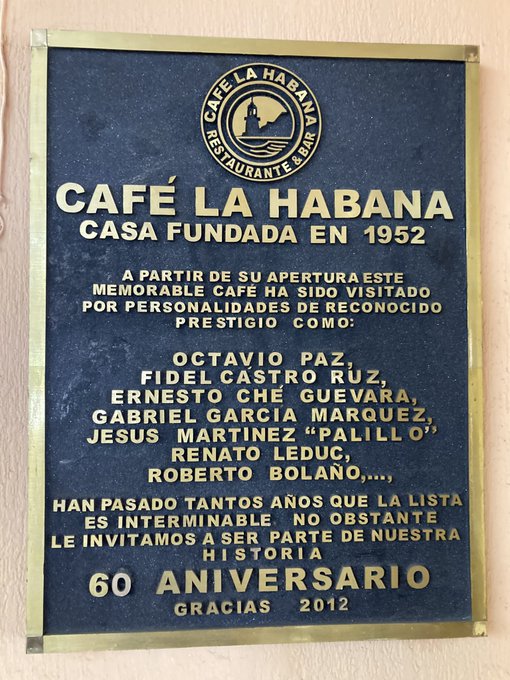
Also Bolaño-related: We lunched at Café la Habana, a charming restaurant boasting a history as a salon for poets, politicians, theorists and other bullshitters. In Bolaño’s Mexican opus The Savage Detectives, Café la Habana appears as Café Quito.

I also visited Under the Volcano, a tiny and charming bookstore in Condesa that carries English-language books–mostly literature. The store is named for Malcolm Lowry’s excellent novel, but there didn’t appear to be any of his books there the day I visited. There was a first-edition hardback copy of Robert Coover’s Pricksongs and Descants, but it was jacketless and out of my price range. There was also a standalone magazine-sized Dalkey Archive edition of William H. Gass’s story Willie Master’s Lonesome Wife, which, based on its price, the owner seemed to believe the most valuable item in the store. I also spied a copy of Jay McInerney’s 1984 novel Ransom, notable because it’s the first and so-far only hardcover of a Vintage Contemporaries edition I’ve ever seen.
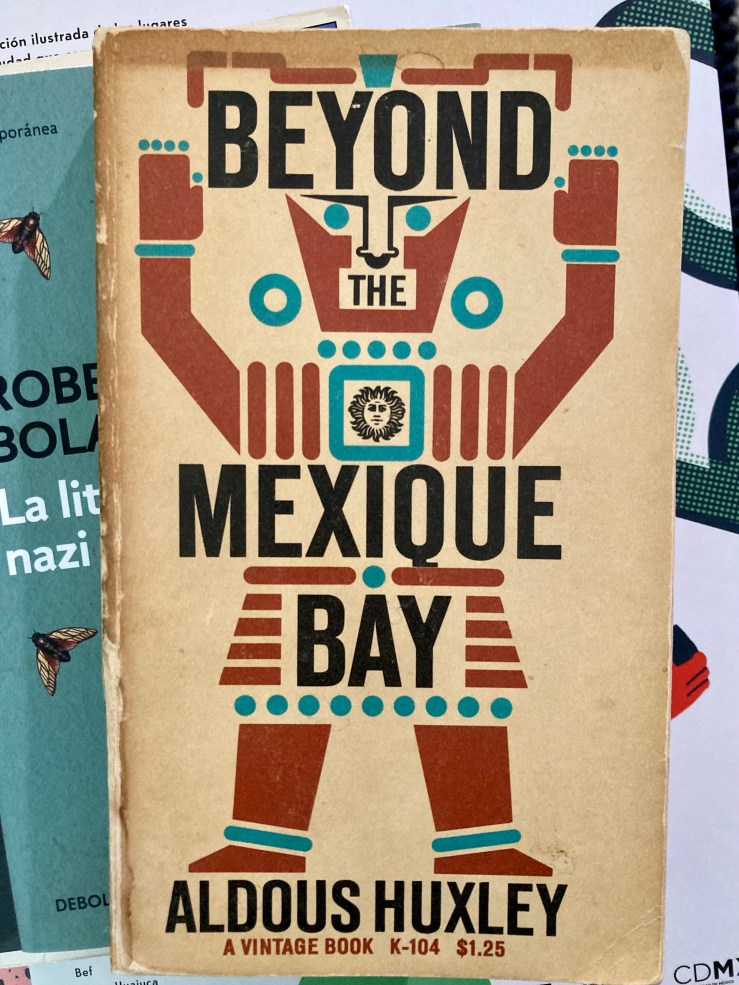
I wound up with two books from Under the Volcano: a Europa Editions of Steven Erickson’s Zeroville and Vintage edition of Aldous Huxley’s Beyond the Mexique Bay. I listened to the audiobook of Zeroville a few years ago, loved it, and have kept an eye out for a reasonably-priced copy ever since. I admit that I picked up Huxley’s essay collection in large part because of its title and its cover design (by Bradbury Thompson). I only found it because I was looking for a copy of Huxley’s The Devils of Loudun. I’ve been falling asleep to an audiobook version of Devils for about three weeks now.

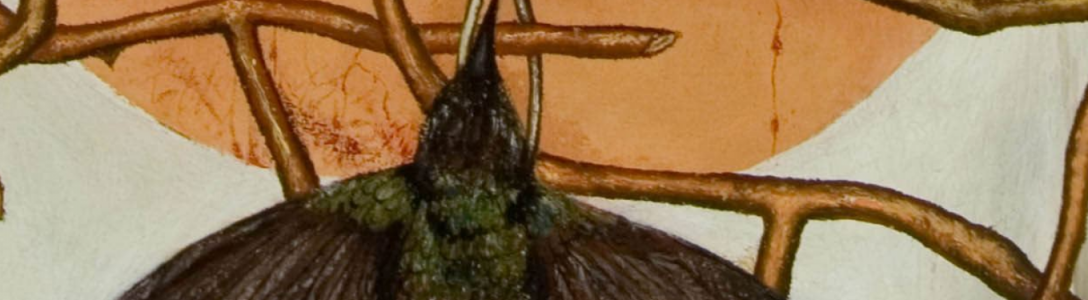
I stopped into a La Increíble Librería at random while walking through Condesa. It’s a charming store that specializes in art books and arty children’s books. They also sell a small but excellent selection of Latin American titles in English translation. I picked up a coffee table book there called 50 íconos de la Ciudad de México. The book is in both Spanish and English, and features lovely illustrations of iconic Mexico City locations by ten different artists. Here’s a detail from Diego Huacuja’s illustration of the Auditorio Nacional:

As we looked through this book this morning, my wife remarked on just how few of the fifty icons presented we missed seeing on this trip. And although we saw a lot that’s not in the book, it nevertheless confirmed my feeling that we need to visit Mexico City again.

“On Visiting Bookshops” — Christopher Morley

“On Visiting Bookshops” by Christopher Morley

It is a curious thing that so many people only go into a bookshop when they happen to need some particular book. Do they never drop in for a little innocent carouse and refreshment? There are some knightly souls who even go so far as to make their visits to bookshops a kind of chivalrous errantry at large. They go in not because they need any certain volume, but because they feel that there may be some book that needs them. Some wistful, little forgotten sheaf of loveliness, long pining away on an upper shelf—why not ride up, fling her across your charger (or your charge account), and gallop away. Be a little knightly, you book-lovers!

The lack of intelligence with which people use bookshops is, one supposes, no more flagrant than the lack of intelligence with which we use all the rest of the machinery of civilization. In this age, and particularly in this city, we haven’t time to be intelligent.

A queer thing about books, if you open your heart to them, is the instant and irresistible way they follow you with their appeal. You know at once, if you are clairvoyant in these matters (libre-voyant, one might say), when you have met your book. You may dally and evade, you may go on about your affairs, but the paragraph of prose your eye fell upon, or the snatch of verses, or perhaps only the spirit and flavour of the volume, more divined than reasonably noted, will follow you. A few lines glimpsed on a page may alter your whole trend of thought for the day, reverse the currents of the mind, change the profile of the city. The other evening, on a subway car, we were reading Walter de la Mare’s interesting little essay about Rupert Brooke. His discussion of children, their dreaming ways, their exalted simplicity and absorption, changed the whole tenor of our voyage by some magical chemistry of thought. It was no longer a wild, barbaric struggle with our fellowmen, but a venture of faith and recompense, taking us home to the bedtime of a child.

The moment when one meets a book and knows, beyond shadow of doubt, that that book must be his—not necessarily now, but some time—is among the happiest excitements of the spirit. An indescribable virtue effuses from some books. One can feel the radiations of an honest book long before one sees it, if one has a sensitive pulse for such affairs. Its honour and truth will speak through the advertising. Its mind and heart will cry out even underneath the extravagance of jacket-blurbings. Some shrewd soul, who understands books, remarked some time ago on the editorial page of the Sun’s book review that no superlative on a jacket had ever done the book an atom of good. He was right, as far as the true bookster is concerned. We choose our dinner not by the wrappers, but by the veining and gristle of the meat within. The other day, prowling about a bookshop, we came upon two paper-bound copies of a little book of poems by Alice Meynell. They had been there for at least two years. We had seen them before, a year or more ago, but had not looked into them fearing to be tempted. This time we ventured. We came upon two poems—“To O, Of Her Dark Eyes,” and “A Wind of Clear Weather in England.” The book was ours—or rather, we were its, though we did not yield at once. We came back the next day and got it. We are still wondering how a book like that could stay in the shop so long. Once we had it, the day was different. The sky was sluiced with a clearer blue, air and sunlight blended for a keener intake of the lungs, faces seen along the street moved us with a livelier shock of interest and surprise. The wind that moved over Sussex and blew Mrs. Meynell’s heart into her lines was still flowing across the ribs and ledges of our distant scene.

There is no mistaking a real book when one meets it. It is like falling in love, and like that colossal adventure it is an experience of great social import. Even as the tranced swain, the book-lover yearns to tell others of his bliss. He writes letters about it, adds it to the postscript of all manner of communications, intrudes it into telephone messages, and insists on his friends writing down the title of the find. Like the simple-hearted betrothed, once certain of his conquest, “I want you to love her, too!” It is a jealous passion also. He feels a little indignant if he finds that any one else has discovered the book, too. He sees an enthusiastic review—very likely in The New Republic—and says, with great scorn, “I read the book three months ago.” There are even some perversions of passion by which a book-lover loses much of his affection for his pet if he sees it too highly commended by some rival critic.
This sharp ecstasy of discovering books for one’s self is not always widespread. There are many who, for one reason or another, prefer to have their books found out for them. But for the complete zealot nothing transcends the zest of pioneering for himself. And therefore working for a publisher is, to a certain type of mind, a never-failing fascination. As H. M. Tomlinson says in “Old Junk,” that fascinating collection of sensitive and beautifully poised sketches which came to us recently with a shock of thrilling delight:

To come upon a craft rigged so, though at her moorings and with sails furled, her slender poles upspringing from the bright plane of a brimming harbour, is to me as rare and sensational a delight as the rediscovery, when idling with a book, of a favourite lyric.

To read just that passage, and the phrase the bright plane of a brimming harbour, is one of those “rare and sensational delights” that set the mind moving on lovely journeys of its own, and mark off visits to a bookshop not as casual errands of reason, but as necessary acts of devotion. We visit bookshops not so often to buy any one special book, but rather to rediscover, in the happier and more expressive words of others, our own encumbered soul.

John Hodgman Riffs on Bookstores on The Daily Show

Vodpod videos no longer available.