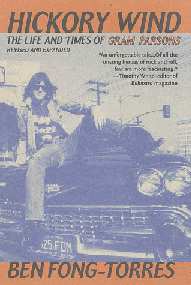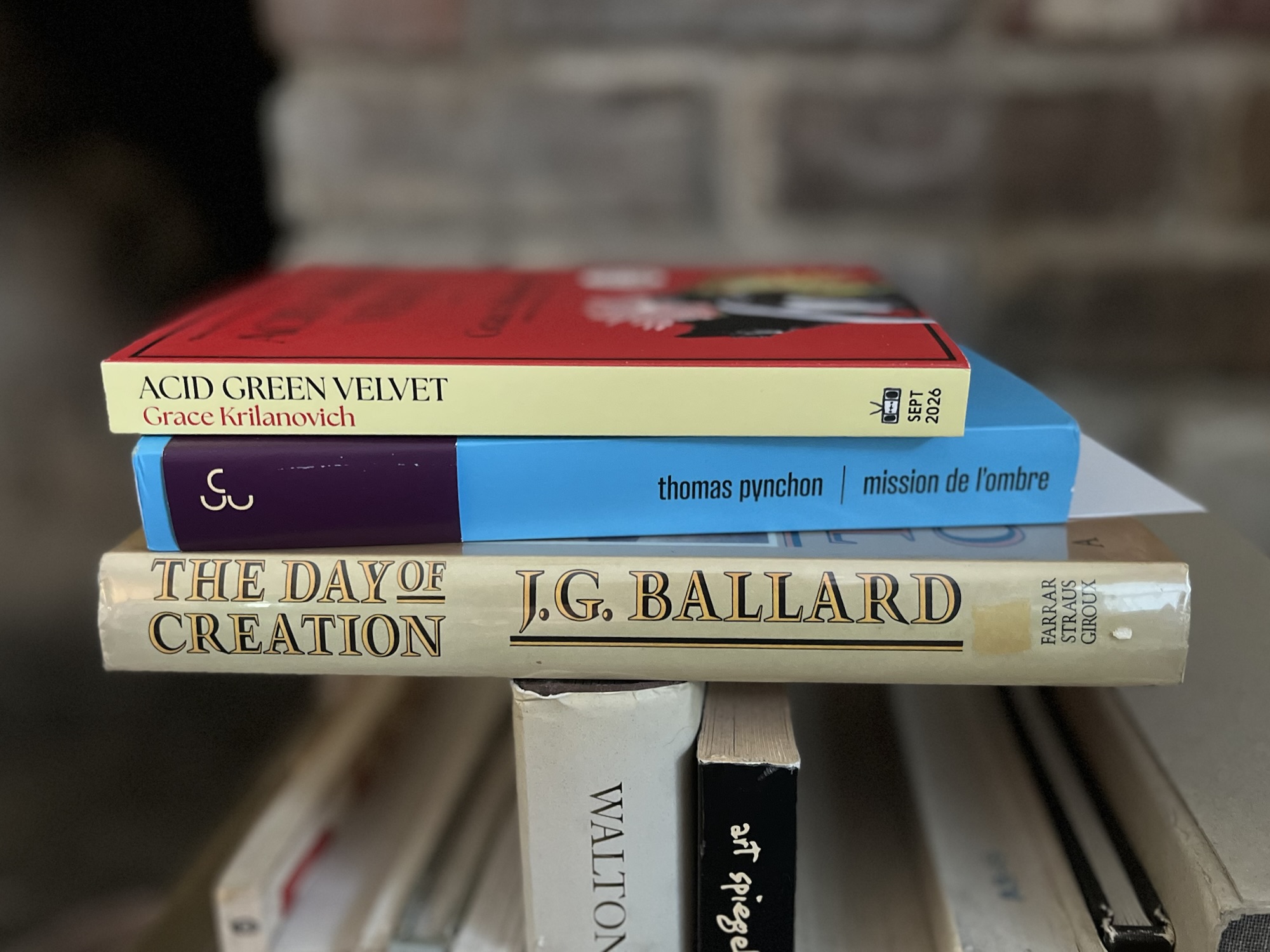
Any time I visit Atlanta, I have to stop by A Capella Books. I walked down there from Little Five Points, where my wife and son were still looking around. I have never seen L5P so busy, thick with hipsters young and old and even older who were killing hours, like we were, I suppose, before the first set of bands that night at the Shaky Knees festival in Piedmont Park. A Capella was pleasantly empty, for the most part.
I picked up a first American edition of J.G. Ballard’s 1987 novel The Day of Creation. Not Ballard’s finest, not his worst; the collector in me thought it should go home with me.
After some downtime at a rental we walked to Piedmont Park for the first night of Shaky Knees, an outdoor music festival featuring four stages in the sweltering swooning swanning sauna September heat. I am very much not a Music Festival Guy, but I wanted to see some of the bands in this year’s lineup, and my son wanted to see even more of the bands — so we made a family trip of it.
We arrived not quite an hour before the psyop (?) indie sensation Geese were to start their set. A band called Hot Mulligan were playing; I had tried to listen to a little bit of their music on the drive up to Atlanta (I did this for pretty much all the bands I hadn’t heard before), and it was decidedly Not For Me. I did like their live sound though, and especially the singer’s charisma. Oh who the fuck am I kidding — I guess he really just won me over when he implored the crowd to “Boo the VIP section!” (Shaky Knees, like every other thing in America right now, is a capitalist swine scam: shaded areas barricaded off for the richies to rest, covered stadium seating for the very rich richies to enjoy their punk-indie-etc., $35 margaritas, a little village of “brand partner experiences” where you could, if you were so stupidly inclined, take pictures in front of a Sierra Nevada “immersion room.” So fuckin punk!). Anyway, speaking of rich kids–
I tried to watch the band Geese with an open mind. My son likes their record and he generally has good taste. The crowd seemed to like what they were doing, which was really just a shoddy whiny blues-rock thing expressed in impoverished chords. One of the guitar players was wearing a Melt Banana t-shirt. I opened for Melt Banana at a record store in like 1999 or 2000, a piece of information that dramatically drove up my esteem in my son’s eyes. I thought Geese were genuinely bad at playing their instruments, their songs were boring, and, worst of all, their guitar tone was terrible.
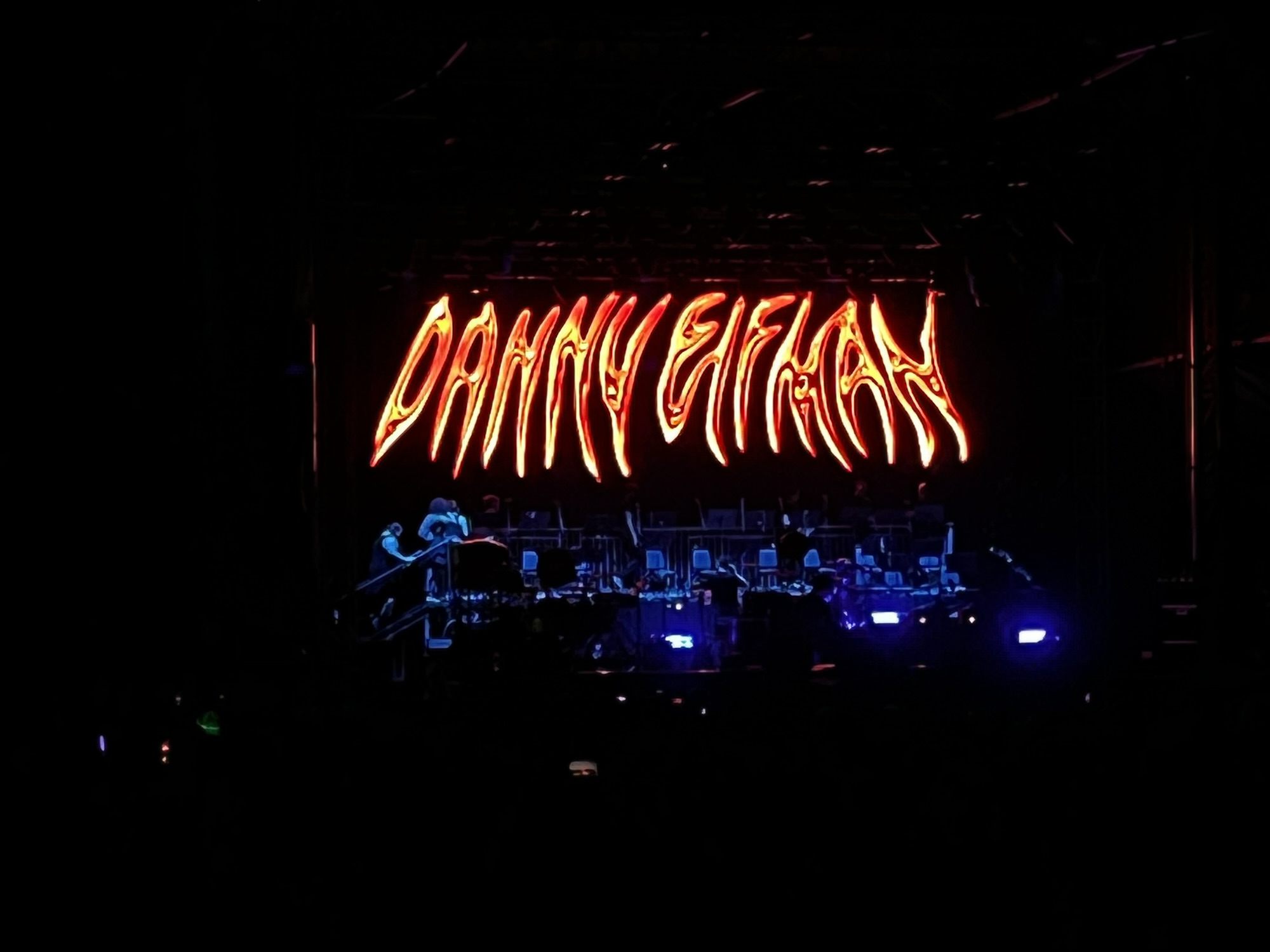
Luckily Danny Elfman played next. For some reason, this legend was consigned to the smallest stage at the festival, tucked back in the hills of the park (I would see Geordie Greep there later, as well as some of the Bone Thugs-n-Harmony set). Elfman plays a lot of Oingo Boingo songs mixed in with some of the greatest hits of his scores. He plays with a full rock band, orchestra, and choir. It’s totally fucked up and amazing. If there had been a roof over the park it would’ve exploded when they played “This Is Halloween”; what’s left of the metaphorical roof would have disintegrated during The Simpsons theme. I am not, like, a Danny Elfman fan–but I guess I’m Gen X or whatever, and I suppose I really enjoy weird but very accomplished musicianship. Also, Danny Elfman is like 73 and totally jacked. (Google him.)
We caught the end of Fontaines D.C. (great show from a band I didn’t really care about) and then (speaking of rich kids), watched headliners The Strokes. I was impressed by their show — they seemed to understand the assignment and Played the Hits and Mostly That First Album.
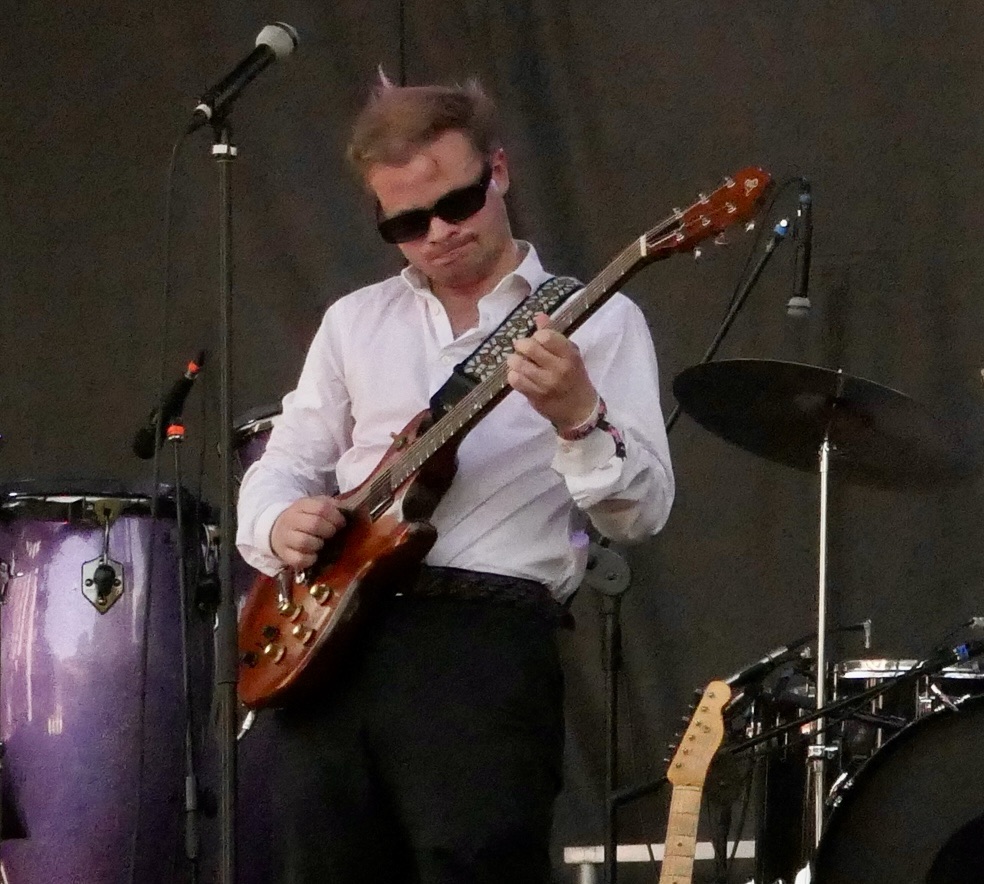
Next day, Saturday, was generally a weaker lineup, but it featured the two acts I most wanted to see: Geordie Greep and Pavement. I’d caught Greep last week in Jacksonville, a show I didn’t know was going to happen back when I bought the Shaky tickets. Both shows were excellent. If you don’t know Greep’s stuff, it’s kinda like Zappa or King Crimson with the horny Philip-Roth-persona lyrics delivered in a crooning but theatrical style, a mix of David Lee Roth and Meat Loaf. His album The New Sound was my favorite of 2024 and pretty much everyone I’ve tried to play it for has hated it, other than my son. The day was blazing, so we scooted back to the rental, rested, and returned for Blood Orange. Their set started great but was then interrupted by lightning and thunder and then a torrential downpour and an evacuation of the park. No Pavement for your boy! I got beat by weather.
I consoled myself with recollecting the show I saw back in, what was it, ’95, ’96, with Royal Trux opening? They were fucking terrible at that show. We trudged home in inches of thick gross water. I watched the Florida-Auburn game on my laptop, another consolation. (Feed my thrill.)
We spent too much of Sunday at Piedmont Park. I think there were like 50,000 people there. It was Hot as Fuck. I was impressed by Santigold’s set, which was high energy despite the astounding, oppressive heat. My son was looking forward to Modest Mouse and was disappointed, much as I had been disappointed way back in, what was it, ’98, ’99 when I first saw them shit the bed in a boozy concert in Gainesville? (I should disclose that their front man later lived down the street from me for a season and was a notorious total dick to everyone in the scene and generally thought he was like, too cool for school I guess.) They sounded thin and unenthusiastic.
Wu-Tang Clan were unexpectedly fantastic — I mean, I love those early albums, but I honestly expected them to phone it in, but they played all the “hits” with enthusiasm and energy. LCD Soundsystem turned out to be the highlight of the festival. I’ve loved some of their tracks over the years, but soured on the band when they made an enormous fuckin’ deal about disbanding (I mean they made a film about it!) only to reunite — but they were great. I’m generally ambivalent about headliners Gorillaz, but they sounded great, played all the hits, and had an impressive roster of features show up in person, including Del the Funky Homosapien, who capped the festival with a rousing rendition of “Clint Eastwood.”
Unable to sleep, my ears ringing, I finished the novel I’d been reading on the trip,Grace Krilanovich’s Acid Green Velvet. This is a novel about hoboes, grifters, yeggs, anarchists, socialists, cults and movements and capital and anti-capital. It takes place in some alternate version of the end of the nineteenth century, in some alternate California. Acid Green Velvet is surreal and sinister and funny and sexy and gross; it’s part horror, part social satire, part historical thriller, part part part part part…Look, I loved this novel, Acid Green Velvet. Maybe fifty, sixty pages in it really sank into me, or I really sank into it. It reminds me strongly of Thomas Pynchon’s work, particularly Against the Day, with which it shares many themes and motifs, as well as Slothrop’s toilet adventures in Gravity’s Rainbow (it’s, uh, abject). It’s not just the themes, but also the oblique, layered, surrealistic/mystical style of Krilanovich’s prose that recalls Pynchon’s style. Her approach is, to be clear, in no way an imitation or approximation, but rather blood that flows from the same vein. (The phrase against the day pops up late in the novel, by the way.) Proper review to come.
And more Pynchon:
When I got back home, I had a package from Paris — Nicolas Richard’s new French translation of Pynchon’s latest novel Shadow Ticket:
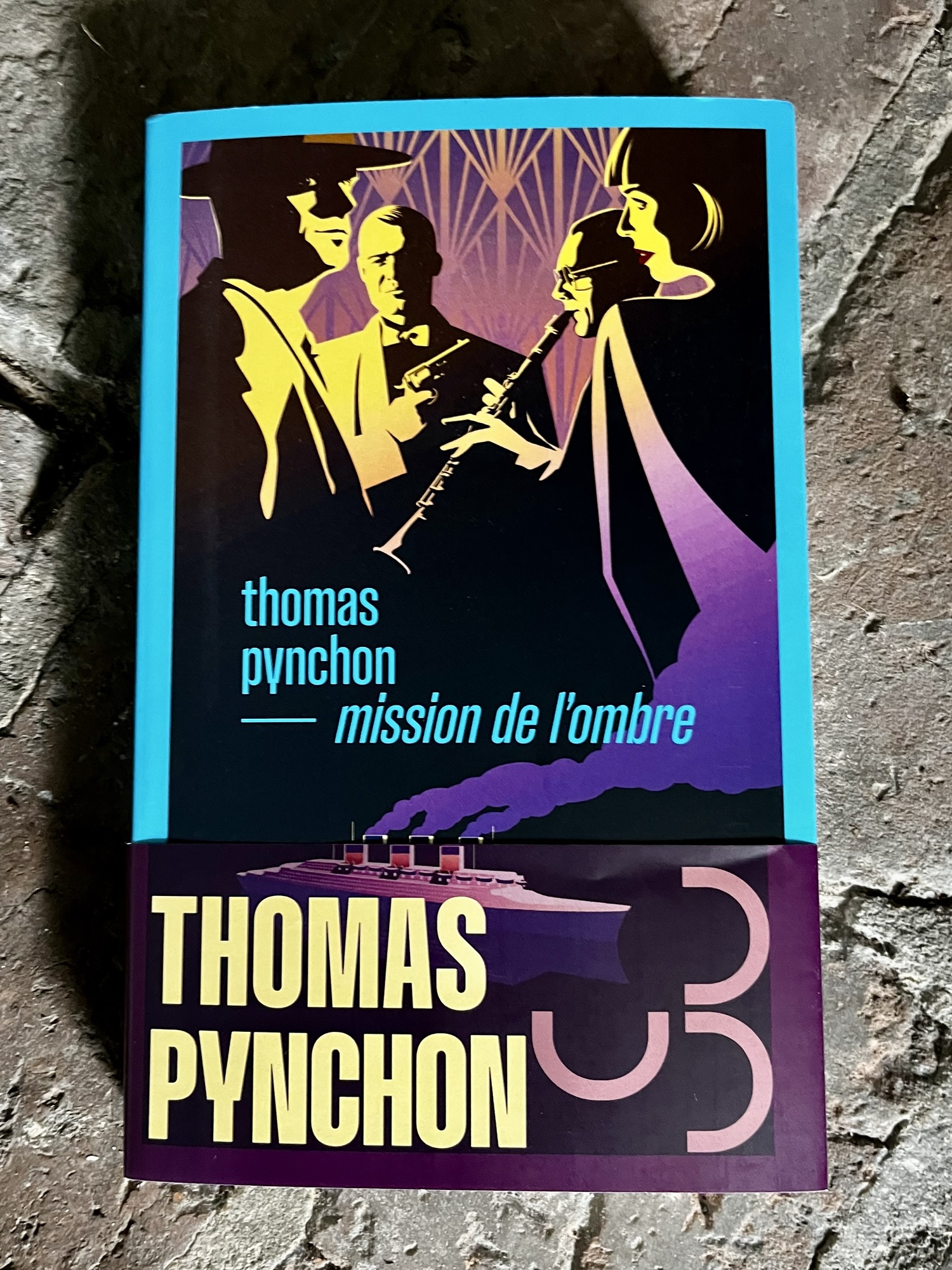
Nicolas got in touch with me early last year, and we corresponded for a few months about the novel. Answering his questions and trying out some of his phrasing was some of the most fun I’ve had in years. It was like reading the novel again through different eyes, different ears. Nicolas was kind enough to include me in his acknowledgements, which is one of the biggest little thrills of my life: