“Fictional Map of L.A.” — Geoff McFetridge


Geoff McFetridge’s fictional map of L.A., from GOOD magazine.

Biblioklept’s Favorite Books of the Summer

With Memorial Day ’11 just a memory and Labor Day warning off the wearing of white, I revisit some of the best books I read this summer:

Although I posted a review of Roberto Bolaño’s collection Between Parentheses two weeks before Memorial Day, I continued to read and reread the book over the entire summer. It was the gift that kept giving, a kind of blurry filter for the summer heat, a rambling literary dictionary for book thieves. For example, when I started Witold Gombrowicz’s Trans-Atlantyk a week or two ago, I spent a beer-soaked midnight tracing through Bolaño’s many notations on the Polish self-exile.

Trans-Atlantyk also goes on this list, or a sub-list of this list: great books that I’ve read, been reading (or in some cases, listened to/am listening to) but have not yet reviewed. I finished Trans-Atlantyk at two AM Sunday morning (surely the intellectual antidote to having watched twelve hours of college football that day) and it’s one of the strangest, most perplexing books I’ve ever read—and that’s saying something. Full review when I can process the book (or at least process the idea of processing the book).

I also read and absolutely loved Russell Hoban’s Kleinzeit, which is almost as bizarre as Trans-Atlantyk; like that novel (and Hoban’s cult classic Riddley Walker), Kleinzeit  is written in its own idiom, an animist world where concepts like Death and Action and Hospital and even God become concrete characters. It’s funny and sad. Also funny and sad: Christopher Boucher’s How to Keep Your Volkswagen Alive (new from Melville House). Like Trans-Atlantyk and Kleinzheit, Volkswagen is composed in its own language, a concrete surrealism full of mismatched metaphorical displacements. It’s a rare bird, an experimental novel with a great big heart. Full reviews forthcoming.

I’ll be running a review of Evelio Rosero’s new novel Good Offices this week, but I read it two sittings at the beginning of August and it certainly belongs on this list. It’s a compact and spirited satire of corruption in a Catholic church in Bogotá, unwinding almost like a stage play over the course of a few hours in one life-changing evening for a hunchback and his friends. Good stuff.

On the audiobook front, I’ve been working my way through George R. R. Martin’s A Song of Ice and Fire series; I finished the first audiobook, A Game of Thrones, after enjoying the HBO series, and then moved into the second book, A Clash of Kings, which I’m only a few hours from completing. I think that the HBO series, which follows the first book fairly faithfully, is much closer to The Wire or Deadwood than it is to Peter Jackson’s Tolkien films—the story is less about fantasy and magic than it is about political intrigue during an ongoing civil war. This is a world where honor and chivalry, not to mention magic and dragons, have disappeared, replaced by Machiavellian cunning and schemers of every stripe. Martin slowly releases fantastic elements into this largely desacralized world, contesting his characters’ notions of order and meaning. There are also beheadings. Lots and lots of beheadings. The books are a contemporary English department’s wet dream, by the by. Martin’s epic concerns decentered authority; it critiques power as a constantly shifting set of differential relations lacking a magical centering force. He also tells his story through multiple viewpoints, eschewing the glowing third person omniscient lens that usually focuses on grand heroes in fantasy, and concentrates instead, via a sharp free indirect style, on protagonists who have been relegated to the margins of heroism: a dwarf, a cripple, a bastard, a mother trying to hold her family together, a teenage exile . . . good stuff.

Leo Tolstoy’s final work Hadji Murad also depicts a world of shifting power, civil war, unstable alliances, and beheadings (although not as many as in Martin’s books). Hadji Murad tells the story of the real-life Caucasian Avar general Hadji Murad who fought under Imam Shamil, the leader of the Muslim tribes of the Northern Caucuses; Shamil was Russia’s greatest foe. This novel concerns Murad’s attempt to defect to the Russians and save his family, which Shamil has captured. The book is a richly detailed and surprisingly funny critique of power and violence.

William Faulkner’s Light in August might be the best book I read this summer; it’s certainly the sweatiest, headiest, and grossest, filled with all sorts of vile abjection and hatred. Faulkner’s writing is thick, archaeological even, plowing through layers of Southern sediment to dig up and reanimate old corpses. The book is somehow both nauseating and vital. Not a pleasant read, to be honest, but one that sticks with you—sticks in you even—long after the last page.

Although David Foster Wallace’s posthumous novel The Pale King was released in the spring, I didn’t start reading it until June; too much buzz in my ears. If you’ve avoided reading it so far because of the hype, fair enough—but don’t neglect it completely. It’s a beautiful, frustrating, and extremely rewarding read.

Speaking of fragments from dead writers: part two of Roberto Bolaño’s The Third Reich, published in the summer issue of The Paris Review, was a perfect treat over the July 4th weekend. I’m enjoying the suspense of a serialized novel far more than I would have imagined.

Wayne Koestenbaum’s Humiliation is probably the funniest, wisest, and most moving work of cultural studies I’ve ever read.  Unlike many of the tomes that clutter academia, Humiliation is accessible, humorous, and loving, a work of philosophical inquiry that also functions as cultural memoir. Despite its subject of pain and abjection, it repeatedly offers solutions when it can, and consolation and sympathy when it cannot.

So the second posthumously published, unfinished novel from a suicide I read this summer was Ernest Hemingway’s The Garden of Eden, the sultry strange tale of a doomed ménage à trois. (I’m as humiliated by that last phrase as you might be, dear reader. Sorry). Hemingway’s story of young beautiful newlyweds drinking and screwing and eating their way across the French Riviera is probably the weirdest thing he ever wrote. It’s a story of gender reversals, the problems of a three-way marriage, elephant hunting, bizarre haircuts, and heavy, heavy drinking. The Garden of Eden is perhaps Hemingway at his most self-critical; it’s a study in how Hemingway writes (his protagonist and stand-in is a rising author) that also actively critiques his shortcomings (as both author and human). The Garden of Eden should not be overlooked when working through Hemingway’s oeuvre. I’d love to see a critical edition with the full text someday (the novel that Scribner published pared down Hemingway’s unfinished manuscript to about a third of its size).

Also fragmentary fun: F. Scott Fitzgerald’s Notebooks. Like Twitter before Twitter, sort of.

These weren’t the only books I read this summer but they were the best.

“Backwood Names” — F. Scott Fitzgerald

F. Scott Fitzgerald puts his imagination to work. From Notebooks

BACKWOOD NAMES.
Olsie, Hassie, Goba, Bleba, Onza, (Ozma—my own), Retha, Otella, Tatrina, Delphia, Wedda, Zannis, Avaline, Burtryce, Chalme, Glenola, Turla, Verlie, Legitta, Navilla, Oha, Verla, Blooma, Inabeth, Versia, Gomeria, Valaria, Berdine, Olabeth, Adelloyd.

“The Sport Roadster” — F. Scott Fitzgerald

“The Sport Roadster,” a short short story/scene/memory (?) from F. Scott Fitzgerald’s Notebooks

The Sport Roadster
When I was a boy I dreamed that I sat always at the wheel of a magnificent Stutz—in those days the Stutz was the stamp of the romantic life—a Stutz as low as a snake and as red as an Indiana barn. But in point of fact, the best I could manage was the intermittent use of the family car. If I were willing to endure the most unaristocratic groanings and vibrations I could torture it up to fifty miles an hour.
But no matter how passionately I slouched down in the seat, I couldn’t make it look like a Stutz. One day I lowered the top and opened the windshield, and with the car thus pathetically jazzed up, took my mother and another lady down town shopping.
It was a scorching day. The sun blazed down upon us, the molten air blew like the breath of a furnace into our faces—through the open windshield. I could literally feel the sunburn deepening on me, block by block. It was appalling.
The two ladies fanned themselves uneasily. I don’t believe either of them quite realized what the trouble was. But I, even with the perspiration pouring into my eyes, found sight to envy the owner of a peagreen cut-down flivver which oozed by us through the heat.
My passengers visited a series of stores. I waited in the sun, still slouched down, and with that sort of half-sneer on my face which I had noted was peculiar to drivers of racing cars. The heat continued to be terrific.
Finally my mother’s friend came out of the store and I helped her into the car. She sank down into the seat—then sank quickly up again.
“Ah!” she said wildly.
She had burned herself.
When we reached home I offered—most unusually—to take them both for a long ride—anywhere they wished to go. They said politely that they were going for a little walk to cool off!

“He’s One of My Favorite American Writers” — F. Scott Fitzgerald

Another fragment from F. Scott Fitzgerald’s Notebooks. The piece was left out of Tender Is the Night. Phillips Oppenheim was British.

“Did you ever read the books of Phillips Oppenheim?”
“I think I’ve read one.”
“He’s one of my favorite American writers,” Tommy said simply. “He writes about the Riviera, you know. I don’t know whether the things he writes about are true but this place is like that.”
Standing before the gate they were suddenly bathed in a small floodlight, quick as a flashlight, that left them blinded for a moment. Then a voice from behind the gate.
“Who’s this, please?”
“Tell Monsieur Irv that it’s Monsieur Tommy. Tell him we can’t come in the house, but can he come out in the garden a minute.”
A section of the gate rumbled open like a safe and they were in a park, following a young Italo-American dandy toward a lighted house. They waited just out of range of the porch light, and presently the door opened and a dark thin man of forty came out and gazed blindly.
“Where you, Tommy?”
“Down here. Don’t come. I have a lady with me who wants to remain anonymous.”
“How?”
“I’ve got a lady with me who doesn’t want to be seen— like you.”
“Oh, I unestand, I unestand.”
“We want to swim. Anybody on the beach?”
“Nobody, nobody. Go ahead, Tommy. You want suits, towels?”
“All right, some towels. Nodoby’s going to come down, are they?”
“No, no, nobody. Say, did you see Du Pont de Nemours went up—”
“No stock market in the presence of ladies.”
“All right, excuse me, lady. You wait now—Salve will take you down—don’t want you to get in trouble.”
As Irv re-entered the house Tommy said, “Probably he’s phoning the machine gunner to pass us. He was a fellow townsman of yours in Chicago—now he has the best beach on the Riviera.”
Curiously Nicole followed down an intricate path, then through a sliding steel door that operated like a guillotine, out into a roofless cavern of white moonlight, formed by pale boulders about a cup of phosphorescent waters. It faced Monaco and the blur of Mentone beyond. She likes his taste in bringing her here—from the high­handed storming of Mr. Irv’s fortress.
Then, starting back the lane by which they had come Tommy tripped over a wire and a faint buzzer sounded far away.
“My God!” he excalimed, “that a man should have to live like this!”
“Is he afraid of burglars?”
“He’s afraid of your lovely city and came here with a bodyguard of a dozen monkeys—is that the right slang? Maybe Al Capone is after him. Anyhow he has one period between being drunk and being sober when he is very nice.”
He broke off as again they were momentarily bathed in the ubiquitous spotlight. Then amber lamps glowed on the porch of the castellated villa and Mr. Irv, this time supported by the very neat young man, came out unsteadily.
“I kept them off the beach, Tommy,” he announced.
“Thank you, very much.”
“Won’t you both change your minds and come in? In greatest confidence. I have some other ladies here.” He raised his voice as if to address Nicole. “As you are a lady of background you will like ’em.”
“It’s four o’clock,” said Tommy. “We have to get to our background. Good night.”
Irv’s voice followed them.
“You never make a mistake having to do with a lady.”

F. Scott Fitzgerald’s Dirty Talk

From the section of F. Scott Fitzgerald’s Notebooks titled “Rough Stuff,” some choice morsels—

My mind is the loose cunt of a whore, to fit all genitals.

His bowels, heavy with the night’s catch groaned out new scenes.

A man giving up the idea of himself as a hero. Perhaps picking his nose in a can.

You can’t take the son of a plough manufacturer, clip off his testicles and make an artist of him.

“Did you ever see squirrels yincing?” he asked her suddenly.

Scenario hacks having removed all life from a story substituting the stink of life—a fart, a loose joke, a dirty jeer. How they do it.

Apology to Ogden Nash:
Every California girl has lost at least one ovary
And none of them has read Madame Bovary.

F. Scott Fitzgerald’s College Slang, Including Some Amorous Vocabulary

Even more from F. Scott Fitzgerald’s Notebooks

Slang (collegiate)

A Jeep……………….Orchid Consumer

Floating……………….Long Dress

Drag……………….Main Street

Jelly……………….Small Date

Joe College……………….Collegiate

A drip……………….Bird<

” of the pt. water……………….Bird

Clapping……………….Cutting in.

Trucking……………….Walking like that.

Smooch)

Perch)                                    Necking

Pitch and Fling Woo)

“Notes of Childhood” — F. Scott Fitzgerald

More from F. Scott Fitzgerald’s Notebooks. Apparently young Scottie was into Hume against Lock [sic]—

Notes of Childhood:

Make a noise like a hoop and roll away
She’s neat ha ha
Grandfather’s whiskers
Aha, she laughed
Annex rough house
Hume against Lock
Changing Voice
Snow
Hot dogs
Hair oily and pumps from notes
Miss Sweet’s school
Folwell Paulson
Each Bath
Writing in class
Debates
It’s one thing to call a man
Story of dirty shirt
Trick show lemonade stand

“Ernest Taking Me to That Bum Restaurant” and Other References to Hemingway in F. Scott Fitzgerald’s Notebooks

F. Scott Fitzgerald’s Notebooks are crammed with little sketches, scenes, observations, and, uh, notes (obviously). Although they are brief, his notes on Ernest Hemingway reveal much about Fitzgerald’s agon with Papa.

Ernest—until we began trying to walk over each other with cleats.

Snubs—Gen. Mannsul, Telulah phone, Hotel O’Con­nor, Ada Farewell, Toulman party, Barrymore, Tal­madge, and M. Davies. Emily Davies, Tommy H. meeting and bottle, Frank Ritz and Derby, Univ. Chicago, Vallambrosa and yacht, Condon, Gerald in Paris, Ernest apartment.

Day with a busy man. Combine the day of Ernest’s pictures, the man of genius episode,

As to Ernest as a boy—reckless, adventurous, etc. Yet it is undeniable that the dark was peopled for him. His bravery and acquired characteristics.

Nevertheless value of Ernest’s feeling about the pure heart when writing—in other words the comparatively pure heart, the “house in order.”

That Willa Cather’s poem shall stand at beginning of Mediaval and that it shall be the story of Ernest.

Just as Stendahl’s portrait of a Byronic man made Le Rouge et Noir so couldn’t my portrait of Ernest as Phillipe make the real modern man.

Didn’t Hemmingway say this in effect:  If Tom Wolfe ever learns to separate what he gets from books from what he gets from life he will be an original. All you can get from books is rhythm and technique. He’s half-grown artistically—this is truer than what Ernest said about him. But when I’ve criticized him (several times in talk) I’ve felt bad afterwards. Putting sharp weapons in the hands of his inferiors.

Ernest Hemingway, while careful to avoid cliches in his work, fairly revels in them in his private life, his favorite being Parbleu (“So what?”) French, and “Yes, We Have No Bananas.” Contrary to popular opinion he is not as tall as Thomas Wolfe, standing only six feet five in his health belt. He is naturally clumsy with his body, but shooting from a blind or from adequate cover, makes a fine figure of a man. We are happy to announce that his work will appear in future exclusively on United States postage stamps.

Parallel of Ernest’s and French conversation as opposed to Gerald and me and U.S.A. emotional bankruptcy.

Do you know what your affair was founded on? On sorrow. You got sorry for each other. (Did Ernest borrow this one?)

Very strong personalities must confine themselves in mutual conversation to very gentle subjects. Everything eventually transpired—but if they start at a high pitch as at the last meeting of Ernest, Bunny and me their meeting is spoiled. It does not matter who sets the theme or what it is.

Ernest taking me to that bum restaurant. Change of station implied.

Ernest would always give a helping hand to a man on a ledge a little higher up.

Ernest Hemingway and Ernest Lubitsch—Dotty “We’re all shits.”

I talk with the authority of failure—Ernest with the authority of success. We could never sit across the table again.

People like Ernest and me were very sensitive once and saw so much that it agonized us to give pain. People like Ernest and me love to make people very happy, caring desperately about their happiness. And then people like Ernest and me had reactions and punished people for being stupid, etc., etc. People like Ernest and me————

Tom Fast’s story of Ernest.

Ernest and “Farewell to Arms”—producer story.

An inferiority complex comes simply from not feeling you’re doing the best you can—Ernest’s “drink” was simply a form of this.

It [For Whom the Bell Tolls] is so to speak Ernest’s ’Tale of Two Cities’ though the comparison isn’t apt. I mean it is a thoroughly superficial book which has all the profundity of Rebecca.

I want to write scenes that are frightening and inimitable. I don’t want to be as intelligible to my contemporaries as Ernest who as Gertrude Stein said, is bound for the Museums. I am sure I am far enough ahead to have some small immortality if I can keep well.

But there was one consolation:  They could never use any of Mr. Hemingway’s four letter words, because that was for fourth class and fourth class has been abolished—
(The first class was allowed to cheat a little on the matter.)
But on the other hand they could never use any two letter words like NO. They had to use three letter words like YES!

Bald Hemingway characters.

“Notes on Accident Room” — F. Scott Fitzgerald

“Notes on Accident Room,” another fragment from F. Scott Fitzgerald’s Notebooks, which I am enjoying so very much—I know that The Notebooks are Fitzgerald’s sketches and ideas and quotes and anecdotes and dreams (etc.), but they read like some strange experimental novel.

Notes on Accident Room

Afternoon—Rolling table with splints, gauze bandages, rotten
Tiled floor—wall halfway
Tubes nitrous oxide (gas)
Deaf man—humble. Man with broken arm. Whether I took my coat off or not. Coat like intruding. Fireman’s child (make it wife) take wings, notices on door, smoking. Red headed conceited interne who took me other ward. Laughter of O’ O’Donovan’s nurse.
First Night—Thrice told story of the night before about the transfusion from the assailant to the victim. Why it was necessary. Crowding medical student. Barber. Barrel of fish. Souture with flap, the ordinary needle and black thin gut. The two lady dactors. “Externes” Blonde nurse. Bad cut of uniforms. Injections, pink disinfectant, needle and tweezers to draw it through, the flap. Negresses with gonorrhea probably. Zinder’s wife. Barber’s pretentiousness—wonderful. Oyster barrel from biggest sea food dealer in X. Can I work? Wiggles fingers. Straps on chair. Orderly and board washed; his morality. Big legs of doctoresses, petit bourgeousie manners of Zinder. Negroes by first name even by northerners. Discussion about dyes. Difference and relation between lady doctors one already the prom girl, her coat.
Second Night—Jamaica negro. His name. Writing it. Two wounds, one found. Drunk named Katy or Casey ( damn good name he says; hesitation saying it) Medical students in evidence. Princeton spies, Trimbles schedule (relatives, diet, time—other doctors’ rounds) Blood transference—won’t you have a chair? Not a wrinkle in the colored woman’s face—nor a flicker—her disease. How it sounded bad faucet, looked—wine sloshed around looking for vein, lost pump, elevators, close both doors, upstairs in biology laboratory. Previous memories “never mind how much” and “it’ll do you good” and joking while they do it and change of tone as if patient wouldn’t understand “Awful trouble getting this blood.” Little boy, fanning wet cast. Dirty feet. Miss Brady—her psychology. Miss Brady knowing everything. The stitches through the eyebrows, Niagara Falls, North Falls, Miss Brady kidding. The student who got fresh. The policeman. The sick negro kid with 103 degrees. The father with “six head of children” and the son with the dislocated arm that would have to be operated on.
He had other commission from outside. One of the nurses in the accident room, an abandoned movie fan, wanted to know if she was really going to marry a certain star. It was in all the magazines— all Bill had to ask her was yes or no.

“Two Dreams” — F. Scott Fitzgerald

“Two Dreams,” a fragment from F. Scott Fitzgerald’s Notebooks

(1) A trip to Florida with Howard Garrish and many bathing beauties. Asleep standing on the prow the beach and girls dancing. The one one skates like skiis. Like Switzerland, far castles and palaces. The horseman in the sea, the motor truck on sand, the horsemen coming ashore, the Bishop rears, falls, the horse saves him. My room, suits and ties, the view, the soldiers drilling under arcs in khaki, the wonderful water man is now Tom Taylor, I buy and ties wake in strange room. Blunder into Mother who nags me. My mean remarks.
(2) The colored burglar. Found clothes in hotel—underwear, suit; I discover pocket book, Echenard, my accusation.

“This Schedule In Effect July 5th, 1922” — The Great Gatsby’s House Guests

In Chapter 4 of F. Scott Fitzgerald’s The Great Gatsby, narrator Nick Carraway recounts the names of the rich, shallow, parasitic guests who attended Gatsby’s parties. Nick tells us the list comes from “an old time-table” of names he originally recorded in July 5th—significantly, the day after Independence Day: the day after the hopes and dreams of a new country. From the chapter—-

Once I wrote down on the empty spaces of a time-table the names of those who came to Gatsby’s house that summer. It is an old time-table now, disintegrating at its folds, and headed “This schedule in effect July 5th, 1922.” But I can still read the gray names, and they will give you a better impression than my generalities of those who accepted Gatsby’s hospitality and paid him the subtle tribute of knowing nothing whatever about him.

From East Egg, then, came the Chester Beckers and the Leeches, and a man named Bunsen, whom I knew at Yale, and Doctor Webster Civet, who was drowned last summer up in Maine. And the Hornbeams and the Willie Voltaires, and a whole clan named Blackbuck, who always gathered in a corner and flipped up their noses like goats at whosoever came near. And the Ismays and the Chrysties (or rather Hubert Auerbach and Mr. Chrystie’s wife), and Edgar Beaver, whose hair, they say, turned cotton-white one winter afternoon for no good reason at all.

Clarence Endive was from East Egg, as I remember. He came only once, in white knickerbockers, and had a fight with a bum named Etty in the garden. From farther out on the Island came the Cheadles and the O. R. P. Schraeders, and the Stonewall Jackson Abrams of Georgia, and the Fishguards and the Ripley Snells. Snell was there three days before he went to the penitentiary, so drunk out on the gravel drive that Mrs. Ulysses Swett’s automobile ran over his right hand. The Dancies came, too, and S. B. Whitebait, who was well over sixty, and Maurice A. Flink, and the Hammerheads, and Beluga the tobacco importer, and Beluga’s girls.

From West Egg came the Poles and the Mulreadys and Cecil Roebuck and Cecil Schoen and Gulick the state senator and Newton Orchid, who controlled Films Par Excellence, and Eckhaust and Clyde Cohen and Don S. Schwartze (the son) and Arthur McCarty, all connected with the movies in one way or another. And the Catlips and the Bembergs and G. Earl Muldoon, brother to that Muldoon who afterward strangled his wife. Da Fontano the promoter came there, and Ed Legros and James B. (“Rot-Gut.”) Ferret and the De Jongs and Ernest Lilly — they came to gamble, and when Ferret wandered into the garden it meant he was cleaned out and Associated Traction would have to fluctuate profitably next day.

A man named Klipspringer was there so often and so long that he became known as “the boarder.”— I doubt if he had any other home. Of theatrical people there were Gus Waize and Horace O’donavan and Lester Meyer and George Duckweed and Francis Bull. Also from New York were the Chromes and the Backhyssons and the Dennickers and Russel Betty and the Corrigans and the Kellehers and the Dewars and the Scullys and S. W. Belcher and the Smirkes and the young Quinns, divorced now, and Henry L. Palmetto, who killed himself by jumping in front of a subway train in Times Square.

Benny McClenahan arrived always with four girls. They were never quite the same ones in physical person, but they were so identical one with another that it inevitably seemed they had been there before. I have forgotten their names — Jaqueline, I think, or else Consuela, or Gloria or Judy or June, and their last names were either the melodious names of flowers and months or the sterner ones of the great American capitalists whose cousins, if pressed, they would confess themselves to be.

In addition to all these I can remember that Faustina O’brien came there at least once and the Baedeker girls and young Brewer, who had his nose shot off in the war, and Mr. Albrucksburger and Miss Haag, his fiancee, and Ardita Fitz-Peters and Mr. P. Jewett, once head of the American Legion, and Miss Claudia Hip, with a man reputed to be her chauffeur, and a prince of something, whom we called Duke, and whose name, if I ever knew it, I have forgotten.

All these people came to Gatsby’s house in the summer.

“Crazy Sunday” — F. Scott Fitzgerald

“Crazy Sunday” by F. Scott Fitzgerald-

It was Sunday–not a day, but rather a gap between two other days. Behind, for all of them, lay sets and sequences, the long waits under the crane that swung the microphone, the hundred miles a day by automobiles to and fro across a county, the struggles of rival ingenuities in the conference rooms, the ceaseless compromise, the clash and strain of many personalities fighting for their lives. And now Sunday, with individual life starting up again, with a glow kindling in eyes that had been glazed with monotony the afternoon before. Slowly as the hours waned they came awake like “Puppenfeen” in a toy shop: an intense colloquy in a corner, lovers disappearing to neck in a hall. And the feeling of “Hurry, it’s not too late, but for God’s sake hurry before the blessed forty hours of leisure are over.”

Joel Coles was writing continuity. He was twenty-eight and not yet broken by Hollywood. He had had what were considered nice assignments since his arrival six months before and he submitted his scenes and sequences with enthusiasm. He referred to himself modestly as a hack but really did not think of it that way. His mother had been a successful actress; Joel had spent his childhood between London and New York trying to separate the real from the unreal, or at least to keep one guess ahead. He was a handsome man with the pleasant cow-brown eyes that in 1913 had gazed out at Broadway audiences from his mother’s face.

When the invitation came it made him sure that he was getting somewhere. Ordinarily he did not go out on Sundays but stayed sober and took work home with him. Recently they had given him a Eugene O’Neill play destined for a very important lady indeed. Everything he had done so far had pleased Miles Calman, and Miles Calman was the only director on the lot who did not work under a supervisor and was responsible to the money men alone. Everything was clicking into place in Joel’s career. (“This is Mr. Calman’s secretary. Will you come to tea from four to six Sunday–he lives in Beverly Hills, number–.”)

Continue reading ““Crazy Sunday” — F. Scott Fitzgerald”

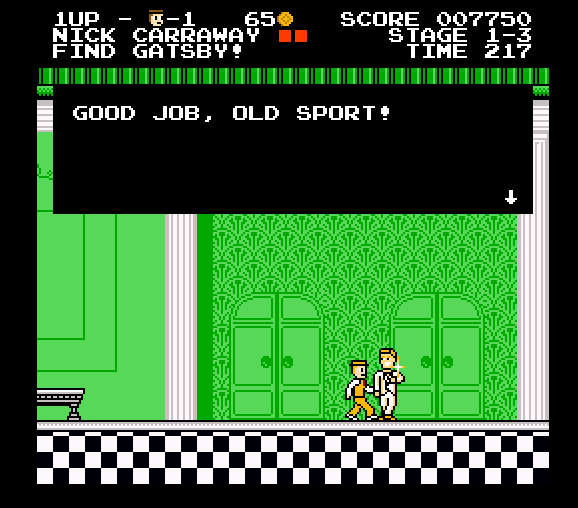
The Great Gatsby for NES

Brilliant game sure to waste too much of your time — The Great Gatsby for NES.

F. Scott Fitzgerald Falls off the Wagon

Just finished reading this great 1982 Paris Review interview with famed poet, journalist, and tastemaker Malcolm Cowley; he talks Faulkner, Hemingway, Stein, drinking, sanity, poetry, publishing and more. Here, he shares an anecdote about F. Scott Fitzgerald

INTERVIEWERS

Do you see a relationship between unhappiness and poetic creativity?

COWLEY

To the extent that poems may be born from a straining of one’s senses and imagination to a degree to which they couldn’t be strained in ordinary life. I was reading F. Scott Fitzgerald’s correspondence the other day. Scott and Zelda’s difficulties were ones that I never had to face; I never had to drive myself to drink in order to get my imagination working. Actually, I found my imagination worked best on fatigue. That’s another form of intoxication . . . to set yourself writing, and keep on writing until after two or three hours the subconscious takes over. It’s certainly safer than alcohol. The trouble with alcohol is that you can’t keep it up.

I went to visit the Fitzgeralds when they were living outside of Baltimore—a place called “La Paix.” Scott said to me, “I’m on the wagon, but I got you a pint of whiskey from my bootlegger; I’m on water.” So we talked, or mostly he talked, and every once in a while he’d go out to the kitchen to get another glass of water. His talk became more belligerent, sometimes incoherent, until finally he said, “You know, that water I’ve been drinking all evening—it’s half grain alcohol.” I said to myself, “Oh . . . surprise!”


Beaton Does Gatsby

Cartoonist Kate Beaton lampoons F. Scott Fitzgerald’s The Great Gatsby at her site Hark, A Vagrant. Wonderful send-up of what has to be one of America’s most overrated novels.