
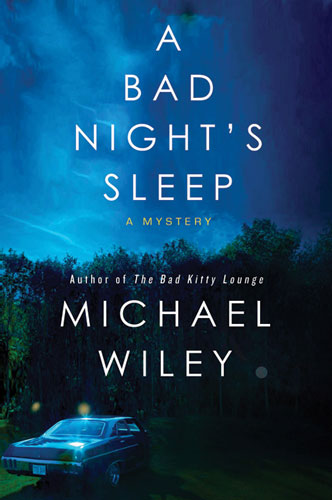
A Bad Night’s Sleep, Michael Wiley’s third detective novel, opens with protagonist PI Joe Kozmarski working what appears to be a boring job. He’s hired to investigate the repeated robberies of a Chicago construction site. Sure, it’s a glorified nightwatchman gig, but this job might get him closer to retiring in a certain north Florida fishing town he dreams about. The job gets too interesting too quickly, however, when the burglars arrive and begin stealing equipment and material. Then the police show up—and help rob the site. Kozmarski calls 911, more police arrive, and, in the firefight that ensues he shoots—and kills—one of the robber cops.
While waiting in jail to be charged—an event that never quite comes to light—Kozmarski reflects—
Every time I’d seen someone die I’d felt the world go a little quieter like I’d lost part of my hearing, and sooner or later the singing, laughing, and screaming would fade into a hushing wind of white noise. That had happened when my dad died. It had happened when Kevin, a boy I was supposed to be protecting, ended up twisted and broken on his mother’s kitchen floor. It happened. Shooting the cop felt worse. I’d ripped a little hole in the universe and I wondered what sound would fly through it.
Kozmarski’s little hole lets in more than strange sounds. The cop-shooting imperils his PI license, damages his (not exactly heretofore spotless) reputation, and leads undercover cops to threaten him (to the point of firing shots) as he leaves jail. The stress doesn’t exactly help protect his tenuous sobriety either, and Kozmarski’s soon on the sauce again (let’s not even mention that little bag of coke his “friend” sends him to help through these troubled times). Luckily (although that’s hardly an appropriate adverb here), Kozmarski’s friend on the force sets up another job for our distressed hero, one that could clear his name and clean out some of the dirty cops of the Chicago PD. Kozmarski infiltrates the corrupt gang of crooked cops, but as he plumbs deeper into the mystery, the line between good guys and bad guys becomes increasingly nebulous.
A Bad Night’s Sleep is a page turner telegraphed in terse, tense, vivid prose. Wiley’s plot and dialogue alike are hardboiled in the noir tradition of Hammett or Chandler, and his characters and pacing bristle with the gritty immediacy one might find in George V. Higgins. There’s a smart brush of black humor to A Bad Night’s Sleep that comes from Wiley’s characterization and his protagonist’s wry observations. And for all of his hard edges, we find in Kozmarski an engaged protagonist, a man of genuine pathos. Wiley delivers what readers want from an intelligent mystery—keen, suspenseful plotting, sharp action sequences, and a hero we can care about.
A Bad Night’s Sleep is available now in hardback from St. Martin’s Minotaur imprint. Read our interview with Michael Wiley.

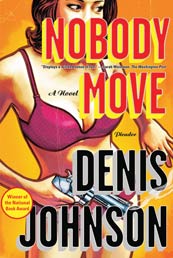 Denis Johnson’s Nobody Move is a tight snare drum of a comedy crime novel. Jimmy Luntz, still decked out in his white barbershop chorus tux (don’t ask) gets into trouble with a big gorilla he owns money too. On the run, he meets smoldering bombshell Anita. More trouble ensues. Nobody Move, originally serialized in Playboy, is a dark, funny genre exercise propelled by Johnson’s sharp dialogue and keen eye for detail. Johnson’s restraint and economy demonstrate writerly chops, but its his story and his characters that made me stay up too late reading last night.
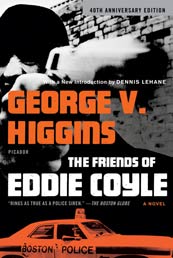 I’m kind of embarrassed that I’d never heard of George V. Higgins’s seminal crime novel, The Friends of Eddie Coyle, the story of a down-on-his luck gunrunner trying to get a break on a three-year sentence. Picador’s new edition celebrates the book’s 40th anniversary. Higgins’s electric dialogue thrusts the reader right into the action, trading narrative clarity for a smoky milieu of backroom deals and gritty alleys. But my phrasing here sounds way too corny and trite. Forgive me, I don’t really know how to write about good crime fiction because I’m so unused to it. I’ll lazily favorably compare The Friends of Eddie Coyle to David Simon’s Baltimore crime epic The Wire.
 I’ve been too engrossed with Coyle and Nobody Move the past few days to do more than skim over Clancy Martin’s How to Sell, a novel about grifters and scam artists in the jewelery world, but I did read and very much enjoy its first chapter, where the protagonist pawns his mother’s wedding ring (“the only precious thing she had left”) and yet still manages to keep reader sympathy (mine, at least). Martin worked for years in the fine jewelery business. He also translates Nietzsche and Kierkegaard. Zadie Smith says of How to Sell: “It’s a little like Dennis Cooper with a philosophical intelligence, or Raymond Carver without hope. But mostly it’s like itself.” I like that.
 Biblioklept