
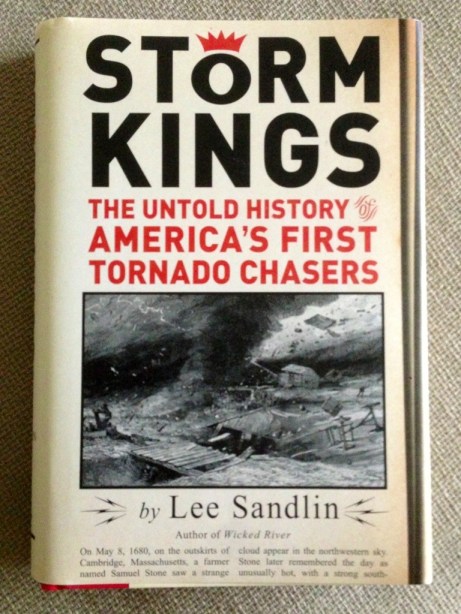
I liked Lee Sandlin’s last book Wicked River, so I took interest when a reader copy of his new book Storm Kings: The Untold History of America’s First Tornado Chasers showed up at Biblioklept World Headquarters a few months ago. I have no special interest in tornadoes or meteorology, but so far Storm Kings has intrigued me into reading more.
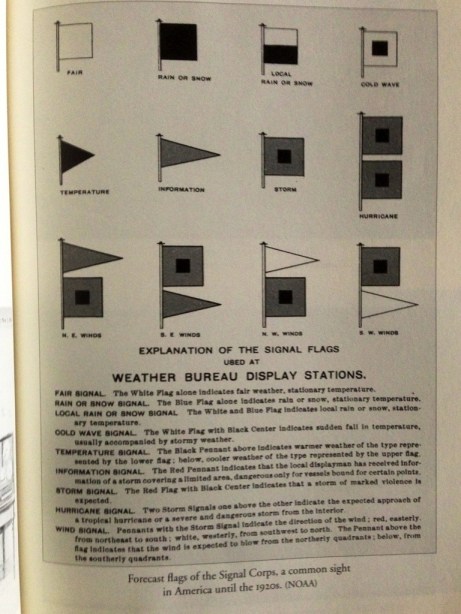
Publisher Random House’s blurb:
From the acclaimed author of Wicked River comes Storm Kings, a riveting tale of supercell tornadoes and the quirky, pioneering, weather-obsessed scientists whose discoveries created the science of modern meteorology.
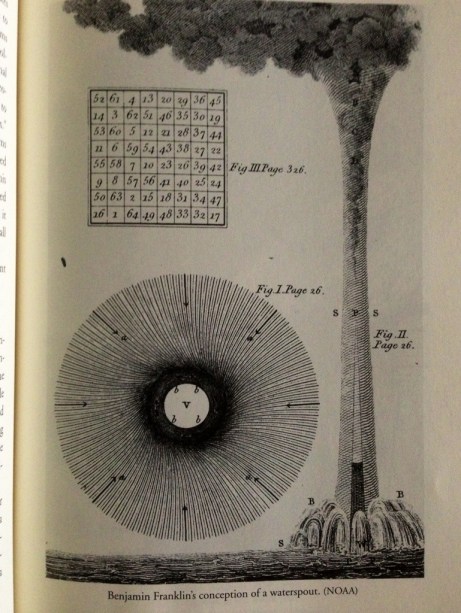
While tornadoes have occasionally been spotted elsewhere, only the central plains of North America have the perfect conditions for their creation. For the early settlers the sight of a funnel cloud was an unearthly event. They called it the “Storm King,” and their descriptions bordered on the supernatural: it glowed green or red, it whistled or moaned or sang. In Storm Kings, Lee Sandlin explores America’s fascination with and unique relationship to tornadoes. From Ben Franklin’s early experiments to the “great storm war” of the nineteenth century to heartland life in the early twentieth century, Sandlin re-creates with vivid descriptions some of the most devastating storms in America’s history, including the Tri-state Tornado of 1925 and the Peshtigo “fire tornado,” whose deadly path of destruction was left encased in glass.
Drawing on memoirs, letters, eyewitness testimonies, and archives, Sandlin brings to life the forgotten characters and scientists who changed a nation—including James Espy, America’s first meteorologist, and Colonel John Park Finley, who helped place a network of weather “spotters” across the country. Along the way, Sandlin details the little-known but fascinating history of the National Weather Service, paints a vivid picture of the early Midwest, and shows how successive generations came to understand, and finally coexist with, the spiraling menace that could erase lives and whole towns in an instant.
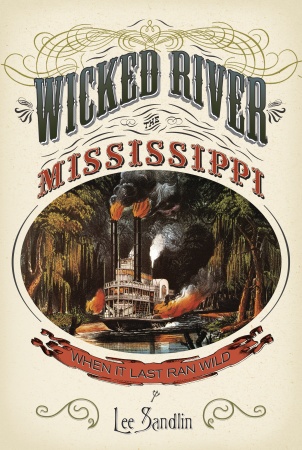 The mighty Mississippi River remains perhaps the signal geographical symbol of the United States of America. It divides our country neatly into East and West, flowing down from the industrial North to the agricultural South, and in this sense, the Mississippi is the major artery of America’s heart. We find in the Mississippi a rich mythos, one that both informs and reflects our national character. And while plenty of writers have striven to capture and express the river’s culture and character, it is Mark Twain who more or less invented our idea of the Mississippi. In his fascinating new history Wicked River, Lee Sandlin observes that, “There is a pretty much universal idea that Twain has a proprietary relationship to the Mississippi. It belongs to him, the way Victorian London belongs to Dickens or Dublin belongs to Joyce.” Sandlin’s goal in Wicked River is not to wrest the Mississippi from Twain; rather, he aims to show us the gritty turbulence swelling under Twain’s romantic myth–a myth that many Americans have come to hold as a received truth. Sandlin points out that Twain’s “Mississippi books are works of memory, even of archaeology”; they point to a vibrant river culture in a prelapsarian past, one “with its own culture and its own language and its own unspoken rules.” Sandlin’s own book plumbs that culture, revealing strange, wild tales of river pirates and con-men, fiddlers and gamblers, road agents and robbers, politicians and drunkards, and Indians and would-be “civilizers.” Sandlin’s canny observations come from a myriad of first-hand accounts–always the sign of a legitimate history–but Wicked River is never dry or dusty, but rather brims with vigor and intensity, whether we’re learning about the earthquakes that shook up New Madrid, the tornado that smashed Natchez, the sinking of the Sultana, or the ice floe that destroyed the St. Louis Harbor. Sandlin’s writing is concise, lively, and often wry and earthy–although always grounded in fact. (One colorful passage begins, “There was one simple explanation for the wildness of river culture: everybody was drunk”). Wicked River does a marvelous job conveying the tumultuous and eclectic history of an American frontier in the nineteenth century. Recommended.
 Biblioklept