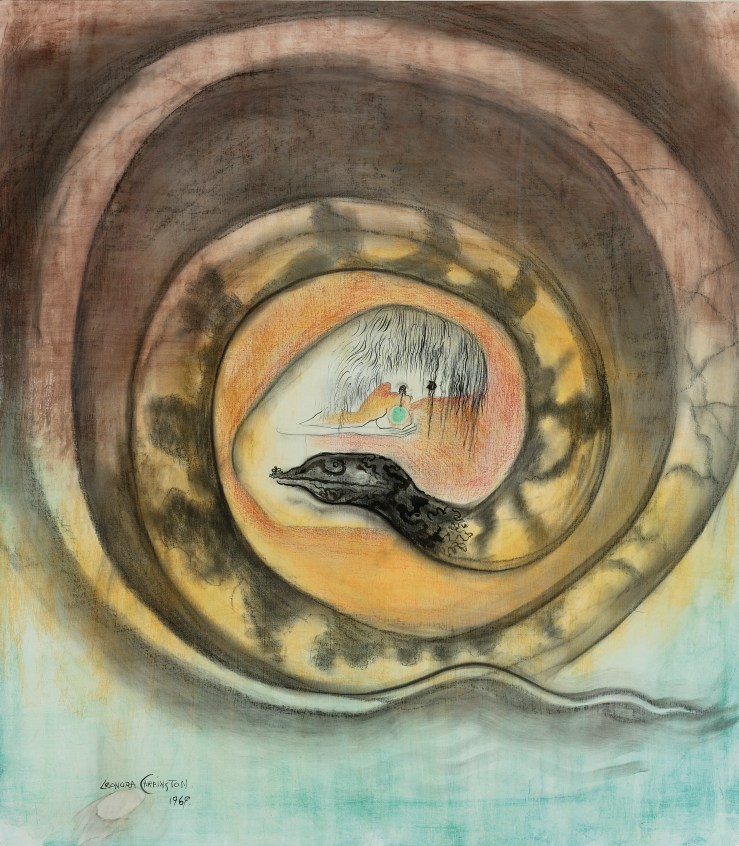
Snake — Leonora Carrington

Snake 1969 gouache, ink, pastel and wax crayon on board 29.875 x 26.5 in

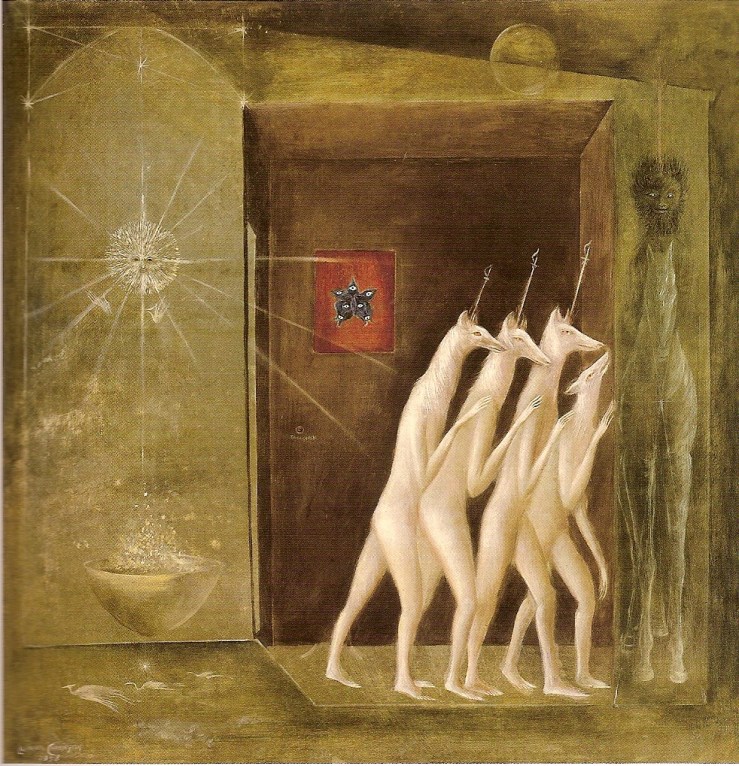
The 4706th Floor — Leonora Carrington

The 4706th Floor

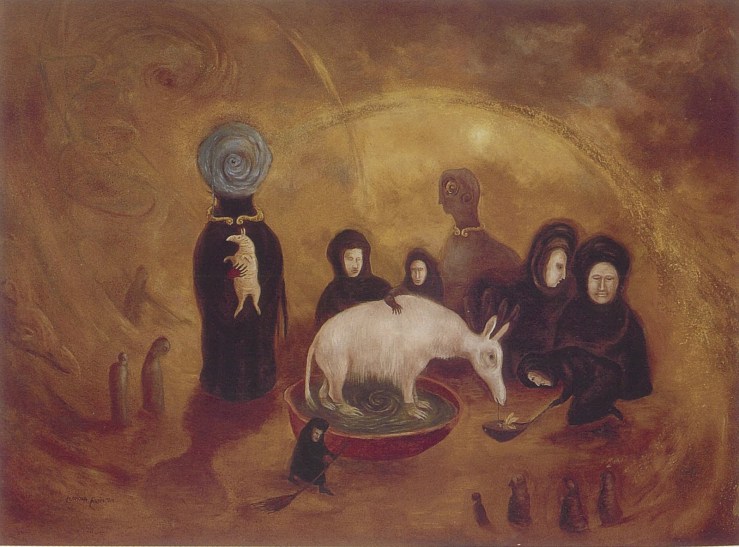
Aardvark Groomed by Widows — Leonora Carrington

Aardvark Groomed by Widows

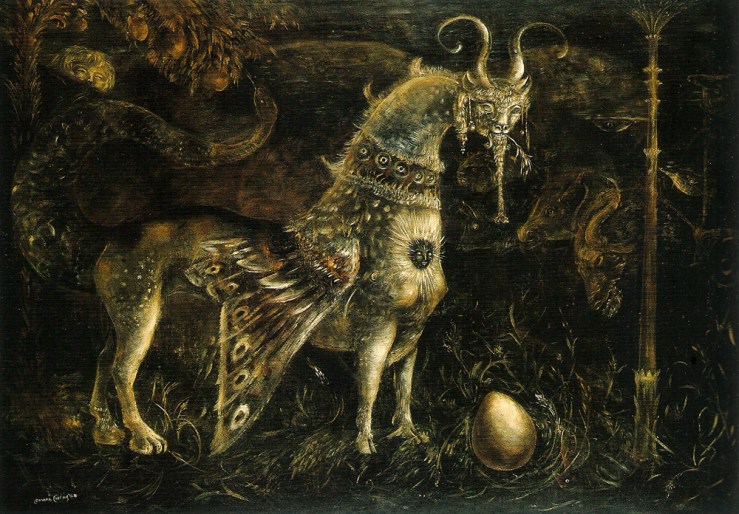
Syssigy — Leonora Carrington

Syssigy

Who Art Thou White Face? — Leonora Carrington

who art thou white face leonora carrington

“The Royal Command,” A Surreal Short Story by Leonora Carrington

“The Royal Command”

by

Leonora Carrington

I had received a royal command to visit the rulers of my country.

The invitation, in gold letters in relief and adorned with roses and swallows, was bordered in lace.

I went to look for my car, but the chauffeur, who lacks practical sense, had buried it.

“It’s to grow mushrooms,” he told me. “Nothing better for mushrooms.”

“Brady,” I said to him, “you are an imbecile of the first degree. You have ruined my car.”

Actually, since the car was completely ruined, I had to rent a horse-pulled buggy.

Upon reaching the palace, an impossible servant, dressed in red and gold, said to me: “The queen went crazy yesterday; she is in her bathtub.”

“How unfortunate!” I exclaimed. “How did that happen?”

“It’s the heat.”

“Can I see her in any event?” (I hoped I hadn’t made the long voyage for nothing.)
Continue reading ““The Royal Command,” A Surreal Short Story by Leonora Carrington”

“White Rabbits” — Leonora Carrington

rabbit

“White Rabbits”

by Leonora Carrington

THE TIME has come that I must tell the events which began in 40 Pest St. The houses which were reddish-black looked as if they had survived mysteriously from the fire of London. The house in front of my window, covered with an occasional wisp of creeper, was as blank and empty looking as any plague-ridden residence subsequently licked by flames and saliv’d with smoke. This is not the way that I had imagined New York.

It was so hot that I got palpitations when I ventured out into the streets—so I sat and considered the house opposite and occasionally bathed my sweating face.

The light was never very strong in Pest Street. There was always a reminiscence of smoke which made visibility troubled and hazy—still it was possible to study the house opposite carefully, even precisely; besides my eyes have always been excellent.

I spent several days watching for some sort of movement opposite but there was none and I finally took to undressing quite freely before my open window and doing breathing exercises optimistically in the thick Pest Street air. This must have blackened my lungs as dark as the houses. One afternoon I washed my hair and sat out on the diminuitive stone crescent which served as a balcony to dry it. I hung my head between my knees ¡and watched a blue-bottle suck the dry corpse of a spider between my feet. I looked up through my lank hair and saw something black in the sky, ominously quiet for an airplane. Parting my hair I was in time to see a large raven alight on the balcony of the house opposite. It sat on the balustrade and seemed to peer into the empty window, then poked its head under its wing apparently searching for lice. A few minutes later I was not unduly surprised to see the double windows open and and admit a woman onto the balcony—she carried a large dish full of bones which she emptied onto the floor. With a short appreciative squawk, the raven hopped down and picked about amongst its unpleasant repast.

The woman, who had hemp-long black hair, wiped out the dish, using her hair for this purpose.

Then she looked straight at me and smiled in a friendly fashion. I smiled back and waved a towel. This seemed to encourage her for she tossed her head coquettishly and gave me a very elegant salute after the fashion of a queen.

“Do you happen to have any bad meat over there that you don’t need?” she called.

“Any what?” I called back, wondering if my ears had deceived me.

“Any stinking meat? Decomposed flesh … meat?”

“Not at the moment,” I replied, wondering if she was trying to be funny.

“Won’t you have any towards the end of the week? If so, I would be very grateful if you would bring it over.”

Then she stepped back into the empty window and disappeared. The raven flew away. Continue reading ““White Rabbits” — Leonora Carrington”

“The Debutante,” A Short Story by Leonora Carrington

debutante

“The Debutante”

by Leonora Carrington

WHEN I was a debutante I often went to the zoological garden. I went so often that I was better acquainted with animals than with the young girls of my age. It was to escape from the world that I found myself each day at the zoo. The beast I knew best was a young hyena. She knew me too. She was extremely intelligent; I taught her French and in return she taught me her language. We spent many pleasant hours in this way.

For the first of May my mother had arranged a ball in my honor. For entire nights I suffered: I had always detested balls, above all those given in my own honor.

On the morning of May first, 1934, very early, I went to visit the hyena. “What a mess of shit,” I told her. “I must go to my ball this evening.”

“You’re lucky,” she said. “I would go happily. I do not know how to dance, but after all, I could engage in conversation.”

“There will be many things to eat,” said I. “I have seen wagons loaded entirely with food coming up to the house.”

“And you complain!” replied the hyena with disgust. “As for me, I eat only once a day, and what rubbish they stick me with!”

I had a bold idea; I almost laughed. “You have only to go in my place.”

“We do not look enough alike, otherwise I would gladly go,” said the hyena, a little sad. “Listen,” said I, “in the evening light one does not see very well. If you were disguised a little, no one would notice in the crowd. Besides, we are almost the same size. You are my only friend; I implore you.”

She reflected upon this sentiment. I knew that she wanted to accept. “It is done,” she said suddenly.

It was very early; not many keepers were about. Quickly I opened the cage and in a moment we were in the street. I took a taxi; at the house, everyone was in bed. In my room, I brought out the gown I was supposed to wear that evening. It was a little long, and the hyena walked with difficulty in my high-heeled shoes. I found some gloves to disguise her hands which were too hairy to resemble mine. When the sunlight entered, she strolled around the room several times—walking more or less correctly. We were so very occupied that my mother, who came to tell me good morning, almost opened the door before the hyena could hide herself under my bed. “There is a bad odor in the room,” said my mother, opening the window. “Before this evening you must take a perfumed bath with my new salts.”

“Agreed,” said I. She did not stay long; I believe the odor was too strong for her. “Do not be late for breakfast,” she said, as she left the room.

The greatest difficulty was to find a disguise for the hyena’s face. For hours and hours we sought an answer: she rejected all of my proposals. At last she said, “I think I know a solution. You have a maid?”

“Yes,” I said, perplexed.

“Well, that’s it. You will ring for the maid and when she enters we will throw ourselves upon her and remove her face. I will wear her face this evening in place of my own.”

“That’s not practical,” I said to her.

“She will probably die when she has no more face; someone will surely find the corpse and we will go to prison.”

“I am hungry enough to eat her,” replied the hyena.

“And the bones?”

“Those too,” she said.

“Then it’s settled?”

“Only if you agree to kill her before removing her face. It would be too uncomfortable otherwise.”

“Good; it’s all right with me.” I rang for Marie, the maid, with a certain nervousness. I would not have done it if I did not detest dances so much. When Marie entered I turned to the wall so as not to see. I admit that it was done quickly. A brief cry and it was over. While the hyena ate, I looked out the window. A few minutes later, she said: “I cannot eat anymore; the two feet are left, but if you have a little bag I will eat them later in the day.”

“You will find in the wardrobe a bag embroidered with fleurs de lys. Remove the handkerchiefs inside it and take it.” She did as I indicated.

At last she said: “Turn around now and look, because I am beautiful!” Before the mirror, the hyena admired herself in Marie’s face. She had eaten very carefully all around the face so that what was left was just what was needed. “Surely, it’s properly done,” said I.

Toward evening, when the hyena was all dressed, she declared: “I am in a very good mood. I have the impression that I will be a great success this evening.” When the music below had been heard for some time, I said to her: “Go now, and remember not to place yourself at my mother’s side: she will surely know that it is not I. Otherwise I know no one. Good luck.” I embraced her as we parted but she smelled very strong.

Night had fallen. Exhausted by the emotions of the day, I took a book and sat down by the open window. I remember that I was reading Gulliver’s Travels by Jonathan Swift. It was perhaps an hour later that the first sign of misfortune announced itself. A bat entered through the window, emitting little cries. I am terribly afraid of bats, I hid behind a chair, my teeth chattering. Scarcely was I on my knees when the beating of the wings was drowned out by a great commotion at my door. My mother entered, pale with rage. “We were coming to seat ourselves at the table,” she said, “when the thing who was in your place rose and cried: ‘I smell a little strong, eh? Well, as for me, I do not eat cake.’ With these words she removed her face and ate it. A great leap and she disappeared out the window.”

Portrait of the Late Ms. Partridge — Leonora Carrington

“The Beloved,” A Short Surrealist Tale by Leonora Carrington

“The Beloved” by Leonora Carrington

ONE LATE afternoon, passing through a narrow street, I stole a melon. The fruit man who was hidden behind his fruits seized me by the arm and said to me: “Señorita, I’ve been waiting for an occasion like this for forty years. I have spent forty years hidden behind this pile of oranges with the hope that someone would steal a fruit from me. I will tell you why; I need to talk, I need to tell my story. If you don’t listen, I will hand you over to the police.”

“I’ll listen,’ I said. Without letting me go, he took me to the inside of the store, among fruits

Without letting me go, he took me to the inside of the store, among fruits and vegetables. We shut a door at the far end, and we reached a room where there was a bed on which an immovable and probably dead woman lay. It appeared to me that she had been there for a long time since the bed was covered with weeds.

“I water her every day,” said the fruitman with a pensive air. “In 40 years I have not succeeded in knowing whether she is dead or not. She has never moved, nor spoken, nor eaten during that time. But the curious thing is that she remains warm. If you don’t believe me, look.”

The man lifted a corner of the cover, which permitted me to see many eggs and some little chicks recently hatched.

“As you notice,” he said, “I incubate eggs here. I also sell fresh eggs.”

We each sat down on one side of the bed and the fruit man began to tell his story.

“Believe me; I love her so much! I have always loved her! She was so sweet! She had little agile white feet. Would you like to see them?”

“No,” I answered.

“Finally,” he continued, after exhaling a deep breath, “she was so beautiful! My hair was blonde; hers, magnificently black! Now, both of us have white hair. Her father was an extraordinary man. He had a mansion in the country. He was a collector of lamb chops. For that we came to know each other. I have a certain skill in drying meat with a glance. Mr. Pushfoot (so he was called) heard about me. He invited me to his house in order to dry his ribs to keep them from rotting. Agnes was his daughter. We loved each other from the first moment. We departed in a boat by way of the Seine. I rowed. Agnes said to me: ‘I love you so much that I only live for you.’ I answered her with the same words. I believe that it is my love which keeps her warm, perhaps she is dead, but the warmth persists.”

After a short pause, with an absent look, he continued: “Next year I will grow some tomatoes; it wouldn’t surprise me if they would grow well there inside … It became night, and I didn’t know where we would spend our wedding night. Agnes had become very pale, because of fatigue. Finally we had scarcely left Paris behind when I saw an inn that faced the river. I moored the boat and we walked toward an obscure and sinister terrace. There were two wolves there and a fox, who began to walk around us. There was nobody else … I knocked and knocked at the door, on the other side of which a terrible silence prevailed. ‘Agnes is tired! Agnes is very tired!’ I shouted with as much force as I could. Finally, an old lady’s head appeared at the window and said: ‘I don’t know anything. The landlord here is the fox. Let me sleep. You are bothering me.’ Agnes began to cry. There was no other remedy than to direct ourselves to the fox. ‘Have you beds?’ I asked several times. Nobody responded: he didn’t know how to speak. And again the head, older than the other, but which now descended slowly through the window tied to the end of a little cord. ‘Direct yourself to the wolves; I am not the landlord here. Let me sleep! please!’ I understood that that head was crazy and I did not have the heart to continue. Agnes kept crying. I walked around the house a few times and finally, I was able to open a window, through which we entered. Then we found ourselves in a kitchen with a high ceiling; over a large oven made hot by fire were some vegetables that were cooking and they jumped in the boiling water, a thing that much amused us. We ate well and then we laid ourselves down on the floor. I had Agnes in my arms. We did not sleep. That terrible kitchen contained all kinds of things. Many rats had stuck their heads out of their holes and then sang with screeching and disagreeable little voices. Filthy odors expanded and diminished one after the other, and there were air drafts. I believe that it was the air drafts that finished my poor Agnes. She never recovered. From that day, each time she spoke less . . .”

And the fruitman was so blinded by tears that I could escape with my melon.

Nursery at Midnight — Leonora Carrington

Daughter of the Minotaur — Leonora Carrington

carrington

Remedios Varo Wearing a Mask by Leonora Carrington and Kati Horna

Remedios+Varo,+wearing+a+mask+made+by+Leonora+Carrington+and+Kati+Horna,+1957+(Kati+Horna)

Design for the Tempest — Leonora Carrington

design for the tempest carrington

The House Opposite — Leonora Carrington

untitled1336461157077