Mass-market Monday | Miguel de Unamuno’s Abel Sanchez and Other Stories

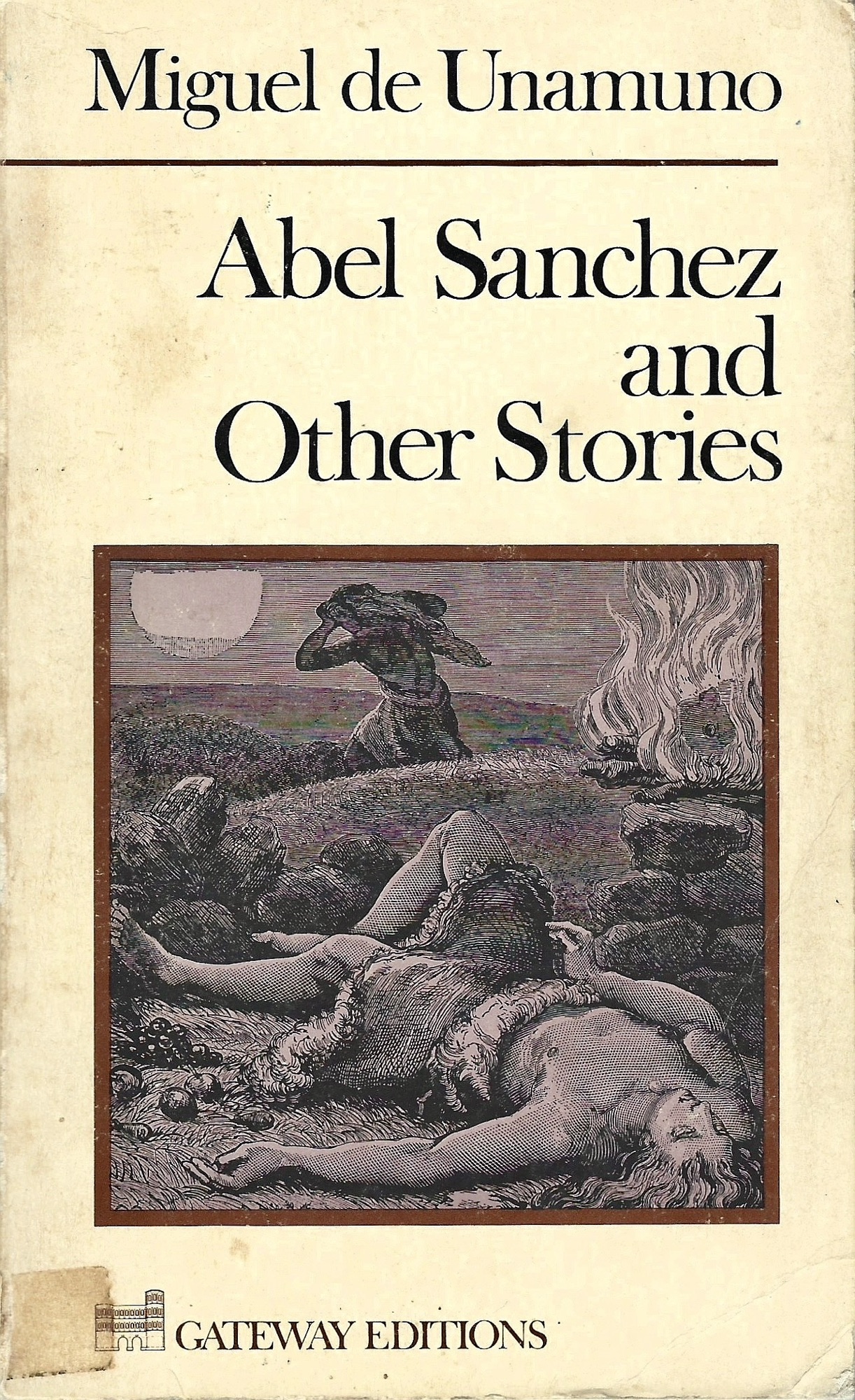
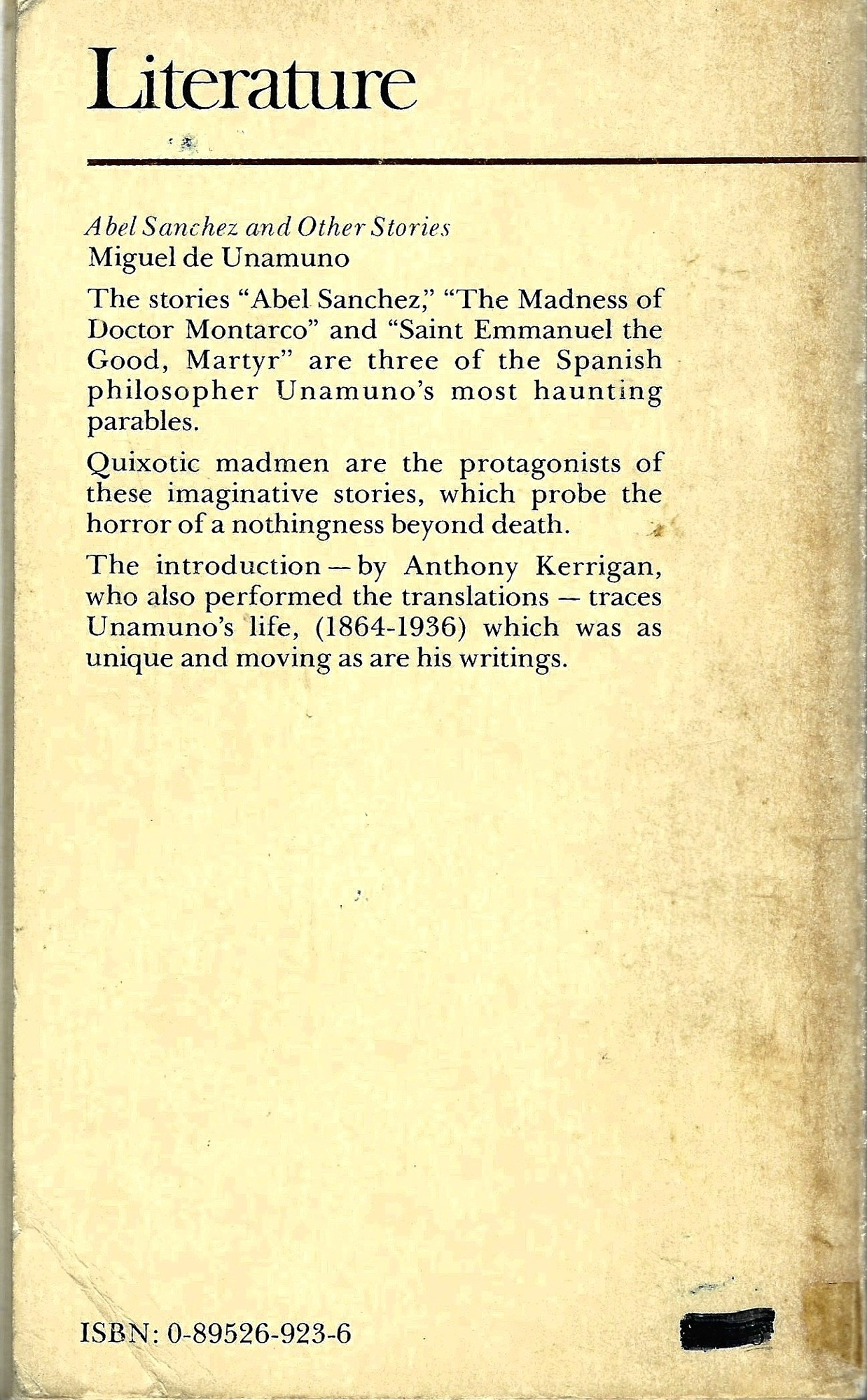
Abel Sanchez and Other Stories, Miguel de Unamuno. Translated by Anthony Kerrigan. Regnery Gateway (1956). No cover designer or artist credited; cover image credited to the Bettman Archive. 267 pages.

I wrote a bit about the collection back in February:

A few weeks ago, I picked up Anthony Kerrigan’s translation of Miguel de Unamuno’s Abel Sanchez and Other Stories based on its cover and the blurb on its back. I wound up reading the shortest of the three tales, “The Madness of Dr. Montarco,” that night. The story’s plot is somewhat simple: A doctor moves to a new town and resumes his bad habit of writing fiction. He slowly goes insane as his readers (and patients) query him about the meaning of his stories, and he’s eventually committed to an asylum. The tale’s style evokes Edgar Allan Poe’s paranoia and finds an echo in Roberto Bolaño’s horror/comedy fits. The novella that makes up the bulk of the collection is Abel Sanchez, a Cain-Abel story that features one of literature’s greatest haters, a doctor named Joaquin who grows to hate his figurative brother, the painter Abel. Sad and funny, this 1917 novella feels contemporary with Kafka and points towards the existentialist novels of Albert Camus. (I’m saving the last tale, “Saint Manuel Bueno, Martyr,” for a later day.)

Christine Brooke-Rose/Miguel de Unamuno (Books acquired, 23 Feb. 2024)

Picked up Christine Brooke-Rose’s 1984 postmodern novel Amalgamemnon and the Grove Press collection of Three Exemplary Novels by Miguel de Unamuno the other day. Those three exemplary novels are Marquis of Lubria; Two Mothers; and Nothing Less Than a Man, in translation by Angel Flores. It’s an older edition; Grove Press’s contemporary copy offers the following:

In Two Mothers, the demonic will of a woman runs amok in a whirlwind of maternal power, and in The Marquis of Lumbria, another unforgettable heroine steers a violent course through the dense sea of tradition. By contrast, Nothing Less Than a Man, Unamuno’s most forceful piece of writing, focuses on a truly Nietzchean hero, a man who embodies human will deprived of spiritual strength.

And here’s a bit on Brooke-Rose’s Amalgamemnon from Susie E. Hawkins’ essay “Innovation/History/Politics: Reading Christine Brooke-Rose’s Amalgamemnon” from the Spring 1991 issue of Contemporary Literature:

While the title signals possible mythic revisions of Aeschylus’s play Agamemnon, such anticipations on the reader’s part prove to be utterly unfounded. To begin with, there is no “story” as such, there are no “characters,” no “plot,” no “conflict,” and certainly no “climax.” In addition, the fiction is cast entirely in the future and conditional tenses with a few imperatives and subjunctives thrown in. Although Amalgamemnon exhibits few remnants of a traditional narrative desire for unity, presence, psychological accuracy, closure, and so forth, it does do what most innovative writing should do: it challenges the audience in terms of accustomed modes of perception, interpretation, and reading strategies – in short, challenges readerly ideology. In part, this text enacts such a challenge by performing itself, by “being about” language, by being a performance. The text becomes a space in which a cacophony of voices, or discursive amplifications, or babble, or little stories – whichever term best suits — enact their own sounding.

Blog about some recent reading

A few weeks ago, I picked up Anthony Kerrigan’s translation of Miguel de Unamuno’s Abel Sanchez and Other Stories based on its cover and the blurb on its back. I wound up reading the shortest of the three tales, “The Madness of Dr. Montarco,” that night. The story’s plot is somewhat simple: A doctor moves to a new town and resumes his bad habit of writing fiction. He slowly goes insane as his readers (and patients) query him about the meaning of his stories, and he’s eventually committed to an asylum. The tale’s style evokes Edgar Allan Poe’s paranoia and finds an echo in Roberto Bolaño’s horror/comedy fits. The novella that makes up the bulk of the collection is Abel Sanchez, a Cain-Abel story that features one of literature’s greatest haters, a doctor named Joaquin who grows to hate his figurative brother, the painter Abel. Sad and funny, this 1917 novella feels contemporary with Kafka and points towards the existentialist novels of Albert Camus. (I’m saving the last tale, “Saint Manuel Bueno, Martyr,” for a later day.)

I’m near the end of Iain Banks’s second novel, Walking on Glass (1985), which so far follows three separate narrative tracks: one focusing on an art student pining after an enigmatic beauty; one following an apparent paranoid-schizophrenic who believes himself to be a secret agent of some sort from another galaxy, imprisoned on earth; and one revolving around a fantastical castle where two opposing warriors, trapped in ancient bodies, play bizarre table top games while they try to solve an unsolvable riddle. I should finish later tonight, I think, and while there are some wonderful and funny passages, I’m not sure if Banks will stick the landing here. My gut tells me his debut novel The Wasp Factory is a stronger effort.

I’ve been soaking in Sorokin lately, thanks to his American translator Max Lawton, with whom I’ve been conducting an email-based interview over the past few months. Max had kindly shared some of his manuscripts with me, including an earlier draft of the story collection published as Red Pyramid. I’ve found myself going through the collection again now that it’s in print from NYRB—skipping around a bit (but as usual with most story collections, likely leaving at least one tale for the future.)

I very much enjoyed Gerhard Rühm’s Cake & Prostheses (in translation by Alexander Booth)—sexy, surreal, silly, and profound. Lovely little thought experiments and longer meditations into the weird.

I really enjoyed Debbie Urbanski’s debut novel After World. The novel’s “plot,” such as it is, addresses the end of the world: Or not the end of the world, but the end of the world of humans: Or the beginning of a new world, where consciousness might maybe could who the fuck actually can say be uploaded to a virtual after world. After World is a pastiche of forms, but dominated by the narrator [storyworker] ad39-393a-7fbc whose task is to reimagine the life of Sen Anon, one of the final humans to live and die on earth—and the last human to be archived/translated/transported into the Digital Human Archive Project. This ark will carry humanity…somewhere. [storyworker] ad39-393a-7fbc creates Sen’s archive through a number of sources, including drones, cameras, Sen’s own diary, and a host of ancillary materials. [storyworker] ad39-393a-7fbc also crafts the story, drawing explicitly on the tropes and forms of dystopian and post-apocalyptic literature. After World is thus explicitly and formally metatextual; [storyworker] ad39-393a-7fbc archives the life of Sen Anon, last witness to the old world and Urbanski archives the dystopian and post-apocalyptic pop narratives that populate bestseller lists and serve as the basis for Hollywood hits. [storyworker] ad39-393a-7fbc namechecks a number of these authors and novels, including Octavia Butler, Margaret Atwood, and Ann Leckie, while Sen Anon holds tight to two keystone texts: Mark Z. Danielewski’s House of Leaves and Emily St. John Mandel’s Station Eleven. But the end-of-the-world novel it most reminded me of was David Markson’s Wittgenstein’s Mistress. Even as it works to a truly human finale, Urbanski’s novel is spare: post-postmodern, post-apocalyptic, and post-YA. Good stuff.

Speaking of: Carole Masso’s 1991 novel Ava also strongly reminded me of Markson’s Wittgenstein’s Mistress. Its controlling intelligence is the titular Ava, dying too young of cancer. The novel is an elliptical assemblage of quips, quotes, observations, dream thoughts, and other lovely sad beautiful bits. Masso creates a feeling, not a story; or rather a story felt, intuited through fragmented language, experienced.

I continue to pick my way through Frederick Karl’s American Fictions. He is going to make me buy Joseph McElroy’s 1974 novel Lookout Cartridge. 
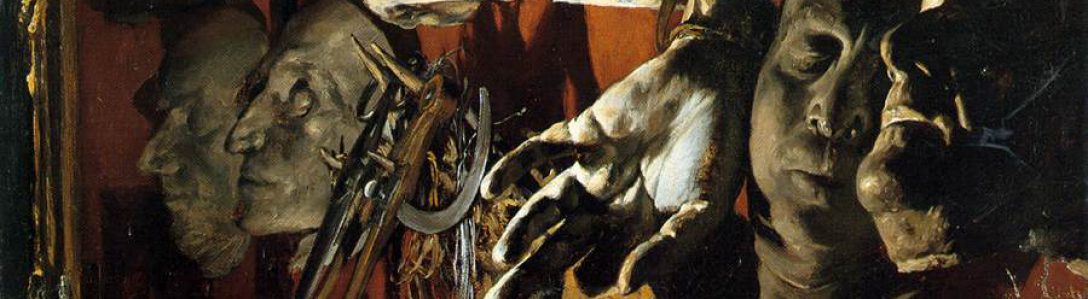
Condemned to seriousness and silliness, two blood sisters | Miguel de Unamuno

A little while after arriving in the city, and after he had built up a better than average practice and had acquired the reputation of a serious, careful, painstaking and well-endowed doctor, a local journal published his first story, a story half-way between fantasy and humor, without descriptive writing and without a moral. Two days later I found him very upset; when I asked the reason, he burst forth: “Do you think I’m going to be able to resist the overwhelming pressure of the idiocy prevailing here? Tell me, do you think so? It’s the same thing all over again, exactly the same as in my town, the very same! And just as happened there, I’ll end by becoming known as a madman. I, who am a marvel of calm! And my patients will gradually drop away, and I’ll lose my practice. Then the dismal days will come again. days filled with despair, disgust, and bad temper, and 1 will have to leave here just as I had to leave my own town!”

“But what has happened?” I was finally able to ask.

“What has happened? Simply that five people have already approached me to ask what I meant by writing the piece of fiction I just published, what I intended to say, and what bearing did it have. Idiots, idiots, and thrice idiots! They’re worse than children who break dolls to find out what’s inside. This town has no hope of salvation, my friend; it’s simply condemned to seriousness and silliness, two blood sisters. People here have the souls of school teachers. They believe no one could write except to prove some-thing, or defend or attack some proposition, or from an ulterior motive. One of these blockheads asked me the meaning of my story and by way of reply I asked him: ‘Did it amuse you?’ And he answered: ‘As far as that goes, it certainly did; as a matter of fact, I found it quite amusing; but…’ I left the last word in his mouth, because as soon as he reached this point in the conversation, I turned my back on him and walked away. That a piece of writing is amusing wasn’t enough for this monster. They have the souls of school teachers, the souls of school teachers!”

“But, now…” I ventured to take up the argument.

“Listen,” he interrupted, “don’t you come at me with any more ‘buts.’ Don’t bother. The infectious disease, the itch of our Spanish literature is the urge to preach. Everywhere a sermon, and a bad sermon at that. Every little Christ sets himself up to dispense advice, and does it with a poker-face. I remember picking up the Moral Epistle to Fabian and being unable to get beyond the first three verses; I simply couldn’t stomach it. This breed of men is totally devoid of imagination, and so all their madness is merely silly. An oyster-like breed—there’s no use of your denying it—; oysters, that’s what they are, nothing but oysters. Everything here savors of oyster beds, or ground-muck. I feel like I’m living among human tubers. And they don’t even break through the ground, or lift their heads up, like regular tubers.”

In any case, Dr. Montarco did not take heed, and he went and published another story, more satirical and fantastic than the first.

From “The Madness of Dr. Montarco” by Miguel de Unamuno; trans. by Anthony Kerrigan.

Blog about some recent books acquired, other stuff

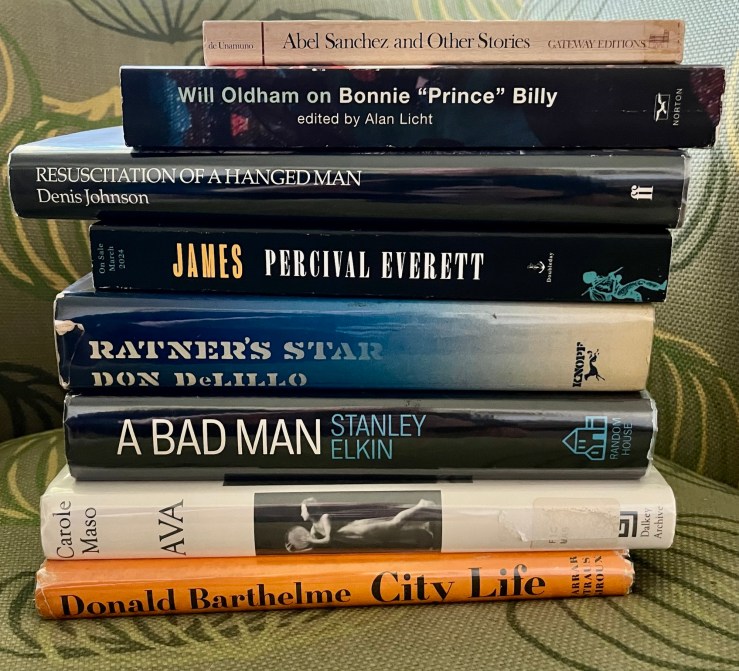
I read Will Oldham’s book On Bonnie ‘Prince’ Billy almost a decade and it therefore doesn’t belong in a stack of recent acquisitions, but it’s there—I pulled it off the shelf last week and thumbed through it in anticipation of seeing Oldham play this past Thursday. I even brought the book to the venue, thinking maybe I’d ask him to sign it. But I left it in the car and simply enjoyed Oldham and his pal run through a set of covers and originals. His voice is more resonant, richer, bolder than the last time I saw him live, and even if I didn’t know half of the songs, I enjoyed the gentle chill music on a cold Florida Thursday night. (I suspect Oldham’s short “tour” of Florida is an excuse to get out of the midwestern cold—although he complained it was “fuckin’ cold” here.)

Other books in the stack above are a composite of three or maybe four book store visits. The most memorable visit was to Aeon Bookstore in the Lower East Side of NYC.

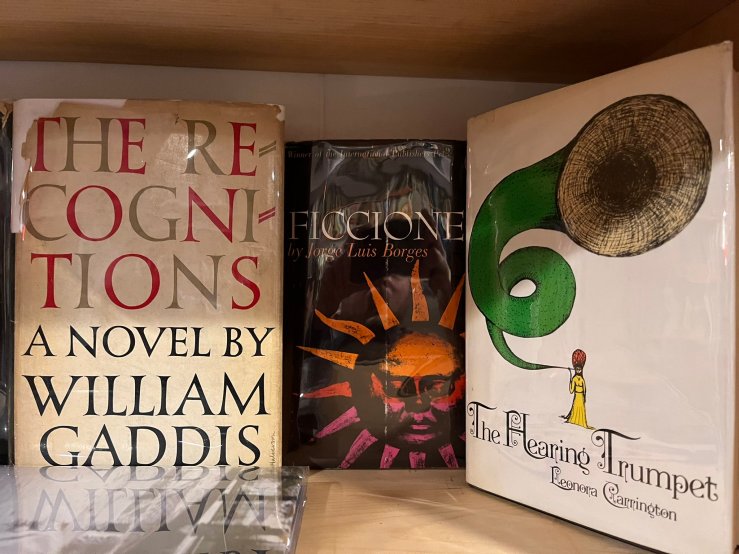
Aeon is a small, cozy shop, well-curated with art, philosophy, anthropology, and literature books, as well as an excellent selection of jazz records. The clerk let me handle some first editions of Williams Burroughs and Gaddis, as well as Ishmael Reed and others.

I resisted The Recognitions and The Hearing Trumpet and picked up first editions of Donald Barthelme’s City Life and Don DeLillo’s Ratner’s Star.

Over two or possibly three visits to my local bookshop over the last month, I picked up copies of Stanley Elkin’s A Bad Man, Denis Johnson’s Resuscitation of a Hanged Man, and Carole Maso’s Ava. I also picked up Anthony Kerrigan’s translation of Miguel de Unamuno stories, Abel Sanchez and Other Stories.

I also snagged an advance copy of Percival Everett’s James. Blurb:

When the enslaved Jim overhears that he is about to be sold to a man in New Orleans, separated from his wife and daughter forever, he decides to hide on nearby Jackson Island until he can formulate a plan. Meanwhile, Huck Finn has faked his own death to escape his violent father, recently returned to town. As all readers of American literature know, thus begins the dangerous and transcendent journey by raft down the Mississippi River toward the elusive and too-often-unreliable promise of the Free States and beyond.

While many narrative set pieces of Adventures of Huckleberry Finn remain in place (floods and storms, stumbling across both unexpected death and unexpected treasure in the myriad stopping points along the river’s banks, encountering the scam artists posing as the Duke and Dauphin…), Jim’s agency, intelligence and compassion are shown in a radically new light.