Books acquired, 26 May 2023

I brought a box of old books to my spot; I did not intend to pick up any books but then I picked up six:

I’d been looking for a handsome and/or cheap copy of Aldous Huxley’s The Devils of Loudon for a few years ago; success.

I posted something on Twitter a few days ago about how much I’ve been enjoying Steve Erickson’s Days Between Stations; one of the replies put James Crumley in his company (along with McCarthy and Joy Williams), so I picked up Dancing Bear and The Last Good Kiss:

I’ve long loved Peter Mendelsund’s cover designs, so I didn’t pass up on a used copy of What We See When We Read. It has a lot of pictures and diagrams and such.

I saw a very interesting looking person reading an actor’s edition of Philip Ridley’s play Mercury Fur on the train a few weeks ago. I had never heard of the play, but looked it up, thought it sounded pretty cool, and then looked for it in the drama section of this same book store the last time I was there. I didn’t find it. I found it yesterday mixed in with the novels. (I wasn’t actually looking for it.)

I don’t own physical copies of The Last Novel and Vanishing Point, two of the three novels collected in David Markson’s This Is Not a Novel and Other Novels, so I couldn’t pass on this omnibus. I do own a copy of Reader’s Block, which is not collected in This Is Not a Novel and Other Novels.
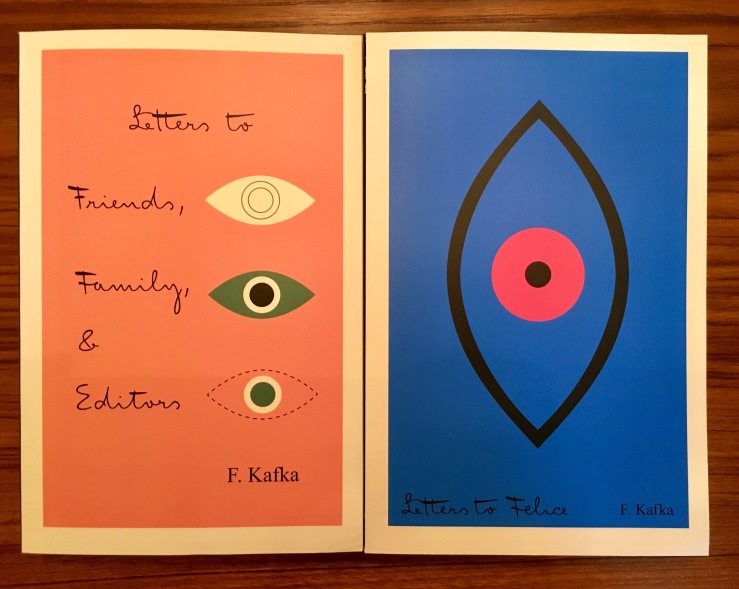
Two lovely Kafkas (Books acquired, 11.29.2016)

img_4365

Two volumes of Franz Kafka’s letters are forthcoming next month from SchockenLetters to Friends, Family, and Editors; and Letters to Felice.

Both covers are designed by Peter Mendelsund (as are all those lovely Schocken Kafka editions).

Schocken’s blurb for Friends, Family and Editors:

Collected after his death by his friend and literary executor Max Brod, here are more than two decades’ worth of Franz Kafka’s letters to the men and women with whom he maintained his closest personal relationships, from his years as a student in Prague in the early 1900s to his final months in the sanatorium near Vienna where he died in 1924.

Sometimes surprisingly humorous, sometimes wrenchingly sad, they include charming notes to school friends; fascinating accounts to Brod about his work in its various stages of publication; correspondence with his publisher, Kurt Wolff, about manuscripts in progress, suggested book titles, type design, and late royalty statements; revealing exchanges with other young writers of the day, including Martin Buber and Felix Weltsch, on life, literature, and girls; and heartbreaking reports to his parents, sisters, and friends on the declining state of his health in the last months of his life.

And Felice:

Franz Kafka met Felice Bauer in August 1912, at the home of his friend Max Brod. Energetic, down-to-earth, and life-affirming, the twenty-five-year-old secretary was everything Kafka was not, and he was instantly smitten. Because he was living in Prague and she in Berlin, his courtship was largely an epistolary one—passionate, self-deprecating, and anxious letters sent almost daily, sometimes even two or three times a day. But soon after their engagement was announced in 1914, Kafka began to worry that marriage would interfere with his writing and his need for solitude.

The more than five hundred letters Kafka wrote to Felice—through their breakup, a second engagement in 1917, and their final parting in the fall of that year, when Kafka began to feel the effects of the tuberculosis that would eventually claim his life—reveal the full measure of his inner turmoil as he tried, in vain, to balance his desire for human connection with what he felt were the solitary demands of his craft.