“Books in the Age of the iPad” — Craig Mod

In his recent essay, “Books in the Age of the iPad,” Craig Mod distinguishes between “Formless” and “Definite” content:

Formless Content is is unaware of the container. Definite Content embraces the container as a canvas. Formless content is usually only text. Definite content usually has some visual elements along with text. Much of what we consume happens to be Formless. The bulk of printed matter — novels and non-fiction — is Formless.

Mod argues that the rise of e-readers like the Kindle and (presumably) the iPad are harbingers of a new age in reading, where both formless and, now, definite content might be readily (and easily) displayed. He makes a brash judgment:

The convenience of digital text — on demand, lightweight (in file size and physicality), searchable — already far trumps that of traditional printed matter.

Really? On demand? For whom? “On demand” here presupposes a number of conditions, first and foremost, that each person who wishes to enjoy this new medium has the economic means to do so. The projected retail cost of the iPad is currently $500, a price that does not include monthly ISP fees, let alone the prices of e-books and other e-texts. The Kindle retails now for about half the price of the iPad. Although these prices will certainly fall over time, it is difficult to imagine that the “convenience of digital text” will trump equitable access to “traditional printed matter” — particularly for families with multiple children (at least any time soon).

Mod makes some good points about the future of printed, physical books in the age of e-readers (or, the iPad, a device he seems to think will normalize the medium):

I propose the following to be considered whenever we think of printing a book:

  • The Books We Make embrace their physicality — working in concert with the content to illuminate the narrative.
  • The Books We Make are confident in form and usage of material.
  • The Books We Make exploit the advantages of print.
  • The Books We Make are built to last.

The result of this is:

  • The Books We Make will feel whole and solid in the hands.
  • The Books We Make will smell like now forgotten, far away libraries.
  • The Books We Make will be something of which even our children — who have fully embraced all things digital — will understand the worth.
  • The Books We Make will always remind people that the printed book can be a sculpture for thoughts and ideas.

Anything less than this will be stepped over and promptly forgotten in the digital march forward.

Goodbye disposable books.

Hello new canvases.

Books as aesthetic, durable objects — great idea. But books as relics, as things to recall the smell of “now forgotten, far away libraries”? Really? Libraries function as an important space in communities that transcend the mediums of information in those libraries. It’s almost downright scary to posit some kind of project-utopia where a library becomes “digitized.” Also — and again, much of what Mod suggests here is great — but also, who are “our children” who “have fully embraced all things digital”? In the current geopolitical climate, Mod’s line of thinking can only realistically apply to “First World” countries. Even in our own beloved United States, first among the “First World,” we have difficulty feeding all of our children or funding their educations. E-readers like the iPad or Kindle could presumably do much to ameliorate the burgeoning education gap, but recent efforts haven’t gained much momentum or praise.

It’s not that I disagree with (what I perceive to be) Mod’s overall thesis — that the iPad and successive e-readers will revolutionize how we read, access, and store information. I do, however, think that his rosy-toned enthusiasm has led to a number of blind spots in his article. Why should e-readers eliminate libraries? What, exactly, are “disposable books”? Who will have access to these “new canvases,” and in what capacity? Why the implicit presumption that digital storage of media is fail safe, easier than current methods, and more permanent?

Finally, my biggest problem with the piece is the simple assumption that any e-reader could be more comfortable than a paperback book. Mod addresses arguments like mine:

When people lament the loss of the printed book, this — comfort — is usually what they’re talking about. My eyes tire more easily, they say. The batteries run out, the screen is tough to read in sunlight. It doesn’t like bath tubs.

Mod responds to these arguments:

Important to note is that these aren’t complaints about the text losing meaning. Books don’t become harder to understand, or confusing just because they’re digital. It’s mainly issues concerning quality. One inevitable property of the quality argument is that technology is closing the gap (through advancements in screens and batteries) and because of additional features (note taking, bookmarking, searching), will inevitably surpass the comfort level of reading on paper.

While Mod’s point of meaning vs. quality (what I’d refer to as readability) is certainly right, his assumption that technology “will inevitably surpass the comfort level of reading on paper” is wholly unfounded and unsupported. It’s exactly the kind of teleological claim we see too often about technology — that technology always progresses to an inevitable, good, and superior end point. Still, Apple can feel free to send me an iPad and I’ll be sure to test my own assumptions on the issue, and redress them here if need be.
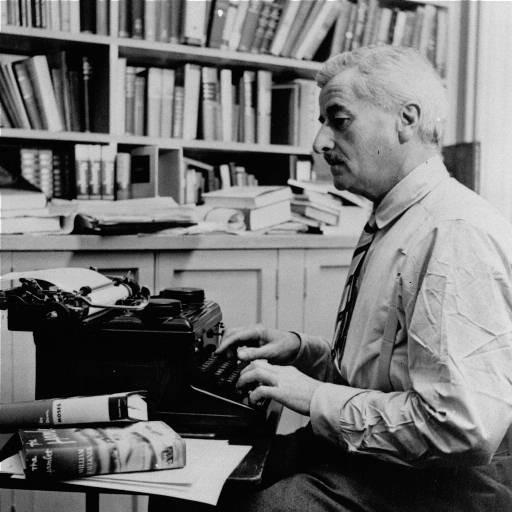
William Faulkner, As I Lay Dying, The Perils of Assigned Reading, and A Call for Second Chances

WKD WILLIAM FAULKNER

Not quite two years ago, I wrote some pretty awful things about William Faulkner on this blog. In a review of his first published novel Sancutary, I argued, quite ineffectually, that, “Faulkner as an American Great is nothing but a scam.” Elsewhere, I proffered this ignorant nugget:

“…it seems that a few critics–notably Malcolm Cowley and Cleanth Brooks–decided either that a. Faulkner is really great and/or b. America needs a new master of literary fiction, and it might as well be Faulkner. It seems amazing to me that these two critics conned a whole generation into believing that someone whose books were so unbelievably poorly written was actually, like, a totally awesome and important writer.”

Ouch. At the time I wrote that rant, I was still in grad school, which is to say I was still being assigned reading by well-intentioned professors. I was also laboring under a cruel miscalculation, the mistaken belief that I had actually read most of Faulkner’s great works–As I Lay Dying, The Sound and the Fury, and Absalom, Absalom!–in my high school and undergraduate courses–where said books were assigned reading. The truth, I realize now, is that while Faulkner’s strange, dense, elliptical prose might have passed under my eyes, I completely failed to read his books when I was a young man. It wasn’t until last spring, when I read one of Faulkner’s last novels, Go Down, Moses, that I came to understand the genius of his writing, which is to say I came to learn to read his voices in a non-academic, non-studied fashion, intuitively and rhythmically. Go Down, Moses is strange and sad and funny and truly an achievement, a book that works as a sort of time machine, an attempt to undo or recover the racial and familial (in Faulkner, these are the same) divides of the past.

So. Skip ahead a year.

After reading Bolaño’s stunning 2666, I strategically read Cormac McCarthy’s Child of God, knowing that I’d need a voice at least equal to Bolaño’s in order to not get totally bummed out and sort of paralyzed with that “What do I read next?” feeling. The strategy worked, but of course I needed a follow up book. So I picked up As I Lay Dying, the story of a poor rural family who labor to return their dead matriarch to her family’s home town for burial. I’d “read” the book in high school; I remembered the plot, but I could not in any way comment on it. This time, with the freedom to choose to read it–and perhaps, older, better equipped–I truly entered the book, entered into each of the character’s heads, their eyes, their voices. I “got” it.

as-i-lay-dying

I read As I Lay Dying in essentially three or four long sittings, sustained by Faulkner’s incomparable, engrossing language. I realize now that as a high school student, and then again as an undergrad, I resisted the book, attempted to impose my own consciousness into the narrative in order to “understand” the plot, rather than letting the book happen to me–which I believe is how one must read Faulkner. I was amazed how quickly I read the book once I attuned myself to Faulkner’s rhythm, and I was equally amazed at how conflicted and confused I felt about the story. I can’t recall a novel whose characters I’ve ever felt so hateful and sympathetic toward at the same time. Great, great book.

Anyway. The point of this post is to say, “Hey, I was wrong, mistaken, terribly wrong about Faulkner when I said he wasn’t a Great American Writer.” I suppose I’m also implicitly arguing that the necessary evil of assigned reading can sometimes be less necessary and more evil: How many kids are we turning away from the really great stuff forever by forcing it upon them when they are too young, too unequipped to appreciate it? The other side of this logic, of course, is to point out that often assigned reading can turn us on to great writers forever; this was the case for me, with most of what I read in high school. Still, as an English teacher I do worry that in assigning and then dissecting literature–under the pretense of explaining it and appreciating it and learning from it–we always run the risk of killing it, draining it of the very vitality that was the rationale for reading it in the first place. Of course, there’s a simple, simple antidote to reconciling yourself to all those books you hated in high school, those books you were supposed to love and be moved by and learn important and meaningful lessons from–you can read them again for the first time. The worst that could happen is a confirmation of your own prejudice; far more likely, in assigning your own reading, you’ll find something truly great and meaningful.

Cheat Code

Motoko Rich’s article “The Future of Reading,” published in today’s New York Times, discusses the emerging trend in publishing and education of reaching out to young readers via video games. According to the article–

Increasingly, authors, teachers, librarians and publishers are embracing this fast-paced, image-laden world in the hope that the games will draw children to reading. Spurred by arguments that video games also may teach a kind of digital literacy that is becoming as important as proficiency in print, libraries are hosting gaming tournaments, while schools are exploring how to incorporate video games in the classroom. In New York, the John D. and Catherine T. MacArthur Foundation is supporting efforts to create a proposed public school that will use principles of game design like instant feedback and graphic imagery to promote learning.

Loyal readers will recall that last year I wrote quite positively about the MacArthur grant to promote gaming literacy. However, the trend detailed in today’s article seems like a big step in the wrong direction. While graphic design and computer programming are vital skill sets we should be teaching our kids, trying to hook them on reading through video games is altogether different. It smacks of cheap gimmickry that dismisses outright that reading might be a pleasure unto itself. In an age when the majority of college students can’t handle complex but necessary reading tasks and high school illiteracy rates are woefully underreported, trying to hook kids on books with Dance Dance Revolution just doesn’t seem like a great plan. If anything, it’s yet another step in the dumbing-down of America, a land increasingly hostile to anything with a hint of intellectualism–reading included. No wonder the Nobel Committee are such dicks to the U.S. Buried at the end of the article, luckily, is a voice of reason–

“I actually think reading is pretty great and can compete with video games easily,” said Mark S. Seidenberg, a professor at the University of Wisconsin in Madison who specializes in reading research. “So rather than say, ‘Oh, books are irrelevant in the modern era because there are all these other media available,’ I would ask shouldn’t we be doing a better job of teaching kids how to read?”

Professor Seidenberg seems like a wise and reasonable man. Let’s hope that we can get this country back on track and realize that the skill sets needed to survive and compete in a technological world do not replace but rather augment traditional literacy. Video games are great entertainment but it’s hard to imagine that they could ever trump the depth and breadth of philosophy and cultural currency contained in literature. Let’s not cheat our children out of that heritage by mistakenly believing that they cannot be taught to access it.

On Rereading

So I just read Blood Meridian again. And–

Like many bibliophiles, I have a stack of books marked “to read,” both a physical and a mental one, a stack that only grows, one that my book-buying addiction feeds and that the reader in me can in no way deplete. The saddest thing in the stack–or about the stack, really (about is the proper preposition, not in) are all the books that I’m sure are just totally great (Atonement, The Sot-Weed Factor) and the ones that I’ve started at least half a dozen times yet never finished–yet (Gravity’s Rainbow, The Wind-up Bird Chronicles) that might not ever get read because of all the new books that get thrown on the stack.

The saddest thing though, is that we–and the “we” here is not editorial, folks, it refers to bibliophiles–we simply don’t reread enough. Because I teach high school, there are dozens of books that I get to reread every year. Every time I read Macbeth or Of Mice and Men or Their Eyes Were Watching God, I’m amazed by how rich and complex and just downright masterful these books are. Each new reading produces new insights, layers, new motifs unraveled, new details, once seemingly mere happenstances, reveal themselves as key to the whole ship and shebang. Rereading is good. And yet we don’t reread enough, precisely because of the stack, the insane egomaniacal compulsion to read all of the great books before, uh, death.

And so well and so thus I reread Blood Meridian. I read it a few months ago, put it down in a daze, read a few more books, all etiolated by comparison, and then, despite the stack I picked up Blood Meridian again, a strange ineffable compulsion forcing it into my hands; I didn’t want to reread the whole thing, just a few passages, and then, and then, well and then so well and thus I was just rereading the whole thing, a whole new book there under the book I thought I had read, had known, knew. I had experienced this before: when I first read Holden Caulfield, we were the same age; five years later I was five years older and he was a jerk. A decade passed and he was an alien (maybe I was a phony). Now, well, now I’m afraid to read the book

We can’t ever really know a book because we change. The book doesn’t change but the reading of the book changes. Because I get so much out of a rereading, because I know that reading in itself is not enough, the stack–which, I should probably emphasize, is a very real, physical presence, a little mound by my bed–because of this, there is a second distress, a pain of not only not being able to read all of the books, but also not being able to not reread many of them that deserve it.

So and well, after I reread Blood Meridian, I do something that I do after I finish every book–I go pick up a couple of books that I’m desperate to reread, as well as a few from the stack. The feeling is strange and breathless and giddy, and ultimately overwhelming. I uncover over old bookmarks, shocked that I made it so far on the last attempt, or stumble over the first five pages. I lie to myself, reading sections of Finnegans Wake, as if.

Right now I’m halfway through DeLillo’s masterpiece Underworld. It’s huge and unwieldy and really fucking good, and I will finish it–this time–but even as I read it I know that I’m missing half of it, that I can only really “get it” in the rereading. And yet and well this is a book that’s been in the stack for years. I have no solution, and I guess there’s no point to this post, only that I wish I had more time to read and then to read again.

Summer Reading List: Primer–Beach Reading and School Reading

The end of the Memorial Day weekend marks the beginning of summer, and with it, summer reading. This week Biblioklept will offer up some swell reading suggestions that will both entertain you and make you a better human being (seriously). In advance of that, let’s start with a silly question: just what is “summer reading” and how is it different–or is it different–than any other type of reading?

We’ll divide summer reading into two distinct camps: there’s elective summer reading, which we will henceforth call beach reading (no beach need be involved, as we will soon see), and then there’s the summer reading forced upon young people, henceforth known as the mandatory summer reading list. Let’s look at mandatory reading first, and then quickly dismiss it.

The lists. Oh the lists. We imagine most of our audience has been through the whole mandatory summer reading drill: schlepping around Barnes & Noble (or B. Dalton, back in the day), diligent Mom with said list clutched in hand, the embarrassment of the whole thing summed up in the piles of A Raisin in the Sun and A Separate Peace displayed in the aisles, the sullen look of an emerging sophomore gripping various honeybee-colored editions of Cliff’s Notes, the indignant cries of younger siblings, also forced to read, your never-read copy of My Side of the Mountain foisted upon them. The list seems impossible: A Portrait of the Artist as a Young Man? The Aeneid? Tess of the D’Ubervilles? Christ on crutches! Almost everything else in the bookstore seems doubly alluring by comparison. We want to read what we want to read, not what you tell us we want to read

This isn’t to suggest that a codified summer reading list should be done away with, of course. Summer reading helps to keep young people’s minds engaged during a time when they’d otherwise, let’s face it, consume naught but the cotton candy fare of Grand Theft Auto and Flavor of Love. Without the rigors of summer reading, students would return to school in the fall with their mind-muscled atrophied, puny, impotent. Still, having someone mandate what you should read is never fun. We had to go back years later, on our own, to appreciate much of what was forced upon us in youth.

That said, summer is a fine time to go back to those very lists. Just because you didn’t “get” Don Quixote when you were fifteen (and really, why would you have?) doesn’t mean that you won’t find it hilarious now that you’re older and your frames of reference have so greatly expanded. Ditto Moby-Dick, The Turn of the Screw, Walden, et al. There’s no rule that what we are calling here “beach reads” have to be light and fluffy. Still.

Ideas of just what constitutes beach reading, are, of course varied. But for many of us, beach reading implies a book that we can read on the beach or by the pool or swaying in a hammock in our backyard. Beach reading is a book that we can still follow after three beers on the porch. Beach reading can be trashy and lurid; beach reading can be literary junk food. Beach reading is genre fiction in cheap mass produced paperbacks, the kind of books we’re happy to leave at the condo when we’re through with them. Someone else will find them, digest them along with a blender of margaritas. At the same time, for a lot of us beach reading is the time to play catch up with all those books that have been stacking up in the margins of our homes, neglected, unread. In any case, summer is a time that many of us put renewed energies into pursuing the endangered pastime of reading, and over the next week Biblioklept aims to aid the cause.

Gaming Literacy

According to this NPR report, the MacArthur Foundation is providing a $1.1 million grant to create a new middle/high school in New York with a curriculum based on video game design. The idea here is that video game design promotes a new type of literacy vital for America’s success in the rapidly growing global economy. The report stresses a shift from older models of literacy, which focus on content memorization, to the pressing need to emphasize literacy models that engage the dynamic systems inherent in newer media.

I think that this is a fantastic idea. Some may find it a nonsensical or even radical shift in education, but we have to try something new. The educational system in this country is based on a model that hasn’t really changed since the industrial revolution. Although numerous sources rank America as having one of the highest literacy rates in the world, my own anecdotal evidence collected as a high school English teacher leads me to believe that this country is in the midst of a literacy crisis that is sure to have a major impact in the country’s ability to compete with countries like India and China.

The risks here are very, very real. Literacy is not just a matter of being able to read stop signs or popular novels or wikipedia pages–literacy is what informs the content of our cultural, social, and political discourse. And beyond the economic issues presented in our difficulty competing in fields like science and engineering–an issue that the MacArthur Foundation’s grant may help address–the everyday rhetoric in this country has become drastically dumbed-down, polarized, reduced to hackneyed platitudes and snappy sound-bites. Political and cultural discourse now consists of empty catch-phrases and meaningless psychobabble. I mean, it’s like totally gay, know what I’m sayin’?

This clip from Mike Judge’s satire Idiocracy neatly sums up the future of verbal discourse in America: