RIP Joe Simon

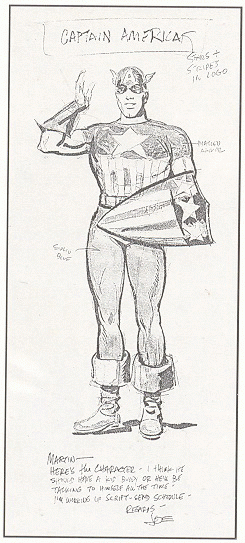
Early Captain America Design Sketch by Joe Simon

RIP comic book legend Joe Simon.

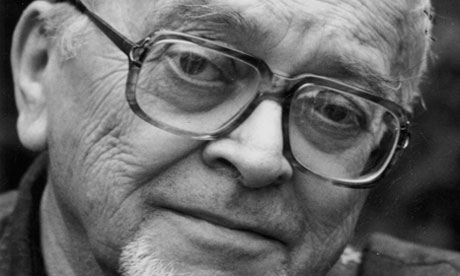
RIP Russell Hoban

Russell Hoban, author of Riddley Walker and other cult classics, died last night at the age of 86. The first “review” I ever wrote on this site was for Riddley Walker (the review is so bad that I won’t link to it out of shame); that was back when Biblioklept’s primary mission was to document stolen books. I stole the book from a dear friend and subsequently lent it to a student who never returned it. Oh, the circle of theft! Riddley Walker is the sort of book that begs to be stolen (or never returned, or passed on to another). It’s an apocalyptic Huckleberry Finn, a coming of age story set against the backdrop of a new dark age. Riddley Walker is deeply weird and strongly strange; I don’t know what a “cult” novel is, but I know of no better example.

Riddley Walker might be Hoban’s most famous work (aside from his children’s works, including the Frances the Badger series), but readers who stopped there would do well to pick up some of his earlier books. The Lion of Boaz-Jachin and Jachin-Boaz is a fantasy piece about fathers, sons, and map-making; Kleinzheit, a baffling schizophrenic novel, explores death and illness in an animistic world; Pilgermann plumbs the medieval intersection of Judaism, Christianity, and Islam, narrated through the eyes of the ghost of a castrated European Jew on a bizarre holy quest—it’s like Hieronymous Bosch on LSD.

The Guardian has a short but lucid biographical obit for Hoban, which ends with Hoban contemplating how death might affect his career:

Death, Hoban predicted in 2002, would “be a good career move”. “People will say, ‘yes, Hoban, he seems an interesting writer, let’s look at him again’,” he said.

The grim humor there was always part of Hoban’s program, and I hope that he’s right: I hope that folks who haven’t heard of Hoban will pick up Riddley Walker, and perhaps those who haven’t read beyond that book will make time to read another.

RIP Bert Jansch

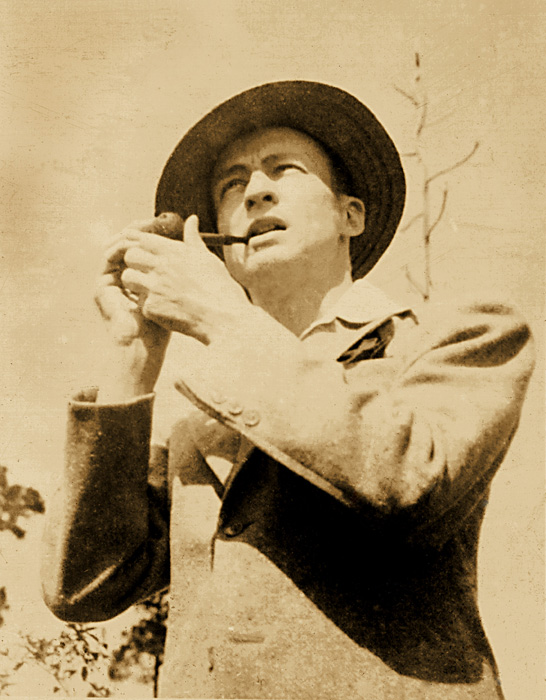
RIP Stetson Kennedy, Florida Folklorist, Writer, and Human Rights Activist

Stetson Kennedy died today at 94 in his native city, Jacksonville, FL.

Kennedy began his career collecting folklore throughout the South in 1937 after leaving the University of Florida. Kennedy worked for the Works Progress Administration’s Florida Writers’ Project, traveling with Zora Neale Hurston to collect oral histories and folk tales from both black and white Floridians alike. In the 1940s, Kennedy worked for the Atlanta office of the CIO. He also infiltrated the Ku Klux Klan in the 1940s and ’50s, exposing many of the racist organization’s secrets and alerting the world to the intrinsic injustice of the Jim Crow system in Southern states.

When Kennedy ran (quite unsuccessfully) for Governor of Florida in 1952, Woody Guthrie wrote the song “Stetson Kennedy” to support his good friend (Wilco and Billy Bragg put the lyrics to music decades later). Kennedy’s anti-Jim Crow, early Civil Rights platform didn’t win him much popularity throughout the state, and when his home in Fruit Cove was firebombed, he moved to France. It was there that the philosopher Jean-Paul Sartre published Kennedy’s The Jim Crow Guide—but the book was too controversial for US publication, despite multiple translations across Europe. Even more incendiary was Kennedy’s expose The Klan Unmasked (1954), which helped to undermine the organization’s secret authority in the South.

Just as Kennedy’s contribution to the Civil Rights movement cannot be underestimated, neither can his work in collecting and preserving Florida folklore (as well as Southern folklore in general). Kennedy helped found the Florida Folklore Society and also served as president, and volumes like Palmetto County and Grits and Grunts: Folkloric Key West will remain staples of Florida folk culture. In 2009, Kennedy bequeathed his papers and personal library to the Civic Media Center in Gainesville, FL, a nonprofit info center and alternative library devoted to human rights, environmental protection, and other causes. Kennedy was closely involved with the CMC since its inception in 1993.

Kennedy was a vibrant fount of cultural and historical force, a man who worked his entire, long life not just to preserve folklore and its history, but also to show the radical place that folk culture occupies throughout time, linking core human values from generation to generation. Stetson Kennedy will live through his legacy.

Kennedy’s website sheds light on his final moments—

He was with his wife and stepdaughter, He was in no pain. And as recently as 4 days ago he was lucid and talking. The doctor, checking his mental faculties asked him questions “where are you from”, Kennedy replied, “The planet Earth”

Stetson’s wishes were for a party and not a funeral. A luncheon at Beluthahatchee will be held October 1st.

Kennedy on This American Life.

Read a 2011 interview with Kennedy in Vice Magazine.
RIP Sidney Lumet

Sidney Lumet, who directed dozens of classic films, including 12 Angry Men, Dog Day Afternoon, Serpico, and Network, has died at the age of 86. We are big fans of his fine films, including the last film he made, 2007’s underappreciated Before the Devil Knows You’re Dead (heck, we even liked his totally unnecessary remake of Gloria). Here’s Lumet talking about 12 Angry Men

RIP Diana Wynne Jones

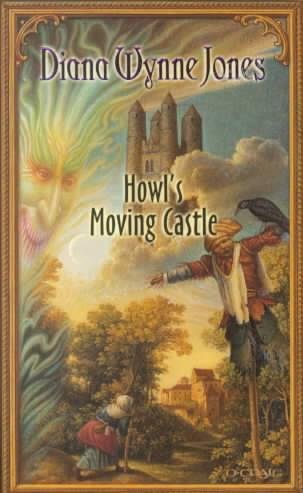
According to a number of sources, including Neil Gaiman and the fan-operated site she approved of, author Diana Wynne Jones has passed away after fighting cancer. Jones wrote dozens of novels, mostly in the fantasy genre, for adults and children alike, although she is perhaps most known for Howl’s Moving Castle, which Hayao Miyazaki adapted into an excellent film in 2004. Jones’s work bears comparison to the Harry Potter series, and recent reissues of her novels insure that a younger generation will have access to her work.

RIP Captain Beefheart

Read a proper eulogy here.