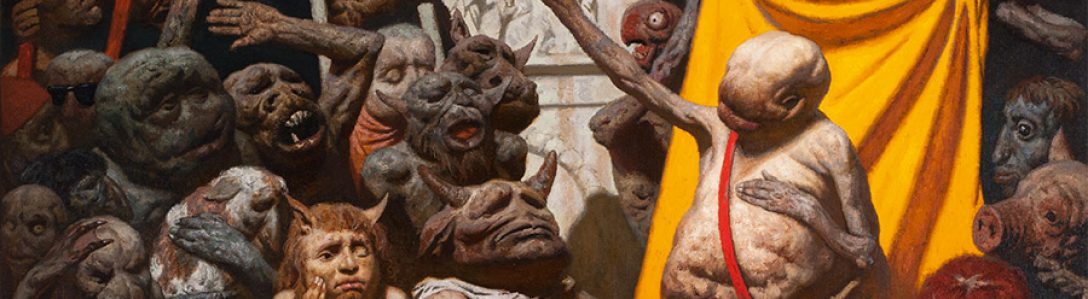
“The Egg,” a short story by Sherwood Anderson

“The Egg”

by

Sherwood Anderson


My father was, I am sure, intended by nature to be a cheerful, kindly man. Until he was thirty-four years old he worked as a farmhand for a man named Thomas Butterworth whose place lay near the town of Bidwell, Ohio. He had then a horse of his own and on Saturday evenings drove into town to spend a few hours in social intercourse with other farmhands. In town he drank several glasses of beer and stood about in Ben Head’s saloon–crowded on Saturday evenings with visiting farmhands. Songs were sung and glasses thumped on the bar. At ten o’clock father drove home along a lonely country road, made his horse comfortable for the night and himself went to bed, quite happy in his position in life. He had at that time no notion of trying to rise in the world.

It was in the spring of his thirty-fifth year that father married my mother, then a country schoolteacher, and in the following spring I came wriggling and crying into the world. Something happened to the two people. They became ambitious. The American passion for getting up in the world took possession of them.

It may have been that mother was responsible. Being a schoolteacher she had no doubt read books and magazines. She had, I presume, read of how Garfield, Lincoln, and other Americans rose from poverty to fame and greatness and as I lay beside her–in the days of her lying-in–she may have dreamed that I would someday rule men and cities. At any rate she induced father to give up his place as a farmhand, sell his horse and embark on an independent enterprise of his own. She was a tall silent woman with a long nose and troubled grey eyes. For herself she wanted nothing. For father and myself she was incurably ambitious.

The first venture into which the two people went turned out badly. They rented ten acres of poor stony land on Griggs’s Road, eight miles from Bidwell, and launched into chicken raising. I grew into boyhood on the place and got my first impressions of life there. From the beginning they were impressions of disaster and if, in my turn, I am a gloomy man inclined to see the darker side of life, I attribute it to the fact that what should have been for me the happy joyous days of childhood were spent on a chicken farm. Continue reading ““The Egg,” a short story by Sherwood Anderson”
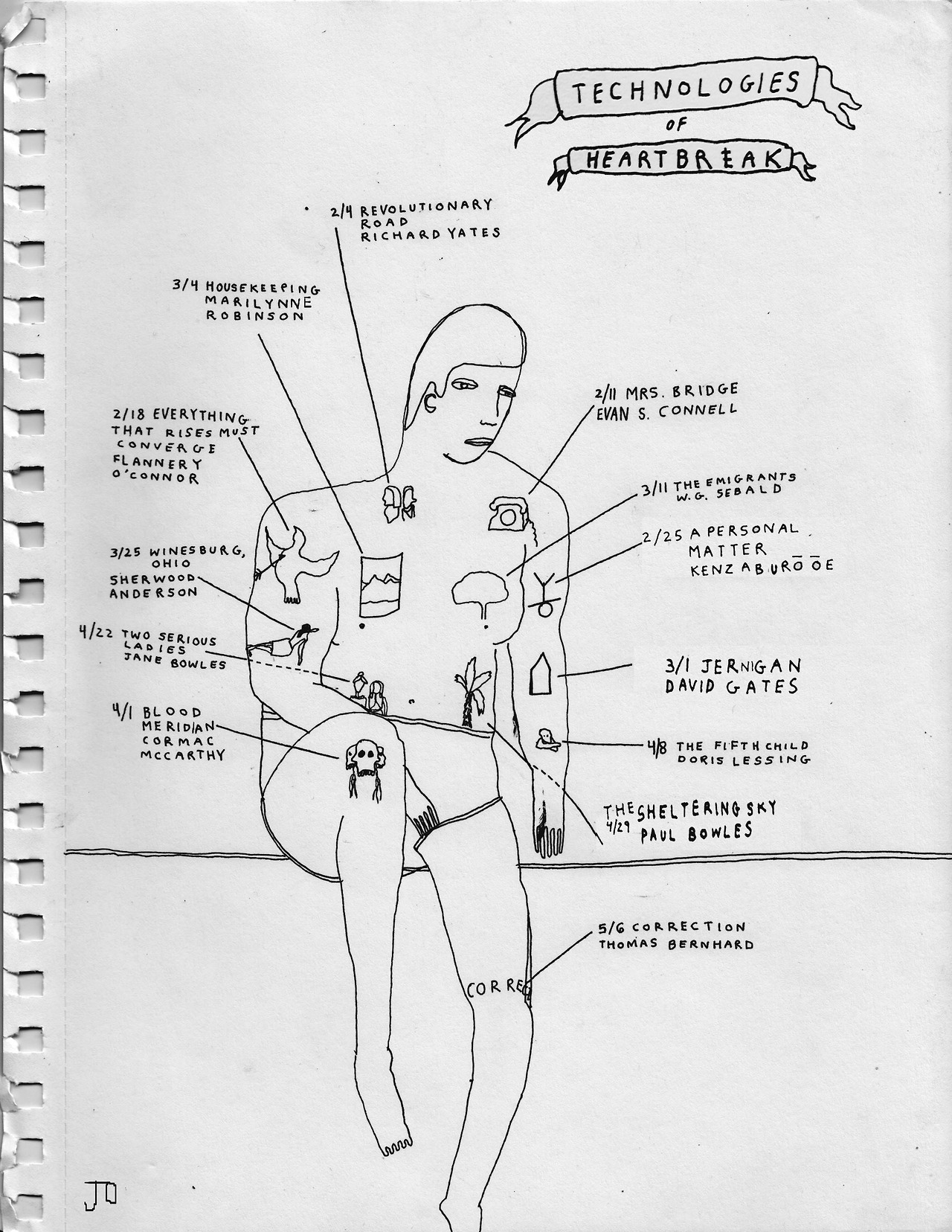
“Technologies of Heartbreak” — Josephine Demme

tumblr_n7osgziyJc1qzh8wko1_1280

Illustration for a syllabus by Ben Marcus. (via)

“Death in the Woods” — Sherwood Anderson

“Death in the Woods” by Sherwood Anderson

She was an old woman and lived on a farm near the town in which I lived. All country and small-town people have seen such old women, but no one knows much about them. Such an old woman comes into town driving an old worn-out horse or she comes afoot carrying a basket. She may own a few hens and have eggs to sell. She brings them in a basket and takes them to a grocer. There she trades them in. She gets some salt pork and some beans. Then she gets a pound or two of sugar and some flour.

Afterwards she goes to the butcher’s and asks for some dog-meat. She may spend ten or fifteen cents, but when she does she asks for something. Formerly the butchers gave liver to any one who wanted to carry it away. In our family we were always having it. Once one of my brothers got a whole cow’s liver at the slaughter-house near the fairgrounds in our town. We had it until we were sick of it. It never cost a cent. I have hated the thought of it ever since.

The old farm woman got some liver and a soup-bone. She never visited with any one, and as soon as she got what she wanted she lit out for home. It made quite a load for such an old body. No one gave her a lift. People drive right down a road and never notice an old woman like that.

There was such an old woman who used to come into town past our house one Summer and Fall when I was a young boy and was sick with what was called inflammatory rheumatism. She went home later carrying a heavy pack on her back. Two or three large gaunt-looking dogs followed at her heels.

The old woman was nothing special. She was one of the nameless ones that hardly any one knows, but she got into my thoughts. I have just suddenly now, after all these years, remembered her and what happened. It is a story. Her name was Grimes, and she lived with her husband and son in a small unpainted house on the bank of a small creek four miles from town.

The husband and son were a tough lot. Although the son was but twenty-one, he had already served a term in jail. It was whispered about that the woman’s husband stole horses and ran them off to some other county. Now and then, when a horse turned up missing, the man had also disappeared. No one ever caught him. Once, when I was loafing at Tom Whitehead’s livery-barn, the man came there and sat on the bench in front. Two or three other men were there, but no one spoke to him. He sat for a few minutes and then got up and went away. When he was leaving he turned around and stared at the men. There was a look of defiance in his eyes. “Well, I have tried to be friendly. You don’t want to talk to me. It has been so wherever I have gone in this town. If, some day, one of your fine horses turns up missing, well, then what?” He did not say anything actually. “I’d like to bust one of you on the jaw,” was about what his eyes said. I remember how the look in his eyes made me shiver. Continue reading ““Death in the Woods” — Sherwood Anderson”

“Hands” — Sherwood Anderson

“Hands” by Sherwood Anderson

Upon the half decayed veranda of a small frame house that stood near the edge of a ravine near the town of Winesburg, Ohio, a fat little old man walked nervously up and down. Across a long field that had been seeded for clover but that had produced only a dense crop of yellow mustard weeds, he could see the public highway along which went a wagon filled with berry pickers returning from the fields. The berry pickers, youths and maidens, laughed and shouted boisterously. A boy clad in a blue shirt leaped from the wagon and attempted to drag after him one of the maidens, who screamed and protested shrilly. The feet of the boy in the road kicked up a cloud of dust that floated across the face of the departing sun. Over the long field came a thin girlish voice. “Oh, you Wing Biddlebaum, comb your hair, it’s falling into your eyes,” commanded the voice to the man, who was bald and whose nervous little hands fiddled about the bare white forehead as though arranging a mass of tangled locks.

Wing Biddlebaum, forever frightened and beset by a ghostly band of doubts, did not think of himself as in any way a part of the life of the town where he had lived for twenty years. Among all the people of Winesburg but one had come close to him. With George Willard, son of Tom Willard, the proprietor of the New Willard House, he had formed something like a friendship. George Willard was the reporter on the Winesburg Eagle and sometimes in the evenings he walked out along the highway to Wing Biddlebaum’s house. Now as the old man walked up and down on the veranda, his hands moving nervously about, he was hoping that George Willard would come and spend the evening with him. After the wagon containing the berry pickers had passed, he went across the field through the tall mustard weeds and climbing a rail fence peered anxiously along the road to the town. For a moment he stood thus, rubbing his hands together and looking up and down the road, and then, fear overcoming him, ran back to walk again upon the porch on his own house. Continue reading ““Hands” — Sherwood Anderson”