“Unhappiness” — Franz Kafka

“Unhappiness” by Franz Kafka

WHEN it was becoming unbearable – once toward evening in November – and I ran along the narrow strip of carpet in my room as on a racetrack, shrank from the sight of the lit-up street, then turning to the interior of the room found a new goal in the depths of the looking glass and screamed aloud, to hear only my own scream which met no answer nor anything that could draw its force away, so that it rose up without check and could not stop even when it ceased being audible, the door in the wall opened toward me, how swiftly, because swiftness was needed and even the cart horses down below on the paving stones were rising in the air like horses driven wild in a battle, their throats bare to the enemy.

Like a small ghost a child blew in from the pitch-dark corridor, where the lamp was not yet lit, and stood a-tiptoe on a floor board that quivered imperceptibly. At once dazzled by the twilight in my room she made to cover her face quickly with her hands, but contented herself unexpectedly with a glance at the window, where the mounting vapor of the street lighting had at last settled under its cover of darkness behind the crossbars. With her right elbow she supported herself against the wall in the open doorway and let the draught from outside play along her ankles, her throat, and her temples.

I gave her a brief glance, then said ‘Good day,’ and took my jacket from the hood of the stove, since I didn’t want to stand there half-undressed. For a little while I let my mouth hang open, so that my agitation could find a way out. I had a bad taste in my mouth, my eyelashes were fluttering on my cheeks, in short this visit, though I had expected it, was the one thing needful.

The child was still standing by the wall on the same spot, she had pressed her right hand against the plaster and was quite taken up with finding, her cheeks all pink, that the whitewashed walls had a rough surface and chafed her finger tips. I said: ‘Are you really looking for me? Isn’t there some mistake? Nothing easier than to make a mistake in this big building. I’m called So-and-so and I live on the third floor. Am I the person you want to find? Continue reading ““Unhappiness” — Franz Kafka”

“The Valley of Spiders” — H.G. Wells

“The Valley of Spiders” by H.G. Wells

Towards mid-day the three pursuers came abruptly round a bend in the torrent bed upon the sight of a very broad and spacious valley. The difficult and winding trench of pebbles along which they had tracked the fugitives for so long, expanded to a broad slope, and with a common impulse the three men left the trail, and rode to a little eminence set with olive-dun trees, and there halted, the two others, as became them, a little behind the man with the silver-studded bridle.

For a space they scanned the great expanse below them with eager eyes. It spread remoter and remoter, with only a few clusters of sere thorn bushes here and there, and the dim suggestions of some now waterless ravine, to break its desolation of yellow grass. Its purple distances melted at last into the bluish slopes of the further hills—hills it might be of a greener kind—and above them invisibly supported, and seeming indeed to hang in the blue, were the snowclad summits of mountains that grew larger and bolder to the north-westward as the sides of the valley drew together. And westward the valley opened until a distant darkness under the sky told where the forests began. But the three men looked neither east nor west, but only steadfastly across the valley.

The gaunt man with the scarred lip was the first to speak. “Nowhere,” he said, with a sigh of disappointment in his voice. “But after all, they had a full day’s start.”

“They don’t know we are after them,” said the little man on the white horse.

“SHE would know,” said the leader bitterly, as if speaking to himself.

“Even then they can’t go fast. They’ve got no beast but the mule, and all to-day the girl’s foot has been bleeding—-”

The man with the silver bridle flashed a quick intensity of rage on him. “Do you think I haven’t seen that?” he snarled.

“It helps, anyhow,” whispered the little man to himself.

The gaunt man with the scarred lip stared impassively. “They can’t be over the valley,” he said. “If we ride hard—”

He glanced at the white horse and paused.

“Curse all white horses!” said the man with the silver bridle, and turned to scan the beast his curse included.

The little man looked down between the melancholy ears of his steed.

“I did my best,” he said.

The two others stared again across the valley for a space. The gaunt man passed the back of his hand across the scarred lip. Continue reading ““The Valley of Spiders” — H.G. Wells”

“The Blind Man” — Guy de Maupassant

“The Blind Man” by Guy de Maupassant

How is it that the sunlight gives us such joy? Why does this radiance when it falls on the earth fill us with the joy of living? The whole sky is blue, the fields are green, the houses all white, and our enchanted eyes drink in those bright colors which bring delight to our souls. And then there springs up in our hearts a desire to dance, to run, to sing, a happy lightness of thought, a sort of enlarged tenderness; we feel a longing to embrace the sun.

The blind, as they sit in the doorways, impassive in their eternal darkness, remain as calm as ever in the midst of this fresh gaiety, and, not understanding what is taking place around them, they continually check their dogs as they attempt to play.

When, at the close of the day, they are returning home on the arm of a young brother or a little sister, if the child says: “It was a very fine day!” the other answers: “I could notice that it was fine. Loulou wouldn’t keep quiet.”

I knew one of these men whose life was one of the most cruel martyrdoms that could possibly be conceived.

He was a peasant, the son of a Norman farmer. As long as his father and mother lived, he was more or less taken care of; he suffered little save from his horrible infirmity; but as soon as the old people were gone, an atrocious life of misery commenced for him. Dependent on a sister of his, everybody in the farmhouse treated him as a beggar who is eating the bread of strangers. At every meal the very food he swallowed was made a subject of reproach against him; he was called a drone, a clown, and although his brother-in-law had taken possession of his portion of the inheritance, he was helped grudgingly to soup, getting just enough to save him from starving. Continue reading ““The Blind Man” — Guy de Maupassant”

“Markheim” — Robert Louis Stevenson

“Markheim” by Robert Louis Stevenson

“Yes,” said the dealer, “our windfalls are of various kinds. Some customers are ignorant, and then I touch a dividend on my superior knowledge. Some are dishonest,” and here he held up the candle, so that the light fell strongly on his visitor, “and in that case,” he continued, “I profit by my virtue.”

Markheim had but just entered from the daylight streets, and his eyes had not yet grown familiar with the mingled shine and darkness in the shop. At these pointed words, and before the near presence of the flame, he blinked painfully and looked aside.

The dealer chuckled. “You come to me on Christmas Day,” he resumed, “when you know that I am alone in my house, put up my shutters, and make a point of refusing business. Well, you will have to pay for that; you will have to pay for my loss of time, when I should be balancing my books; you will have to pay, besides, for a kind of manner that I remark in you to-day very strongly. I am the essence of discretion, and ask no awkward questions; but when a customer cannot look me in the eye, he has to pay for it.” The dealer once more chuckled; and then, changing to his usual business voice, though still with a note of irony, “You can give, as usual, a clear account of how you came into the possession of the object?” he continued. “Still your uncle’s cabinet? A remarkable collector, sir!”

And the little pale, round-shouldered dealer stood almost on tip- toe, looking over the top of his gold spectacles, and nodding his head with every mark of disbelief. Markheim returned his gaze with one of infinite pity, and a touch of horror.

“This time,” said he, “you are in error. I have not come to sell, but to buy. I have no curios to dispose of; my uncle’s cabinet is bare to the wainscot; even were it still intact, I have done well on the Stock Exchange, and should more likely add to it than otherwise, and my errand to-day is simplicity itself. I seek a Christmas present for a lady,” he continued, waxing more fluent as he struck into the speech he had prepared; “and certainly I owe you every excuse for thus disturbing you upon so small a matter. But the thing was neglected yesterday; I must produce my little compliment at dinner; and, as you very well know, a rich marriage is not a thing to be neglected.”

There followed a pause, during which the dealer seemed to weigh this statement incredulously. The ticking of many clocks among the curious lumber of the shop, and the faint rushing of the cabs in a near thoroughfare, filled up the interval of silence.

“Well, sir,” said the dealer, “be it so. You are an old customer after all; and if, as you say, you have the chance of a good marriage, far be it from me to be an obstacle. Here is a nice thing for a lady now,” he went on, “this hand glass—fifteenth century, warranted; comes from a good collection, too; but I reserve the name, in the interests of my customer, who was just like yourself, my dear sir, the nephew and sole heir of a remarkable collector.” Continue reading ““Markheim” — Robert Louis Stevenson”

“Silence–A Fable” — Edgar Allan Poe

“Silence–A Fable” by Edgar Allan Poe

ALCMAN. The mountain pinnacles slumber; valleys, crags and
     caves are silent.

“LISTEN to me,” said the Demon as he placed his hand upon my head. “The region of which I speak is a dreary region in Libya, by the borders of the river Zaire. And there is no quiet there, nor silence.

“The waters of the river have a saffron and sickly hue; and they flow not onwards to the sea, but palpitate forever and forever beneath the red eye of the sun with a tumultuous and convulsive motion. For many miles on either side of the river’s oozy bed is a pale desert of gigantic water-lilies. They sigh one unto the other in that solitude, and stretch towards the heaven their long and ghastly necks, and nod to and fro their everlasting heads. And there is an indistinct murmur which cometh out from among them like the rushing of subterrene water. And they sigh one unto the other.

“But there is a boundary to their realm—the boundary of the dark, horrible, lofty forest. There, like the waves about the Hebrides, the low underwood is agitated continually. But there is no wind throughout the heaven. And the tall primeval trees rock eternally hither and thither with a crashing and mighty sound. And from their high summits, one by one, drop everlasting dews. And at the roots strange poisonous flowers lie writhing in perturbed slumber. And overhead, with a rustling and loud noise, the gray clouds rush westwardly forever, until they roll, a cataract, over the fiery wall of the horizon. But there is no wind throughout the heaven. And by the shores of the river Zaire there is neither quiet nor silence.

“It was night, and the rain fell; and falling, it was rain, but, having fallen, it was blood. And I stood in the morass among the tall and the rain fell upon my head—and the lilies sighed one unto the other in the solemnity of their desolation.

“And, all at once, the moon arose through the thin ghastly mist, and was crimson in color. And mine eyes fell upon a huge gray rock which stood by the shore of the river, and was lighted by the light of the moon. And the rock was gray, and ghastly, and tall,—and the rock was gray. Upon its front were characters engraven in the stone; and I walked through the morass of water-lilies, until I came close unto the shore, that I might read the characters upon the stone. But I could not decypher them. And I was going back into the morass, when the moon shone with a fuller red, and I turned and looked again upon the rock, and upon the characters;—and the characters were DESOLATION.

“And I looked upwards, and there stood a man upon the summit of the rock; and I hid myself among the water-lilies that I might discover the actions of the man. And the man was tall and stately in form, and was wrapped up from his shoulders to his feet in the toga of old Rome. And the outlines of his figure were indistinct—but his features were the features of a deity; for the mantle of the night, and of the mist, and of the moon, and of the dew, had left uncovered the features of his face. And his brow was lofty with thought, and his eye wild with care; and, in the few furrows upon his cheek I read the fables of sorrow, and weariness, and disgust with mankind, and a longing after solitude.

“And the man sat upon the rock, and leaned his head upon his hand, and looked out upon the desolation. He looked down into the low unquiet shrubbery, and up into the tall primeval trees, and up higher at the rustling heaven, and into the crimson moon. And I lay close within shelter of the lilies, and observed the actions of the man. And the man trembled in the solitude;—but the night waned, and he sat upon the rock.

“And the man turned his attention from the heaven, and looked out upon the dreary river Zaire, and upon the yellow ghastly waters, and upon the pale legions of the water-lilies. And the man listened to the sighs of the water-lilies, and to the murmur that came up from among them. And I lay close within my covert and observed the actions of the man. And the man trembled in the solitude;—but the night waned and he sat upon the rock.

“Then I went down into the recesses of the morass, and waded afar in among the wilderness of the lilies, and called unto the hippopotami which dwelt among the fens in the recesses of the morass. And the hippopotami heard my call, and came, with the behemoth, unto the foot of the rock, and roared loudly and fearfully beneath the moon. And I lay close within my covert and observed the actions of the man. And the man trembled in the solitude;—but the night waned and he sat upon the rock.

“Then I cursed the elements with the curse of tumult; and a frightful tempest gathered in the heaven where, before, there had been no wind. And the heaven became livid with the violence of the tempest—and the rain beat upon the head of the man—and the floods of the river came down—and the river was tormented into foam—and the water-lilies shrieked within their beds—and the forest crumbled before the wind—and the thunder rolled—and the lightning fell—and the rock rocked to its foundation. And I lay close within my covert and observed the actions of the man. And the man trembled in the solitude;—but the night waned and he sat upon the rock.

“Then I grew angry and cursed, with the curse of silence, the river, and the lilies, and the wind, and the forest, and the heaven, and the thunder, and the sighs of the water-lilies. And they became accursed, and were still. And the moon ceased to totter up its pathway to heaven—and the thunder died away—and the lightning did not flash—and the clouds hung motionless—and the waters sunk to their level and remained—and the trees ceased to rock—and the water-lilies sighed no more—and the murmur was heard no longer from among them, nor any shadow of sound throughout the vast illimitable desert. And I looked upon the characters of the rock, and they were changed;—and the characters were SILENCE.

“And mine eyes fell upon the countenance of the man, and his countenance was wan with terror. And, hurriedly, he raised his head from his hand, and stood forth upon the rock and listened. But there was no voice throughout the vast illimitable desert, and the characters upon the rock were SILENCE. And the man shuddered, and turned his face away, and fled afar off, in haste, so that I beheld him no more.”

Now there are fine tales in the volumes of the Magi—in the iron-bound, melancholy volumes of the Magi. Therein, I say, are glorious histories of the Heaven, and of the Earth, and of the mighty sea—and of the Genii that over-ruled the sea, and the earth, and the lofty heaven. There was much lore too in the sayings which were said by the Sybils; and holy, holy things were heard of old by the dim leaves that trembled around Dodona—but, as Allah liveth, that fable which the Demon told me as he sat by my side in the shadow of the tomb, I hold to be the most wonderful of all! And as the Demon made an end of his story, he fell back within the cavity of the tomb and laughed. And I could not laugh with the Demon, and he cursed me because I could not laugh. And the lynx which dwelleth forever in the tomb, came out therefrom, and lay down at the feet of the Demon, and looked at him steadily in the face.


“Mrs. Bullfrog” — Nathaniel Hawthorne

“Mrs. Bullfrog” by Nathaniel Hawthorne

It makes me melancholy to see how like fools some very sensible people act in the matter of choosing wives. They perplex their judgments by a most undue attention to little niceties of personal appearance, habits, disposition, and other trifles which concern nobody but the lady herself. An unhappy gentleman, resolving to wed nothing short of perfection, keeps his heart and hand till both get so old and withered that no tolerable woman will accept them. Now this is the very height of absurdity. A kind Providence has so skilfully adapted sex to sex and the mass of individuals to each other, that, with certain obvious exceptions, any male and female may be moderately happy in the married state. The true rule is to ascertain that the match is fundamentally a good one, and then to take it for granted that all minor objections, should there be such, will vanish, if you let them alone. Only put yourself beyond hazard as to the real basis of matrimonial bliss, and it is scarcely to be imagined what miracles, in the way of recognizing smaller incongruities, connubial love will effect.

For my own part I freely confess that, in my bachelorship, I was precisely such an over-curious simpleton as I now advise the reader not to be. My early habits had gifted me with a feminine sensibility and too exquisite refinement. I was the accomplished graduate of a dry goods store, where, by dint of ministering to the whims of fine ladies, and suiting silken hose to delicate limbs, and handling satins, ribbons, chintzes calicoes, tapes, gauze, and cambric needles, I grew up a very ladylike sort of a gentleman. It is not assuming too much to affirm that the ladies themselves were hardly so ladylike as Thomas Bullfrog. So painfully acute was my sense of female imperfection, and such varied excellence did I require in the woman whom I could love, that there was an awful risk of my getting no wife at all, or of being driven to perpetrate matrimony with my own image in the looking-glass. Besides the fundamental principle already hinted at, I demanded the fresh bloom of youth, pearly teeth, glossy ringlets, and the whole list of lovely items, with the utmost delicacy of habits and sentiments, a silken texture of mind, and, above all, a virgin heart. In a word, if a young angel just from paradise, yet dressed in earthly fashion, had come and offered me her hand, it is by no means certain that I should have taken it. There was every chance of my becoming a most miserable old bachelor, when, by the best luck in the world, I made a journey into another state, and was smitten by, and smote again, and wooed, won, and married, the present Mrs. Bullfrog, all in the space of a fortnight. Owing to these extempore measures, I not only gave my bride credit for certain perfections which have not as yet come to light, but also overlooked a few trifling defects, which, however, glimmered on my perception long before the close of the honeymoon. Yet, as there was no mistake about the fundamental principle aforesaid, I soon learned, as will be seen, to estimate Mrs. Bullfrog’s deficiencies and superfluities at exactly their proper value.

The same morning that Mrs. Bullfrog and I came together as a unit, we took two seats in the stage-coach and began our journey towards my place of business. There being no other passengers, we were as much alone and as free to give vent to our raptures as if I had hired a hack for the matrimonial jaunt. My bride looked charmingly in a green silk calash and riding habit of pelisse cloth; and whenever her red lips parted with a smile, each tooth appeared like an inestimable pearl. Such was my passionate warmth that—we had rattled out of the village, gentle reader, and were lonely as Adam and Eve in paradise—I plead guilty to no less freedom than a kiss. The gentle eye of Mrs. Bullfrog scarcely rebuked me for the profanation. Emboldened by her indulgence, I threw back the calash from her polished brow, and suffered my fingers, white and delicate as her own, to stray among those dark and glossy curls which realized my daydreams of rich hair. Continue reading ““Mrs. Bullfrog” — Nathaniel Hawthorne”

“The Oblong Box” — Edgar Allan Poe

“The Oblong Box” by Edgar Allan Poe

SOME years ago, I engaged passage from Charleston, S. C, to the city of New York, in the fine packet-ship “Independence,” Captain Hardy. We were to sail on the fifteenth of the month (June), weather permitting; and on the fourteenth, I went on board to arrange some matters in my state-room.

I found that we were to have a great many passengers, including a more than usual number of ladies. On the list were several of my acquaintances, and among other names, I was rejoiced to see that of Mr. Cornelius Wyatt, a young artist, for whom I entertained feelings of warm friendship. He had been with me a fellow-student at C— University, where we were very much together. He had the ordinary temperament of genius, and was a compound of misanthropy, sensibility, and enthusiasm. To these qualities he united the warmest and truest heart which ever beat in a human bosom.

I observed that his name was carded upon three state-rooms; and, upon again referring to the list of passengers, I found that he had engaged passage for himself, wife, and two sisters—his own. The state-rooms were sufficiently roomy, and each had two berths, one above the other. These berths, to be sure, were so exceedingly narrow as to be insufficient for more than one person; still, I could not comprehend why there were three state-rooms for these four persons. I was, just at that epoch, in one of those moody frames of mind which make a man abnormally inquisitive about trifles: and I confess, with shame, that I busied myself in a variety of ill-bred and preposterous conjectures about this matter of the supernumerary state-room. It was no business of mine, to be sure, but with none the less pertinacity did I occupy myself in attempts to resolve the enigma. At last I reached a conclusion which wrought in me great wonder why I had not arrived at it before. “It is a servant of course,” I said; “what a fool I am, not sooner to have thought of so obvious a solution!” And then I again repaired to the list—but here I saw distinctly that no servant was to come with the party, although, in fact, it had been the original design to bring one—for the words “and servant” had been first written and then overscored. “Oh, extra baggage, to be sure,” I now said to myself—”something he wishes not to be put in the hold—something to be kept under his own eye—ah, I have it—a painting or so—and this is what he has been bargaining about with Nicolino, the Italian Jew.” This idea satisfied me, and I dismissed my curiosity for the nonce. Continue reading ““The Oblong Box” — Edgar Allan Poe”

“In Football Season” — John Updike

“In Football Season” by John Updike

            Do you remember a fragrance girls acquire in autumn? As you walk beside them after school, they tighten their arms about their books bend their heads forward to give a more flattering attention to you words, and in the little intimate area thus formed, carved into the clear; by an implicit crescent, there is a complex fragrance woven of tobacco, powder, lipstick, rinsed hair, and that perhaps imaginary and certainly elusive scent that wool, whether in the lapels of a jacket or the nap of a j sweater, seems to yield when the cloudless fall sky like the blue bell of I a vacuum lifts toward itself the glad exhalations of all things. This fra­grance, so faint and flirtatious on those afternoon walks through the dry leaves, would be banked a thousand-fold on the dark slope of the stadium when, Friday nights, we played football in the city.

“We”—we the school. A suburban school, we rented for some of our home games the stadium of a college in the city of Alton three miles away. My father, a teacher, was active in the Olinger High athletic department, and I, waiting for him beside half-open doors of varnished wood and frosted glass, overheard arguments and felt the wind of the worries that accompanied this bold and at that time unprecedented deci­sion. Later, many of the other county high schools followed our lead; for the decision was vindicated. The stadium each Friday night when we played was filled. Not only students and parents came but spectators unconnected with either school, and the money left over when the sta­dium rent was paid supported our entire athletic program. I remember the smell of the grass crushed by footsteps behind the end zones. The smell was more vivid than that of a meadow, and in the blue electric glare the green vibrated as if excited, like a child, by being allowed up late. I remember my father taking tickets at the far corner of the wall, wedged into a tiny wooden booth that made him seem somewhat magical, like a troll.

And of course I remember the way we, the students, with all of our jealousies and antipathies and deformities, would be—beauty and boob, sexpot and grind—crushed together like flowers pressed to yield to the black sky a concentrated homage, an incense, of cosmetics, cigarette smoke, warmed wool, hot dogs, and the tang, both animal and metallic, of clean hair. In a hoarse olfactory shout, these odors ascended. A dense haze gathered along the ceiling of brightness at the upper limit of the arc lights, whose glare blotted out the stars and made the sky seem romanti­cally void and intimately near, like the death that now and then stooped and plucked one of us out of a crumpled automobile. If we went to the back row and stood on the bench there, we could look over the stone lip of the stadium down into the houses of the city, and feel the cold Novem­ber air like the black presence of the ocean beyond the rail of a ship; and when we left after the game and from the hushed residential streets of this part of the city saw behind us a great vessel steaming with light, the arches of the colonnades blazing like portholes, the stadium seemed a great ship sinking and we the survivors of a celebrated disaster. Continue reading ““In Football Season” — John Updike”

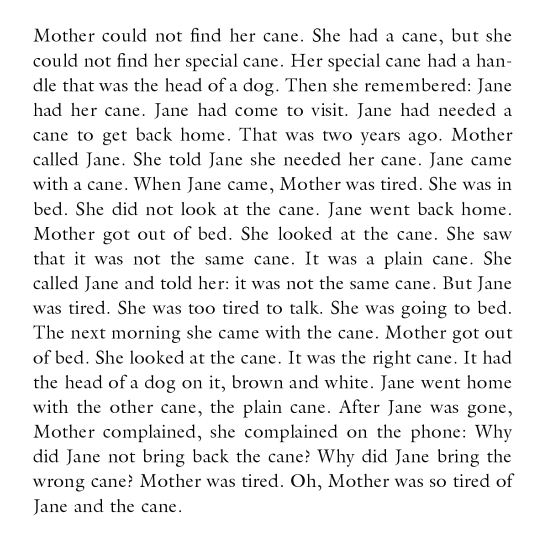
Lydia Davis Reads “Jane and the Cane”; Talks to Ben Marcus

“Jane and the Cane” by Lydia Davis; collected in Collected Stories:

Capture

“The She-Wolf” — Saki

“The She-Wolf” by Saki

Leonard Bilsiter was one of those people who have failed to find this world attractive or interesting, and who have sought compensation in an “unseen world” of their own experience or imagination—or invention.  Children do that sort of thing successfully, but children are content to convince themselves, and do not vulgarise their beliefs by trying to convince other people.  Leonard Bilsiter’s beliefs were for “the few,” that is to say, anyone who would listen to him.

His dabblings in the unseen might not have carried him beyond the customary platitudes of the drawing-room visionary if accident had not reinforced his stock-in-trade of mystical lore.  In company with a friend, who was interested in a Ural mining concern, he had made a trip across Eastern Europe at a moment when the great Russian railway strike was developing from a threat to a reality; its outbreak caught him on the return journey, somewhere on the further side of Perm, and it was while waiting for a couple of days at a wayside station in a state of suspended locomotion that he made the acquaintance of a dealer in harness and metalware, who profitably whiled away the tedium of the long halt by initiating his English travelling companion in a fragmentary system of folk-lore that he had picked up from Trans-Baikal traders and natives.  Leonard returned to his home circle garrulous about his Russian strike experiences, but oppressively reticent about certain dark mysteries, which he alluded to under the resounding title of Siberian Magic.  The reticence wore off in a week or two under the influence of an entire lack of general curiosity, and Leonard began to make more detailed allusions to the enormous powers which this new esoteric force, to use his own description of it, conferred on the initiated few who knew how to wield it.  His aunt, Cecilia Hoops, who loved sensation perhaps rather better than she loved the truth, gave him as clamorous an advertisement as anyone could wish for by retailing an account of how he had turned a vegetable marrow into a wood pigeon before her very eyes.  As a manifestation of the possession of supernatural powers, the story was discounted in some quarters by the respect accorded to Mrs. Hoops’ powers of imagination.

However divided opinion might be on the question of Leonard’s status as a wonderworker or a charlatan, he certainly arrived at Mary Hampton’s house-party with a reputation for pre-eminence in one or other of those professions, and he was not disposed to shun such publicity as might fall to his share.  Esoteric forces and unusual powers figured largely in whatever conversation he or his aunt had a share in, and his own performances, past and potential, were the subject of mysterious hints and dark avowals.

“I wish you would turn me into a wolf, Mr. Bilsiter,” said his hostess at luncheon the day after his arrival. Continue reading ““The She-Wolf” — Saki”

“X-ing a Paragraph” — Edgar Allan Poe

“X-ing a Paragraph” by Edgar Allan Poe

As it is well known that the ‘wise men’ came ‘from the East,’ and as Mr. Touch-and-go Bullet-head came from the East, it follows that Mr. Bullet-head was a wise man; and if collateral proof of the matter be needed, here we have it—Mr. B. was an editor. Irascibility was his sole foible, for in fact the obstinacy of which men accused him was anything but his foible, since he justly considered it his forte. It was his strong point—his virtue; and it would have required all the logic of a Brownson to convince him that it was ‘anything else.’

I have shown that Touch-and-go Bullet-head was a wise man; and the only occasion on which he did not prove infallible, was when, abandoning that legitimate home for all wise men, the East, he migrated to the city of Alexander-the-Great-o-nopolis, or some place of a similar title, out West.

I must do him the justice to say, however, that when he made up his mind finally to settle in that town, it was under the impression that no newspaper, and consequently no editor, existed in that particular section of the country. In establishing ‘The Tea-Pot’ he expected to have the field all to himself. I feel confident he never would have dreamed of taking up his residence in Alexander-the-Great-o-nopolis had he been aware that, in Alexander-the-Great-o-nopolis, there lived a gentleman named John Smith (if I rightly remember), who for many years had there quietly grown fat in editing and publishing the ‘Alexander-the-Great-o-nopolis Gazette.’ It was solely, therefore, on account of having been misinformed, that Mr. Bullet-head found himself in Alex-suppose we call it Nopolis, ‘for short’—but, as he did find himself there, he determined to keep up his character for obst—for firmness, and remain. So remain he did; and he did more; he unpacked his press, type, etc., etc., rented an office exactly opposite to that of the ‘Gazette,’ and, on the third morning after his arrival, issued the first number of ‘The Alexan’—that is to say, of ‘The Nopolis Tea-Pot’—as nearly as I can recollect, this was the name of the new paper.

The leading article, I must admit, was brilliant—not to say severe. It was especially bitter about things in general—and as for the editor of ‘The Gazette,’ he was torn all to pieces in particular. Some of Bullethead’s remarks were really so fiery that I have always, since that time, been forced to look upon John Smith, who is still alive, in the light of a salamander. I cannot pretend to give all the ‘Tea-Pot’s’ paragraphs verbatim, but one of them runs thus:

‘Oh, yes!—Oh, we perceive! Oh, no doubt! The editor over the way is a genius—O, my! Oh, goodness, gracious!—what is this world coming to? Oh, tempora! Oh, Moses!’

A philippic at once so caustic and so classical, alighted like a bombshell among the hitherto peaceful citizens of Nopolis. Groups of excited individuals gathered at the corners of the streets. Every one awaited, with heartfelt anxiety, the reply of the dignified Smith. Next morning it appeared as follows:

‘We quote from “The Tea-Pot” of yesterday the subjoined paragraph: “Oh, yes! Oh, we perceive! Oh, no doubt! Oh, my! Oh, goodness! Oh, tempora! Oh, Moses!” Why, the fellow is all O! That accounts for his reasoning in a circle, and explains why there is neither beginning nor end to him, nor to anything he says. We really do not believe the vagabond can write a word that hasn’t an O in it. Wonder if this O-ing is a habit of his? By-the-by, he came away from Down-East in a great hurry. Wonder if he O’s as much there as he does here? “O! it is pitiful.”‘

The indignation of Mr. Bullet-head at these scandalous insinuations, I shall not attempt to describe. On the eel-skinning principle, however, he did not seem to be so much incensed at the attack upon his integrity as one might have imagined. It was the sneer at his style that drove him to desperation. What!—he Touch-and-go Bullet-head!—not able to write a word without an O in it! He would soon let the jackanapes see that he was mistaken. Yes! he would let him see how much he was mistaken, the puppy! He, Touch-and-go Bullet-head, of Frogpondium, would let Mr. John Smith perceive that he, Bullet-head, could indite, if it so pleased him, a whole paragraph—aye! a whole article—in which that contemptible vowel should not once—not even once—make its appearance. But no;—that would be yielding a point to the said John Smith. He, Bullet-head, would make no alteration in his style, to suit the caprices of any Mr. Smith in Christendom. Perish so vile a thought! The O forever; He would persist in the O. He would be as O-wy as O-wy could be.

Burning with the chivalry of this determination, the great Touch-and-go, in the next ‘Tea-Pot,’ came out merely with this simple but resolute paragraph, in reference to this unhappy affair:

‘The editor of the “Tea-Pot” has the honor of advising the editor of the “Gazette” that he (the “Tea-Pot”) will take an opportunity in tomorrow morning’s paper, of convincing him (the “Gazette”) that he (the “Tea-Pot”) both can and will be his own master, as regards style; he (the “Tea-Pot”) intending to show him (the “Gazette”) the supreme, and indeed the withering contempt with which the criticism of him (the “Gazette”) inspires the independent bosom of him (the “TeaPot”) by composing for the especial gratification (?) of him (the “Gazette”) a leading article, of some extent, in which the beautiful vowel—the emblem of Eternity—yet so offensive to the hyper-exquisite delicacy of him (the “Gazette”) shall most certainly not be avoided by his (the “Gazette’s”) most obedient, humble servant, the “Tea-Pot.” “So much for Buckingham!”‘

In fulfilment of the awful threat thus darkly intimated rather than decidedly enunciated, the great Bullet-head, turning a deaf ear to all entreaties for ‘copy,’ and simply requesting his foreman to ‘go to the d——l,’ when he (the foreman) assured him (the ‘Tea-Pot’!) that it was high time to ‘go to press’: turning a deaf ear to everything, I say, the great Bullet-head sat up until day-break, consuming the midnight oil, and absorbed in the composition of the really unparalleled paragraph, which follows:—

‘So ho, John! how now? Told you so, you know. Don’t crow, another time, before you’re out of the woods! Does your mother know you’re out? Oh, no, no!—so go home at once, now, John, to your odious old woods of Concord! Go home to your woods, old owl—go! You won’t! Oh, poh, poh, don’t do so! You’ve got to go, you know! So go at once, and don’t go slow, for nobody owns you here, you know! Oh! John, John, if you don’t go you’re no homo—no! You’re only a fowl, an owl, a cow, a sow,—a doll, a poll; a poor, old, good-for-nothing-to-nobody, log, dog, hog, or frog, come out of a Concord bog. Cool, now—cool! Do be cool, you fool! None of your crowing, old cock! Don’t frown so—don’t! Don’t hollo, nor howl nor growl, nor bow-wow-wow! Good Lord, John, how you do look! Told you so, you know—but stop rolling your goose of an old poll about so, and go and drown your sorrows in a bowl!’

Exhausted, very naturally, by so stupendous an effort, the great Touch-and-go could attend to nothing farther that night. Firmly, composedly, yet with an air of conscious power, he handed his MS. to the devil in waiting, and then, walking leisurely home, retired, with ineffable dignity to bed.

Meantime the devil, to whom the copy was entrusted, ran up stairs to his ‘case,’ in an unutterable hurry, and forthwith made a commencement at ‘setting’ the MS. ‘up.’

In the first place, of course,—as the opening word was ‘So,’—he made a plunge into the capital S hole and came out in triumph with a capital S. Elated by this success, he immediately threw himself upon the little-o box with a blindfold impetuosity—but who shall describe his horror when his fingers came up without the anticipated letter in their clutch? who shall paint his astonishment and rage at perceiving, as he rubbed his knuckles, that he had been only thumping them to no purpose, against the bottom of an empty box. Not a single little-o was in the little-o hole; and, glancing fearfully at the capital-O partition, he found that to his extreme terror, in a precisely similar predicament. Awe—stricken, his first impulse was to rush to the foreman.

‘Sir!’ said he, gasping for breath, ‘I can’t never set up nothing without no o’s.’

‘What do you mean by that?’ growled the foreman, who was in a very ill humor at being kept so late.

‘Why, sir, there beant an o in the office, neither a big un nor a little un!’

‘What—what the d-l has become of all that were in the case?’

‘I don’t know, sir,’ said the boy, ‘but one of them ere “G’zette” devils is bin prowling ’bout here all night, and I spect he’s gone and cabbaged ’em every one.’

‘Dod rot him! I haven’t a doubt of it,’ replied the foreman, getting purple with rage ‘but I tell you what you do, Bob, that’s a good boy—you go over the first chance you get and hook every one of their i’s and (d——n them!) their izzards.’

‘Jist so,’ replied Bob, with a wink and a frown—’I’ll be into ’em, I’ll let ’em know a thing or two; but in de meantime, that ere paragrab? Mus go in to-night, you know—else there’ll be the d-l to pay, and-‘

‘And not a bit of pitch hot,’ interrupted the foreman, with a deep sigh, and an emphasis on the ‘bit.’ ‘Is it a long paragraph, Bob?’

‘Shouldn’t call it a wery long paragrab,’ said Bob.

‘Ah, well, then! do the best you can with it! We must get to press,’ said the foreman, who was over head and ears in work; ‘just stick in some other letter for o; nobody’s going to read the fellow’s trash anyhow.’

‘Wery well,’ replied Bob, ‘here goes it!’ and off he hurried to his case, muttering as he went: ‘Considdeble vell, them ere expressions, perticcler for a man as doesn’t swar. So I’s to gouge out all their eyes, eh? and d-n all their gizzards! Vell! this here’s the chap as is just able for to do it.’ The fact is that although Bob was but twelve years old and four feet high, he was equal to any amount of fight, in a small way.

The exigency here described is by no means of rare occurrence in printing-offices; and I cannot tell how to account for it, but the fact is indisputable, that when the exigency does occur, it almost always happens that x is adopted as a substitute for the letter deficient. The true reason, perhaps, is that x is rather the most superabundant letter in the cases, or at least was so in the old times—long enough to render the substitution in question an habitual thing with printers. As for Bob, he would have considered it heretical to employ any other character, in a case of this kind, than the x to which he had been accustomed.

‘I shell have to x this ere paragrab,’ said he to himself, as he read it over in astonishment, ‘but it’s jest about the awfulest o-wy paragrab I ever did see’: so x it he did, unflinchingly, and to press it went x-ed.

Next morning the population of Nopolis were taken all aback by reading in ‘The Tea-Pot,’ the following extraordinary leader:

‘Sx hx, Jxhn! hxw nxw? Txld yxu sx, yxu knxw. Dxn’t crxw, anxther time, befxre yxu’re xut xf the wxxds! Dxes yxur mxther knxw yxu’re xut? Xh, nx, nx!—sx gx hxme at xnce, nxw, Jxhn, tx yxur xdixus xld wxxds xf Cxncxrd! Gx hxme tx yxur wxxds, xld xwl,—gx! Yxu wxn’t? Xh, pxh, pxh, Jxhn, dxn’t dx sx! Yxu’ve gxt tx gx, yxu knxw, sx gx at xnce, and dxn’t gx slxw; fxr nxbxdy xwns yxu here, yxu knxw. Xh, Jxhn, Jxhn, Jxhn, if yxu dxn’t gx yxu’re nx hxmx—nx! Yxu’re xnly a fxwl, an xwl; a cxw, a sxw; a dxll, a pxll; a pxxr xld gxxd-fxr-nxthing-tx-nxbxdy, lxg, dxg, hxg, xr frxg, cxme xut xf a Cxncxrd bxg. Cxxl, nxw—cxxl! Dx be cxxl, yxu fxxl! Nxne xf yxur crxwing, xld cxck! Dxn’t frxwn sx—dxn’t! Dxn’t hxllx, nxr hxwl, nxr grxwl, nxr bxw-wxw-wxw! Gxxd Lxrd, Jxhn, hxw yxu dx lxxk! Txld yxu sx, yxu knxw,—but stxp rxlling yxur gxxse xf an xld pxll abxut sx, and gx and drxwn yxur sxrrxws in a bxwl!’

The uproar occasioned by this mystical and cabalistical article, is not to be conceived. The first definite idea entertained by the populace was, that some diabolical treason lay concealed in the hieroglyphics; and there was a general rush to Bullet-head’s residence, for the purpose of riding him on a rail; but that gentleman was nowhere to be found. He had vanished, no one could tell how; and not even the ghost of him has ever been seen since.

Unable to discover its legitimate object, the popular fury at length subsided; leaving behind it, by way of sediment, quite a medley of opinion about this unhappy affair.

One gentleman thought the whole an X-ellent joke.

Another said that, indeed, Bullet-head had shown much X-uberance of fancy.

A third admitted him X-entric, but no more.

A fourth could only suppose it the Yankee’s design to X-press, in a general way, his X-asperation.

‘Say, rather, to set an X-ample to posterity,’ suggested a fifth.

That Bullet-head had been driven to an extremity, was clear to all; and in fact, since that editor could not be found, there was some talk about lynching the other one.

The more common conclusion, however, was that the affair was, simply, X-traordinary and in-X-plicable. Even the town mathematician confessed that he could make nothing of so dark a problem. X, every. body knew, was an unknown quantity; but in this case (as he properly observed), there was an unknown quantity of X.

The opinion of Bob, the devil (who kept dark about his having ‘X-ed the paragrab’), did not meet with so much attention as I think it deserved, although it was very openly and very fearlessly expressed. He said that, for his part, he had no doubt about the matter at all, that it was a clear case, that Mr. Bullet-head ‘never could be persuaded fur to drink like other folks, but vas continually a-svigging o’ that ere blessed XXX ale, and as a naiteral consekvence, it just puffed him up savage, and made him X (cross) in the X-treme.’
 

“The Stranger” — Katherine Mansfield

“The Stranger” by Katherine Mansfield

It seemed to the little crowd on the wharf that she was never going to move again. There she lay, immense, motionless on the grey crinkled water, a loop of smoke above her, an immense flock of gulls screaming and diving after the galley droppings at the stern. You could just see little couples parading—little flies walking up and down the dish on the grey crinkled tablecloth. Other flies clustered and swarmed at the edge. Now there was a gleam of white on the lower deck—the cook’s apron or the stewardess perhaps. Now a tiny black spider raced up the ladder on to the bridge.

In the front of the crowd a strong-looking, middle-aged man, dressed very well, very snugly in a grey overcoat, grey silk scarf, thick gloves and dark felt hat, marched up and down, twirling his folded umbrella. He seemed to be the leader of the little crowd on the wharf and at the same time to keep them together. He was something between the sheep-dog and the shepherd.

But what a fool—what a fool he had been not to bring any glasses! There wasn’t a pair of glasses between the whole lot of them.

“Curious thing, Mr. Scott, that none of us thought of glasses. We might have been able to stir ’em up a bit. We might have managed a little signalling. ‘Don’t hesitate to land. Natives harmless.’ Or: ‘A welcome awaits you. All is forgiven.’ What? Eh?”

Mr. Hammond’s quick, eager glance, so nervous and yet so friendly and confiding, took in everybody on the wharf, roped in even those old chaps lounging against the gangways. They knew, every man-jack of them, that Mrs. Hammond was on that boat, and that he was so tremendously excited it never entered his head not to believe that this marvellous fact meant something to them too. It warmed his heart towards them. They were, he decided, as decent a crowd of people—Those old chaps over by the gangways, too—fine, solid old chaps. What chests—by Jove! And he squared his own, plunged his thick-gloved hands into his pockets, rocked from heel to toe. Continue reading ““The Stranger” — Katherine Mansfield”

“Hollow” — Breece D’J Pancake

“Hollow” by Breece D’J Pancake

Hunched on his knees in front of the three-foot coal seam, Buddy was lost in the back-and-forth rhythm of the truck mine’s relay: the glitter of coal and sandstone in his cap light, the setting and lifting and pouring into the cart that carried the stuff to the mouth of the mine. This was nothing like shaft mining, no deep tunnels or up-and-down man-trips, only the setting, lifting, pouring, only the rumbling of the relay cart and the light-flash from caps in the relay. In the pace of work, he daydreamed his father lowering him into the cistern: many summers ago he touched the cool tile walls, felt the moist air from the water below, heard the pulley squeak in the circle of blue above. The tin of the well-pail buckled under his tiny feet, and he began to cry. His father hauled him up. “That’s the way we do it,” he said, laughing, and carried Buddy to the house.

But that came before everything; before they moved from the ridge, before the big mine closed, before welfare. Now, at the far end of the relay, the men were quiet, and Buddy wondered if they thought of stupid things. From where he squatted he could see the gray grin of light at the mouth of the truck mine, the March wind spraying dust into little clouds. The half-ton relay cart was full now, and the last man in the relay shoved it toward the chute at the mine-mouth on two-by-four tracks.

“Take a break” came from the opening, and as he set his shovel aside to rise from where he knelt at the coal face, Buddy saw his cousin Curtis start through the mine-mouth. Curtis was dragging a poplar post behind him as he crawled past the relay cart toward the face. Buddy watched while Curtis worked the post upright from the floor to catch the weight of the ceiling. It was too short, and Curtis hammered wedges in to tighten the fit.

“Got it?” Buddy asked.

“Hell no, but she looks real pretty.”
Continue reading ““Hollow” — Breece D’J Pancake”

“Sweat” — Zora Neale Hurston

“Sweat” by Zora Neale Hurston

It was eleven o’clock of a Spring night in Florida. It was Sunday. Any other night, Delia Jones would have been in bed for two hours by this time. But she was a wash-woman, and Monday morning meant a great deal to her. So she collected the soiled clothes on Saturday when she returned the clean things. Sunday night after church, she sorted them and put the white things to soak. It saved her almost a half day’s start. A great hamper in the bedroom held the clothes that she brought home. It was so much neater than a number of bundles lying around.

She squatted in the kitchen floor beside the great pile of clothes, sorting them into small heaps according to color, and humming a song in a mournful key, but wondering through it all where Sykes, her husband, had gone with her horse and buckboard.

Just then something long, round, limp and black fell upon her shoulders and slithered to the floor beside her. A great terror took hold of her. It softened her knees and dried her mouth so that it was a full minute before she could cry out or move. Then she saw that it was the big bull whip her husband liked to carry when he drove.

She lifted her eyes to the door and saw him standing there bent over with laughter at her fright. She screamed at him.

“Sykes, what you throw dat whip on me like dat? You know it would skeer me–looks just like a snake, an’ you knows how skeered Ah is of snakes.”

“Course Ah knowed it! That’s how come Ah done it.” He slapped his leg with his hand and almost rolled on the ground in his mirth. “If you such a big fool dat you got to have a fit over a earth worm or a string, Ah don’t keer how bad Ah skeer you.”

“You aint got no business doing it. Gawd knows it’s a sin. Some day Ah’m goin’ tuh drop dead from some of yo’ foolishness. ‘Nother thing, where you been wid mah rig? Ah feeds dat pony. He aint fuh you to be drivin’ wid no bull whip.”

“You sho is one aggravatin’ nigger woman!” he declared and stepped into the room. She resumed her work and did not answer him at once. “Ah done tole you time and again to keep them white folks’ clothes outa dis house.”

He picked up the whip and glared down at her. Delia went on with her work. She went out into the yard and returned with a galvanized tub and set it on the washbench. She saw that Sykes had kicked all of the clothes together again, and now stood in her way truculently, his whole manner hoping, praying, for an argument. But she walked calmly around him and commenced to re-sort the things.

“Next time, Ah’m gointer kick ’em outdoors,” he threatened as he struck a match along the leg of his corduroy breeches. Continue reading ““Sweat” — Zora Neale Hurston”

“Hands” — Sherwood Anderson

“Hands” by Sherwood Anderson

Upon the half decayed veranda of a small frame house that stood near the edge of a ravine near the town of Winesburg, Ohio, a fat little old man walked nervously up and down. Across a long field that had been seeded for clover but that had produced only a dense crop of yellow mustard weeds, he could see the public highway along which went a wagon filled with berry pickers returning from the fields. The berry pickers, youths and maidens, laughed and shouted boisterously. A boy clad in a blue shirt leaped from the wagon and attempted to drag after him one of the maidens, who screamed and protested shrilly. The feet of the boy in the road kicked up a cloud of dust that floated across the face of the departing sun. Over the long field came a thin girlish voice. “Oh, you Wing Biddlebaum, comb your hair, it’s falling into your eyes,” commanded the voice to the man, who was bald and whose nervous little hands fiddled about the bare white forehead as though arranging a mass of tangled locks.

Wing Biddlebaum, forever frightened and beset by a ghostly band of doubts, did not think of himself as in any way a part of the life of the town where he had lived for twenty years. Among all the people of Winesburg but one had come close to him. With George Willard, son of Tom Willard, the proprietor of the New Willard House, he had formed something like a friendship. George Willard was the reporter on the Winesburg Eagle and sometimes in the evenings he walked out along the highway to Wing Biddlebaum’s house. Now as the old man walked up and down on the veranda, his hands moving nervously about, he was hoping that George Willard would come and spend the evening with him. After the wagon containing the berry pickers had passed, he went across the field through the tall mustard weeds and climbing a rail fence peered anxiously along the road to the town. For a moment he stood thus, rubbing his hands together and looking up and down the road, and then, fear overcoming him, ran back to walk again upon the porch on his own house. Continue reading ““Hands” — Sherwood Anderson”

“The Four Fists” — F. Scott Fitzgerald

“The Four Fists” — F. Scott Fitzgerald

At the present time no one I know has the slightest desire to hit Samuel Meredith; possibly this is because a man over fifty is liable to be rather severely cracked at the impact of a hostile fist, but, for my part, I am inclined to think that all his hitable qualities have quite vanished. But it is certain that at various times in his life hitable qualities were in his face, as surely as kissable qualities have ever lurked in a girl’s lips.

I’m sure every one has met a man like that, been casually introduced, even made a friend of him, yet felt he was the sort who aroused passionate dislike—expressed by some in the involuntary clinching of fists, and in others by mutterings about “takin’ a poke” and “landin’ a swift smash in ee eye.” In the juxtaposition of Samuel Meredith’s features this quality was so strong that it influenced his entire life.

What was it? Not the shape, certainly, for he was a pleasant-looking man from earliest youth: broad-bowed with gray eyes that were frank and friendly. Yet I’ve heard him tell a room full of reporters angling for a “success” story that he’d be ashamed to tell them the truth that they wouldn’t believe it, that it wasn’t one story but four, that the public would not want to read about a man who had been walloped into prominence.

It all started at Phillips Andover Academy when he was fourteen. He had been brought up on a diet of caviar and bell-boys’ legs in half the capitals of Europe, and it was pure luck that his mother had nervous prostration and had to delegate his education to less tender, less biassed hands.

At Andover he was given a roommate named Gilly Hood. Gilly was thirteen, undersized, and rather the school pet. From the September day when Mr. Meredith’s valet stowed Samuel’s clothing in the best bureau and asked, on departing, “hif there was hanything helse, Master Samuel?” Gilly cried out that the faculty had played him false. He felt like an irate frog in whose bowl has been put goldfish. Continue reading ““The Four Fists” — F. Scott Fitzgerald”

“The Californian’s Tale” — Mark Twain

“The Californian’s Tale” — Mark Twain

Thirty-five years ago I was out prospecting on the Stanislaus, tramping all day long with pick and pan and horn, and washing a hatful of dirt here and there, always expecting to make a rich strike, and never doing it. It was a lovely region, woodsy, balmy, delicious, and had once been populous, long years before, but now the people had vanished and the charming paradise was a solitude. They went away when the surface diggings gave out. In one place, where a busy little city with banks and newspapers and fire companies and a mayor and aldermen had been, was nothing but a wide expanse of emerald turf, with not even the faintest sign that human life had ever been present there. This was down toward Tuttletown. In the country neighborhood thereabouts, along the dusty roads, one found at intervals the prettiest little cottage homes, snug and cozy, and so cobwebbed with vines snowed thick with roses that the doors and windows were wholly hidden from sight—sign that these were deserted homes, forsaken years ago by defeated and disappointed families who could neither sell them nor give them away. Now and then, half an hour apart, one came across solitary log cabins of the earliest mining days, built by the first gold-miners, the predecessors of the cottage-builders. In some few cases these cabins were still occupied; and when this was so, you could depend upon it that the occupant was the very pioneer who had built the cabin; and you could depend on another thing, too—that he was there because he had once had his opportunity to go home to the States rich, and had not done it; had rather lost his wealth, and had then in his humiliation resolved to sever all communication with his home relatives and friends, and be to them thenceforth as one dead. Round about California in that day were scattered a host of these living dead men—pride-smitten poor fellows, grizzled and old at forty, whose secret thoughts were made all of regrets and longings—regrets for their wasted lives, and longings to be out of the struggle and done with it all. Continue reading ““The Californian’s Tale” — Mark Twain”