“The Landlord” — New Fiction from Wells Tower

The New Yorker has published a new short story by Biblioklept fave Wells Tower. It’ called “The Landlord” and would have fit fine in Tower’s collection Everything Ravaged, Everything Burned. An excerpt from the story–

My daughter has come from Los Angeles to live with me. Rhoda is thirty-one, and she used to work in advertising, but now she’s a painter and a maker of other art that I’m not sure how to describe. Her field is bummers. Rhoda’s past exhibitions include leukemia-cluster art, floating-yuan art, water-rights art, and mental-health-funding-cuts art, which was piles of clothes painted bronze and rigged up with speakers that yelled. She has also made a lot of hand art and hair art. Eight years ago, shortly into her new career, while getting the hang of a radial-arm saw, Rhoda severed the index, middle, and ring fingers of her left hand. The surgeons reattached them, and Rhoda recovered nearly complete range of motion, but the shock of the injury caused some of her hair to fall out. She keeps her head shaved close now, a style that improves the plainness of face she inherited from me. Bald, she looks about fifteen years older than she is, but also terrifyingly smart and owlish, Lady Malcolm McDowell.

“Extreme Solitude” — New Fiction from Jeffrey Eugenides

“Extreme Solitude” — a new story from Jeffrey Eugenides at The New Yorker. Read the whole story here. Here’s an excerpt that might ring true to many an English major:

Madeleine had met Leonard in an upper-level semiotics seminar taught by a renegade from the English department. Michael Zipperstein had arrived at Brown thirty-two years earlier filled with zeal for the New Criticism. He’d inculcated the habits of close reading and biography-free interpretation into three generations of students before taking a Road to Damascus sabbatical, in Paris, in 1975, where he’d met Roland Barthes at a dinner party and been converted, over duck cassoulet, to the new faith. Now Zipperstein taught two courses in the newly created Program in Semiotic Studies: Introduction to Semiotic Theory, in the fall, and, in the spring, Semiotics 211. Hygienically bald, with a seaman’s mustacheless white beard, Zipperstein favored French fisherman’s sweaters and wide-wale corduroys. He buried people with his reading lists: in addition to all the semiotic big hitters––Derrida, Eco, Barthes––the students in Semiotics 211 had to contend with a magpie nest of reserve reading that included everything from Balzac’s “Sarrasine” to issues of Semiotext(e) to xeroxed selections from E. M. Cioran, Robert Walser, Claude Lévi-Strauss, Peter Handke, and Carl Van Vechten. To get into the seminar, you had to submit to a one-on-one interview with Zipperstein during which he asked bland personal questions, such as what your favorite food or dog breed was, and made enigmatic Warholian remarks in response. This esoteric probing, along with Zipperstein’s guru’s dome and beard, gave his students a sense that they’d been spiritually vetted and were now—for two hours Wednesday afternoons, at least––part of a campus lit-crit élite.

Almost overnight it became laughable to read writers like Cheever or Updike, who wrote about the suburbia Madeleine and most of her friends had grown up in, in favor of reading the Marquis de Sade, who wrote about anally deflowering virgins in eighteenth-century France. Madeleine had become an English major for the purest and dullest of reasons: because she loved to read. The university’s “British and American Literature Course Catalogue” was, for Madeleine, what its Bergdorf equivalent was for her roommates. A course listing like “English 274: Lyly’s Euphues” excited Madeleine the way a pair of Fiorucci cowboy boots did Abby. “English 450A: Hawthorne and James” filled Madeleine with an expectation of sinful hours in bed that was not unlike the sensation Olivia got from wearing a Lycra skirt and leather blazer to Danceteria. Right up through her third year of college, Madeleine had kept wholesomely taking courses like “Victorian Fantasy: From ‘Phantastes’ to ‘The Water-Babies,’ ” but by senior year she could no longer ignore the contrast between the blinky people in her Beowulf seminar and the hipsters down the hall reading Maurice Blanchot. Going to college in the moneymaking eighties lacked a certain radicalism. Semiotics was the first thing that smacked of revolution. It drew a line; it created an elect; it was sophisticated and Continental; it dealt with provocative subjects, with torture, sadism, hermaphroditism––with sex and power.
“Prefiguration of Lalo Cura” — Roberto Bolaño

The New Yorker has published another short story by Roberto Bolaño. It’s called “Prefiguration of Lalo Cura” and it backgrounds a character from 2666, Olegario Cura Exposito (page 384, if you want to correlate things). The first paragraph:

It’s hard to believe, but I was born in a neighborhood called Los Empalados: The Impaled. The name glows like the moon. The name opens a way through the dream with its horn, and man follows that path. A quaking path. Invariably harsh. The path that leads into or out of Hell. That’s what it all comes down to. Getting closer to Hell or farther away. Me, for example, I’ve had people killed. I’ve given the best birthday presents. I’ve backed projects of epic proportions. I’ve opened my eyes in the dark. Once, I opened them by slow degrees in total darkness, and all I saw or imagined was that name: Los Empalados, shining like the star of destiny

The Devil and Tom Walker and the Financial Crisis

Washington Irving’s famous short story, “The Devil and Tom Walker,” seems as prescient and uncanny as ever in the lurid light of our recent financial woes:

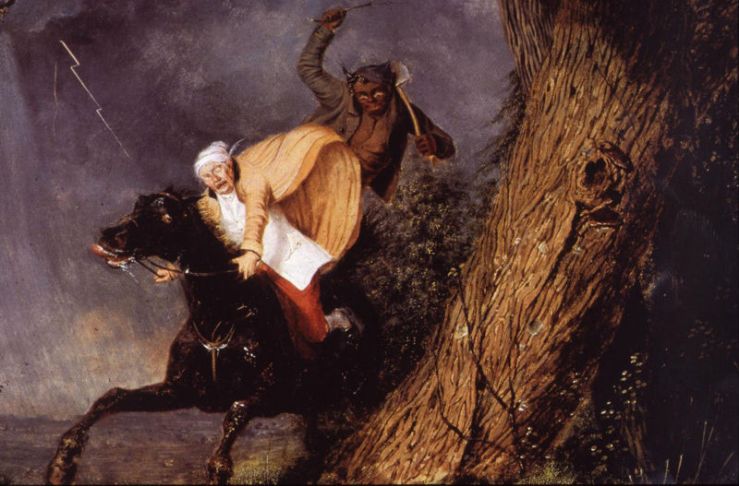
Finding Tom so squeamish on this point, he did not insist upon it, but proposed instead that he should turn usurer; the devil being extremely anxious for the increase of usurers, looking upon them as his peculiar people.To this no objections were made, for it was just to Tom’s taste.“You shall open a broker’s shop in Boston next month,” said the black man.“I’ll do it to-morrow, if you wish,” said Tom Walker.“You shall lend money at two per cent. a month.”“Egad, I’ll charge four!” replied Tom Walker.“You shall extort bonds, foreclose mortgages, drive the merchant to bankruptcy—”“I’ll drive him to the d——l,” cried Tom Walker, eagerly.“You are the usurer for my money!” said the black legs, with delight. “When will you want the rhino?”“This very night.”“Done!” said the devil.“Done!” said Tom Walker. —So they shook hands, and struck a bargain.A few days’ time saw Tom Walker seated behind his desk in a counting house in Boston. His reputation for a ready moneyed man, who would lend money out for a good consideration, soon spread abroad. Every body remembers the days of Governor Belcher, when money was particularly scarce. It was a time of paper credit. The country had been deluged with government bills; the famous Land Bank had been established; there had been a rage for speculating; the people had run mad with schemes for new settlements; for building cities in the wilderness; land jobbers went about with maps of grants, and townships, and Eldorados, lying nobody knew where, but which every body was ready to purchase. In a word, the great speculating fever which breaks out every now and then in the country, had raged to an alarming degree, and every body was dreaming of making sudden fortunes from nothing. As usual the fever had subsided; the dream had gone off, and the imaginary fortunes with it; the patients were left in doleful plight, and the whole country resounded with the consequent cry of “hard times.”