Read an excerpt of Ishmael Reed’s forthcoming novel, The Terrible Fives

Rex Stuart (T.2s) had made a pile as the star of the soap opera Sorrows and Trials. He’d set up his film company to cater to the streaming market. Right now, Afro-Futurism is hot. He asked his agents to name a Black writer who could write a series for his company. Secretariat’s name came up. Someone said he’d read his novel Yellow Back Radio Broke Down (1969), and it ended with AI running things. Before the end of the day, Secretariat received a call from Rex Stuart. He said that he had a proposition for Secretariat. It could be a rewarding trip for him to come to Los Angeles. Secretariat picked up his ticket at United. A limousine was waiting for him at LAX. He checked in at the Beverly Hills Hotel. This would be his third stay at the hotel. He remembered that his rooms had fireplaces. Stuart met him in the restaurant. He wasn’t the matinee idol who’d thrilled millions by portraying the polo-playing playboy of Sorrows. Jowly. A paunch. Otherwise, he’d aged gracefully. Something was different about him. He had a beard. Secretariat spotted him and joined him at his table. He had a copy of Yellow Back that he wanted Secretariat to sign.

“Interesting work. I can see why the critics call you Sun Ra and George Clinton, Afro-Futurism’s fathers. Artificial intelligence is running things, leading to the elimination of 9-to-5 drudgery. You had that in your novel that was published in 1969.”

Yes, Secretariat thought, that was before my idealism went sour.

Stuart then said, “Well, it’s upon us. This Afro-Futurist stuff is trending. What do you think of it?”

Secretariat saw it as another academic scam—an excuse for professors to lure students into empty classrooms by offering something snappy to those who grew up on Star Wars. They could write long papers with the usual obscure references. Professors could attend conferences, sample good food, sightsee, and make dates.

“It’s popular, but the Afro-Futurists are missing an opportunity,” Secretariat said.

“How is that?”

“They could use the popularity of space-travel films and art to introduce Black and Brown kids to sciences like astrophysics. After a Black astrophysicist lectured, he was surrounded by Black and Brown kids. They hadn’t been taught that such a field was open to them. They were told that the football field, the basketball court, and the criminal court were the only areas open to them.”

Stuart gave Secretariat an odd look. “Something to think about. I don’t know whether you have seen—” Stuart mentioned a spate of films that carried the Afro-Futurist label. “We’d like you to try your hand at writing one for us.” Stuart mentioned an amount of money that would pay his family’s bills for a couple of years. All Secretariat had to do was write a treatment. Others would develop the story; he could withdraw his name from the production if he didn’t like the result.

Their drinks arrived, followed by a gorgeous meal. The next morning, he returned to Oakland.

Read the full excerpt from Ishmael Reed’s forthcoming novel The Terrible Fives at the Evergreen Review.

A review of Ishmael Reed’s Christmas satire, The Terrible Twos

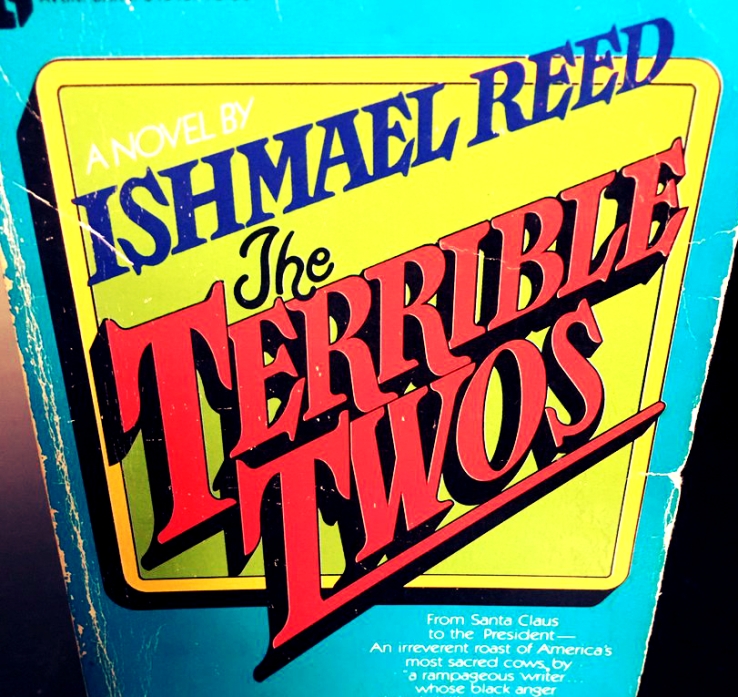
Christmas is here, so let me recommend a Christmas novel for you: Ishmael Reed’s The Terrible Twos (1982). I read it back in unChristmasy August and dipped into it a bit again today, looking for a passage or two to share. Maybe the bit where Santa Claus starts an anti-capitalist riot in Times Square?, or where the First Lady is electrocuted while lighting the White House Christmas tree?, or where the idiot U.S. President meets Harry Truman in A Christmas Carol tour of hell? I scrounged for a big fat citation that works on its own, but I kept wanting to build a frame, set a stage, and ended up with this instead, a “review,” a recommendation. A stage setting.  Of course, Ishmael Reed’s novels create their own stages, their own contexts and rhythms, and each paragraph, each sentence, each note fits into that context, blaring or humming or blasting the reader. Reed’s satire is simultaneously bitter and salty and sweet and sharp sharp sharp, the sort of strange rich dish you gobble up too fast and then, Hell!, it gives you weird dreams. For months.

But nice fat slices of Reed’s prose can be served on their own, as John Leonard’s 1982 NYT  review of The Terrible Twos shows. Leonard’s review is ten paragraphs long and he quotes Reed in full for two of those paragraphs, including this one, the longest paragraph in the piece:

Two-year-olds are what the id would look like if the id could ride a tricycle. That’s the innocent side of 2, but the terrible side as well. A terrible world the world of 2-year-olds. The world of the witch’s door you knock on when your mother told you not to go near the forest in the first place. Pigs building houses of straw. Vain and egotistic gingerbread men who end up riding on the nose of a fox. Nightmares in the closet. Someone is constantly trying to eat them up. The gods of winter crave them – the gods of winter who, some say, are represented by the white horse that St. Nicholas, or St. Nick, rides as he enters Amsterdam, his blackamoor servant, Peter, following with his bag of switches and candy. Two-year-olds are constantly looking over their shoulders for the man in the shadows carrying the bag. Black Peter used to carry them across the border into Spain.

Leonard (who describes the paragraph as “a kind of jive transcendence”— I’ll settle for “transcendence”) offers up this nugget as a condensation of Reed’s themes and mythologies. The paragraph neatly conveys the central idea of Reed’s novel, that American capitalism refuses to allow its subjects to Grow Up. It’s a tidyish paragraph. Tidyish. Reed always sprawls into some new mumbo jumbo. The anarchic energy of his prose digs up old mythologies, boots skeletons out closets, and makes all the old ghosts of Western history sing and dance.

So there’s a lot going in The Terrible Twos’ not-quite 200 pages. Should I take a stab at unjumbling the plot? Okay, so: Reagan is elected president. Things are bad. Rough for, like, the people. Fast forward a few terms, to the early/mid-nineties (Reed’s future…this is a sci-fi fantasy). Former fashion model Dean Clift ascends to the Presidency. Only he’s just a puppet for his cabinet, a cabal of war-profiteering zealots secretly planning a genocidal operation that would not only destroy a nuclear-armed African nation, but also “rid America of surplus people.” Surplus = poor. After Clift’s wife dies in a freak (not-really-freak) Christmas-tree-lighting accident, his life changes, and Saint Nicholas (like, the real Santa) comes to visit him. Santa takes the President on a Dantean-cum-Dickensian trip through the hell of American past. The poor dumb idiot President transforms his soul. Hearing Truman lament the bombing of Hiroshima might do that (not that that’s the only horror that haunts this novel—but a nuclear winter is not a winter wonderland, and Reed’s characters, despite their verve, are all suffering from Cold War Blues). Clift goes on TV and advocates a Christmas Change—but too late. The conspiracy cabinet hits him with the 25th Amendment to the United States Constitution. Reed gives a history lesson to the highest office of the land, changes the man’s life, and then imprisons him in a sanatorium. Satire at its cruelest.

But hell, what am I doing here, foregrounding President Clift? Or even Santa? There’s so much more going on in The Terrible Twos: the secret sect of Nicolites who worship Saint Nick; devotees of Black Peter (a version of the Dutch tradition of “Zwarte Piet”); the North Pole syndicate; secret agents, thugs, and sundry assassins; punk rioters; a rasta dwarf (um, Black Peter). And somehow I’ve left out the novel’s semi-hapless hero, Nance Saturday…

Look, the plot—the picaresque, mumbo-jumbo, always-mutating plot of The Terrible Twos is, yes, fun—but it’s the prose, the energy, the commentary, and, yes, the prescience of the novel that makes it so engrossing and fun and terrifying. This is a book that begins: “By Christmas, 1980, the earth had had enough and was beginning to send out hints,” a book that has the American President meeting with the American Nazi Party in the Oval Office, a book that has one character comment to another, on the election of Reagan, that “It feels good to be a white man again with him in office.” The satire’s prescience is painful, but Reed’s wisdom—the ballast of this ever-shifting picaresque—anchors the commentary in a deeper condemnation: It has always been this way. Ishmael Reed seems so prescient because we keep failing the past. Same as it ever was. Thus The Terrible Twos plays out in a series of plots and schemes, retaliations and riots—but also wry comments and righteous resistance. And so if Reed’s analysis of American history is unbearably heavy, it also points towards a negation of that heavy history, towards a vision of something better.

I shall give the last words to Reed’s Santa:

Two years old, that’s what we are, emotionally—America, always wanting someone to hand us some ice cream, always complaining, Santa didn’t bring me this and why didn’t Santa bring me that…Nobody can reason with us. Nobody can tell us anything. Millions of people are staggering about and passing out in the snow and we say that’s tough. We say too bad to the children who don’t have milk….I say it’s time to pull these naughty people off their high chairs and get them to clean up their own shit. Let’s hit them where it hurts, ladies and gentlemen. In their pockets. Let’s stop buying their war toys, their teddy bears, their dolls, tractors, wagons, their video games, their trees. Trees belong in the forest.

A riot ensues.

Very highly recommended.

[Editorial note: Biblioklept ran a version of this review in December, 2017].

A review of Ishmael Reed’s Christmas satire, The Terrible Twos

Christmas approaches, so let me recommend a Christmas novel for you: Ishmael Reed’s The Terrible Twos (1982). I read it back in unChristmasy August and dipped into it a bit again today, looking for a passage or two to share. Maybe the bit where Santa Claus starts an anti-capitalist riot in Times Square?, or where the First Lady is electrocuted while lighting the White House Christmas tree?, or where the idiot U.S. President meets Harry Truman in A Christmas Carol tour of hell? I scrounged for a big fat citation that works on its own, but I kept wanting to build a frame, set a stage, and ended up with this instead, a “review,” a recommendation. A stage setting.  Of course, Ishmael Reed’s novels create their own stages, their own contexts and rhythms, and each paragraph, each sentence, each note fits into that context, blaring or humming or blasting the reader. Reed’s satire is simultaneously bitter and salty and sweet and sharp sharp sharp, the sort of strange rich dish you gobble up too fast and then, Hell!, it gives you weird dreams. For months.

But nice fat slices of Reed’s prose can be served on their own, as John Leonard’s 1982 NYT  review of The Terrible Twos shows. Leonard’s review is ten paragraphs long and he quotes Reed in full for two of those paragraphs, including this one, the longest paragraph in the piece:

Two-year-olds are what the id would look like if the id could ride a tricycle. That’s the innocent side of 2, but the terrible side as well. A terrible world the world of 2-year-olds. The world of the witch’s door you knock on when your mother told you not to go near the forest in the first place. Pigs building houses of straw. Vain and egotistic gingerbread men who end up riding on the nose of a fox. Nightmares in the closet. Someone is constantly trying to eat them up. The gods of winter crave them – the gods of winter who, some say, are represented by the white horse that St. Nicholas, or St. Nick, rides as he enters Amsterdam, his blackamoor servant, Peter, following with his bag of switches and candy. Two-year-olds are constantly looking over their shoulders for the man in the shadows carrying the bag. Black Peter used to carry them across the border into Spain.

Leonard (who describes the paragraph as “a kind of jive transcendence”— I’ll settle for “transcendence”) offers up this nugget as a condensation of Reed’s themes and mythologies. The paragraph neatly conveys the central idea of Reed’s novel, that American capitalism refuses to allow its subjects to Grow Up. It’s a tidyish paragraph. Tidyish. Reed always sprawls into some new mumbo jumbo. The anarchic energy of his prose digs up old mythologies, boots skeletons out closets, and makes all the old ghosts of Western history sing and dance.

So there’s a lot going in The Terrible Twos’ not-quite 200 pages. Should I take a stab at unjumbling the plot? Okay, so: Reagan is elected president. Things are bad. Rough for, like, the people. Fast forward a few terms, to the early/mid-nineties (Reed’s future…this is a sci-fi fantasy). Former fashion model Dean Clift ascends to the Presidency. Only he’s just a puppet for his cabinet, a cabal of war-profiteering zealots secretly planning a genocidal operation that would not only destroy a nuclear-armed African nation, but also “rid America of surplus people.” Surplus = poor. After Clift’s wife dies in a freak (not-really-freak) Christmas-tree-lighting accident, his life changes, and Saint Nicholas (like, the real Santa) comes to visit him. Santa takes the President on a Dantean-cum-Dickensian trip through the hell of American past. The poor dumb idiot President transforms his soul. Hearing Truman lament the bombing of Hiroshima might do that (not that that’s the only horror that haunts this novel—but a nuclear winter is not a winter wonderland, and Reed’s characters, despite their verve, are all suffering from Cold War Blues). Clift goes on TV and advocates a Christmas Change—but too late. The conspiracy cabinet hits him with the 25th Amendment to the United States Constitution. Reed gives a history lesson to the highest office of the land, changes the man’s life, and then imprisons him in a sanatorium. Satire at its cruelest.

But hell, what am I doing here, foregrounding President Clift? Or even Santa? There’s so much more going on in The Terrible Twos: the secret sect of Nicolites who worship Saint Nick; devotees of Black Peter (a version of the Dutch tradition of “Zwarte Piet”); the North Pole syndicate; secret agents, thugs, and sundry assassins; punk rioters; a rasta dwarf (um, Black Peter). And somehow I’ve left out the novel’s semi-hapless hero, Nance Saturday…

Look, the plot—the picaresque, mumbo-jumbo, always-mutating plot of The Terrible Twos is, yes, fun—but it’s the prose, the energy, the commentary, and, yes, the prescience of the novel that makes it so engrossing and fun and terrifying. This is a book that begins: “By Christmas, 1980, the earth had had enough and was beginning to send out hints,” a book that has the American President meeting with the American Nazi Party in the Oval Office, a book that has one character comment to another, on the election of Reagan, that “It feels good to be a white man again with him in office.” The satire’s prescience is painful, but Reed’s wisdom—the ballast of this ever-shifting picaresque—anchors the commentary in a deeper condemnation: It has always been this way. Ishmael Reed seems so prescient because we keep failing the past. Same as it ever was. Thus The Terrible Twos plays out in a series of plots and schemes, retaliations and riots—but also wry comments and righteous resistance. And so if Reed’s analysis of American history is unbearably heavy, it also points towards a negation of that heavy history, towards a vision of something better.

I shall give the last words to Reed’s Santa:

Two years old, that’s what we are, emotionally—America, always wanting someone to hand us some ice cream, always complaining, Santa didn’t bring me this and why didn’t Santa bring me that…Nobody can reason with us. Nobody can tell us anything. Millions of people are staggering about and passing out in the snow and we say that’s tough. We say too bad to the children who don’t have milk….I say it’s time to pull these naughty people off their high chairs and get them to clean up their own shit. Let’s hit them where it hurts, ladies and gentlemen. In their pockets. Let’s stop buying their war toys, their teddy bears, their dolls, tractors, wagons, their video games, their trees. Trees belong in the forest.

A riot ensues.

Very highly recommended.

[Editorial note: Biblioklept ran a version of this review in December, 2017].

A review of Ishmael Reed’s Christmas satire, The Terrible Twos

Christmas approaches, so let me recommend a Christmas novel for you: Ishmael Reed’s The Terrible Twos (1982). I read it back in unChristmasy August and dipped into it a bit again today, looking for a passage or two to share. Maybe the bit where Santa Claus starts an anti-capitalist riot in Times Square?, or where the First Lady is electrocuted while lighting the White House Christmas tree?, or where the idiot U.S. President meets Harry Truman in A Christmas Carol tour of hell? I scrounged for a big fat citation that works on its own, but I kept wanting to build a frame, set a stage, and ended up with this instead, a “review,” a recommendation. A stage setting.  Of course, Ishmael Reed’s novels create their own stages, their own contexts and rhythms, and each paragraph, each sentence, each note fits into that context, blaring or humming or blasting the reader. Reed’s satire is simultaneously bitter and salty and sweet and sharp sharp sharp, the sort of strange rich dish you gobble up too fast and then, Hell!, it gives you weird dreams. For months.

But nice fat slices of Reed’s prose rest can well on their own, as John Leonard’s 1982 NYT  review of The Terrible Twos shows. Leonard’s review is ten paragraphs long and he quotes Reed in full for two of those paragraphs, including this one, the longest paragraph in the piece:

Two-year-olds are what the id would look like if the id could ride a tricycle. That’s the innocent side of 2, but the terrible side as well. A terrible world the world of 2-year-olds. The world of the witch’s door you knock on when your mother told you not to go near the forest in the first place. Pigs building houses of straw. Vain and egotistic gingerbread men who end up riding on the nose of a fox. Nightmares in the closet. Someone is constantly trying to eat them up. The gods of winter crave them – the gods of winter who, some say, are represented by the white horse that St. Nicholas, or St. Nick, rides as he enters Amsterdam, his blackamoor servant, Peter, following with his bag of switches and candy. Two-year-olds are constantly looking over their shoulders for the man in the shadows carrying the bag. Black Peter used to carry them across the border into Spain.

Leonard (who describes the paragraph as “a kind of jive transcendence”— I’ll settle for “transcendence”) offers up this nugget as a condensation of Reed’s themes and mythologies. The paragraph neatly conveys the central idea of Reed’s novel, that American capitalism refuses to allow its subjects to Grow Up. It’s a tidyish paragraph. Tidyish. Reed always sprawls into some new mumbo jumbo. The anarchic energy of his prose digs up old mythologies, boots skeletons out closets, and makes all the old ghosts of Western history sing and dance.

So there’s a lot going in The Terrible Twos’ not-quite 200 pages. Should I take a stab at unjumbling the plot? Okay, so: Reagan is elected president. Things are bad. Rough for, like, the people. Fast forward a few terms, to the early/mid-nineties (Reed’s future…this is a sci-fi fantasy). Former fashion model Dean Clift ascends to the Presidency. Only he’s just a puppet for his cabinet, a cabal of war-profiteering zealots secretly planning a genocidal operation that would not only destroy a nuclear-armed African nation, but also “rid America of surplus people.” Surplus = poor. After Clift’s wife dies in a freak (not-really-freak) Christmas-tree-lighting accident, his life changes, and Saint Nicholas (like, the real Santa) comes to visit him. Santa takes the President on a Dantean-cum-Dickensian trip through the hell of American past. The poor dumb idiot President transforms his soul. Hearing Truman lament the bombing of Hiroshima might do that (not that that’s the only horror that haunts this novel—but a nuclear winter is not a winter wonderland, and Reed’s characters, despite their verve, are all suffering from Cold War Blues). Clift goes on TV and advocates a Christmas Change—but too late. The conspiracy cabinet hits him with the 25th Amendment to the United States Constitution. Reed gives a history lesson to the highest office of the land, changes the man’s life, and then imprisons him in a sanatorium. Satire at its cruelest.

But hell, what am I doing here, foregrounding President Clift? Or even Santa? There’s so much more going on in The Terrible Twos: the secret sect of Nicolites who worship Saint Nick; devotees of Black Peter (a version of the Dutch tradition of “Zwarte Piet”); the North Pole syndicate; secret agents, thugs, and sundry assassins; punk rioters; a rasta dwarf (um, Black Peter). And somehow I’ve left out the novel’s semi-hapless hero, Nance Saturday…

Look, the plot—the picaresque, mumbo-jumbo, always-mutating plot of The Terrible Twos is, yes, fun—but it’s the prose, the energy, the commentary, and, yes, the prescience of the novel that makes it so engrossing and fun and terrifying. This is a book that begins: “By Christmas, 1980, the earth had had enough and was beginning to send out hints,” a book that has the American President meeting with the American Nazi Party in the Oval Office, a book that has one character comment to another, on the election of Reagan, that “It feels good to be a white man again with him in office.” The satire’s prescience is painful, but Reed’s wisdom—the ballast of this ever-shifting picaresque—anchors the commentary in a deeper condemnation: It has always been this way. Ishmael Reed seems so prescient because we keep failing the past. Same as it ever was. Thus The Terrible Twos plays out in a series of plots and schemes, retaliations and riots—but also wry comments and righteous resistance. And so if Reed’s analysis of American history is unbearably heavy, it also points towards a negation of that heavy history, towards a vision of something better.

I shall give the last words to Reed’s Santa:

Two years old, that’s what we are, emotionally—America, always wanting someone to hand us some ice cream, always complaining, Santa didn’t bring me this and why didn’t Santa bring me that…Nobody can reason with us. Nobody can tell us anything. Millions of people are staggering about and passing out in the snow and we say that’s tough. We say too bad to the children who don’t have milk….I say it’s time to pull these naughty people off their high chairs and get them to clean up their own shit. Let’s hit them where it hurts, ladies and gentlemen. In their pockets. Let’s stop buying their war toys, their teddy bears, their dolls, tractors, wagons, their video games, their trees. Trees belong in the forest.

A riot ensues.

Very highly recommended.