Book Acquired, 9.12.11 — Nathanael West Biography

20110912-050619.jpg

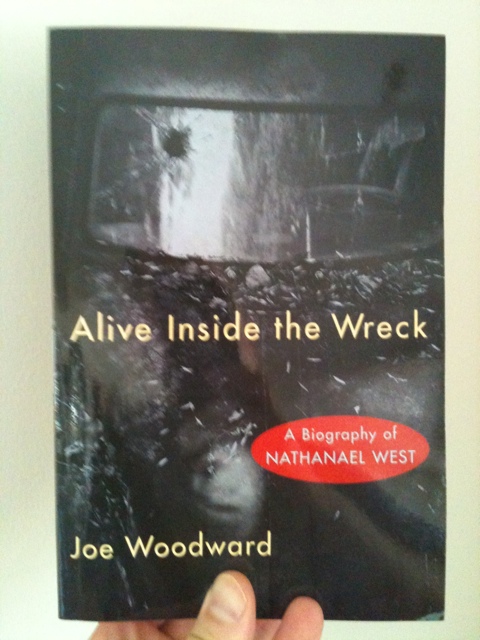
This one’s new from OR BooksJoe Woodward’s Alive Inside the Wreck: A Biography of Nathanael West. (Sorry for the extraordinarily amateurish photograph—the glossy cover spit back much light). I read the first three chapters this afternoon, and Woodward has a punchy, even terse style that I greatly appreciate in a literary biographer. It’s rare that the literary critic, “showing a little plumage,” to borrow a phrase from James Wood, knows when to remove himself from the text under discussion. Woodward’s writing here dispenses with any airy rhetoric, cutting sharply to bone in telegraphic sentences and short chapters.It’s the kind of  beginning that makes me want to keep reading. Here’s the publisher’s description—

From his name to his college transcript to his literary style, Nathanael West was self-invented. Born Nathan Weinstein, the author of the classics Miss Lonelyhearts (1933) and The Day of theLocust (1939) was an uncompromising artist obsessed with writing the perfect novel. He pursued his passion from New York to California, flirting dangerously with the bleak, faux-glamour of Hollywood as the country suffered through the grim realities of the Great Depression. At the center of a circle of vigorous young literary writers that included F. Scott Fitzgerald, Malcolm Cowley, William Carlos Williams, S. J. Perelman, and Dashiell Hammett, West rose to become one of the most original literary talents of the twentieth century—an accomplished yet regrettably underappreciated master of the short lyric novel.

In December of 1940, West — a notoriously bad driver — was racing back from a vacation in Mexico with his young bride of eight months when he crashed at full speed into another car. He was dead at 37. Just as he was finally starting to enjoy financial stability as a Hollywood screenwriter, he died in the California desert.

For this book, the first biography on West alone in over 40 years, Joe Woodward combed the archives at The Huntington Library and the John Hay Library at Brown University. He had access to personal letters, photographs, unpublished manuscripts and corrected typescripts as well as seldom-heard taped interviews with S. J. Perelman, Dalton Trumbo, Matthew Josephson and others.

Alive Inside the Wreck comes alive as it explores West’s struggle to survive both the writer’s life and the 1930s.
 

“Joyce Maims Words” — William Carlos Williams on James Joyce

William Carlos Williams on James Joyce (from Our Exagmination Round His Factification for Incamination of Work in Progress, a symposium on Finnegans Wake)—

Joyce maims words. Why? Because meanings have been dulled, then lost, then perverted by their connotations (which have grown over them) until their effect on teh mind is no longer what it was when they were fresh, but grows rotten as poi — though we may get to like poi.

Meanings are perverted by time and chance — but kept perverted by academic observance and intention. At worst they are inactive and get only the static value of anything, which retains its shape but is dead. All words, all sense of being is gone out of them. Or trained into them by the drill of the deadly minded. Joyce is restoring them.

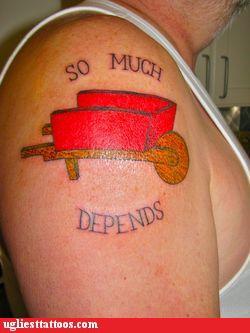
So Much Depends on the Hideous William Carlos Williams Tattoo

(Via).

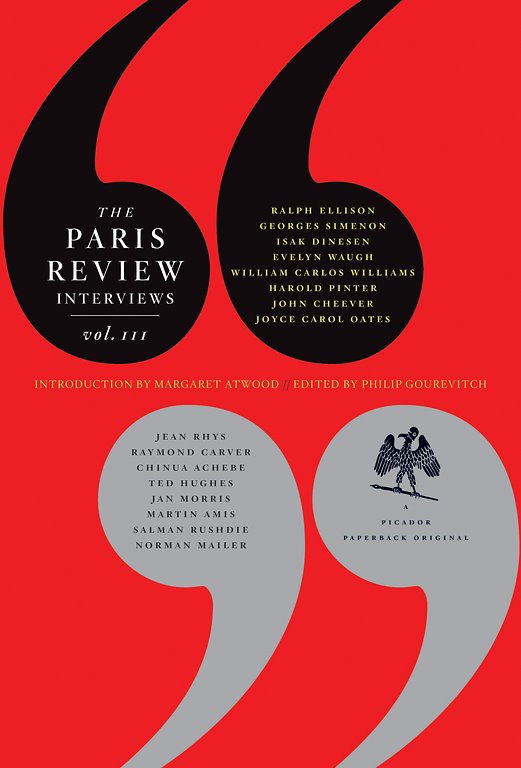
The Paris Review Interviews, Volume III

How much you enjoy the third collection The Paris Review Interviews will depend entirely on how much you enjoy reading intelligent and thoughtful writers discussing intelligent and thoughtful subjects. I happen to love reading author interviews–even interviews with authors I don’t particularly like–and hence, I enjoyed this book quite a bit.

Covering sixteen disparate authors and fifty-two tumultuous years, the interviews here are by turns insightful, hilarious, strange, and at times, infuriating. The first interview (the book is organized chronologically), a 1955 conversation with Ralph Ellison evokes all of these emotions. One can almost feel Ellison’s restraint as he patiently replies to asinine questions like, “Then you consider your novel a purely literary work as opposed to one in the tradition of social protest?” and, “But isn’t it going to be difficult for the Negro writer to escape provincialism when his literature is concerned with a minority?” If anything, these politicized charges prompt Ellison to some of the most salient observations about literature’s universalizing powers that I’ve ever read.

In his 1964 interview, poet William Carlos Williams also sheds quite a bit of light on his art and craft. Interestingly, his wife is also a major part of the interview, discussing at some length her own role in her husband’s writing. Beyond literature, craft, and writing, Williams also sets another early theme that unites the interviews collected here–dissing other writers. He calls T.S. Eliot a “conformist” determined to set poets back twenty years. Evelyn Waugh picks up on this theme in his 1963 interview. Of Faulkner: “I find Faulkner intolerably bad.” And Raymond Chandler: “I’m bored by all those slugs of whiskey. I don’t care for all the violence either.” Zing!

Don’t feel too bad for Chandler, though; he comes off funny and earthy and sad in his 1983 interview, especially when he discusses his alcoholism, and how and why he quit drinking. Apparently, teaching–and drinking–with John Cheever when the two were teaching at the Iowa Writer’s Workshop in 1973 had a major impact on Chandler’s decision to stop drinking.

John Cheever focuses mostly on the writing craft in his 1976 interview–not much talk of drinking here. He does, however, share this insight: “Plot implies narrative and a lot of crap. It is a calculated attempt to hold the reader’s interest at the sacrifice of moral conviction.” I’ve never liked Cheever’s writing, but he’s a great interview. In his 1994 interview, Achebe–an author whose fiction (and essays) I do like comes off as far more insightful and far less pretentious. On why creative writing classes exist: “I think it’s very important for writers who need something else to do, especially in these precarious times. Many writers can’t make a living. So to be able to teach how to write is a valuable to them. But I don’t really know about its value to the student.” Lovely. MFAs beware!

The interviews collected here are funny, smart, and very entertaining–whether its Achebe on general misunderstandings of his famous Conrad essay, Salman Rushdie on New Wave Cinema, or Joyce Carol Oates on Finnegans Wake, The Paris Review Interviews, Volume III is full of smart people talking about smart things–and what’s better than that? Highly recommended.

The Paris Review Interviews, Volume III is available October 28th, 2008 from Picador.

Icarus Falls, No Big Deal

“Landscape with the Fall of Icarus” by William Carlos Williams

According to Brueghel
when Icarus fell
it was spring

a farmer was ploughing
his field
the whole pageantry

of the year was
awake tingling
near

the edge of the sea
concerned
with itself

sweating in the sun
that melted
the wings’ wax

unsignificantly
off the coast
there was

a splash quite unnoticed
this was
Icarus drowning

“Musée de Beaux Arts” by W.H. Auden

About suffering they were never wrong,
The Old Masters: how well, they understood
Its human position; how it takes place
While someone else is eating or opening a window or just walking dully along;
How, when the aged are reverently, passionately waiting
For the miraculous birth, there always must be
Children who did not specially want it to happen, skating
On a pond at the edge of the wood:
They never forgot
That even the dreadful martyrdom must run its course
Anyhow in a corner, some untidy spot
Where the dogs go on with their doggy life and the torturer’s horse
Scratches its innocent behind on a tree.

In Brueghel’s Icarus, for instance: how everything turns away
Quite leisurely from the disaster; the ploughman may
Have heard the splash, the forsaken cry,
But for him it was not an important failure; the sun shone
As it had to on the white legs disappearing into the green
Water; and the expensive delicate ship that must have seen
Something amazing, a boy falling out of the sky,
had somewhere to get to and sailed calmly on.