The Squid and the Whale

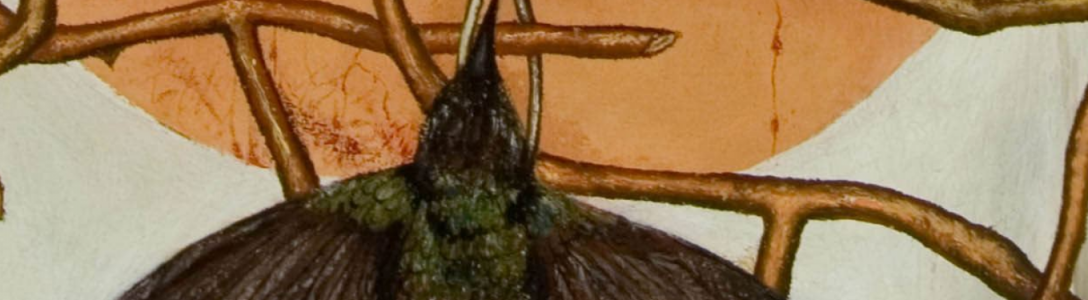
Late last year, we wrote about Matt Kish’s project to illustrate Herman Melville’s Moby-Dick, one page at a time. Kish’s work is still going strong (in fact it looks better than ever) and he’s very close to the half way mark. We love this recent piece, an image to accompany page 273 —

...previous to that connexion, the short-warp goes through sundry mystifications too tedious to detail.

Keep it up!

Devoid of Original Content, We Offer Instead These Links

Barbara King has to forget everything she thought she knew about Rick Steves after reviewing his new book Travel as a Political Act at Bookslut. Here’s a taste of her review:

The book is an eye-opener. Steves describes himself as a traveler and “a historian, Christian, husband, parent, carnivore, musician, capitalist, minimalist, member of NORML, and a workaholic.” The marijuana habit (I have discovered) has been headlined for a while now; the reveal here is Steves’s brand of forthright liberalism.

Promising not to “take the edge off” his opinions, Steves embraces geopolitical philosophizing “with the knowledge that good people will respectfully disagree with each other.” Speaking of assumptions, that’s a generous one. Given the mood of a large segment of the American public and Steves’s penchant for pointed passages, anyone care to wager how his fan mail is running?

Ahmad Saidullah reviews Keri Walsh’s compendium The Letters of Sylvia Beach at 3 Quarks Daily. This gives us a chance to plug our own interview with Keri Walsh from last month about the book (See? There’s some original content here after all–even if it’s recycled. Recycling is good, right?)

As part of the new partnership between Salon and McSweeney’s, you can read Nick Hornby’s latest “Stuff I’ve Been Reading” column online. The column has returned to The Believer after a too-long hiatus; it’s easily one of our favorite features in the magazine. It’s also one of the major inspirations for this site.

At The New York Times, Dave Itzkoff uses Kristen Stewart’s reaction shots as a way to review the cultural black hole that was the 2010 MTV Movie Awards. Hilarious.

The New Yorker has begun coverage on their “20 Under 40” collection of writers. The editors on their thought process:

The habit of list-making can seem arbitrary or absurd, leaving the list-makers endlessly open to second-guessing (although to encourage such second-guessing is perhaps the best reason to make lists). Good writing speaks for itself, and it speaks over time; the best writers at work today are the ones our grandchildren and their grandchildren will read. Yet the lure of the list is deeply ingrained. The Ten Commandments, the twelve disciples, the seven deadly sins, the Fantastic Four—they have the appeal of the countable and the contained, even if we suspect that there may have been other, equally compelling commandments, disciples, sins, and superheroes. What we have tried to do, in selecting the writers featured in this issue, is to offer a focussed look at the talent sprouting and blooming around us.

Finally, here’s one of those celebrated writers, Wells Tower, in an interview at a bar:

The Joys of Random Reading

The New York Times published a little piece yesterday on the pleasures of finding–and reading–random books in vacation spots. From the article: “There is fate in the moldy, dog-eared paperbacks found on the shelves and bedside tables of summer guest rooms. When the masterpiece we’ve dutifully brought along stalls five pages in, the accidental bounty of other people’s discarded reading beckons. Like conversations with strangers on a train, these random literary encounters can be unsettling, distracting or life changing.” They ask eight authors, including Wells Tower and Dave Eggers about some of their random reading encounters. Here’s Tower on The Bridges of Madison County:

“The Bridges of Madison County,” by Robert James Waller, found in a beach house in Brooklin, Me. Strenuously unrecommended as a novel, but if you strike every third verb and noun it converts into a superb volume of Mad Libs with which to pass idle hours by the sea.

I’ve picked up many weird books over the years, at guest houses, hostels, and other places I was staying: a cheap novelization of old Annie Oakley magazine serials (at a beach condo); H.G. Wells’s A Short History of the World (at a river house); too some mild shame, sundry trashy V.C. Andrews novels (they must have been my older cousin’s); any Stephen King novel I’ve ever read. Probably the best random reading experience I’ve had though was when staying at a friend’s grandfather’s house in Miami. I stayed in his mother’s old room–she had all kinds of cool books, including John Barth’s slim second novel The End of the Road, which I devoured in one sleepless night. I did not steal it.

Five Favorite Fictional Sons

A son is born to The Biblioklept! To celebrate–and, perhaps to respond to last year’s Father’s Day post, Five Favorite Fictional Fathers–I offer five favorite fictional sons. In the earlier post, I suggested that Western literature holds a certain ambivalence toward fatherhood, one that evinces in one of its most ubiquitous tropes–the hero-as-orphan. These orphan-heroes tend to have father-figures, but their biological dads are usually displaced in some way. So, to set some ground rules for the post, I chose heroes whose narratives are still deeply intertwined with their biological parents–particularly their fathers. Yet in the cases below, parental displacement remains.
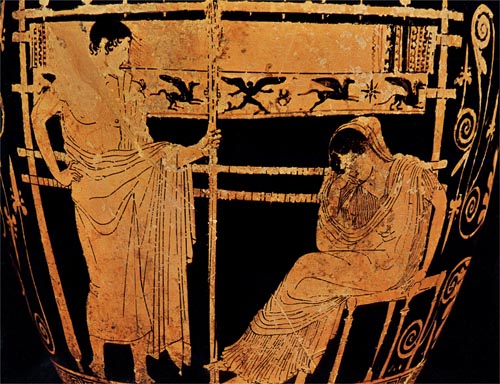
1. Telemachus, The Odyssey (Homer)

The original angry young man. And who can blame him, what with dad away (having all the fun, tricking gods and monsters and bagging nymphs) and rude would-be step-dads gobbling up all the goods (and, uh, trying to bang your mom to boot). Although the swineherd Eumaeus was probably more of a dad to Telly-Mack than Odysseus was, there’s something touching about the end of The Odyssey, when the pair slaughter the suitors wholesale.

2. Hamlet, Hamlet (William Shakespeare)

Poor, grieving Hamlet–dad departed–a ghost!–revenge me!–uncle usurping dad’s role (and his promised throne (and banging mom to boot))–wait–I think we’ve hit a theme here. This has to be a theme, right? Kids need guidance, and Hamlet has none. No wonder he goes bonkers.

3. Stephen Dedalus, A Portrait of the Artist as a Young Man and Ulysses (James Joyce)

OK, we’ve definitely hit a theme. Through the sympathetic yet often repulsive figure of Stephen Dedalus, Joyce reworked Telemachus and Hamlet (and Icarus and everything else (hang on, shouldn’t Jesus be on this list?)). Bloom gets too much credit as a father figure. Reread Portrait–Simon looms large enough.

4. Quentin Compson, The Sound and the Fury and Absalom, Absalom! (William Faulkner)

The theme is readily conceded. Compson funnels Hamlet’s neuroses and Dedalus’s intellectual acumen through a channel of Southern alienation. Plus, like Stephen, his dad’s a drunk. Like Hamlet, Quentin is ultimately a tragic figure, but he’s nonetheless a hero, a son who attempts to reconcile the traditions of his father’s world against the shifting dimensions of his own time (or something like that).

5. Hal Incandenza, Infinite Jest (David Foster Wallace)

A tennis champ with a secret marijuana addiction (or, more accurately, an addiction to secret behaviors) cursed with an eidetic memory, Prince Hal is easily one of DFW’s finest inventions. And yes, yes, yes, his relationship with dad James (again, a drunk) repeats the drama of Hamlet–right down to the ghost-demands-revenge scene and its usurping uncle (although Charles Tavis ain’t so bad). So, unwittingly, the theme finds its summation in Hal, a kid anyone would be proud to call son.
Ethical Realism (and Grim Decadence) in Hans Fallada’s Wolf Among Wolves

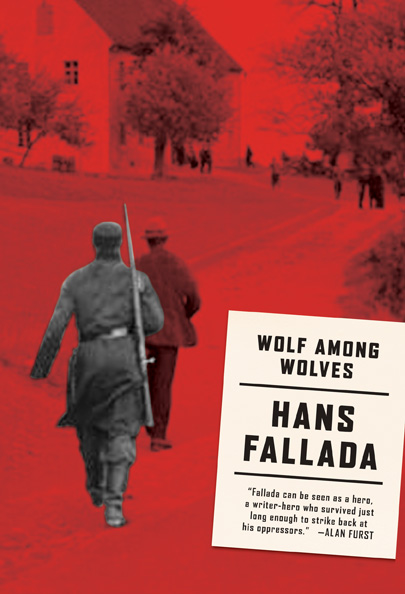
On the heels of last year’s hugely successful first-time-in-English publication of Every Man Dies Alone, the good folks at Melville House have issued another of Hans Fallada’s epic novels, Wolf Among Wolves. Set during Germany’s 1923 economic collapse, Wolf centers on Wolfgang Pagel, a former soldier and itinerant gambler languishing in the corruption of Weimar Berlin.The beginning of the novel focuses on a single summer day in Berlin; Fallada’s naturalist, realist eye paradoxically puts all the minutiae of this world under a microscope even as it expands to capture a holistic vision of life in morally-decadent, post-war Germany. The effect is both devastating and enlightening. It is epic realism, the condensation of the everyday existence of an alien world. Another paradox–behind Fallada’s omniscient, steady, neutral narrative, so plain and descriptive and frank, there lies another voice, a moral, ethical voice that prompts Pagel to transcend the wolf-eat-wolf world. Indeed, Fallada presents a vision of moral cooperation in a world dominated by self-interest. Here’s a passage describing some of Berlin’s heady post-war decadence:

But the girls were the worst. They strolled about calling, whispering, taking people’s arms, running alongside men, laughing. Some girls exposed their bodies in a way that was revolting. A market of flesh–white flesh bloated with drink, and lean dark flesh which seemed to have been burned up by spirits. But worst of all were the entirely shameless, the almost sexless: the morphine addicts with their contracted pupils, the cocaine sniffers with their white noses, and the cocaine addicts with high-pitched voices and irrepressibly twitching faces. They wriggled, they jiggled their flesh in low-cut or cunningly-slashed blouses, and when they made room for you or went round a corner they picked up their skirts (which, even so, didn’t reach their knees), exhibiting between stockings and drawers a strip of pale flesh and a green or pink garter. They exchanged remarks about passing men, bawled obscenities to each other across the street, and their greedy eyes searched among the slowly drifting crowd for foreigners who might be expected to have foreign currency in their pockets.

Melville House’s edition of Wolf Among Wolves is the first unabridged English translation ever–scholars Thorsten Carstensen and Nicholas Jacobs have restored  passages originally omitted in Philip Owens’s contemporaneous translation.In his insightful afterward, Carstensen addresses why certain passages were not included in Owens’s original translation, pointing out that most omitted passages showed an inclination toward fairy-tale or mythic structures, aesthetics that “contradict the claim to naturalistic representation” one expects in Fallada’s work. By preserving the occasional “almost surreal mode of perception” omitted in the original, Carstensen argues that:

In short, the fully reconstructed text, with its enhanced inconsistency, provides the reader with insight into a literary aesthetics that is unique among the novels of German modernism: Fallada combines realist prose and ethical concerns with a narrative technique that renders ambiguous what is supposedly a semi-documentary representation, shaped by his very own experiences in the country.

We’re eating up Wolf Among Wolves right now, and will have a full review in time); for now, we recommend you pick it up for some good summer reading.

The New Yorker Publishes Meaningless List Celebrating an Arbitrary Number of Writers under an Arbitrary Age

Because, people love reading lists: The New Yorker reveals their “20 Under 40” list, naming, um, 20 writers who are, like, under 40 years old and, you know, worth reading. Here’s the list, via The New York Times:

They are Chimamanda Ngozi Adichie, 32; Chris Adrian, 39; Daniel Alarcón, 33; David Bezmozgis, 37; Sarah Shun-lien Bynum, 38; Joshua Ferris, 35; Jonathan Safran Foer, 33; Nell Freudenberger, 35; Rivka Galchen, 34; Nicole Krauss, 35; Yiyun Li, 37; Dinaw Mengestu, 31; Philipp Meyer, 36; C. E. Morgan, 33; Téa Obreht, 24; Z Z Packer, 37; Karen Russell, 28; Salvatore Scibona, 35; Gary Shteyngart, 37; and Wells Tower, 37.

Glad to see that Biblioklept faves Wells Tower and Chris Adrian are getting their due.

Paul Auster Explains Why Philip Roth Is Wrong

Paul Auster explains why Philip Roth is wrong about the death of the novel: