Sometime last year, during a rare visit to a big chain bookstore, I was disgusted to see what had happened to David Foster Wallace’s amazing Kenyon College commencement speech, “This Is Water.” Wallace’s speech, about 3,815 words, give or take (maybe twelve standard typed pages), was being sold as a 144 page hardback volume with only a sentence or two printed per page. The book was (and is) a nakedly commercial attempt to turn a text that is widely available on the web into the sort of thing that well-meaning uncles give to their nephews or nieces as graduation gifts. Of course, hardcore Wallace fans might want such a book — and I’d never begrudge them that — but it’s hard to imagine that Wallace would have been comfortable with how his book was marketed.
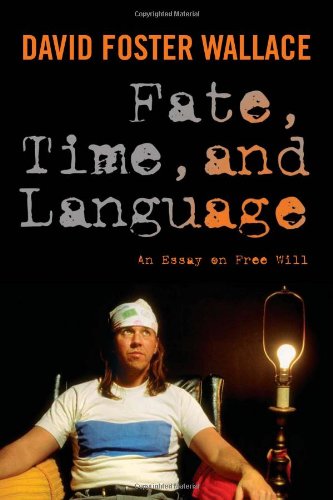
Which brings us to Fate, Time, and Language: An Essay on Free Will, new from Columbia University Press this week. The book publishes the 1985 honors thesis that Wallace submitted to the Amherst College’s Department of Philosophy, “Richard Taylor’s ‘Fatalism’ and the Semantics of Physical Modality.” The essay’s title alone signals a prohibitive level of academic specialization. In his introductory essay to the volume, “A Head That Throbbed Heartlike,” New York Times Magazine editor James Ryerson points out, “Its obscurity is easy to appreciate. A highly specialized, seventy-six page work of logic, semantics, and metaphysics, it is not for the philosophically faint of heart.” Ryerson then warns his reader to “Brace yourself for a sample sentence,” before offering a sample from Wallace’s essay that I do not have the patience or fortitude to type out (it would take me too long to locate all the diacritical marks and special logic symbols). Ryerson concludes the paragraph with this wry remark: “There are reasons that he’s better known for an essay about a cruise ship.”
Fortunately, the editors of Fate, Time, and Language make every effort to contextualize Wallace’s essay in a way that explains its aims, strengths, and even shortcomings. There’s Ryerson’s lengthy introduction, which provides an overview to Wallace’s life in philosophy. Then there’s Taylor’s “Fatalism” of course, a short, provocative argument combining six presuppositions that led Taylor to declare that humans have no control — none, whatsoever — over any future event. The volume collects four other essays by Taylor on fatalism, as well as eight other essays responding to his arguments, before delivering Wallace’s essay (the longest in the collection). Here’s Wallace—
So Taylor’s central claim, the Taylor problem, is that just a few basic logical and semantic presuppositions, regarded as uncontroversially true by most philosophers, lead directly to the metaphysical conclusion that human beings, agents, have no control over what is going to happen.
I ain’t even gonna front–pretty much everything that Wallace says after this was lost on me; if you want to read and comprehend the details of his argument you will need to have a grasp on the basics of Montague grammar and tensed modal logic. If you lack these skills, there will be skimming. Lots and lots of skimming. So, in short, I have no ideawhether Wallace’s logic is sound, although I find his conclusion (minus all the modal evidence) quite compelling—
This essay’s semantic analysis has shown that Taylor’s proof doesn’t “force” fatalism on us at all. We should now recall that Taylor was offering a very curious sort of argument: a semantic argument for ametaphysical conclusion. In light of what we’ve seen about the semantics of physical modality, I hold that Taylor’s semantic argument does not in fact yield his metaphysical conclusion.
After Wallace’s honors thesis, there’s a wonderful little memoir essay by his adviser on the project, Jay L. Garfield, who offers up this nugget—
I knew at the time, as I mention above, that David was also writing a novel as a thesis in English. But I never took that seriously. I though of David as a very talented young philosopher with a writing hobby, and did not realize that he was instead one of the most talented fiction writers of his generation who had a philosophy hobby.
These little pockets of insight appeal to me most in Fate, Time, and Language, and as such, Ryerson’s essay “A Head That Throbbed Heartlike” is the highpoint of the book. It weaves together Wallace’s personal life, writing career, and academic pursuits into a moving elegy of sorts, although one more rooted in ideas than feelings. He also spells out the book’s mission quite clearly—
For all its seeming inscrutability, though, the thesis is lucidly argued and–with some patience and industry on the part of the lay reader–ultimately accessible, which is welcome news for those looking to deepen their understanding of Wallace. The paper offers a point of entry into an overlooked aspect of his intellectual life: a serious early engagement with philosophy that would play a lasting role in his work and thought, including his ideas about the purpose and possibilities of fiction.
Many of us might shudder at the idea of our college essays being published posthumously. Of course, most of us aren’t Wallace, but there are undoubtedly critics out there who will cry foul at this publication. Fortunately, the team behind Fate, Time, and Language has produced a book of remarkable integrity, one that understands why it exists, readily acknowledges its obscurity without trying to gloss over that obscurity, and makes every effort to communicate with and engage its readers without sacrificing erudition. To return to my opening anecdote, this is not the naked commercialism that motivated a gimmicky edition This Is Water; rather, this is a book delivered by people who genuinely care about Wallace and his ideas. Make no mistake–it’s very dry and very specialized, but fanatics will no doubt want it.

 Biblioklept