 I shouldn’t be reading five novels at once. It’s a terrible idea, a symptom of a bad habit that I thought I’d broken, but after abandoning Levin’s tedious tome The Instructions and wasting my time on Shteyngart’s insipid dystopian novel Super Sad True Love Story, I found myself absorbed by a lovely little cache that had been neatly, patiently stacked for a few weeks now.
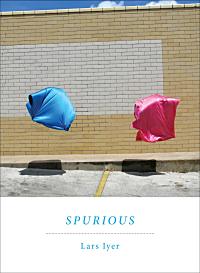
I’m only 60 or so pages into Lars Iyer’s Spurious — about a third of the way through — and at the rate I’m reading, I won’t finish it until the end of this month. It’s not that it’s slow or tedious or hard work: quite the opposite, in fact — it’s funny and lively, even when it’s erudite and depressive. I’ve enjoyed taking it in as a series of vignettes or skits or riffs. Spurious is about, or seems to be about (the term must be placed under suspicion) two would-be intellectuals, W. and his friend the narrator. They bitch and moan and despair: it’s the end of the world, it’s the apocalypse; they find themselves incapable of original thought, of producing any good writing. The shadow of Kafka paralyzes them. They travel about Europe, seeking out knowledge and inspiration — or at least a glimpse of some beautiful first editions. W. is cruel to the narrator, calling him fat and deriding his intellect for sport. But it’s all in good fun. Or maybe not. I’m really enjoying Spurious and have no hesitation recommending it; however, like a strong shot of bourbon, it’s best enjoyed frequently but in small doses. Spurious is brand spanking new from Melville House.
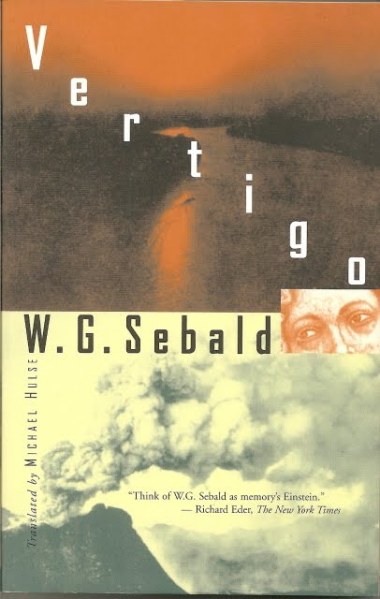 Iyer’s book dovetails nicely with W.G. Sebald’s first novel, Vertigo, which I picked up expressly to get the bad taste of Shteyngart out of my brain. Both books are haunted by Kafka, both blur the lines between fiction and biography, both are works of and about flânerie, and both are melancholy. The book comprises four sections; the first section tells the story of the romantic novelist Stendhal (or, more to the point, a version of Stendhal); the second section details two trips Sebald made to Italy, one in 1980, and one in 1987; the third
  section, which I just read last night, describes a trip Kakfa took to Italy near the end of his life. I’m almost certain that I’ve read this section, “Dr. K Takes the Waters at Riva,” before — but I can’t remember where or when. It was strange reading it, almost as if I were experiencing some of the vertigo that permeates the volume. Full review forthcoming.
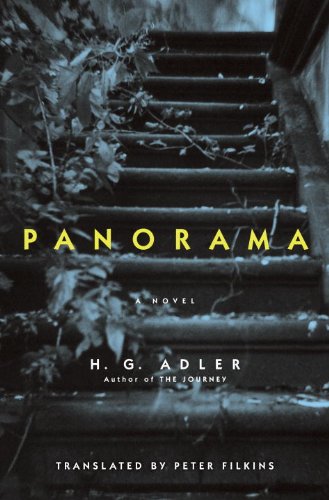
Kafka was a German-speaking Jewish writer from Prague. So was H.G. Adler, author of Panorama, new in English for the first time (hardback; Random House). Another way to transition from the Sebald paragraph above to this write-up of Panorama might be to point out that Sebald references Adler in Austerlitz, a book that tries to measure continental memory of the Holocaust. Adler survived the Holocaust, forced first into Theresienstadt and then Auschwitz, where his wife and mother were murdered in the gas chambers. Panorama is an autobiographical bildungsroman, with its hero young Josef Kramer standing in for Adler, and while it will clearly work its way into grim territory, the beginning — which is to say, the part that I’ve read so far — is bucolic and sweet and strange, as we see young Josef at home with his family. There’s a cinematic scope to Adler’s prose — Panorama is a Modernist work, one where the narrative freely dips into its protagonist’s mind. More to come.
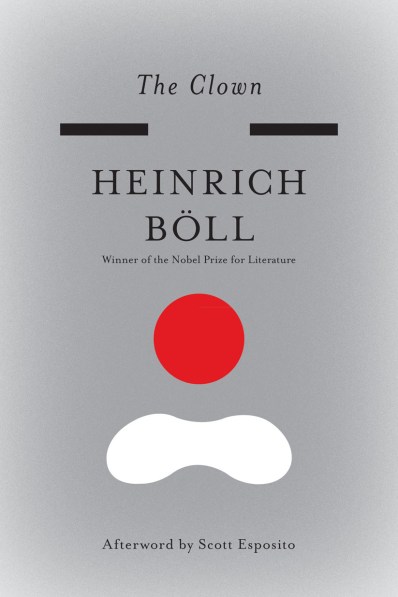 Continuing in this Teutonic vein is Heinrich Böll’s novel The Clown (also Melville House). It’s postwar Germany, and Hans Schnier is a clown who’s crashing and burning. He hurts himself–purposefully–during a performance (at one of the increasingly more provincial venues he finds himself playing for these days) and retreats to Bonn, where he holes up in his small apartment and makes angry desperate phone calls (and tries not to drink too much brandy) and reflects on his past. What’s eating him up? His gal Marie, basically his common-law wife, has reverted back to her Catholic ways and up and left him for some chump named Zupfner. Schnier rants against a complacent and complicit German bourgeoisie, spitting vitriol against Protestants and Catholics alike; some of the best parts of the novel though are his ravings about art and the role of the “artiste” in society. Also: he can smell over the phone. Full review soon.
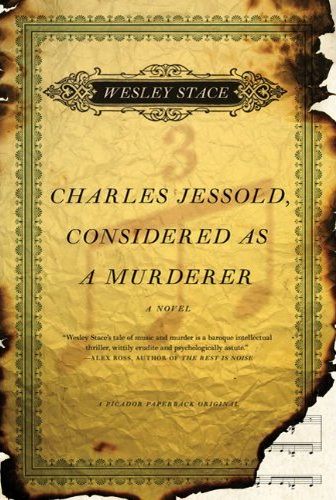 Wesley Stace’s new novel Charles Jessold, Considered as a Murderer (new from Picador) is a musical murder mystery set in the early part of 20th century Britain. Our (seemingly less than reliable) narrator Leslie Shepherd is a music critic with an aristocratic background who likes to spend his weekends collecting folk songs with other rich boys in the towns surrounding their country manors. He’s smitten (platonically, of course) with Charles Jessold, a middle class composer with a spark of avant-garde genius, and wins the younger man’s friendship quickly when he tells the story of Carlo Gesualdo, a fifteenth century composer/lord who kills his wife and her lover. (Notice the etymological connection between their names?) This tale of murder and cuckoldry is doubled in the ballad “Little Musgrave“; when Jessold and Shepherd find a new variation of the ballad, they set out to write the next (only?) great English opera, an adaptation of “Musgrave.” Oh, and that plot? The book opens with a news clipping reporting that Jessold killed his wife and her lover, and then himself, after the première of his opera Little Musgrave. Life imitates art imitates life. Stace has a keen ear for the period he writes about as well as a seemingly encyclopedic knowledge about music, but he also has the good sense to restrain himself and remember that he’s delivering a murder mystery. I’ve been enjoying Jessold quite a bit, and will return to it when I finish writing these lines. (And, for what it’s worth, part of Jessold is set in Germany).
 Biblioklept