“I’m Not a Good Reader” — Witold Gombrowicz

I Watch The Decemberists’ David Foster Wallace Video

I’ll be upfront: I don’t care for the music of The Decemberists. I’ve tried, after being told repeatedly how “deep” or “clever” or “literate” the lyrics are, and how good the music is—but it all strikes me as awfully bland stuff, like someone’s shitty take on R.E.M.

Anyway, I do very much like David Foster Wallace’s novel Infinite Jest, the “inspiration” (yes, I’ll put the word in suspicious quotation marks) behind The Decemberists’ new music video for “Calamity Song.” Here’s their singer/songwriter Colin Meloy (via NPR)—

I wrote “Calamity Song” shortly after I’d finished reading David Foster Wallace’s epic Infinite Jest. The book didn’t so much inspire the song itself, but Wallace’s irreverent and brilliant humor definitely wound its way into the thing. And I had this funny idea that a good video for the song would be a re-creation of the Enfield Tennis Academy’s round of Eschaton — basically, a global thermonuclear crisis re-created on a tennis court — that’s played about a third of the way into the book. Thankfully, after having a good many people balk at the idea, I found a kindred spirit in Michael Schur, a man with an even greater enthusiasm for Wallace’s work than my own. With much adoration and respect to this seminal, genius book, this is what we’ve come up with. I can only hope DFW would be proud.

I’m not going to conjecture whether Wallace would be proud or not. That seems like total asshole move. But, I am interested in seeing a filmed version of Eschaton, and I do like Michael Schur’s show Parks and Recreation. So I’m going to watch the video now—unmuted and everything—and then post a reaction. Here’s the vid—

Okay. Nice production values, I guess. I think that’s the band, right? I like it when bands are in their own videos and “act.” I guess they’re playing the older ETA kids who are watching the game this Interdependence Day. The singer is Pemulis, that seems clear. It snows in the Escahton episode, but it looks like only some rain here. I like the Otis P. Lord kid, but I don’t know if the other kids look right. This is weak criticism, I know. Hmmm. The song . . . well, I’m not into this song, but I guess it’s pleasant enough. It’s terribly competent. Bits of it sound like a sped up version of R.E.M.’s “Talk About the Passion.” Some of the lyrics seem to reference or play off of Infinite Jest maybe—like “Year of the Something Something”  or something.

I don’t know. What can I say here? I hope no one tries to make a movie out of Infinite Jest. It was all I could do to fast forward through most of Jim from The Office’s movie of Hideous Men.

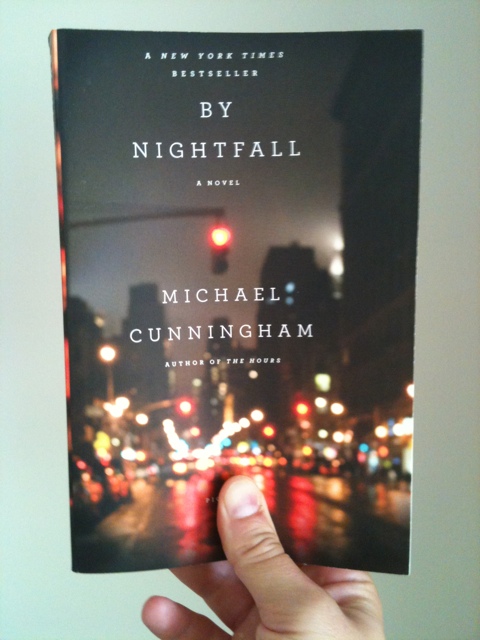
Book Acquired, 8.25.11

20110825-023856.jpg

In the mail today: Michael Cunningham’s By Nightfall, in trade paperback from the good folks at Picador. From novelist Jeanette Winterson’s review of the hardback edition, printed last year in the NYT

Cunningham has taken on the classic plot of the uninvited or unexpected stranger or guest whose arrival brings chaos, self-knowledge, tragedy, the ruin of one kind of life that may or may not lead to something better. It’s a story we know from variants as classic as Shakespeare’s “Twelfth Night” to Mark Twain’s “Mysterious Stranger” to contemporary versions like “The Accidental” by Ali Smith. Cunningham is drawn to simple, potent plots (think of the triptych in “The Hours”), saving his energy for the hearts and minds, the groins and guts, of his characters. Yet he makes you turn the pages. He tells a story here, but not too much of a story. You aren’t deadened by detail; you’re eager to know what happens next.

Cunningham writes so well, and with such an economy of language, that he can call up the poet’s exact match. His dialogue is deft and fast. The pace of the writing is skilled — stretched or contracted at just the right time. And if some of the interventions on art are too long — well, too long for whom? For what? Good novels are novels that provoke us to argue with the writer, not just novels that make us feel magically, mysteriously at home.A novel in which everything is perfect is a waxwork. A novel that is alive is never perfect.

A List of Things Roberto Bolaño Discussed with His Friend Rodrigo Fresán

From the entry “All Subjects with Fresán,” in Bolaño’s collection Between Parentheses, a list of stuff the late writer talked about with his good friend, which includes (as usual) plenty of references to writers, poets, directors—and some funny jokes as well. Read part of Fresán’s essay “The Savage Detective” — it was the piece that first got me to go pick up a Bolaño. Here’s the list—

1) The Latin American hell that, especially on weekends, is concentrated around some Kentucky Fried Chicken or McDonald’s.

2) The doings of Buenos Aires photographer Alfredo Garofano, childhood friend of Rodrigo and how a friend of mine and of anyone with the least bit of discernment.

3) Bad translations.

4) Serial killers and mass murders.

5) Prospective leisure as the antidote to prospective poetry.

6) The vast number of writers who should retire after writing their first book or their second or their third or their fourth or their fifth.

7) The superiority of the work of Basquiat to that of Haring, or vice versa.

8 ) The works of Borges and the works of Bioy.

9) The advisability of retiring to a ranch in Mexico near a volcano to finish writing The Turkey Buzzard Trilogy.

10) Wrinkles in the space time continuum.

11) The kind of majestic women you’ve never met who come up to you in a bar and whisper in your ear that they have AIDS (or that they don’t).

12) Gombrowicz and his conception of immaturity.

13) Philip K. Dick, whom we both unreservedly admire.

14) The likelihood of a war between Chile and Argentina and its possible and impossible consequences.

15) The life of Proust and the life of Stendhal.

16) The activities of some professors in the United States.

17) The sexual practices of titi monkeys and ants and great cetaceans.

18) Colleagues who must be avoided like limpet mines.

19) Ignacio Echevarria, whom both of us love and admire.

20) Some Mexican writers liked by me and not by him, and some Argentine writers like by me and not by him.

21) Barcelonan manners.

22) David Lynch and the prolixity of David Foster Wallace.

23) Chabon and Palahniuk, whom he likes and I don’t.

24) Wittgenstein and his plumbing and carpentry skills.

25) Some twilit dinners, which actually, to the surprise of the diner, become theater pieces in five acts.

26) Trashy TV game shows.

27) The end of the world.

28) Kubrick’s films, which Fresán loves so much that I’m beginning to hate them.

29) The incredible war between the planet of the novel-creatures and the planet of the story beings.

30) The possibility that when the novel awakes from its iron dreams, the story will be there.

Fierce Monster — Goya