Tear Vases, Seven Sponges, A Neapolitan Knife, A Military Almanac, A Rhyming Dictionary . . .

From Roland Barthes’ “Life of Sade,” a short biography of The Marquis de Sade. Translated from the French by Richard Miller. Read the entire essay at Supervert (or here over the next few days, parceled out over 22 sections)—

9. Returning to France from Italy, Sade has sent from Naples to La Coste two large cases; the second, weighing six quintals, travels on the boat Aimable Marie; it contains: “marbles, stones, a vase or amphora for storing Greek wines with resin, antique lamps, tear vases, all à la Greek and Roman, medals, idols, raw and worked stones from Vesuvius, a fine sepulchral urn intact, Etruscan vases, medals, a sculptured piece in serpentine, a bit of nitrate solfatara, seven sponges, a collection of shells, a tiny hermaphrodite and a vase of flowers . . . a marble dish decorated with singularly lifelike fruits of all varieties, chests of drawers of Vesuvian marble, a Saracen buccherini or cup, a Neapolitan knife, used clothing and prints. . . Proofs of Religion, a treatise on the existence of God . . . The Rejected Tithe, an almanac of plays, The Gallant Saxon, a military almanac, Mme de Pompadour’s letters . . . a rhyming dictionary” (LéLy, i, 568). This variety of wares is in every way worthy of Bouvard and Pécuchet: we lack only a few ellipses, a few asyndeta, to read here a bit of Flaubertian bravura. The Marquis, however, did not write this inventory; yet he is the one who amassed this collection, whose heteroclite cultural nature is derisory in relation to culture itself. Dual proof: of the baroque energy of which Sade was capable, and of the writing energy he put into his acts.

Book Acquired, 9.2.11

20110902-032920.jpg

Today in the mail: Ali Smith’s There but for the. Publisher’s description—

At a dinner party in the posh London suburb of Greenwich, Miles Garth suddenly leaves the table midway through the meal, locks himself in an upstairs room, and refuses to leave. An eclectic group of neighbors and friends slowly gathers around the house, and Miles’s story is told from the points of view of four of them: Anna, a woman in her forties; Mark, a man in his sixties; May, a woman in her eighties; and a ten-year-old named Brooke. The thing is, none of these people knows Miles more than slightly. How much is it possible for us to know about a stranger? And what are the consequences of even the most casual, fleeting moments we share every day with one another?

“It’s No Accident that Civics Isn’t Taught Anymore” — More from §19 of David Foster Wallace’s The Pale King

(Help yourself to some context (or not)).

Let’s look at some more of  §19 of David Foster Wallace’s The Pale King. Our interlocutors, all IRS agents, stuck in an elevator (methinks), direct their attention toward the decline of civics education (“‘Civics is the branch of political science that quote concerns itself with citizenship and the rights and duties of US citizens,’” we learn) in America and link this decline to the 1960s—

‘I think it’s no accident that civics isn’t taught anymore or that a young man like yourself bridles at the word duty.’

‘We’ve gotten soft, you’re saying.’

‘I’m saying that the sixties—which God love them did a lot for raising people’s consciousness in a whole lot of areas, such as racism and feminism—‘

‘Not to mention Vietnam.’

‘No, mention it, because here was a whole generation where most of them now for the first time questioned authority and said that their individual moral beliefs about the war outweighed their duty to go fight if their duly elected representatives told them to.’

‘In other words that their highest actual duty was to themselves.’

And down a bit—

‘The sixties were America’s starting to decline into decadence and selfish individualism—the Me generation.’

‘There was more decadence in the twenties than there was in the sixties though.’

‘You know what I think? I think the Constitution and Federalist Papers of this country were an incredible moral and imaginative achievement. For really the first time in a modern nation, those in power set up a system where the citizens’ power over their own government was to be a matter of substance and not mere symbolism. It was utterly priceless, and will go down in history with Athens and the Magna Carta. The fact that it was a utopia which for over two hundred years actually worked makes it beyond priceless—it’s literally a miracle. And—and I’m speaking of Jefferson, Madison, Adams, Franklin, the real church Fathers—what raised the American experiment beyond great imagination and made it very nearly work was not just these men’s intelligence but their profound moral enlightenment—their sense of civics. The fact is that they cared more about the nation and the citizens than about themselves. They could have just set America up as an oligarchy where powerful eastern industrialists and southern landowners controlled all the power and ruled with an iron hand in a glove of liberal rhetoric. Need I say Robespierre, or the Bolsheviks, or the Ayatollah? These Founding Fathers were geniuses of civic virtue. They were heroes. Most of their effort went into restraining the power of the government.’

‘Checks and balances.’

‘Power to the people.’

‘They knew the tendency of power to corrupt—’

As I said in some earlier posts about  §19, I don’t really have any great thesis to share about it: I really just want folks to read it. I think it’s a thoughtful and sometimes funny discussion that seems especially relevant against the backdrop of current American politics, which seem to be infected by a terrible case of the reactionaries, a very vocal contingent that does not seem to believe in civic duty.

Most reviewers have remarked (rightly) upon Wallace’s grand theme of boredom in The Pale King, but I don’t know how much attention has been paid to the way the book tries to measure the costs of existence (namely, death and taxes). Wallace squares boredom as both symptom and affect of a postindustrial existence, a post-democratic existence, an existence that has the leisure, or at least the means and the common vocabulary, to hash out the finnicky sinews between rights and duties—or, in turn, the leisure and means (and entertainments) to psychologically deflect or otherwise ignore those costs. His characters in The Pale King—and not just these guys stuck in the elevator, but, hey, their colloquy is especially instructive—his characters are in many ways are trying to find meaning, a sense of duty, against terrible, soul-crushing boredom, a boredom that capitalist culture fosters and with one hand and then assuages with the other, like a heroin dealer stringing along a junkie for all he’s worth. (There’s an intersection here with Infinite Jest, of course).

It seems that “civics” is a dirty word now, or even worse, a word unattached to any real concept in the American hivemind. It’s pretty much a given (and “given” in the sense of, like, “submission”) that our politicians are wholly corrupted by power, part and parcel of a corporatocracy that thrives on manufactured desire, on the promotion of “lack,” constantly feeding into the basest instincts of a populace easily motivated by xenophobia, paranoia, and the sense that a creeping dark “other” is destabilizing America’s “natural” progress to some great grand glowing telos in the sky. The great lie of the past few decades has been to perpetuate the ideal of a cost-free existence, a metaphysical out, an endless deflection of our rapid consumption. We live in a world where the leading Republican candidates for the 2012 election race are basically cartoons. We live in a world where headlines from The Onion seem more the work of prescient prescription than outright satire. We live in a world where an honest assessment of who-pays-what-taxes can only come from a comedy show.

Perhaps I’m ranting; perhaps this post is too hyperbolic. Sorry. I’ll return to Wallace’s language and that opening line: “‘I think it’s no accident that civics isn’t taught anymore or that a young man like yourself bridles at the word duty.'” Americans are being told that they have no duty to other Americans, that they should not have to have any relationship with other Americans, that, essentially, there is no civic duty to one’s country, to one’s fellow Americans—there is only a duty to one’s ruggedly individual self, only a duty to one’s bootstraps, which you must always pull up by yourself. The corporate-advertising-entertainment-industrial complex perpetuates the illusion of rugged individualism and politicians reinforce it with their empty rhetoric, blasting at any element of a public, civic corpus that isn’t part of the American war machine (which remains of course untouchable; perhaps the greatest signal of cognitive dissonance I regularly see on my commute to and from work are the cars in front of me that somehow bear anti-tax bumper stickers right next to calls to “Support Our Troops”).

Wallace perhaps rightly links the genesis of this cognitive dissonance when it comes to civic rights and civic duties to the 1960s, when the baby boomers, finding power in sheer numbers, were able to assert a generational agency unseen in this country’s history. His elevator talkers here are at the precipice of the Reagan ’80s, post-Watergate disenchantment, but also post-Carter malaise, a time when the boomers are oiled and primed for the complete ideological failure that should forever mark their generation.

There’s more rant in me, of course, but I’ll save it for more excerpts from  §19.

Sade’s Parallel Duplications

From Roland Barthes’ “Life of Sade,” a short biography of The Marquis de Sade. Translated from the French by Richard Miller.  Read the entire essay at Supervert (or here over the next few days, parceled out over 22 sections)—

8. We need only read the Marquis’s biography after having read his work to be convinced that he has put part of his work into his life — and not the opposite, as so-called literary science would have us believe. The “scandals” of Sade’s life are not “models” of analogous situations drawn from his books. Real scenes and fantasized scenes are not directly related; all are no more than parallel duplications, more or less powerful (stronger in the work than in life), of a scene that is absent, unfigured, but not inarticulated, whose site of infiguration and articulation can only be writing: Sade’s work and his life traverse this writing area on an equal footing.

Derrida Talks About the Myth of Echo and Narcissus

Wherever He Goes, He Provokes the Terrified Dismay of the Guardians of Order

From Roland Barthes’ “Life of Sade,” a short biography of The Marquis de Sade. Translated from the French by Richard Miller.  Read the entire essay at Supervert (or here over the next few days, parceled out over 22 sections)—

7. The Lady President of Montreuil was objectively responsible for her son-in-law’s persecutions during the entire first years of his life (perhaps she loved him? One day, someone told the Marquise that the Lady President “loved M. de Sade to distraction”). The impression we have of her character, however, is one of continual fear: fear of scandal, of “difficulties.” Sade seems to have been a triumphant, troublesome victim; like a spoiled child, he is continually “teasing” (teasing is a sadistic passion) his respectable and conformist relations; wherever he goes, he provokes the terrified dismay of the guardians of order: everyone responsible for his confinement at the fort of Miolans (the King of Sardinia, the minister, the ambassador, the governor) is obsessed by the possibility of his escape — which does not fail to occur. The couple he forms with his persecutors is an aesthetic one: it is the malicious spectacle of a lively, elegant animal, both obsessed and inventive, mobile and tenacious, continually escaping and continually returning to the same area, while the giant mannequins, stiff, timorous, pompous, quite simply attempt to contain him (not punish him: this will only come later).

Household Sadism

From Roland Barthes’ “Life of Sade,” a short biography of The Marquis de Sade. Translated from the French by Richard Miller.  Read the entire essay at Supervert (or here over the next few days, parceled out over 22 sections)—

6. Household Sadism: at Marseilles, Sade wants Marianne Lavergne to whip him with a parchment beater with bent pins which he takes from his pocket. The girl quails before so exclusively functional an object (like a surgical instrument), and Sade orders the maidservant to bring a heather broom; this utensil is more familiar to Marianne and she has no hesitation in employing it to strike Sade across the buttocks.

Read the Opening Paragraphs of Denis Johnson’s Forthcoming Novella Train Dreams

The opening paragraphs of Denis Johnson’s forthcoming novella Train Dreams (via)—

In the summer of 1917 Robert Grainier took part in an attempt on the life of a Chinese laborer caught, or anyway accused of, stealing from the company stores of the Spokane International Railway in the Idaho Panhandle.

Three of the railroad gang put the thief under restraint and dragged him up the long bank toward the bridge under construction fifty feet above the MoyeaRiver. A rapid singsong streamed from the Chinaman voluminously. He shipped and twisted like a weasel in a sack, lashing backward with his one free fist at the man lugging him by the neck. As this group passed him, Grainier, seeing them in some distress, lent assistance and found himself holding one of the culprit’s bare feet. The man facing him, Mr. Sears, of Spokane International’smanagement, held the prisoner almost uselessly by the armpit and was the only one of them, besides the incomprehensible Chinaman, to talk during the hardest part of their labors: “Boys, I’m damned if we ever see the top of this heap!” Then we’re hauling him all the way? was the question Grainier wished to ask, but he thought it better to save his breath for the struggle. Sears laughed once, his face pale with fatigue and horror. They all went down in the dust and got righted, went down again, the Chinaman speaking in tongues and terrifying the four of them to the point that whatever they may have had in mind at the outset, he was a deader now. Nothing would do but to toss him off the trestle.

They came abreast of the others, a gang of a dozen men pausing in the sun to lean on their tools and wipe at sweat and watch this thing. Grainier held on convulsively to the Chinaman’s horny foot, wondering at himself, and the man with the other foot let loose and sat down gasping in the dirt and got himself kicked in the eye before Grainier took charge of the free-flailing limb. “It was just for fun. For fun,” the man sitting in the dirt said, and to his confederate there he said, “Come on, Jel Toomis, let’s give it up.” “I can’t let loose,” this Mr. Toomis said, “I’m the one’s got him by the neck!” and laughed with a gust of confusion passing across his features. “Well, I’ve got him!” Grainier said, catching both the little demon’s feet tighter in his embrace. “I’ve got the bastard, and I’m your man!”

The party of executioners got to the midst of the last completed span, sixty feet above the rapids, and made every effort to toss the Chinaman over. But he bested them by clinging to their arms and legs, weeping his gibberish, until suddenly he let go and grabbed the beam beneath him with one hand. He kicked free of his captors easily, as they were trying to shed themselves of him anyway, and went over the side, dangling over the gorge and making hand-over-hand out over the river on the skeleton form of the next span. Mr. Toomis’s companion rushed over now, balancing on a beam, kicking at the fellow’s fingers. The Chinaman dropped from beam to beam like a circus artist downward along the crosshatch structure. A couple of the work gang cheered his escape, while others, though not quite certain why he was being chased, shouted that the villain ought to be stopped. Mr. Sears removed from the holster on his belt a large old four-shot black-powder revolver and took his four, to no effect. By then the Chinaman had vanished.

A Somewhat Disturbing, Probably NSFW Clip from the Film Marquis

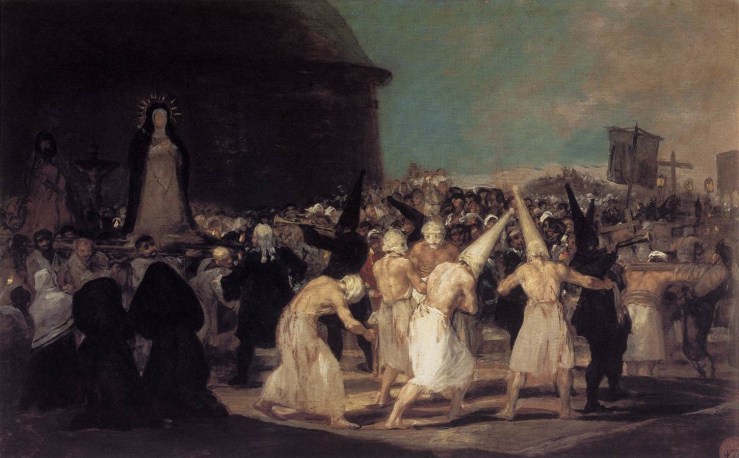
A Procession of Flagellants — Goya

Section 5, “Life of Sade” — Roland Barthes’ Short Biography of The Marquis de Sade

From Roland Barthes’ “Life of Sade,” a short biography of The Marquis de Sade. Translated from the French by Richard Miller.  Read the entire essay at Supervert. (or here over the next few days, parceled out over 22 sections)—

5. Sade likes theater costumes (forms which make the role); he wore them in his own daily life. When whipping Rose Keller, he disguises himself as a flogger (sleeveless vest over a naked torso; kerchief around the head as is worn by young Japanese cooks as they swiftly cut up live eels); later on, he prescribes for his wife the mourning costume she must wear for visiting a captive, unhappy husband: Dress as dark in color as possible, the bosom covered, “a large, very large bonnet without the hair it covers being dressed in any way, merely combed, a chignon, no braids.”