RIP Adam Yauch

RIP MCA. 47 is way too young.

“Quite an Original” — Herman Melville on Hamlet, Don Quixote, and Satan

This is Chapter XLIV of Herman Melville’s The Confidence Man:

“Quite an original:” A phrase, we fancy, rather oftener used by the young, or the unlearned, or the untraveled, than by the old, or the well-read, or the man who has made the grand tour. Certainly, the sense of originality exists at its highest in an infant, and probably at its lowest in him who has completed the circle of the sciences.

As for original characters in fiction, a grateful reader will, on meeting with one, keep the anniversary of that day. True, we sometimes hear of an author who, at one creation, produces some two or three score such characters; it may be possible. But they can hardly be original in the sense that Hamlet is, or Don Quixote, or Milton’s Satan. That is to say, they are not, in a thorough sense, original at all. They are novel, or singular, or striking, or captivating, or all four at once.
More likely, they are what are called odd characters; but for that, are no more original, than what is called an odd genius, in his way, is. But, if original, whence came they? Or where did the novelist pick them up?

Where does any novelist pick up any character? For the most part, in town, to be sure. Every great town is a kind of man-show, where the novelist goes for his stock, just as the agriculturist goes to the cattle-show for his. But in the one fair, new species of quadrupeds are hardly more rare, than in the other are new species of characters—that is, original ones. Their rarity may still the more appear from this, that, while characters, merely singular, imply but singular forms so to speak, original ones, truly so, imply original instincts.

In short, a due conception of what is to be held for this sort of personage in fiction would make him almost as much of a prodigy there, as in real history is a new law-giver, a revolutionizing philosopher, or the founder of a new religion.

In nearly all the original characters, loosely accounted such in works of invention, there is discernible something prevailingly local, or of the age; which circumstance, of itself, would seem to invalidate the claim, judged by the principles here suggested.

Furthermore, if we consider, what is popularly held to entitle characters in fiction to being deemed original, is but something personal—confined to itself. The character sheds not its characteristic on its surroundings, whereas, the original character, essentially such, is like a revolving Drummond light, raying away from itself all round it—everything is lit by it, everything starts up to it (mark how it is with Hamlet), so that, in certain minds, there follows upon the adequate conception of such a character, an effect, in its way, akin to that which in Genesis attends upon the beginning of things.

For much the same reason that there is but one planet to one orbit, so can there be but one such original character to one work of invention. Two would conflict to chaos. In this view, to say that there are more than one to a book, is good presumption there is none at all. But for new, singular, striking, odd, eccentric, and all sorts of entertaining and instructive characters, a good fiction may be full of them. To produce such characters, an author, beside other things, must have seen much, and seen through much: to produce but one original character, he must have had much luck.

There would seem but one point in common between this sort of phenomenon in fiction and all other sorts: it cannot be born in the author’s imagination—it being as true in literature as in zoology, that all life is from the egg.

In the endeavor to show, if possible, the impropriety of the phrase, Quite an Original, as applied by the barber’s friends, we have, at unawares, been led into a dissertation bordering upon the prosy, perhaps upon the smoky. If so, the best use the smoke can be turned to, will be, by retiring under cover of it, in good trim as may be, to the story.

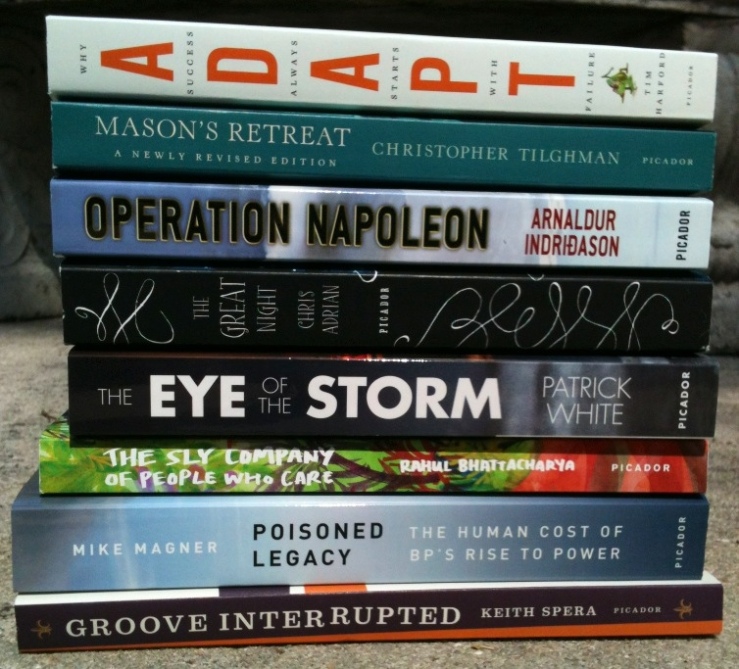
Books Acquired, 4.23.2012 — Or, Here’s What’s New from Picador This Month

20120502-162855.jpgNice little stack from the good people at Picador—novels, reissues, first-time-in-trade-paperbacks, nonfiction . . . a nice little spread.
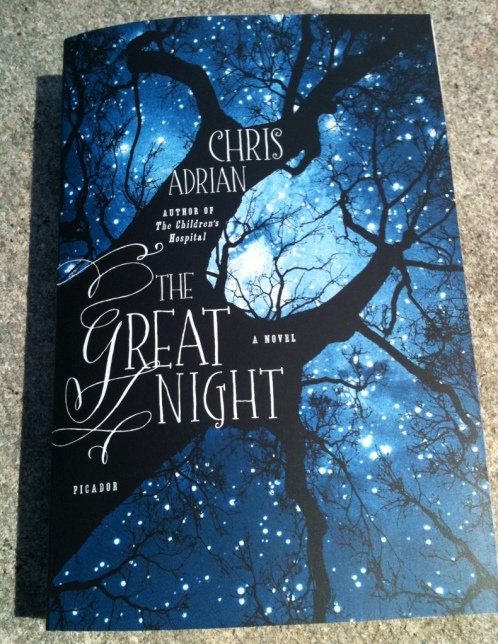
First up is Chris Adrian’s latest novel The Great Night, which, improbably, I’ve yet to read—I’m a huge fan of Chris Adrian’s other books, especially The Children’s Hospital (although I’ve reviewed his other books here too, for those inclined to hit the archives), and I love A Midsummer Night’s Dream, which I know The Great Night basically riffs on. Anyway, my wife snapped this one up right away (I had to go through her nightstand to fetch it up for yon photograph), so my reading will be delayed (although I will likely con her into reviewing it here).

20120502-162916.jpg

From Patrick Ness’s review at The Guardian

The Great Night is set in Buena Vista Park in San Francisco. Titania and Oberon – the very ones from Shakespeare’s play – live under the park’s main hill with their full court. Puck is there too, a malevolent but chained force, chafing for revenge against his masters. He may get his chance, for Titania is collapsing under grief. Boy, a changeling brought in by Oberon to amuse her and for whom she felt the first maternal feelings of her immortal life, has died of a very human disease, leukaemia.

Consumed by the pain of her loss, Titania makes a terrible mistake and tells Oberon she never loved him. Furious, he abandons her and shows no signs of returning. But perhaps if Titania releases Puck, who the other faeries refer to as the Beast, then Oberon will have to return to enslave him again. Won’t he? She breaks Puck’s bonds on the Great Night – Midsummer’s Eve, naturally – for which he says, “Milady, I am in your debt, and so I shall eat you last.” . . .

. . . Adrian does nearly everything right here. The Shakespearean references are worn lightly, and the plotting is so skilful you barely notice it falling into place. The characterisations are rich, too. There’s a spellbinding chapter on Molly’s childhood in a performing Christian family band that is both deeply weird and blisteringly sad. Plus there’s an eye-wateringly matter-of-fact approach to sex (and lots of it), which here is essentially indistinguishable from magic, and from love as well, in all its “intimations from the world that there was more to be had, something different and something better”.

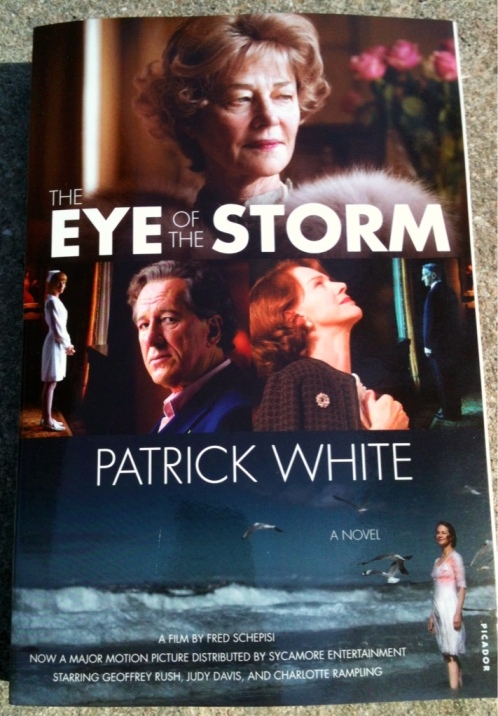
I like the cover of the Adrian, which I only mention here to transition into The Eye of the Storm, the novel that won Patrick White the Nobel in 1973. The book has been adapted into a film, so of course there’s a reissue with a film tie-in cover. (Buzzfeed’s addressed this phenomena recently; I did it a few years ago myself).

20120502-162937.jpg

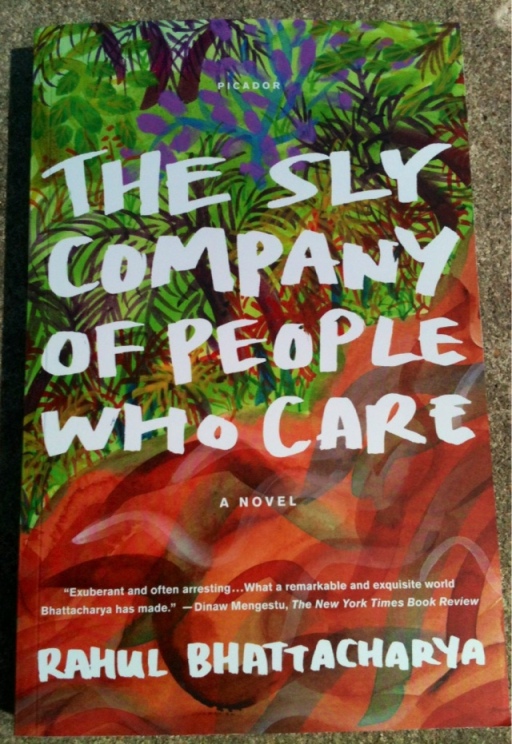
Speaking of covers: Love love love this one for The Sly Company of People Who Care by  Rahul Bhattacharya:

20120502-162952.jpg

Here’s novelist Dinaw Mengestu, from his review in The New York Times:

In the opening paragraph of Rahul Bhattacharya’s first novel, “The Sly Company of People Who Care,” the unnamed narrator, a former cricket journalist from India, declares his intentions for his life, and thus his story — to be a wanderer, or in his words, “a slow ramblin’ stranger.” That rambling, through the forests of Guyana; the ruined streets of its capital, Georgetown; and out to the borders of Brazil and Venezuela, constitutes the novel’s central action. But its heart lies in the exuberant and often arresting observations of a man plunging himself into a world full of beauty, violence and cultural strife.

20120502-163001.jpg

The Kirkus review of Mike Magner’s Poisoned Legacy:

This angry investigative report begins well before the 2010 Deepwater Horizon catastrophe.

In the first chapter, National Journal editor Magner describes a possible cancer epidemic in a Kansas town where refinery wastes have poisoned a wide area and where a courageous retired schoolteacher is fighting an uphill battle to force BP to clean up. Apparently, he had been researching this problem when the Gulf blowout forced him to change the book’s focus, but both stories alternate throughout the narrative. Readers with a taste for heated fist-shaking will have plenty of opportunities as Magner delivers detailed accounts of BP’s mishaps, emphasizing the massive 2005 Texas refinery explosion, leaks and malfunctions along the Alaska pipeline and the Deepwater disaster. Each follows an identical pattern: BP officials cut costs, safety budgets drop, employees grumble and warn of disaster, disaster occurs, individuals who suffered terribly tell their stories and government regulators and the media suddenly show interest, resulting in an outpouring of outrage, investigations, damning reports, fines and apologies from BP executives and the inevitable avalanche of lawsuits. Magner makes a strong case for BP’s negligence and the American government’s feeble oversight, but his case that BP operates less competently than other oil companies is not as convincing. Perhaps wisely, the author makes no argument that Americans are willing to make the painful sacrifices necessary to ensure that these catastrophes never recur. We want oil, and we don’t want it to cost too much.

A relentlessly critical denunciation of the latest environmental disaster that leaves the impression that more will follow.

20120502-163011.jpg

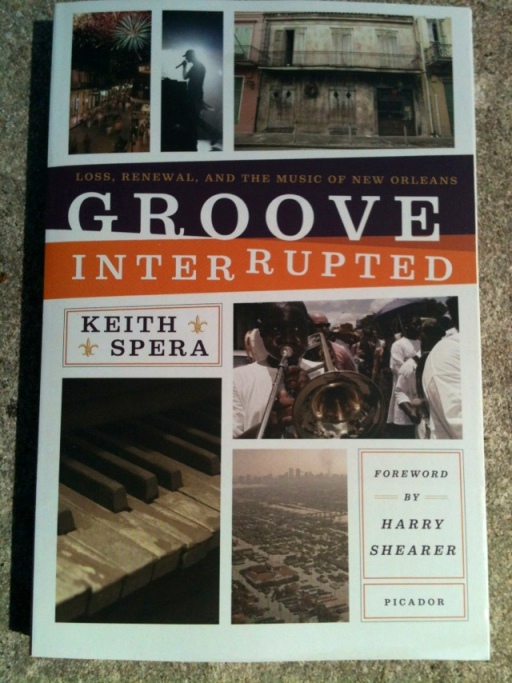
Groove Interrupted immediately piqued my interest and quickly found its way into my stack. Excerpt from Jazz Time’s review:

New Orleans native Spera, a longstanding music writer for The Times-Picayune who was also part of the newspaper’s Pulitzer Prize-winning Hurricane Katrina coverage team, focuses on tales of musicians confronting the challenges of trying to continue to make music in a post-Katrina environment. He covers those displaced New Orleanians forced to seek refuge in Houston, Austin, Nashville and other points around the country in the wake of Hurricane Katrina (known around New Orleans as “the Federal flood”). His profile of the cantankerous, Slidell-based blues guitarist-singer-fiddler Gatemouth Brown, who succumbed to lung cancer shortly after Katrina hit, is particularly moving, as is his eloquent recounting of Aaron Neville’s escape from his beloved hometown in the face of Katrina, his subsequent mourning over the loss of his wife to lung cancer in 2006 and triumphant return to New Orleans in 2008.

Road House Bar Brawls

(Fight Week continues at Biblioklept. Road House (read my essay!) is one of my favorite films of all time).