The Passion of Joan of Arc — Carl Theodor Dreyer (Full Film)

Don Quixote and Sancho Pansa Having a Rest under a Tree — Honore Daumier

List with No Name #6


  1. “Listening to the same programme, she also learned that the only animal that doesn’t crossbreed with its own offspring, is the horse.”
  2. “Somebody went there to die, I believe, in one of the old stories. Paris, perhaps. I mean the Paris who had been Helen’s lover, naturally. And who was wounded quite near the end of that war.”
  3. “With nought a wired from the wordless either.”
  4. “Hack away you mean red nigger, he said, and the old man raised the axe and split the head of John Joel Glanton to the thrapple.”
  5. “I dream of a grave, deep and narrow, where we could clasp each other in our arms as with clamps, and I would hide my face in you and you would hide your face in me, and nobody would ever see us any more.”

Slavoj Žižek on the Pressure to “Do Something”


The pressure to “do something” here is like the superstitious compulsion to make some gesture when we are observing a process over which we have no real influence. Are not our acts often such gestures? The old saying, “Don’t just talk, do something!” is one of the most stupid things one can say, even measured by the low standards of common sense. Perhaps, rather, the problem lately has been that we have been doing too much, such as intervening in nature, destroying the environment, and so forth . . . Perhaps it is time to step back, think and say the right thing. True we often talk about something instead of doing it; but sometimes we also do things in order to avoid talking and thinking about them.”

–From Slavoj Žižek’s First as Tragedy, Then as Farce


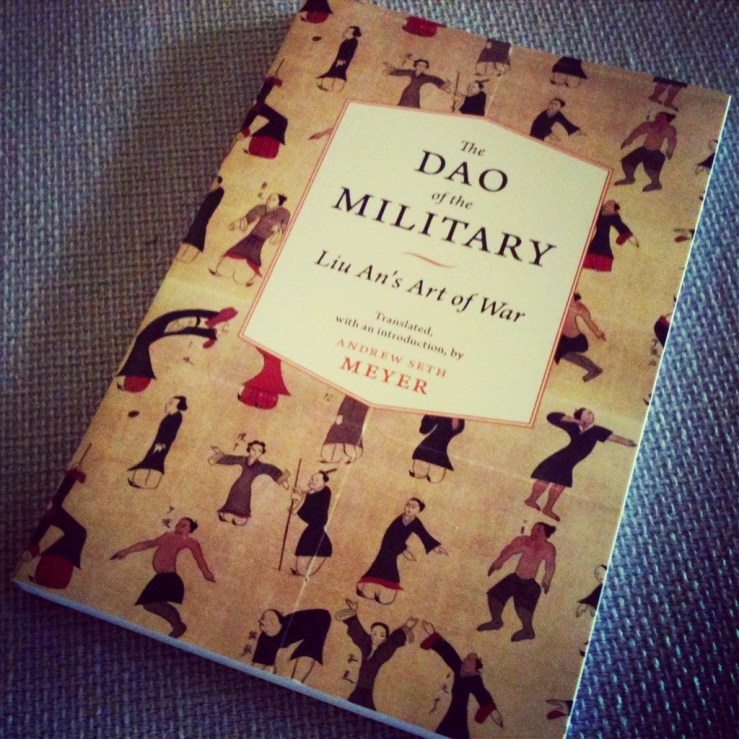
The Dao of the Military (Book Acquired, 8.27.2012)


20120902-141439.jpg

The Dao of the Military: Liu An’s Art of War is new in translation by Andrew Seth Meyer from Columbia University Press. Their blurbs:

The Dao of the Military makes a welcome addition to the growing literature on early Chinese strategy. The translation is exacting and felicitous. It should serve well for those interested in the history of Chinese thought and Chinese military thought.” — Victor H. Mair, University of Pennsylvania

The Dao of the Military summarizes and reflects on many aspects of the theory and practice of warfare developed in the Warring States period. It incorporates much of the theorizing of several traditions of military thought not well represented in the Seven Military Classics, and it is an important and valuable treatise that enriches our understanding of the history of Chinese military theory, the military tradition, Chinese intellectual history, and early China studies.” — Robin D. S. Yates, McGill University

The Dao of the Military is a valuable addition to the body of early China’s military texts available in English. Meyer’s learned introduction and admirably readable translation provide new and fascinating insights into the intellectual world and the military thinking of ancient Chinese philosophers. It is an essential read for everyone interested in how the Chinese tradition has understood warfare.” — Nicola Di Cosmo, Institute for Advanced Study, Princeton University


Reading Maria — Albrecht Durer