Summary of Bloom’s Day in Ulysses — Evan Lavender-Smith (From Old Notebooks)

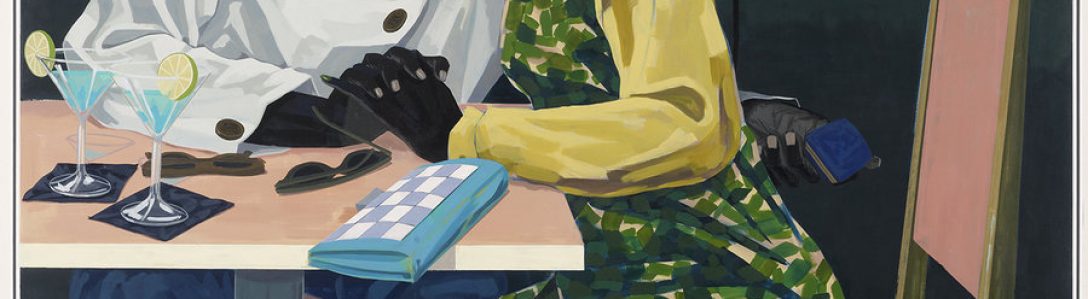
Makes breakfast for his wife. Goes to the butcher. Goes to the post office. Goes to church. Goes to a chemist. Goes to a public bath. Goes to a funeral. Goes to a newspaper press. Goes to a locksmith to canvass an ad. Feeds some seagulls. Goes to a bar. Helps a blind man cross the street. Goes to the museum. Goes to to the library. Visits a bookseller. Window-shops. Goes to a restaurant. Listens to some live music. Writes a love letter. Goes to another bar. Nearly gets in a fight. Masturbates to a beautiful eighteen-year-old exhibitionist giving him a private show. Takes an alfresco nap. Takes up a collection for a widow. Goes to a hospital to visit a pregnant woman. Flits with a nurse. Feeds a stray dog. Goes to a whorehouse. Helps avert a row with the police. Goes to a cabman’s shelter and listens to a sailor tell stories. Breaks into his own house. Urinates under the stars with another man. Watches the sunrise. Kisses his wife on her arse.

It would have been the single busiest, most adventurous day of my life.

From Evan Lavender-Smith’s From Old Notebooks.


“Prepare Your Coffin” — Tortoise

Hemingway and His Infernal Sleeping Bag — Eddie Campbell

campbell_hemingway

(Via).

“…by its indefiniteness it shadows forth the heartless voids and immensities of the universe…” (Moby-Dick)

But not yet have we solved the incantation of this whiteness, and learned why it appeals with such power to the soul; and more strange and far more portentous—why, as we have seen, it is at once the most meaning symbol of spiritual things, nay, the very veil of the Christian’s Deity; and yet should be as it is, the intensifying agent in things the most appalling to mankind.

Is it that by its indefiniteness it shadows forth the heartless voids and immensities of the universe, and thus stabs us from behind with the thought of annihilation, when beholding the white depths of the milky way? Or is it, that as in essence whiteness is not so much a colour as the visible absence of colour; and at the same time the concrete of all colours; is it for these reasons that there is such a dumb blankness, full of meaning, in a wide landscape of snows—a colourless, all-colour of atheism from which we shrink? And when we consider that other theory of the natural philosophers, that all other earthly hues—every stately or lovely emblazoning—the sweet tinges of sunset skies and woods; yea, and the gilded velvets of butterflies, and the butterfly cheeks of young girls; all these are but subtile deceits, not actually inherent in substances, but only laid on from without; so that all deified Nature absolutely paints like the harlot, whose allurements cover nothing but the charnel-house within; and when we proceed further, and consider that the mystical cosmetic which produces every one of her hues, the great principle of light, for ever remains white or colourless in itself, and if operating without medium upon matter, would touch all objects, even tulips and roses, with its own blank tinge—pondering all this, the palsied universe lies before us a leper; and like wilful travellers in Lapland, who refuse to wear coloured and colouring glasses upon their eyes, so the wretched infidel gazes himself blind at the monumental white shroud that wraps all the prospect around him. And of all these things the Albino whale was the symbol. Wonder ye then at the fiery hunt?

From “The Whiteness of the Whale,” Chapter 42 of Moby-Dick by Herman Melville.


Nelson Algren’s Mugshot

(More/about).

“A Dry Spell” — Einar Hjörleifsson Kvaran

“A Dry Spell” by Einar Hjörleifsson Kvaran

It had rained for a fortnight—not all the time heavily, but a fog had sullenly hung about the mountain tops, clinging to the atmosphere and rendering the whole of existence a dull gray colour. Every little while it would discharge a fine drizzle of rain or a heavy shower down upon the hay and everything else on earth, so that only the stones would occasionally be dry—but the grass never.

We were tired of the store—indeed, I should like to know who would have enjoyed it. It dated back to the beginning of the last century, a tarred, coal-black, ramshackle hut. The windows were low and small, the windowpanes diminutive. The ceiling was low. Everything was arranged in such a way as to exclude the possibility of lofty flights of thought or vision.

Just now, not a living soul looked in—not even those thriftless fellows who lived by chance jobs in the village and met in daily conclave at the store. We had often cursed their lengthy visits, but now that they had hired themselves out during the haymaking, we suddenly realized that they had often been entertaining. They had made many amusing remarks and brought us news of the neighbourhood. And now we cursed them for their absence.

We sat there and smoked, staring vacantly at the half-empty shelves, and all but shivering in the damp room. There was no heater in the store at any season, and the one in the office, if used, emitted spurts of smoke through every aperture except the chimney. It had not been cleaned since sometime during winter, and we were not ambitious enough for such an undertaking in the middle of the summer.

We tried to transfer our thoughts from the store to the world outside. We made clever comments to the effect that the farmers were now getting plenty of moisture for the hay-fields, and that it would be a pity if rain should set in now, right at the beginning of the haying season. We had nothing further to say on the subject, but this we repeated from day to day. In short, we were depressed and at odds with things in general. Until the dry spell.

One morning, about nine o’clock, the bank of fog began to move. First, there appeared an opening about the size of your hand, and through it the eastern sky showed a bright blue. Then another opening, and through it shone the sun. Continue reading ““A Dry Spell” — Einar Hjörleifsson Kvaran”

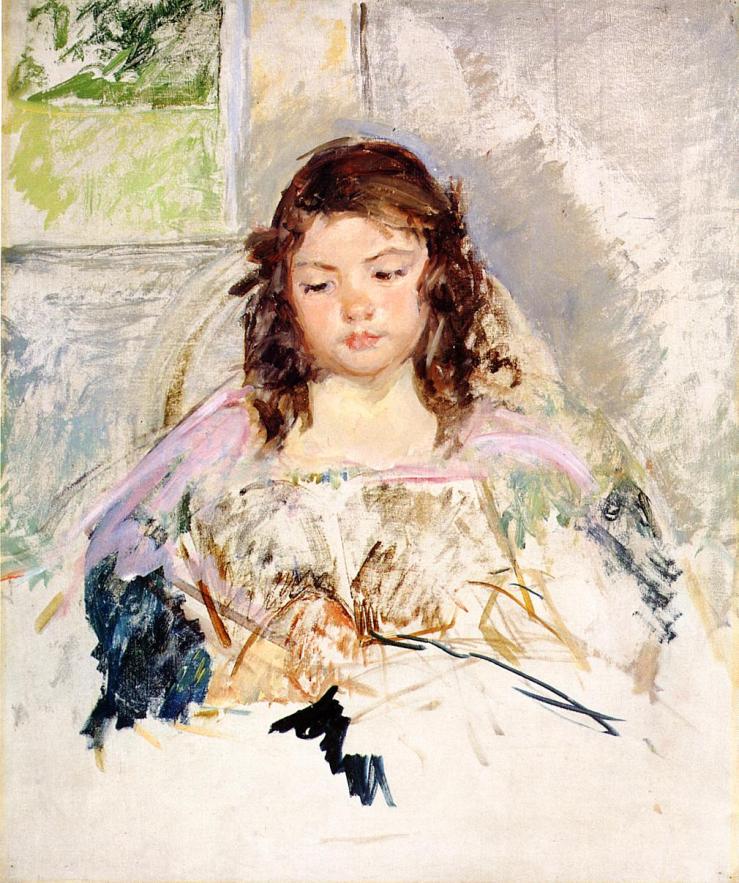
Girl in Pink — Mary Cassatt

sketch-for-francoise-in-a-round-backed-chair-reading-or-a-girl-in-pinkM