Alfred Hitchcock’s The Lady Vanishes (Full Film)

Beastie Variation, Phlegmatic — Thomas Woodruff

beastie variation woodruff

(More).

Skeeno H.C. Rules — Sonic Youth

“How to Write a Novel” — Gordon Lish

“How to Write a Novel” by Gordon Lish

First make sure you have enough time. It is crucial that you have enough time to make things up. Myself, I do not have time enough for anything like that.

But I’ll tell you what’s what. It will not be hard for you to follow me doing it.

Just listen.

Just watch.

I’m composing these instructions on an I.B.M. Selectric. I got it back in 1961. I did not buy it. I finessed it or I finagled it or I stole it.

The person who is the unexpressed direct object of one or the other of these verbs was rich. He said you can borrow this thing, use it for a while. Then he stuck his other thing in my wife’s thing. They still have their things and I have this thing and I’m not giving it up.

It’s given tip-top service. I really loved it when I first saw it, and I still love it just as much.

I never cover it over with anything. I don’t cover it over with anything like a cover or anything—because I like to look at it—the shape.  I.B.M. is good at giving a thing a nice shape. I always look at the shape of things before I snap of the light in a room.

I think 1961 was the Selectric’s first year.

I talk to engineers whenever I get a chance. I don’t mean the kind that build bridges. I mean the fellows that service things. Those are the engineers I talk to.

You know what one of those fellows once told me once? Buy the first of whatever it is! He said buy the first one of whatever it is because the maker of it is never going to knock himself out like that again—making, you know, all of the others after that. That’s why this one’s still going fine after so many wonderful, wonderful years.

The same goes for the Polaroid camera I’ve got. I’ve got the oldest one there is. You know how old that is? Here’s how old it is. It’s called, they call it, the Polaroid Land Camera.

That’s how goddamn old it is!

No shit, it was a first one—it was the very first Polaroid the Polaroid people made!

You want to see pictures? Look at these pictures! Tell me when in your life you ever saw in your life pictures as sharp as these pictures!

Because they’e this big when I start out with them. You see how big? Next to nothing, right? But then what? But then I go get them all blown up as big as life! See them? Look at them all over the walls if you don’t know what I mean!

That’s resolution for you , isn’t it?

Well, that’s my second wife, okay?

They’re framed all over the place.

People come in here and then they look at them and then they smack their heads.

My God, they say, such pictures!

I say, original issue, a maker knows his game.

Little Nemo Strip — Winsor McCay

“A Winter Walk” — Henry David Thoreau

“A Winter Walk” by Henry David Thoreau

The wind has gently murmured through the blinds, or puffed with feathery softness against the windows, and occasionally sighed like a summer zephyr lifting the leaves along, the livelong night. The meadow-mouse has slept in his snug gallery in the sod, the owl has sat in a hollow tree in the depth of the swamp, the rabbit, the squirrel, and the fox have all been housed. The watch-dog has lain quiet on the hearth, and the cattle have stood silent in their stalls. The earth itself has slept, as it were its first, not its last sleep, save when some street-sign or wood-house door has faintly creaked upon its hinge, cheering forlorn nature at her midnight work,—the only sound awake twixt Venus and Mars,—advertising us of a remote inward warmth, a divine cheer and fellowship, where gods are met together, but where it is very bleak for men to stand. But while the earth has slumbered, all the air has been alive with feathery flakes descending, as if some northern Ceres reigned, showering her silvery grain over all the fields.

We sleep, and at length awake to the still reality of a winter morning. The snow lies warm as cotton or down upon the window-sill; the broadened sash and frosted panes admit a dim and private light, which enhances the snug cheer within. The stillness of the morning is impressive. The floor creaks under our feet as we move toward the window to look abroad through some clear space over the fields. We see the roofs stand under their snow burden. From the eaves and fences hang stalactites of snow, and in the yard stand stalagmites covering some concealed core. The trees and shrubs rear white arms to the sky on every side; and where were walls and fences, we see fantastic forms stretching in frolic gambols across the dusky landscape, as if nature had strewn her fresh designs over the fields by night as models for man’s art.

Silently we unlatch the door, letting the drift fall in, and step abroad to face the cutting air. Already the stars have lost some of their sparkle, and a dull, leaden mist skirts the horizon. A lurid brazen light in the east proclaims the approach of day, while the western landscape is dim and spectral still, and clothed in a sombre Tartarian light, like the shadowy realms. They are Infernal sounds only that you hear,—the crowing of cocks, the barking of dogs, the chopping of wood, the lowing of kine, all seem to come from Pluto’s barn-yard and beyond the Styx;—not for any melancholy they suggest, but their twilight bustle is too solemn and mysterious for earth. The recent tracks of the fox or otter, in the yard, remind us that each hour of the night is crowded with events, and the primeval nature is still working and making tracks in the snow. Opening the gate, we tread briskly along the lone country road, crunching the dry and crisped snow under our feet, or aroused by the sharp clear creak of the wood-sled, just starting for the distant market, from the early farmer’s door, where it has lain the summer long, dreaming amid the chips and stubble; while far through the drifts and powdered windows we see the farmer’s early candle, like a paled star, emitting a lonely beam, as if some severe virtue were at its matins there. And one by one the smokes begin to ascend from the chimneys amidst the trees and snows. Continue reading ““A Winter Walk” — Henry David Thoreau”

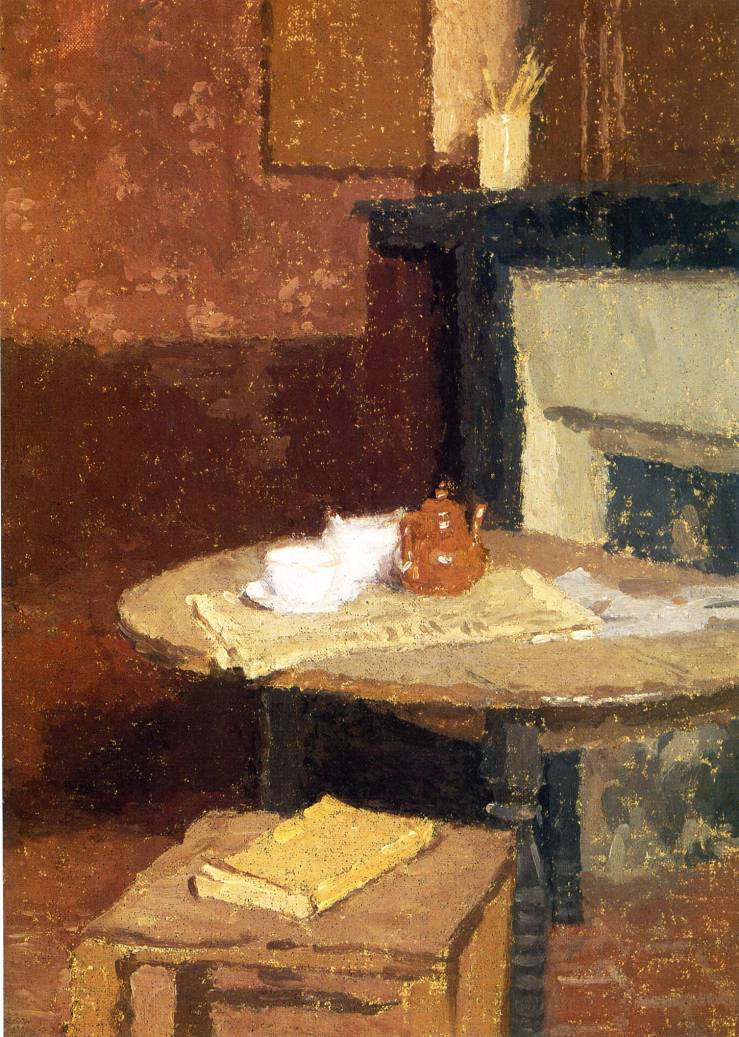
The Brown Pot — Gwen John

the-brown-tea-pot