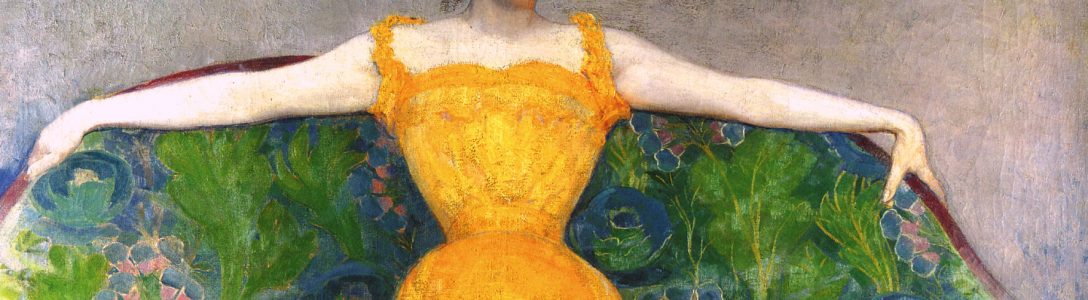
Hairy Harry, Mad Peter and Tiny Amon — Agostino Carracci

hairy-harry-mad-peter-and-tiny-amon-1600

Gerhard Richter Painting (Documentary Film)

John Dos Passos Writes to F. Scott Fitzgerald

Why Scott—you poor miserable bastard, it was damn handsome of you to write me. Had just heard about your shoulder and was on the edge of writing when I got your letter. Must be damned painful and annoying. Let us know how you are. Katy sends love and condolences. We often talk about you and wish we could get to see you.

I’ve been wanting to see you, naturally, to argue about your Esquire articles [The Crack-Up]—Christ, man, how do you find time in the middle of the general conflagration to worry about all that stuff? If you don’t want to do stuff on your own, why not get a reporting job somewhere. After all not many people write as well as you do. Here you’ve gone and spent forty years in perfecting an elegant and complicated piece of machinery (tool I was going to say) and the next forty years is the time to use it—or as long as the murderous forces of history will let you. God damn it, I feel frightful myself—I have that false Etruscan feeling of sitting on my tail at home while etcetera etcetera is on the march to Rome —but I have two things laid out I want to finish up and I’m trying to take a course in American history and most of the time the course of world events seems so frightful that I feel absolutely paralysed—and the feeling that I’ve got to hurry to get stuff out before the big boys close down on us. We’re living in one of the damnedest tragic moments in history—if you want to go to pieces I think it’s absolutely O. K. but I think you ought to write a first rate novel about it (and you probably will) instead of spilling it in little pieces for Arnold Gingrich—and anyway, in pieces or not, I wish I could get an hour’s talk with you now and then, Scott, and damn sorry about the shoulder. Forgive the locker room peptalk.

Yrs, Dos.

(1936; republished in New Directions’ edition of The Crack-Up).

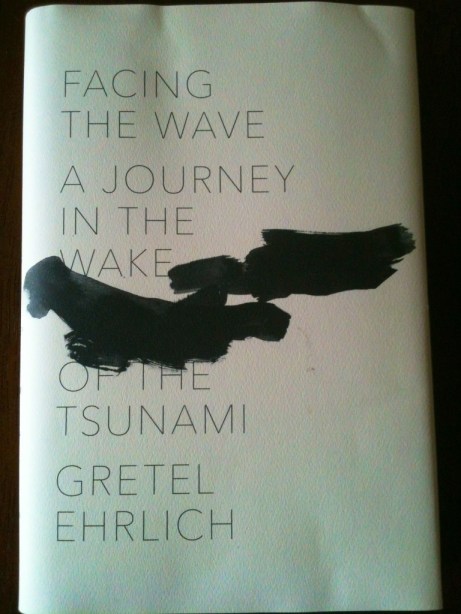
Gretel Ehrlich’s Facing the Wave (Book Acquired, Some Time Earlier This Month)

20130213-170614.jpg

Got into this a bit the other day. Last year, a reader sent me a copy of Ehrlich’s The Future of Ice, which was nice, but I could never really get into it. Anyway, like the cover on this one. Blurb from publisher Pantheon (you can also read an excerpt here):

From one of the preeminent and most admired observers of the natural world, a heartrending and inspirational portrait of Japan after the 2011 tsunami, when survivors found their world utterly transformed by loss, grief, destruction, and the urgent need to reconstruct their homes, their towns, and their lives.

A passionate student of Japanese poetry, theater, and art for much of her life, Gretel Ehrlich felt compelled to return to the earthquake-and-tsunami-devastated Tohoku coast to bear witness, listen to survivors, and experience their terror and exhilaration in villages and towns where all shelter and hope seemed lost. In an eloquent narrative that blends strong reportage, poetic observation, and deeply felt reflection, she takes us into the upside-down world of northeastern Japan, where nothing is certain and where the boundaries between living and dying have been erased by water.

The stories of rice farmers, monks, and wanderers; of fishermen who drove their boats up the steep wall of the wave; and of an eighty-four-year-old geisha who survived the tsunami to hand down a song that only she still remembered are both harrowing and inspirational. Facing death, facing life, and coming to terms with impermanence are equally compelling in a landscape of surreal desolation, as the ghostly specter of Fukushima Daiichi, the nuclear power complex, spews radiation into the ocean and air. Facing the Wave is a testament to the buoyancy, spirit, humor, and strong-mindedness of those who must find their way in a suddenly shattered world.

Sinbad the Sailor — Ub Iwerks

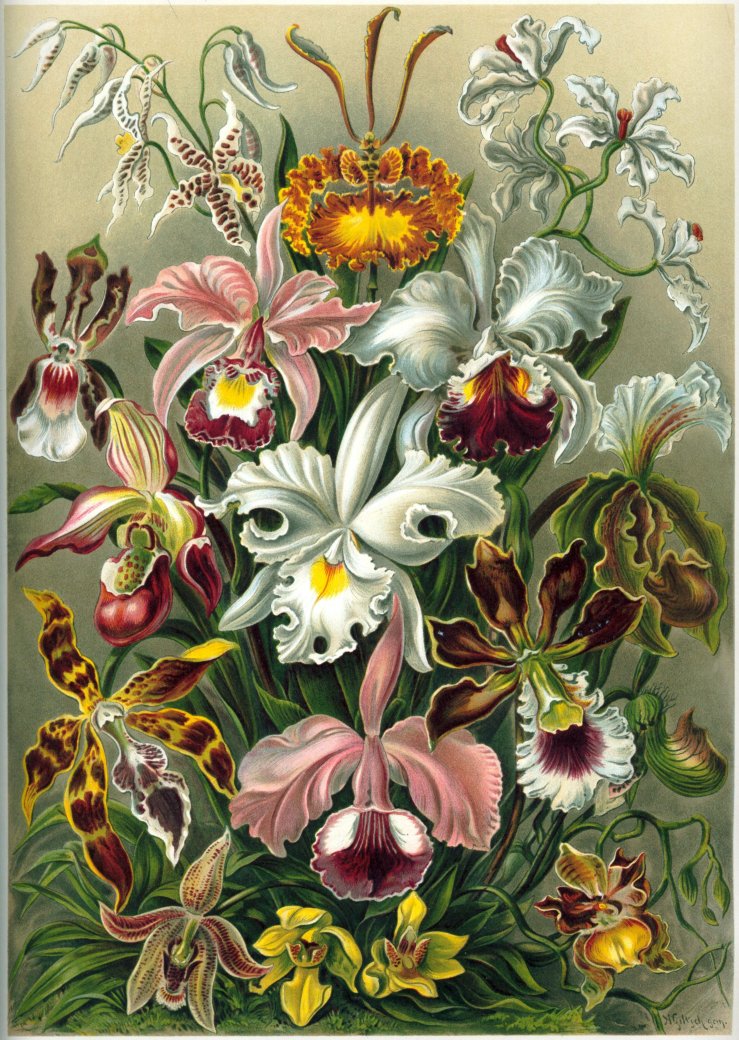
Orchidaceae — Ernst Haeckel

Haeckel_Orchidae

“Bed-Books and Night-Lights” — H.M. Tomlinson

“Bed-Books and Night-Lights” — H.M. Tomlinson

The rain flashed across the midnight window with a myriad feet. There was a groan in outer darkness, the voice of all nameless dreads. The nervous candle-flame shuddered by my bedside. The groaning rose to a shriek, and the little flame jumped in a panic, and nearly left its white column. Out of the corners of the room swarmed the released shadows. Black specters danced in ecstasy over my bed. I love fresh air, but I cannot allow it to slay the shining and delicate body of my little friend the candle-flame, the comrade who ventures with me into the solitudes beyond midnight. I shut the window.

They talk of the candle-power of an electric bulb. What do they mean? It cannot have the faintest glimmer of the real power of my candle. It would be as right to express, in the same inverted and foolish comparison, the worth of “those delicate sisters, the Pleiades.” That pinch of star dust, the Pleiades, exquisitely remote in deepest night, in the profound where light all but fails, has not the power of a sulphur match; yet, still apprehensive to the mind though tremulous on the limit of vision, and sometimes even vanishing, it brings into distinction those distant and difficult hints—hidden far behind all our verified thoughts—which we rarely properly view. I should like to know of any great arc-lamp which could do that. So the star-like candle for me. No other light follows so intimately an author’s most ghostly suggestion. We sit, the candle and I, in the midst of the shades we are conquering, and sometimes look up from the lucent page to contemplate the dark hosts of the enemy with a smile before they overwhelm us; as they will, of course. Like me, the candle is mortal; it will burn out.

As the bed-book itself should be a sort of night-light, to assist its illumination, coarse lamps are useless. They would douse the book. The light for such a book must accord with it. It must be, like the book, a limited, personal, mellow, and companionable glow; the solitary taper beside the only worshiper in a sanctuary. That is why nothing can compare with the intimacy of candle-light for a bed-book. It is a living heart, bright and warm in central night, burning for us alone, holding the gaunt and towering shadows at bay. There the monstrous specters stand in our midnight room, the advance guard of the darkness of the world, held off by our valiant little glim, but ready to flood instantly and founder us in original gloom.

The wind moans without; ancient evils are at large and wandering in torment. The rain shrieks across the window. For a moment, for just a moment, the sentinel candle is shaken, and burns blue with terror. The shadows leap out instantly. The little flame recovers, and merely looks at its foe the darkness, and back to its own place goes the old enemy of light and man. The candle for me, tiny, mortal, warm, and brave, a golden lily on a silver stem!

“Almost any book does for a bed-book,” a woman once said to me. I nearly replied in a hurry that almost any woman would do for a wife; but that is not the way to bring people to conviction of sin. Her idea was that the bed-book is soporific, and for that reason she even advocated the reading of political speeches. That would be a dissolute act. Certainly you would go to sleep; but in what a frame of mind! You would enter into sleep with your eyes shut. It would be like dying, not only unshriven, but in the act of guilt. Continue reading ““Bed-Books and Night-Lights” — H.M. Tomlinson”

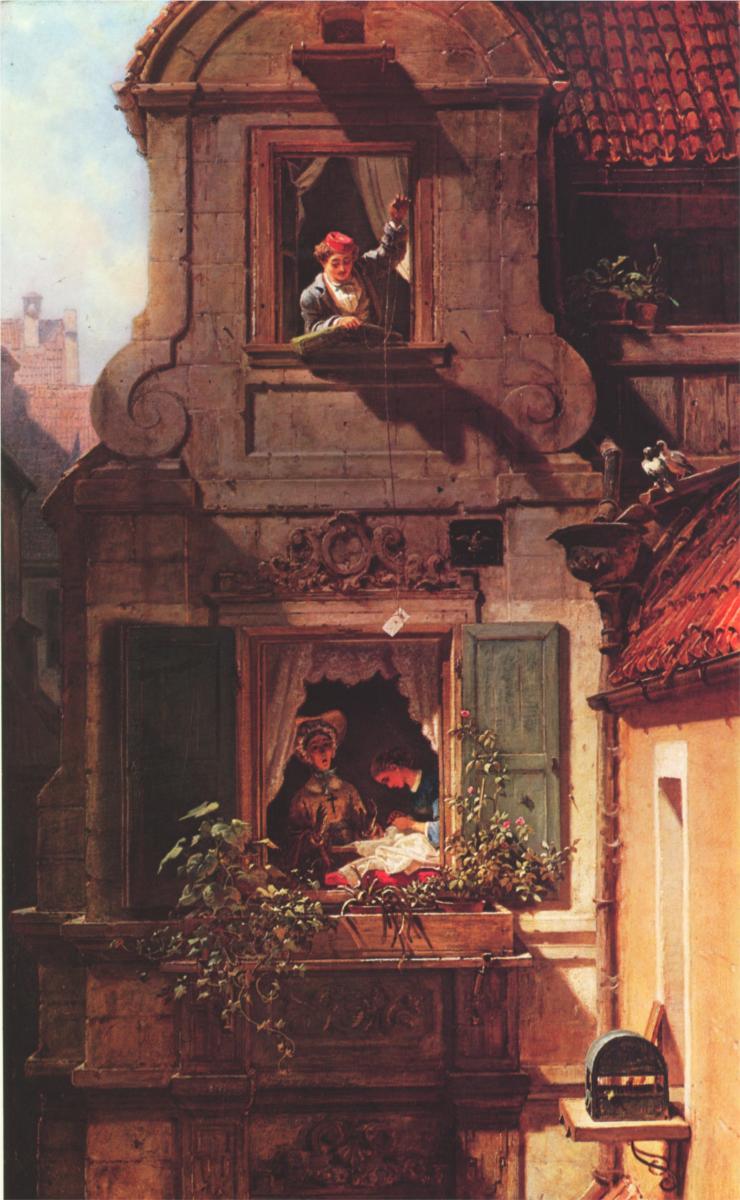
Intercepted Love Letter — Carl Spitzweg

the-intercepted-love-letter.jpg!HD