Don Quixote — Albert Bloch

“Mankind is accursed because our existence on this earth does not tolerate any well-defined and stable hierarchy” (Witold Gombrowicz)

Memories! Mankind is accursed because our existence on this earth does not tolerate any well-defined and stable hierarchy, everything continually flows, spills over, moves on, everyone must be aware of and be judged by everyone else, and the opinions that the ignorant, dull, and slow-witted hold about us are no less important than the opinions of the bright, the enlightened, the refined. This is because man is profoundly dependent on the reflection of himself in another man’s soul, be it even the soul of an idiot. I absolutely disagree with my fellow writers who treat the opinions of the dull-witted with an aristocratic haughtiness and declare: odi profanum vulgus. What a cheap and simplistic way of avoiding reality, what a shoddy escape into specious loftiness! I maintain, on the contrary, that the more dull and narrow-minded they are, the more urgent and compelling are their opinions, just as an ill-fitting shoe hurts us more than a well-fitting one. Oh, those judgments, the bottomless pit of people’s judgments and opinions about your wisdom, feelings, and character, about all the details of your personality—it’s a pit that opens up before the daredevil who drapes his thoughts in print and lets them loose on paper, oh, printed paper, paper, paper! And I’m not even talking about the heartfelt opinions so fondly held by our aunts, no, I mean the opinions of those other aunts—the cultural aunts, those female semi-writers and tacked-on semi-critics who make pronouncements in literary magazines. Indeed, world culture has been beset by a flock of superfluous hens patched-on, pinned-on, to literature, who have become finely tuned to spiritual values and well versed in aesthetics, frequently entertaining views and opinions of their own, who have even caught on to the notions that Oscar Wilde is passé and that Bernard Shaw is a master of paradox. Oh, they are on to the fact that they must be independent, profound, unobtrusively assertive, and filled with auntie kindliness. Auntie, auntie, auntie! Unless you have ever found yourself in the laboratory of a cultural aunt and been dissected, mute and without a groan, by her trivializing mentality that turns all life lifeless, unless you have ever seen an auntie’s critique of yourself in a newspaper, you have no concept of triviality, and auntie-triviality in particular.

Further, let us consider the opinions of men and women of the landed gentry, the opinions of schoolgirls, the narrow-minded opinions of minor office clerks, the bureaucratic opinions of high officials, the opinions of lawyers in the provinces, the hyperbolic opinions of students, the arrogant opinions of little old men, and the opinions of journalists, the opinions of social activists as well as the opinions of doctors’ wives, and, finally, the opinions of children listening to their parents’ opinions, the opinions of underling chambermaids and of cooks, the opinions of our female cousins, the opinions of schoolgirls—a whole ocean of opinions, each one defining you within someone else, and creating you in another man’s soul. It’s as if you were being born inside a thousand souls that are too tight-fitting for comfort!

From Witold Gombrowicz’s novel Ferdydurke.


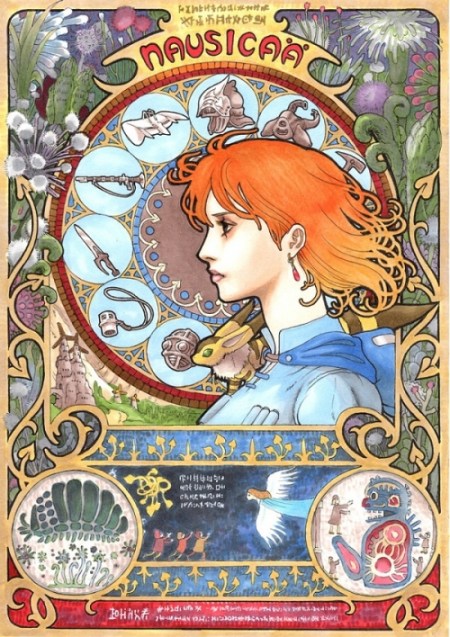
Hayao Miyazaki Through an Art Nouveau Lens

mononoke

(More/via/about).

normal_miyazaki-art-nouveau-2


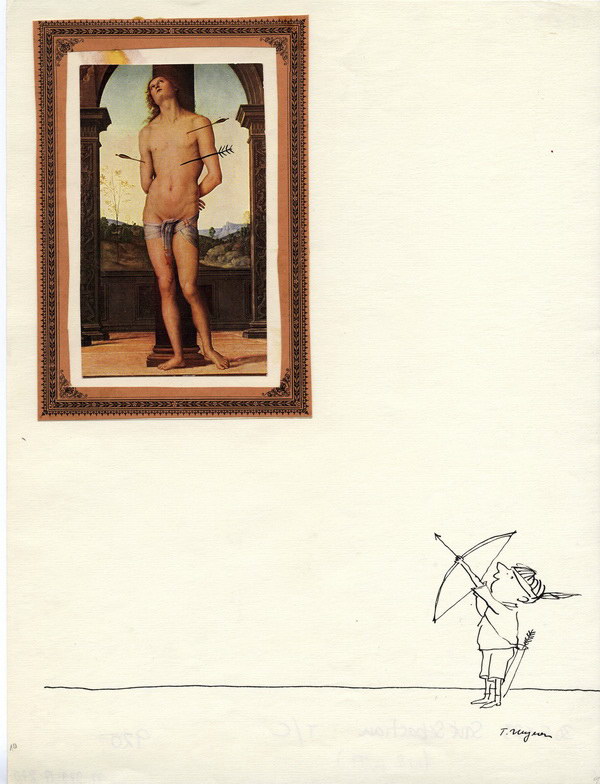
Saint Sebastian — Tomi Ungerer

14 Tomi Ungerer Sebastien

Slavoj Žižek on Atheism and Christianity

“The Adopted Son” — Guy de Maupassant

“The Adopted Son” by Guy de Maupassant

The two cottages stood beside each other at the foot of a hill near a little seashore resort. The two peasants labored hard on the unproductive soil to rear their little ones, and each family had four.

Before the adjoining doors a whole troop of urchins played and tumbled about from morning till night. The two eldest were six years old, and the youngest were about fifteen months; the marriages, and afterward the births, having taken place nearly simultaneously in both families.

The two mothers could hardly distinguish their own offspring among the lot, and as for the fathers, they were altogether at sea. The eight names danced in their heads; they were always getting them mixed up; and when they wished to call one child, the men often called three names before getting the right one.

The first of the two cottages, as you came up from the bathing beach, Rolleport, was occupied by the Tuvaches, who had three girls and one boy; the other house sheltered the Vallins, who had one girl and three boys.

They all subsisted frugally on soup, potatoes and fresh air. At seven o’clock in the morning, then at noon, then at six o’clock in the evening, the housewives got their broods together to give them their food, as the gooseherds collect their charges. The children were seated, according to age, before the wooden table, varnished by fifty years of use; the mouths of the youngest hardly reaching the level of the table. Before them was placed a bowl filled with bread, soaked in the water in which the potatoes had been boiled, half a cabbage and three onions; and the whole line ate until their hunger was appeased. The mother herself fed the smallest.

A small pot roast on Sunday was a feast for all; and the father on this day sat longer over the meal, repeating: “I wish we could have this every day.”

One afternoon, in the month of August, a phaeton stopped suddenly in front of the cottages, and a young woman, who was driving the horses, said to the gentleman sitting at her side:

“Oh, look at all those children, Henri! How pretty they are, tumbling about in the dust, like that!”

The man did not answer, accustomed to these outbursts of admiration, which were a pain and almost a reproach to him. The young woman continued:

“I must hug them! Oh, how I should like to have one of them—that one there—the little tiny one!”

Springing down from the carriage, she ran toward the children, took one of the two youngest—a Tuvache child—and lifting it up in her arms, she kissed him passionately on his dirty cheeks, on his tousled hair daubed with earth, and on his little hands, with which he fought vigorously, to get away from the caresses which displeased him.

Then she got into the carriage again, and drove off at a lively trot. But she returned the following week, and seating herself on the ground, took the youngster in her arms, stuffed him with cakes; gave candies to all the others, and played with them like a young girl, while the husband waited patiently in the carriage.

She returned again; made the acquaintance of the parents, and reappeared every day with her pockets full of dainties and pennies.

Her name was Madame Henri d’Hubieres. Continue reading ““The Adopted Son” — Guy de Maupassant”

Desire Dehau Reading a Newspaper in the Garden — Henri de Toulouse-Lautrec